1st Week of Advent: Readings and Feasts

NOVEMBER 27 SUN FIRST SUNDAY OF ADVENT

Is 2:1-5/Rom 13:11-14/Mt 24:37-44

28 Mon Advent Weekday Is 4:2-6/Mt 8:5-11

29 Tue Advent Weekday Is 11:1-10/Lk 10:21-24 

30 Wed Saint Andrew, Apostle Feast Rom 10:9-18/Mt 4:18-22 

DECEMBER 1 Thu Advent Weekday Is 26:1-6/Mt 7:21, 24-27

2 Fri Advent Weekday Is 29:17-24/Mt 9:27-31 

3 Sat St Francis Xavier, Priest Memorial Is 30:19-21, 23-26/Mt 9:35—10:1, 5a, 6-8 

4 SUN SECOND SUNDAY OF ADVENT Is 11:1-10/Rom 15:4-9/Mt 3:1-

The daily readings at Mass for the first week of Advent are beautifully arranged.

The Prophet Isaiah speaks in the Old Testament readings as a fierce Assyrian army heads towards Jerusalem. Bad times ahead, but the prophet sees something else. All nations are streaming to God’s mountain.

The nations will come to God’s mountain, Jerusalem, where the temple stands, the prophet says.  They’ll be fed a rich banquet (Wednesday),  the poor will triumph (Thursday),  the blind will see (Friday). Safe on this rock, children play around the cobra’s den, and the lion and the lamb lie down together (Tuesday). The prophet  challenges us to see our world in another way.

In the gospels  Jesus Christ fulfills the Isaian prophecies. The Roman centurion, humbly approaching Jesus in Capernaum, represents all nations approaching him. (Monday)  Jesus praises the childlike;  they will enter the kingdom of heaven.(Tuesday)  He feeds a multitude on the mountain.(Wednesday) His kingdom is built on rock.(Thursday)  He gives sight to the blind to find their way.  (Friday)

Many Advent readings in these early weeks of Advent are from the gospel of Matthew, who portrays Jesus teaching on a mountain (Isaiah’s favorite symbol). His miracles affect all. Jesus is the new temple, the Presence of God, Emmanuel, God with us. He brings hope beyond human hope, beyond our hope.

Lord, help us see what you and the prophets see.

December Calendar

I’ll be publishing a calendar at the beginning of each month from now to next December. Our Catholic calendars combine the Roman calendar for the church throughout the world, the national calendar, in this case, for the USA, and any other calendar. This calendar includes the calendar for my religious community, the Passionists.

I like calendars. They remind you life is bigger than the immediate day before you . The scriptures and the feasts, the liturgical seasons open up a timeless world beyond this: “As it was in the beginning is now, and every shall be, world without end.” The calendar teaches us ” to number our days aright that we may gain wisdom of heart.”

We begin a new year in December with the season of Advent. Jesus Christ, the “long-expected Savior” came before, comes to us now, and will come again when calendars are no longer needed.

The Book of Revelation and the Gospel of Luke

The Book of Revelation and the Gospel of Luke

The two scriptures brought together these last two weeks in our lectionary are an interesting combination. The Book of Revelation with its stark imagery of the destruction the end times brings is paired with the Gospel of Luke. 

“Fallen, fallen is Babylon the great.
She has become a haunt for demons.
She is a cage for every unclean spirit,
a cage for every unclean bird,
a cage for every unclean and disgusting beast.                                                     A mighty angel picked up a stone like a huge millstone
and threw it into the sea and said: ‘With such force will Babylon the great city be thrown down, and will never be found again.’ (Rev 18: 24-26)

Luke’s Gospel recalls Jesus and his disciples entering Jerusalem, the city sparkling with its almost completed temple. The disciples are dazzled by the massive new structure. There will not not one stone left on other, Jesus says, warning of the frail world we live in. Yet, Jesus is much more optimistic about life in this world than Revelation is. He speaks of the mercy of God. On his way to Jerusalem he keeps calling sinners. He does so even as he dies on the cross. He never looks at the world as unredeemable. He calls the tax collector, Zachaeus, but he never tells him to give up his job. He warns against burying your talent in the ground. Not matter how bad the times are, we have something to do. He also said not to search into the time and day the Son of Man will come. Our cross is a daily cross, Jesus says. He will help us bear it till he comes again.  

 The best commentators on scripture are the scriptures themselves, St. Augustine taught, and so we read the Book of Revelation and the Gospel of Luke together.

At our evening prayer we read from the Book of Revelation frequently but not its grim passages about the fall of Babylon. We read the beautiful promises of life beyond this. At the end of the day, we go into the night listening to the songs they are singing in heaven.  There’s going to be a great day. 

34TH SUNDAY: READINGS AND FEASTS

NOVEMBER 21 Mon Presentation of Mary Memorial Rv 14:1-3, 4b-5/Lk 21:1-4  22 Tue St Cecilia, Virgin and Martyr Memorial. Rv 14:14-19/Lk 21:5-11  23 Wed Weekday[St Clement I, Pope  Martyr; St Columban, Abbot; USA: Blessed Miguel Agustín Pro, PriestMartyr] Rv 15:1-4/Lk 21:12-19  24 Thu St Andrew Dũng-Lạc, Priest, Companions, Martyrs Memorial [USA: Thanksgiving Day] Rv 18:1-2, 21-23; 19:1-3, 9a/Lk 21:20-28  25 Fri Weekday [Saint Catherine of Alexandria, Virgin and Martyr] Rv 20:1-4, 11—21:2/Lk 21:29-33  26 Sat Weekday 26 [BVM] Rv 22:1-7/Lk 21:34-36  27 SUN FIRST SUNDAY OF ADVENT Is 2:1-5/Rom 13:11-14/Mt 24:37-44

Thursday is ThanksgivingDay in the USA, a day at home with family and friends. The readings for most of this week, from the Book of Revelation and the Gospel of Luke, describe a world turned upside down. Hardly readings for enjoying a family feast in the security of your home. 

But faith embraces a world upset and a world secure.

Martyrs also are remembered this week. Cecilia, Clement, Andrew Dung-Lac and companions, Catherine of Alexandria.

Monday, Presentation of Mary in the Temple, is a special feast for the Passionists. Pray for them.

Next week Advent begins. Christ comes.

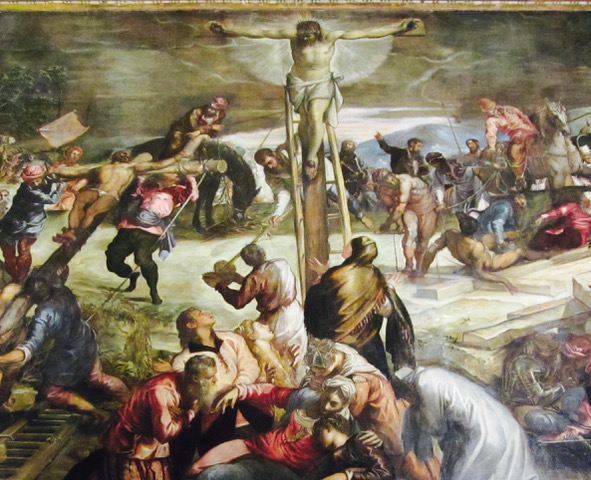
King of the Suffering

                                                                                                                                             By Orlando Hernandez

       Wow! Advent and Christmas are coming up so fast! The Feast of Christ the King is upon us. In Year C, the Gospel for this feast (LK 23: 35-46) presents us with the powerful story of Jesus and “the Good Thief” upon their crosses, side by side. Years ago my Pastor once preached that this Gospel displays the kingly power of Jesus, that of pardoning wrongdoers. This is no small thing. It is the very nature of our all-powerful, all-loving God.

       Upon reading this Gospel I cannot help but remember a Passionist prayer that I “fell into” two years ago. My patron saint, Paul of the Cross, recommends that we remember and meditate upon different scenes in the Passion of our Lord. In an Ignatian sort of way we are to plunge into, to get lost in a particular scene. It will not be pleasant at all, but Our Father in Heaven will reward us with the magnificent grace of experiencing the Divine Love of the Trinity.

       So I tried to pray as Paul of the Cross suggests. I tried to relax and quiet my mind and asked, “Father, what moment of His Passion means the most to me?” A flood of images came. I was ready to give up, when suddenly I imagined myself on a cross squirming in pain, suffocating, and begged my God to deliver me from this suffering. I felt a gentle force moving my head to the right. There I saw my Lord Jesus on His own Cross. Beneath Him people were mocking Him, laughing at Him, “dissing” Him (“King of the Jews, Hah!, King of Losers!”). Even my crucified accomplice  on the other side of Jesus was putting Him down. I tried to defend Him, admit our sinfulness,  His innocence, but it did no good. I asked Jesus for His mercy. His eyes turned to me and He promised me Eternal Life. I got lost in those eyes. He was beautiful; He was beauty itself. 

       I rested in that Beauty until a terrible storm and the unbearable pain in my body brought me back to the awful scene. They were breaking the legs of my screaming accomplice. I looked to Jesus for help, but He was gone, His head down. It seemed He could do nothing to console me. I was all alone. The executioner’s club struck my knees mercilessly. I screamed in pain as my body collapsed. I could not breathe!

       Suddenly I found myself attached to a respirator in an ICU unit. It wasn’t working. I was suffocating, alone, along with every other victim of COVID in the planet. I could not even scream. 

       My eyes opened, and they were full of tears. I was sitting comfortably in my “prayer armchair” wondering, “Was this just a daydream? It was so real. Why did you give me this vision? (If it was a vision), Lord? What are you telling me?” There was only silence. My mind, body and soul rested in this silence. What I perhaps felt the most was gratitude and awe before the love of this all-powerful God.

       “He humbled Himself, becoming obedient to death, even death on a cross. 

        Because of this, God greatly exalted Him and bestowed on Him the name that is above every name,

        that at the name of Jesus every knee should bend,

        of those in heaven and on earth and under the earth 

        and every tongue confess that Jesus Christ is Lord, to the Glory of God the Father.” (Phil 2: 8-11)

Blessed Grimoaldo

Blessed Grimoaldo Santamaria was born in Pontecorvo, Italy. May 4, 1883 and died in the Passionist monastery at Ceccano, Italy, on November 18, 1902. Today’s his feastday.

Like another young Passionist saint, St. Gabriel Possenti, it’s hard to discover anything spectacular about Grimoaldo. He died a Passionist student, preparing for ordination, immersed in the ordinary routine of study and prayer usual for that period of life.  He never reached that goal but died of meningitis. Dying from a sickness alone doesn’t make someone holy, does it?

The gospel reading from a few days ago may give us a clue to his holiness. It’s Luke’s account of the nobleman who goes on a journey and entrusts one of his servants with ten gold coins, another five, and finally another with one. Returning, he upbraids the servant who hides his one coin.

Why so severe with the one who chose to be safe? Is it a warning not to take small gifts for granted, not to keep out of life’s marketplace because we’re afraid we wont make a difference.

God sees small gifts as important, the ordinary tools of human love and service. If you wait for something “big” to happen, you miss out on most of living. So throw yourself bravely and generously into the life you have.

Did Grimoaldo understand that?

Praying with the Creed

I often find myself these days praying the Apostles’ Creed and dwelling especially on that first statement: “I believe in God the Father Almighty, creator of heaven and earth.” I need to strengthen my belief  that God created our world, sustains it in being and guides it to glory.

Two different versions of the creed have come down through the centuries. The Apostles’ Creed is the oldest, still in use today. It’s a summary of faith given to men and women who were being baptized in the early church to help them remember Christian belief. It summarized a faith taught by the apostles.

I like that creed because it’s so simple. In the Catholic church it can be used in the liturgy during Lent and at other times in place of the Nicene Creed. It’s traditionally said at the beginning of the rosary. Prayer books recommend we say it at the beginning of prayer. Good idea.

In a sermon preached in 4th century to prepare people for baptism, St. Cyril of Jerusalem said the creed is related to the scriptures and the rest of the things in church.

“Although not everyone is able to read the Scriptures, some because they have never learned to read, others because their daily activities keep them from such study, still so that their souls will not be lost through ignorance, we have gathered together the whole of the faith in a few concise articles…

“So for the present be content to listen to the simple words of the creed and to memorize them; at some suitable time you can find the proof of each article in the Scriptures. This summary of the faith was not composed at man’s whim, the most important sections were chosen from the whole Scripture to constitute and complete a comprehensive statement of the faith.

“Just as the mustard seed contains in a small grain many branches, so this brief statement of the faith keeps in its heart, as it were, all the religious truth to be found in Old and New Testament alike. That is why, my sisters and brothers, you must consider and preserve the traditions you are now receiving. Inscribe them in your heart.”

The creed sums up all our belief; like a searchlight it gives power to see so much more, it leads us into the most profound  mysteries, and at the same time in its simplicity it helps us find our way through an often bewildering world. The creed is something we can fall back on to go forward.

Here’s  the Apostles’ Creed:
I believe in God, the Father almighty,
creator of heaven and earth.
and in Jesus Christ, his only Son, our Lord.
who was conceived by
the Holy Spirit,
born of the Virgin Mary,
suffered under Pontius Pilate,
was crucified, died and was buried;
he descended into hell;
on the third day he rose again
from the dead.
He ascended into heaven
and is seat at the right hand
of God the Father almighty;
from there he will come to judge
the living and the dead.
I believe in the Holy Spirit,
the holy, catholic Church,
the communion of saints,
the forgiveness of sins,
the resurrection of the body
and life everlasting. Amen


The Last Days

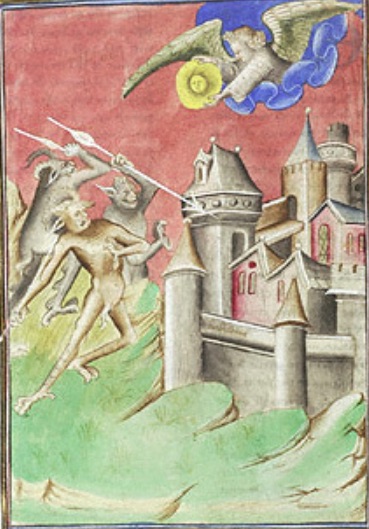
15th Century Apocalypse

During the final weeks of the church year our weekday readings at Mass for the 33rd and 34th weeks of the year are from the Book of Revelation, which describes the last days when God fulfills his promise of a kingdom. The Gospel readings for these weekdays are from Luke 17-21, also about the coming of God’s kingdom. Appropriate readings for our seemingly apocalyptic times.

The author of the Book of Revelation is John, who writes from the prison island of Patmos to the churches of Asia Minor. In strong, imaginative and often violent images, John pictures the final triumph of Christ after a decisive battle between Christ and his followers and Satan and those who follow him. For John, Satan’s kingdom is Rome, the new Babylon.  He tells the churches of Asia Minor to resist this evil empire without compromise. The battle is enjoined and the kingdom is coming soon.

John is invited to behold God’s glory in heaven’s court, portrayed resplendent with gems and other traditional symbols expressing God’s majesty. This is where God wants us to be. A great assembly praises God “who created all things” and the triumphant Christ, the Lamb who was slain and reveals the plan of God:

“Worthy are you, O Lord, to receive the scroll

and break open its seals,

for you were slain and by your Blood you purchased for God

those from every tribe and tongue, people and nation.

You made them a kingdom and priests for our God,

and they will reign on earth.” (Revelation 12,10-12)

John in his writings borrows from Jewish apocalyptic writings before him, Daniel, Ezechiel and others. He writes to give hope to a people in crisis, suffering like him. Commentators say he is possibly a disciple of John, the apostle, whom tradition associates with the church in Asia Minor, and they date the book to the time of a Roman persecution under the Emperor Domitian (A.D. 81–96). 

Some commentators challenge seeing the book responding to the Roman persecution under Domitian. They claim, instead, that Revelation is directed against Christians in Asia Minor who have become too much at home in Roman society. Following the Pastoral Epistles of Paul, the churches of Asia Minor, according to John,  have lost their zeal for the gospel and need to be warned about increasing mediocrity. (cf. Revelation, Wilfrid J. Harrington, OP, Sacra Pagina, Liturgical Press 1993)

The writer of Revelation warns against seeking a comfortable life here on earth. Christ is not just an earthly companion seeing us through the day; he calls us to a life beyond this.  

“‘Behold, I stand at the door and knock.

If anyone hears my voice and opens the door,

then I will enter his house and dine with him,

and he with me. I will give the victor the right to sit with me on my throne,

as I myself first won the victory.

and sit with my Father on his throne.” ( Revelation 3, 14)

The best commentators on scripture are often the scriptures themselves, St. Augustine taught, and so perhaps as we read the Book of Revelation these last days we should also hear Jesus in Luke’s gospel. He kept calling sinners as he made his way to Jerusalem, even as he died on the cross. He never told Zachaeus the publican to give up his job. He warned against burying your talent in the ground while the Master’s away. He also said not to search into the time and the day the Son of Man will come. Keep your eye on the daily cross that’s yours.

But Jesus also told us he’s coming again.

33rd Week of the Year: Readings and Feasts

NOVEMBER 14 Mon Weekday Rv 1:1-4; 2:1-5/Lk 18:35-43 

15 Tue Weekday (St Albert the Great, Bishop Doctor] Rv 3:1-6, 14-22/Lk 19:1-10 

16 Wed Weekday [St Margaret of Scotland; St Gertrude] Rv 4:1-11/Lk 19:11-28 

17 Thu St Elizabeth of Hungary, Memorial Rv 5:1-10/Lk 19:41-44 

18 Fri Weekday [ Dedication of Basilicas of Sts Peter and Paul, Apostles;

USA: St Rose Philippine Duchesne, Virgin] Rv 10:8-11/Lk 19:45-48 

19 Sat Weekday Rv 11:4-12/Lk 20:27-40 

20 SUN Christ, the King Solemnity 2 Sm 5:1-3/Col 1:12-20/Lk 23:35-43 

Readings from Luke’s gospel this week begin with Jesus’ ascent to Jerusalem from Jericho where he meets the blind beggar and Zacchaeus, the publican. As the Messiah ascends to the city he gathers those who sit in darkness and sin. As he enters the city, we weeps over it and cleanses it. The Messiah comes.  

During the final weeks of this church year the first readings at Mass for the 33rd and 34th weeks are from the Book of Revelation, which describes the last days when God fulfills his promise of a kingdom. They complement the gospel readings for these weekdays from Luke 17-21, also about the coming of God’s kingdom.

Margaret of Scotland, Gertrude, Elizabeth of Hungary the Rose Philippine Duchesne are saintly women remembered this week. Interesting, they represent women intellectuals, women missionaries and women who govern.

The Feast of Christ the King, next Sunday,  ends our church year.