Category Archives: Religion

Listening to Tobit

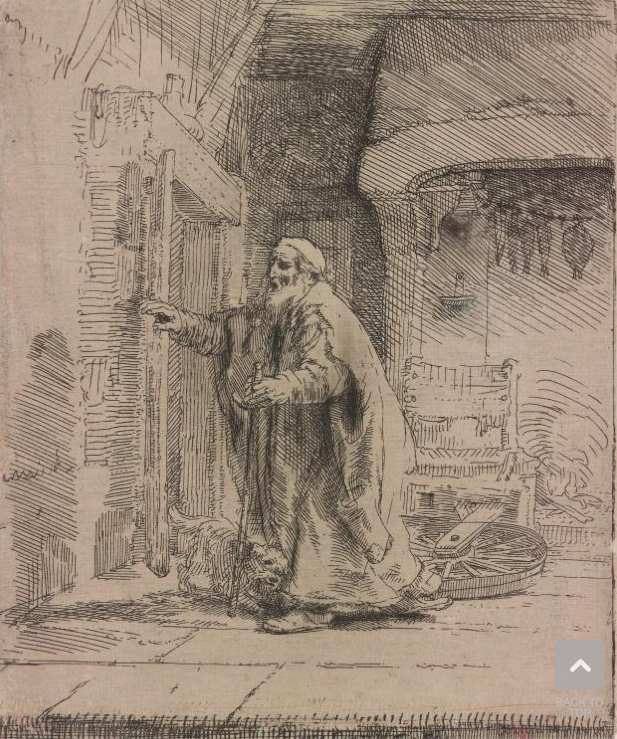
Blind Tobit. Rembrandt

Last week’s lectionary readings from the Old Testament were from the Book of Sirach; this week’s readings are from the Book of Tobit. Sirach offered words of wisdom to his son and grandson in his book. Tobit offers the story of a life that falls apart and God puts back together again. Two respected Jewish holy people.

Tobit describes himself in the first chapter of his book as a Jew from northern Israel enslaved in Nineveh by the Assyrians. He’s a very successful businessman, appreciated by the Assyrians who want to create a world class empire.  Tobit became one of Assyria’s financial agents traveling their vast empire. In one place he visits, Tobit entrusted some of his money to a relative, just in case. 

Tobit was a religious Jews, generous to the poor, faithful to his religious duties and intent on the restoration of Jerusalem. In Nineveh he buried the dead, a dangerous act if the Assyrians wanted the dead body to rot away unburied in a public place.

That didn’t stop Tobit, our story says. During the Jewish feast of Pentecost he leaves his supper table, goes to the market, takes an exposed body and buries it that evening, then he washes and goes to sleep in an alleyway outside his house because of the heat. Something absurd happens: bird droppings fall into his eyes and blind him.

For 4 years he goes to doctors, who make his blindness worse. Not only does his blindness get worse, but he gets worse. Everything gets on his nerves. His wife has to go to work to support them. When she brings home a goat given to her as a gift, Tobit accuses her of stealing the goat. She has enough of him. 

 “I flushed with anger at her over this.” Tobit says,  “So she retorted: ‘Where are your charitable deeds now? Where are your righteous acts? Look! All that has happened to you.”

Tobit becomes so despondent that he wants to die. Rembrandt captures poor Tobit groping for the door in his blindness, while a little dog tries to push him in the right direction. But everything changes, though he doesn’t see it till it does. His son Tobiah returns with a beautiful bride, he gets the money he gave to his relative and an angel cures his blindness. 

Tobit offers two beautiful prayers at the end of his book, which are not in our lectionary but we pray them in the Liturgy of the Hours. 

‘Blessed be God who lives forever

because his kingdom lasts for all ages.

for he scourges and then has mercy.

he casts down to the depths of the nether world

and he brings up from the great abyss… 

Praise him, you Israelites, before the Gentiles,

for though he has scattered you among them, he has shown you his greatness even there….  

In the land of my exile I praise him

And show his power and majesty to a sinful people.”  (Tuesday morning, Week 1)

“Let all speak of his majesty, and sing his praises in Jerusalem.

O Jerusalem, holy city,

he scourged you for the works of your hands,

but will again pity the children of the righteous.”

(Friday morning Week 4)

In the land of our exile,  we may fall apart physically, emotionally, spirituality, but God is still at work.

God will restore Jerusalem, the holy city, for he pities the children of the righteous.
9th Week of the Year: Readings and Feasts

JUNE 5 Mon St Boniface Tb 1:3-2:1b-8/Mk 12:1-12 

6 Tue Weekday [St Norbert] Tb 2:9-14/Mk 12:13-17 

7 Wed Weekday Tb 3:1-11a, 16-17a/Mk 12:18-27 

8 Thu Weekday Tb 6:10-11; 7:1bcde, 9-17; 8:4-9a/Mk 12:28-34

9 Fri Weekday [St Ephrem] Tb 11:5-17/Mk 12:35-37 

10 Sat Weekday [BVM] Tb 12:1, 5-15, 20/Mk 12:38-44 

11 SUN USA: CORPUS CHRISTI Dt 8:2-3, 14b-16a/1 Cor 10:16-17/Jn 6:51-58 

This week’s readings from the Book of Tobit offers an opportunity to relish the wisdom of the Old Testament. We may think only of the New Testament when we think of the scriptures, but God’s wisdom unfolds in the Old Testament as well. I think Jesus must have enjoyed hearing about Tobit in the synagogue at Nazareth. He was a holy man, a Jewish saint, tried by life.

Two important Christian saints are remembered this week. Boniface, the apostle to the Germanic peoples, and Ephrem, one of the great Christian teachers of Syria. Both are witnesses to the spread of the gospel to other parts of the world.

Mark’s gospel in chapter 12 follows Jesus into Jerusalem where he faces fierce questioning from his enemies before his death. Jesus will work only one miracle in Jerusalem.

Sirach: Learning by Doing

Convoy for the Young

Our selections in our liturgy from the Book of Sirach end Friday and Saturday with an old man’s reflections on growing in faith from his childhood. Far from rote learning, Sirach saw his faith grow through prayer and celebrating the Jewish feasts. This kind of prayer brings wisdom and joy. Saturday’s reading says:

“When I was young and innocent, I sought wisdom openly in my prayer. I prayed for her before the temple and I will seek her until the end…My heart delighted in her, my feet kept to the level path because I was familiar with her.”

The journey of faith begins from childhood. Fortunate for those, like Sirach, who get to know faith from the beginning of their lives and never cease to be instructed in her “secrets”. They will keep to the right path. I wonder if young parents today realize that?

In Friday’s reading Sirach sees the example of holy people forming us in faith. I will paraphrase some of his words:

Now will I praise those godly men and women,
our ancestors, each in their own time.
But of others there is no memory,
for when they ceased, they ceased.
And they are as though they had not lived,
they and their children after them.
Yet these also were godly women and men
whose virtues have not been forgotten;
Their wealth remains in their families,
their heritage with their descendants;
Through God’s covenant with them their family endures,
their posterity, for their sake.

Thank God for the example of holy people in your life. Learn from them. They are often, “the saints next door”, a phrase Pope Francis used to described the familiar saints, like mothers and fathers, neighbors and all.

Sirach, “Ecclesiasticus”, was a staple source in the catechesis of the early Christian church. You can see why. The learning Sirach describes is not knowing short questions and answers and then you got it. Catechesis, as you see in Sirach, introduces us to the mystery of God from childhood and carries on until the end.  It’s not a lesson in human behavior. It’s a prayerful search into what was, what is and what ever shall be. It goes far beyond the human world, but embraces the human world.

It’s learning by doing in the everyday classroom of life. Blessed are those who embrace this kind of “great instruction”. 

“Saint” Sirach pray for us.

Procession to the Mary Garden

“All generations shall call me blessed,” Mary says as she visits Elizabeth and praises God for his gift and the mission God gives her. There are signs of her blessed  presence in all generations. Sometimes she comes to bless people through someone she appears to, as she did when she appeared to Juan Diego in Mexico City in the 16th century, to Bernadette Soubrious in France the 19th century and to the children at Fatima in the 20th century.  The apparitions at Mexico City, Lourdes and Fatima are especially significant.

For more than 2000 years Mary has been a steady presence in the church and in the world.

What’s Mary’s mission? Why do generations call her blessed? Mary brings joy to the world by announcing the presence of her Son, the child of womb, Jesus Christ, who came to take away our fears and offers his promise. She brings wisdom for each generation to live wisely in its time.

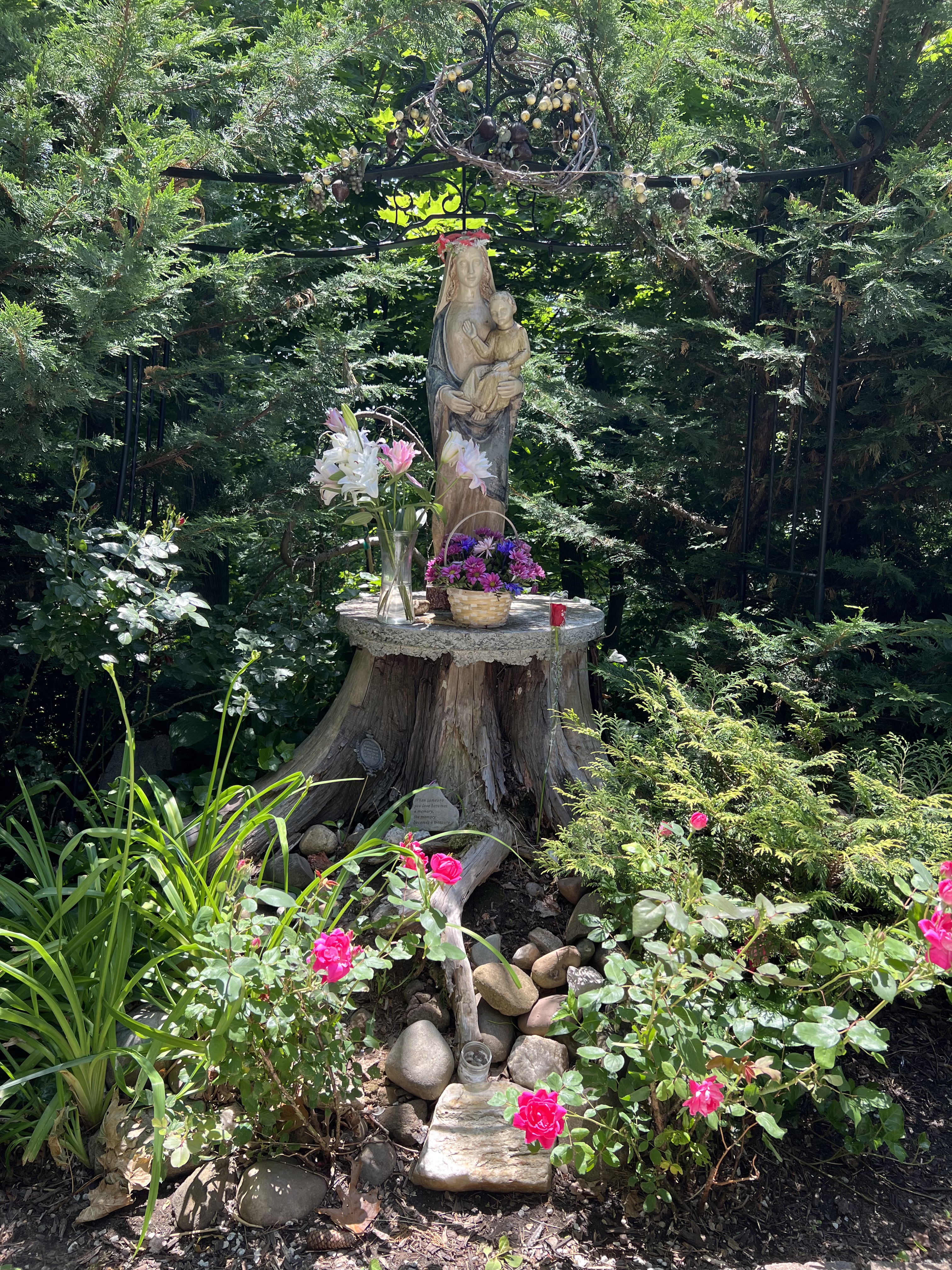
Yesterday, we celebrated the Feast of the Visitation with Mass and then a procession to our Mary Garden. In our generation, I think Mary’s mission is to make us aware that our world is a garden we should love and care for. We seem so uncaring and unloving to creation today, especially to the poor.

In the 14th century, the Black Death took countless lives in Europe, and many saw the earth itself the cause of the pandemic. In response, Mary Gardens were planted next to religious houses and churches.  They were reminders of the Garden of Eden, where God first blessed the human family with the blessings of creation. God saw creation as good, a place of blessing. 

Mary has a special place in creation. She has a special place renewing faith in the God of life. Our procession to our Mary Garden yesterday was a simple way of asking her help today, when creation in endangered.

She stands in our Mary Garden with her mighty Child in her arms, looking out on creation. Don’t lose hope in this planet of ours, she says. Care for it, cherish it, and pray that God, the Creator of heaven and earth, will move the hearts of the children of Adam and Eve, so that all the creatures of the earth, the birds of the sky, the fish of the sea will flourish.

“Pray for us, O Holy Mother of God, that we may be made worthy of the promises of Christ.”

For more on our Mary Garden see here.

Here’s a video on our Mary Garden.

Sirach: Beauty in All His Works

More than a book of do’s and dont’s, of memorized commandments or little gems of human wisdom, Sirach puts human life and creation itself in the context of God’s plan. You can see that in Thursday’s reading:

“How beautiful are all his works!

even to the spark and fleeting vision!

The universe lives and abides forever;

to meet each need, each creature is preserved.

All of them differ, one from another,

yet none of them has he made in vain,

For each in turn, as it comes, is good;

can one ever see enough of their splendor?” (Sirach 42:20-25)

The simplest, smallest thing that passes quickly away, like a spark or fleeting vision, is beautiful–like the small pollinators at work now in our garden or the spring fireflies in our night sky, Each thing has its place in the universe, Sirach says.  “All of them differ, one from another, yet none of them has God made in vain.” 

Sirach sees creation as Pope Francis does in Laudato si’. “For each in turn, as it comes, is good; can one ever see enough of their splendor?” “Creation is given to us, not to be exploited or judged by our needs, but to reveal God’s glory. We live in a world of mutuality and interconnectedness, where the smallest have a place.” 

Look at  creation that way and look at humanity that way, Sirach tells the next generation, which may be looking ahead rather than seeing the present, especially the humble present.  Be humble and don’t miss those who live humbly, the poor, the widow, the suffering, the sick. Be honest and truthful and generous and kind. See God in humanity, especially where God is often in disguise. See God in the smallest things of creation.

An old catechetical work,  does Sirach offer a framework for catechesis today, which may be too humanly oriented in its approach? I think it does.

Sirach, Teacher for Young People

This week we’re reading selections in the lectionary from the Book of Sirach, a 2nd century BC writing. Sirach is a compilation of a Jewish father’s or grandfather’s advice to his son or grandson. Formerly, it was called the Book of Ecclesiasticus, because it was used extensively by the church to teach catechumens and young people about right living and morality. 

What’s the advice to the young in this first reading?

In a generous spirit pay homage to the LORD,
be not sparing of freewill gifts.
With each contribution show a cheerful countenance,
and pay your tithes in a spirit of joy.
Give to the Most High as he has given to you,
generously, according to your means.

My guess is its advice to give yourself generously to society, whether it’s the government, the church, the school, the neighborhood, or the world itself. In times like ours, particularly, the young may pull away from establishments, looking critically at their obvious flaws– many as they are.

Don’t choose isolation. Don’t give up on the world you live in, Sirach seems to say. It’s your world where you’re meant of find meaning and purpose. It’s your world where you’re meant to serve God.

Not bad advice for our younger generation?

Readings here.

The Cry of the Earth

Today we marked the 8th anniversary of Laudato Si’ , Pope Francis’ major encyclical on the environment, by an ecumenical prayer service in our garden, where we blessed our new solar panels. Children from Immaculate Conception Academy sang and offered reflections on the “Cry of the Earth” . Faith Leaders, Fr. James O’Shea, Sr. Teresa Fitzpatrick, Pandit Yoganand Ramnarain, and Fr. Luis Daniel Guivas offered prayers. Our local Congressman James Gennaro was also present and commented on our garden’s privileged place in the geologic development of this area of New York City.

Dan Misleh, from Catholic Climate Covenant and Page Gravely from Mission Energy led the blessing of our solar panels.

The Passionists, responding to Pope Francis’ call, have repositioned our retreat center here in Jamaica, New York – Thomas Berry Place, named for Passionist Thomas Berry, a leading figure in understanding the new story of our environment.

Appropriately, most of those who participated in the event today were young people, who inherit a world now crying out from wars and our poor care of creation and its most vulnerable members. I could not help but think that the trees surrounding us, the fresh green earth, the sparkling sun today was offering the promise of something better and beautiful.

Come, Holy Spirit

St. Peter’s Basilica

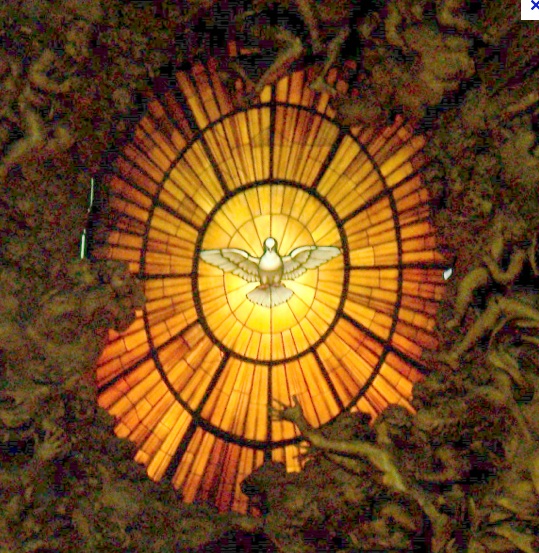
Jesus ascends into heaven and sends the Holy Spirit. Even as we try to grasp who Jesus is and what he has done, we are told the Spirit comes.

God is a mystery and we must respect the mystery of God as it is revealed: Father, Son and Holy Spirit. Jesus himself promises that the Holy Spirit will remain with us to “complete his work on earth and bring us the fullness of grace.”

How describe the Holy Spirit? I like this description of the Holy Spirit St. Cyril of Jerusalem gives in his catechetical homilies. Masterful catechist that he is, he adopts concrete language to approach mystery. Like Jesus, he uses two things we know: water and light.

 “The water I shall give will become a fountain of living water, welling up into eternal life. This is a new kind of water, a living, leaping water, welling up for those who are worthy.

But why did Christ call the grace of the Spirit water? Because all things depend on water; plants and animals originate in water. Water comes down from heaven as rain, and always the same, it produces many different effects, one in the palm tree, another in the vine, and so on through all of creation. It does not come down, now as one thing, now as another, but  remaining essentially the same, it adapts itself to the needs of every creature that receives it.

In the same way the Holy Spirit, whose nature is always the same, simple and indivisible, apportions grace to each one as he wills. Like a dry tree which puts forth shoots when watered, the soul bears the fruit of holiness when repentance makes it worthy of receiving the Holy Spirit. Although the Spirit never changes, its effects, by the will of God and in the name of Christ, are many and marvellous.

The Spirit makes one a teacher of divine truth, inspires another to prophesy, gives another the power of casting out devils, enables another to interpret holy Scripture. The Spirit strengthens one’s self-control, shows another how to help the poor, teaches another to fast and lead a life of asceticism, makes another oblivious to the needs of the body, trains another for martyrdom. The Spirit’s action is different in different people, but the Spirit is always the same. In each person, Scripture says, the Spirit reveals his presence in a particular way for the common good.

 The Spirit comes gently, known by his fragrance, not a burden, but light, very light. Rays of light and knowledge mark his approach. With the tenderness of a true friend, the Spirit comes, and as a protector saves, heals, teaches, counsels, strengthens, and consoles. The Spirit comes first to enlighten the mind of one who receives him, and then, through him, the minds of others as well.

As light strikes the eyes of those coming out of darkness into sunlight enabling them to see what they could not see before, so light floods the soul of those called worthy of receiving the Holy Spirit and enables them to see things beyond human vision, things hitherto undreamed of.”

Come, Holy Spirit.

A Pentecost Novena

I know it’s not 9 days of a novena, but the gospel readings and other prayers for the 7th week of Easter prepare us for the feast of Pentecost very well. From Monday to Thursday they bring us to the Supper Room where Jesus spoke to his disciples. We can hear his promises to them made to us too.

Friday and Saturday they take us to the Sea of Galilee where Jesus, after his resurrection, forgave Peter for his denial and called him to “feed my sheep.” All the disciples shared Peter’s forgiveness and call. Now, we do too.  

Monday the disciples say confidently, “Now you are talking plainly, and not in any figure of speech. Now we realize that you know everything and that you do not need to have anyone question you. Because of this we believe that you came from God.”

Now they know the full plan of God, now they see without “figures of speech.” “Do you believe now?” Jesus says, “Behold, the hour is coming and has arrived when each of you will be scattered to his own home and you will leave me alone.”

They don’t see or know, and we are like them. They needed the Holy Spirit to come. We have that same need. “Come, Holy Spirit, teach us the ways of God and be our Guide.”

In the Supper Room, Jesus promised his disciples peace in a troubled world and told them “take courage, I have conquered the world. “ (John 16:29-32) “Lord, you promise us too.”

Jesus prayed for this apostles in the Supper Room, the readings for Tuesday, Wednesday and Thursday tell us. He prays for us too. He will always pray for his own who are in the world, and we are his own. Prayer is one of the ways we hear his voice and know his promises. “Lord, teach us to pray.” ( John 17:1-19)

Friday and Saturday, we join the disciples at the Sea of Galilee where they went fishing, yet caught nothing. It was after they had scattered in the hour of his Passion and saw him risen from the dead, but now they had gone home, wondering, cautiously wondering, what was yet to come.

“Do you love me, Simon, son of John,” Jesus said to Peter. “Yes, Lord, you know I love you,” Peter answered. “Feed my lambs, tend my sheep,” Jesus said.  (John 21: 1-19)

Jesus gave him forgiveness and called him to follow him. The others received the same gracious gift. We do too. He gave them the Holy Spirit, to renew them and renew the face of the earth.

Come, Holy Spirit, fill the hearts of your faithful and renew the face of the earth.

A devotional church before Vatican II depended on novenas, tridua and other prayers to celebrate the great church feasts. The renewed liturgy of Vatican 11 provides a richer preparation for the feast in the days that precede and follow them. It’s our novena for Pentecost.