Category Archives: Religion

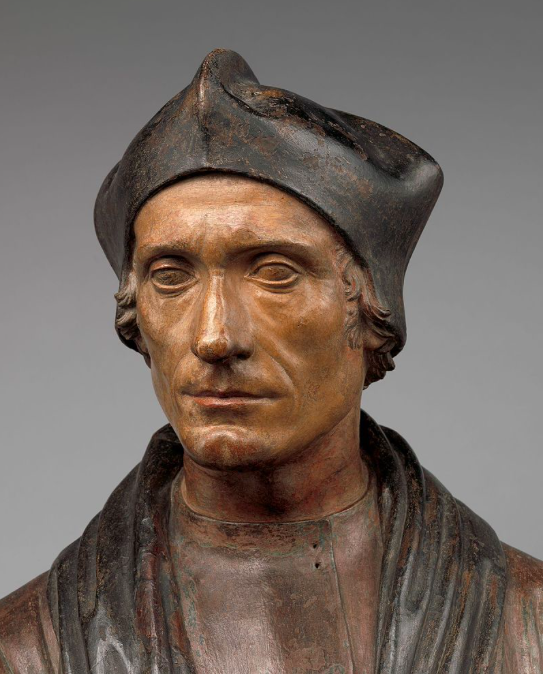
St. John Fisher

St. John Fisher. Pietro Torrigiano

John Fisher was born in Beverly, Yorkshire England in 1469, and entered Cambridge University at 14. Ordained a priest, he became chancellor of Cambridge in 1504 and Bishop of Rochester, the poorest diocese in England, that same year. He attracted some of the leading scholars of Europe to the university and his learning, holiness and pastoral dedication caused the young king, Henry VIII, to say there was no better bishop in all the world.

When Henry sought to divorce his wife, Catherine of Aragon, John Fisher strongly upheld the validity of their union. Furious at Fisher’s opposition to the Oath of Supremacy that stated Henry was the head of the English church, Henry had him arrested and imprisoned in 1534.  “Not that I condemn anyone else’s conscience,” Fisher said, “ Their conscience may save them, and mine must save me.”

While in prison, Pope Paul III made Fisher a cardinal. After 10 months in jail, he went to his death, carrying with him a copy of the New Testament. To the crowd gathered for his execution, he proclaimed his faith in the Catholic Church and asked for their prayers. Then he recited the Te Deum and the psalm “ In you I hoped, O Lord.”  He was beheaded on June 22, 1535.

His execution, two days before the Feast of the Nativity of John the Baptist caused many to see him following courageously his namesake, who condemned Herod’s attempted marriage to Herodias,  He was canonized along with Thomas More by Pope Pius XI on May 19, 1935. His feast, with Thomas More, is celebrated today by the Church of England on July 6.  

The Roman Catholic Church celebrates the joint feast of John Fisher and Thomas More on June 22.

Tower Hill, Execution Place of John Fisher and Thomas More

Matthew 6: 7-15 Descending with Jesus


by Orlando Hernandez

In this Thursday’s Gospel (Mt 6: 7-15) our Lord Jesus introduces the “Our Father” to His followers. This prayer is certainly a pillar of our Catholic faith. I find the Lord’s Prayer so comforting and yet so challenging, even disturbing. At times it feels like a downward slide from Heaven into the heart of life’s darkness.

In the previous day’s Gospel (Mt 6: 6) Jesus describes prayer as a private, secret moment with God in our “inner room”. This is the kind of prayer I always yearn for, full of gratitude, no petitions, not even words, just basking in the loving light of God, present within, and all around me. It feels like a vacation from life. To feel loved like that!

Unfortunately, this does not happen every day. There are times when I feel so dry and lost in darkness, where the fire within me has dwindled down to a small, smoldering ember. There are times when I feel so frustrated with the situation, or so anxious, that I don’t know what to do. It is always in these moments that I find myself going back to the Lord’s Prayer. It never fails to begin to put me back on track, with my Lord. It is my way back into the Light. I find myself praying the “Our Father” several times during the week. This prayer is no vacation from life. It strengthens us to confront the dangers of life, but it is not easy.

I try to pray it in a quiet place, slowly and carefully. It has such a blissful beginning. I feel so close to Jesus, praying with me, teaching me. Sometimes I even imagine myself with Him, on a Galilean hill, beneath the rim of the Milky Way, surrounded by the universe, in the presence of Abba, the tender Father. In my mind’s eye, Papa has blue eyes, like my handsome earthly father, Orlando, when he would hold me in his arms as a toddler. I feel so loved and protected. I am indeed in Heaven, with my loving God.

And I am not alone, but with all of humanity, saints and angels “hallowing” , praising, recognizing the goodness, the beauty, the truth of “His name!” Wow! This Kingdom is a kingdom of love and hope. The Will of the Father is all mercy and happiness for me.

Then, it seems, maybe not completely. I realize how much is required of me, so many difficult tests, so many painful experiences that might come. I must accept what God has in store for me. I say “Yes,” even knowing how prone I am to letting Him down.

In asking for “our daily bread,” I imagine Jesus, the Bread of Life. I can almost taste Him. I love Him so much. But somehow He reminds me of humanity’s constant challenge to find the daily bread, the basic things that we need to survive. I pray for my family, my friends: may they not lose their jobs. We have it so good in our country, but the threat of having to rely upon a food pantry or a homeless shelter is not so far away for most of us. I pray for the hundreds of millions of people without adequate shelter, nourishment, even water. I think about how little I do to be God’s instrument for the fulfillment of this petition— send money to relief agencies, work at St. Vincent de Paul, give $20 to a homeless person? Does that even make a dent? I find myself feeling helpless and guilty.

Then I ask forgiveness once again for the many sins I constantly repeat! My heart breaks when I imagine His Son on the Cross, because of these sins. I realize how undeserving I am. I remember my grudges and secret resentments. Can I forgive? I pray for so many brothers, sisters, parents and children in my own family, who cannot forgive each other. I pray for humanity, caught in a cycle of offense and counter-offense. Am I an instrument of God’s peace?

I am filled with the fear of giving in to so many temptations within and without me. Come on! Where is my confidence? Father, help me, help me! Deliver us from the evil inside of us. Help us to control ourselves!

And the evil from outside? The danger of violence, disease, accidents, natural disasters? The morning news remind us of so many ruined lives. I think of my atheist friends asking, “How could a loving God permit this?”

And then, abruptly, the prayer ends. Am I ready to say “Amen?” Do I believe with all my heart that God will actually answer all our pleas? I find myself forcing my eyes away from the not-so-far-away abyss of doubt. I frown. I approach the abyss. I jump and cry, “Lord!” And God always catches me in His loving hands. I begin to feel this strange peace, this hope that our God has the best plan for all of us. I believe that Supernatural Grace has touched me once again. Lord, why do You love me like this? Thank You, Beloved, King of Peace!

I sometimes think of this prayer as Jesus’ battle hymn. Yes, it has a somewhat bleak ending, but it “works”, it strengthens, it comforts. The extra ending that our Church fathers added explains why: “Because Thine is the Kingdom, the Power and the Glory.”
You better believe it! Amen!

Orlando Hernández
Matthew 7: 12. Do To Others

“Do to others what you would have them do to you.”  (Matthew 7:12)

It’s so simple, isn’t it? “Do to others what you would have them do to you,”  They call it the Golden Rule, because it can be so broadly applied. Though it’s found among the teachings of Jesus in the Sermon on the Mount, which we’re reading today, it’s not just a Christian, or Catholic rule. It could apply to any religion, Moslem, Buddhist, Hindu– or no religion at all.

It’s a rule that stands out among all the teachings of Jesus.

It’s more than just a rule for individuals, a norm for personal conduct. If it were adopted by the community of nations, it would bring peace to our world, fairness to the way we live together. It would bring equality to the present unequal world of ours. How could the strong exploit the weak? How could we go to war? How could we enslave others? How could we neglect those in need?

“How would you like it if someone did that to you? Thought that about you? Wanted that to happen to you? It’s a rule so simple, yet we shy away from it.

“Do to others what you would have them do to you.”  (Matthew 7:12)

Matthew 5: 20-26:  Murder, Anger, Respect

You have heard that it was said to your ancestors,

You shall not kill; and whoever kills will be liable to judgment. But I say to you, whoever is angry with his brother will be liable to judgment, and whoever says to his brother, Raqa, will be answerable to the Sanhedrin, and whoever says, ‘You fool,’ will be liable to fiery Gehenna. Therefore, if you bring your gift to the altar, and there recall that your brother has anything against you, leave your gift there at the altar, go first and be reconciled with your brother, and then come and offer your gift.

Settle with your opponent quickly while on the way to court with him. Otherwise your opponent will hand you over to the judge, and the judge will hand you over to the guard, and you will be thrown into prison.

Amen, I say to you, you will not be released until you have paid the last penny.

In Matthew’s gospel today, Jesus calls for more that keeping a law forbidding killing someone physically. He asks for loving others by the way we think, speak or act toward them. He speaks of anger, a neutral emotion that can push us to do good or do harm. Laws can’t legislate anger; anger goes beyond law. 

Anger can lead to hatred and disrespect. Thoughts can kill, words can destroy. The commandment “You shall not kill” goes further than killing the body. Watch the way you think and speak about others, Jesus teaches. The commandment not to kill goes far beyond a law about murder. 

Jesus doesn’t dispute the need for laws in society in Matthew’s gospel, nor does he call for replacing Jewish law for laws of his own. His words, directed to the Jewish-Christian church represented in Matthew’s gospel, affirms the place of the Torah, the Jewish law. Unfortunately, the English word “law” often used to describe the Torah, restricts its meaning. A law like “Thou shalt not kill” is not meant to be reduced to a law against murder.

Jesus saw the Torah as a guide to something more. 

Matthew 5:17: Listening for Truth

In his Sermon on the Mount Jesus acknowledges his teaching is not totally new. He assures his followers that he’s following teachers and prophets before him.  “Do not think that I have come to abolish the law and the prophets; I have come not to abolish but to fulfill.” ( Mt 5, 17, Wednesday, Week 10 ) 

I repeat James Tissot’s painting in today’s blog for a number of reasons. Seeing those people dressed in clothes of long ago, some might say: “That’s old, we’ve gone way beyond all that.”

Some teachings are never out of date and so it’s wise to pay attention to old laws and prophets from long ago. The last 20 minutes is not the only reality in life, nor am I the only expert on life. We learn from human experience over the ages. Jesus did.

Some might think the Jewish tradition found in the Old Testament not worth looking at, but that too would not be wise. Jesus was an observant Jew, Matthew’s gospel makes clear.  He learned from his tradition, its prayers, its observances, its teachers, its life. Our lectionary wisely offers selections from the Jewish scriptures to study and learn from. Jesus told his disciples to do this. 

We should learn from other religious traditions too, especially those that have formed the peoples of Asia and Africa. In the global world we live in today, we are meant to share in their wisdom and good works.

10th Week: Readings and Feasts

JUNE 12 Mon Weekday 2 Cor 1:1-7/Mt 5:1-12 

13 Tue St Anthony of Padua, Memorial 2 Cor 1:18-22/Mt 5:13-16 

14 Wed Weekday 2 Cor 3:4-11/Mt 5:17-19 

15 Thu Weekday 2 Cor 3:15—4:1, 3-6/Mt 5:20-26 

16 Fri  SACRED HEART OF JESUS Solemnity

Dt 7:6-11/1 Jn 4:7-16/Mt 11:25-30 

17 Sat  Immaculate Heart of Mary Memorial 2 Cor 5:14-21 (364)/Lk 2:41-51

18 SUN ELEVENTH SUNDAY IN ORDINARY TIME

Ex 19:2-6a/Rom 5:6-11/Mt 9:36—10:8 

We begin reading this week (wk 10) from chapter 5 (the Beatitudes) of Matthew’s gospel and continue reading from this gospel till the 21st week of the year.   

Matthew’s gospel presents us with Jesus the teacher in Matthew’s gospel. In our readings there’s little about his miracles or his travels to other places. He makes his place on a mountain in Galilee to teach in a land where people sit in darkness and the shadow of death. He brings light and the promise of life to them, and to us.

The Sermon on the Mount summarizes his teaching and of his life. I think that’s why the first of the beatitudes is “Blessed are the poor in spirit, for theirs is the kingdom of heaven.” Jesus became poor, to bring us to life. He “ took the form of a slave, being born in human likeness, and so he humbled himself even to death, death on a cross. God exalted him.” (Philippians)

St. Anthony of Padua, a popular saint, is celebrated this week. The Feasts of the Sacred Heart and the Immaculate Heart of Mary also occur.   

Corpus Christi

For this week’s homily, please watch the video below.

AMEN

Little words are important. Little words like Yes and No. They’re at the heart of our lives. Yes, No.

Today we are celebrating the mystery of the Holy Eucharist, Corpus Christi. Instead of talking about the Holy Eucharist in theological terms, I would like to reflect on the little words we say as we celebrate this mystery, especially that little word, Yes, which at Mass is the word Amen. Amen is the Hebrew word for yes. 

Did you ever count how many times we say that word, Amen, at Mass? Let me remind you of some of them.  

We began Mass “In the name of the Father, and of the Son, and of the Holy Spirit. Amen.” Yes , we say, we’re began something that only be known by faith. In that simple dialogue, we acknowledge this is something we can only do through the grace of faith that the Triune God, Father, Son and Holy Spirit, gives us, and we pray for that faith. 

Amen not only expresses our faithful assent, but we’re asking for faith. We’re asking for faith through Jesus Christ, our Lord. We’re like the man in the gospel whom Jesus asked, “Do you believe”, who answered “I do believe, but help my unbelief.”

“Amen” ‘’Yes” is what we say to so many of our prayers at Mass. We will end our Creed, our profession of faith, with that word. We will end the prayers we offer for the various intentions with that word, Amen.  We end the Our Father with that word. 

The most important Amen we say at Mass is at the end our Eucharist Prayer, when we hold up the host and the chalice, the Body of Blood of Jesus Christ, and say. “Through him, and with him and in him, in the unity of the Holy Spirit, all glory and honor is yours, Almighty Father, forever and ever. We are saying yes to a prayer of praise that thanks God for the blessings of creation, for the presence of Jesus, God’s Son, for the promise of life he brings us and to all creation. We’ll sing that prayer and that Amen, to signify its importance. 

When you come up for communion (that’s another beautiful word, “communion”) the priest or Eucharistic ministers say simply, “the Body of Christ” and you say “Amen.” We are in communion here. Jesus himself comes to us. We say the Body of Christ because Jesus comes in his body, not only his physical body, but in his body the Church. We’re in communion with one another as we are in communion with him. We’re in communion with the world itself, which he has created and redeemed. 

Amen. A little word that means so much.

Planting a Fig Tree

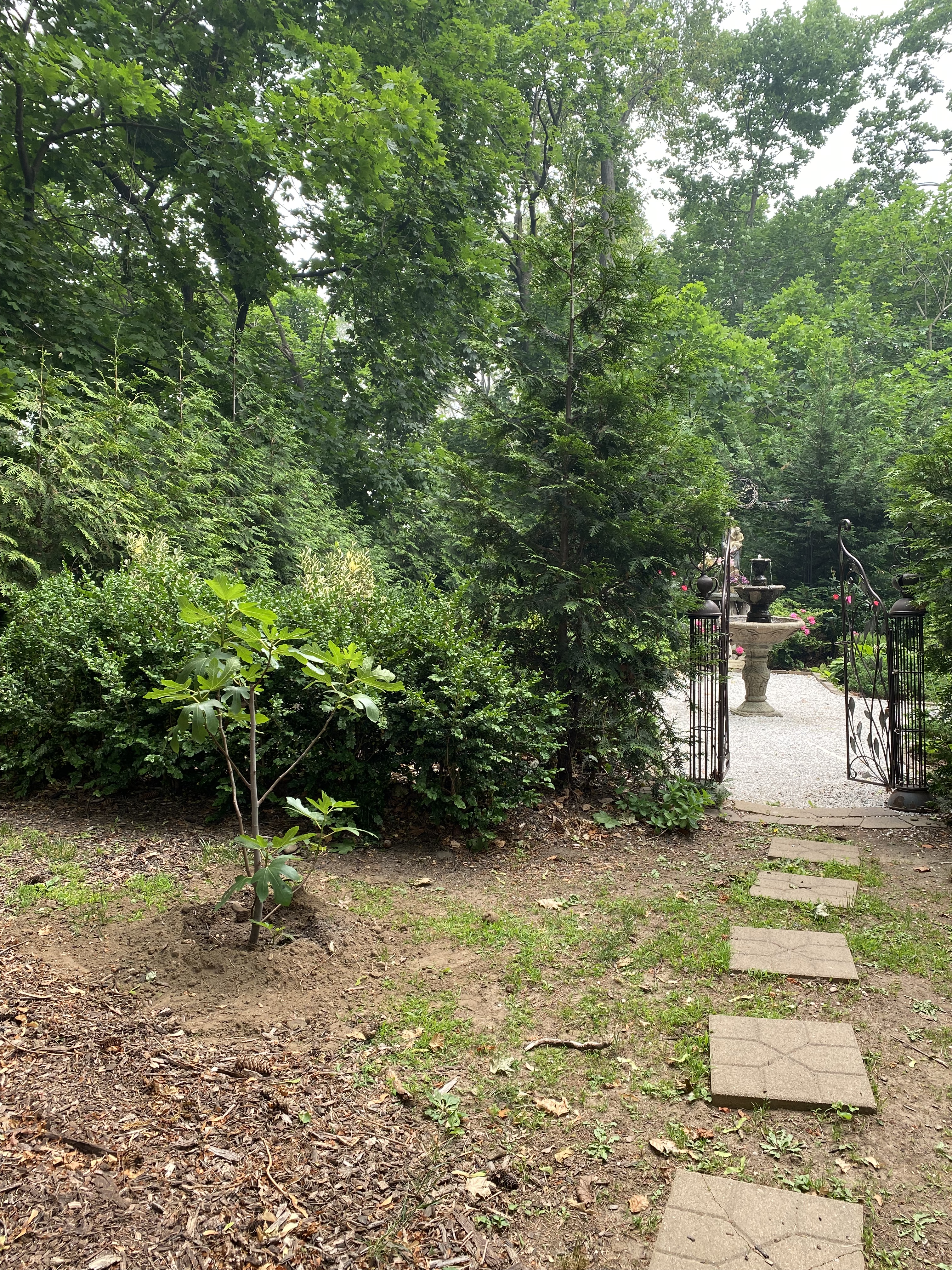
Our neighbor Manuel came over yesterday with the gift of a fig tree, which he planted near the entrance to our Mary Garden. A fig tree belongs there. It’s the first tree named in the garden of Eden (Genesis 3: 7  ), and the last tree mentioned in the Book of Revelations (6: 13). No tree is mentioned more in the Bible.

The fig tree was treasured by Jewish families who prized its dependable supply of fruit, a sign of God’s dependable providence. The prophets often used it to describe God’s blessings and his people’s unfaithfulness. The Prophet Habakkuk’s in our morning prayer describes his own faithfulness to God, using it as an image:

“For though the fig tree blossom not, nor fruit appear on the vine.                           Though the yield of the olive fails and the terraces produce no nourishment.           Though the flocks disappear from the foldand there is no herd in the stalls,                 Yet I will rejoice in the LORD and exult in my saving God.                                                GOD, my Lord, is my strength; he makes my feet swift as those of a deer,                   and enables me to go upon the heights. (Habakkuk 3: 17-19)

Michelangelo’s tree of good and evil in the Sistine Chapel is a fig tree.  

We’re reading this week about Jesus’ entry into Jerusalem from Mark’s Gospel. Unfaithfulness is why Jesus curses the fig tree as he enters the city, and its roots wither. He finds no fruit on it. (Though it was not time for fruit)                                            

It’s the only miracle of Jesus in Jerusalem recorded by Mark, and it surprises his disciples. (Mark  11:12-14; 20-25 ) Jesus, hungering for a response of faith, finds none from Jerusalem’s leaders he meets.

Manuel explained to me the fig tree’s roots spread quickly so the soil doesn’t have to be especially good, but it needs plenty of sun for growing. I have a feeling it will grow in that holy place. It’s meant to be there. 

Desperate Prayers

Poor Tobit, sunk in the misfortune of his blindness and with no one on his side, asks God to “go from the face of the earth into dust”, in our lectionary reading today:

“So now, deal with me as you please, and command my life breath to be taken from me, that I may go from the face of the earth into dust. It is better for me to die than to live, because I have heard insulting calumnies, and I am overwhelmed with grief.

“Lord, command me to be delivered from such anguish; let me go to the everlasting abode; Lord, refuse me not. For it is better for me to die than to endure so much misery in life, and to hear these insults!” (Tobit 3:1-11)

He doesn’t blame God, but he’s had enough. His prays, groaning and weeping aloud. 

Sarah, soon to be his daughter-in-law, prays a desperate prayer too. She’s had 7 husbands who have all died mysteriously immediately after their marriage. She’s turned into a desperate woman who seems to be lashing out at everyone. A real witch, some were calling her.

She’s ready to hang herself, but decides not to for her parents’ sake. She prays:

“Blessed are you, O Lord, merciful God, and blessed is your holy and honorable name. Blessed are you in all your works for ever!”

Simultaneously, two desperate people are heard:

“At that very time,  the prayer of these two suppliants was heard in the glorious presence of Almighty God. So Raphael was sent to heal them both: to remove the cataracts from Tobit’s eyes, so that he might again see God’s sunlight; and to marry Raguel’s daughter Sarah to Tobit’s son Tobiah, and then drive the wicked demon Asmodeus from her.” (Tobit 3: 16-17)

God hears desperate people, even if they can’t find words for a prayer.

I have been reading a book on how our lectionary was composed after the Second Vatican Council.”Words Without Alloy” by Paul Turner.  Some wanted the Book of Tobit left out of the readings. I’m glad they didn’t. God hears desperate people.