Category Archives: Religion

The Shepherd’s Voice

The Second Vatican Council said the liturgy is the most important place for teaching and catechesis in the church. The seasons of lent and easter are the most important times for teaching and catechesis. In the liturgy Jesus, the Bread of life, feeds us with his wisdom.

The easter season is a time for mystagogic catechesis, when we recognize the presence of the Risen Christ in the sacraments, in the church and in the signs of the times. The Second Vatican Council extended the celebration of the easter season.  In the past, the mystagogic catechesis took place for one week after Easter and was focused on the newly baptized. Now in the church’s liturgy mystagogic catechesis takes place, not for just one week, but for 50 days until the feast of Pentecost. It’s not just for the newly baptized, but for the whole Christian community. 

However well we may remember the questions and answers of our catechism or what we learned in theology courses, we’re lifelong learners.  We’ re also forgetful listeners.  We’re living in a changing world which we desperately need to understand, not just through the lens of politics, but  in the light of faith. For those reasons, we follow our liturgy year by year, season by season.

We have to continually study the mystery of the church. That’s true these day with the election of our new pope. The media coverage of this event  has been massive, whether its television,  YouTube, the New York Times. Six thousand journalists covered the pope’s election. It was a big story, but lens of politics, usually the dominant lens of the media, couldn’t  cover it all. 

It seems to me the readings in our liturgy these days offer a better coverage than anything the media might offer.

 Our gospel today speaks of sheep recognizing the voice of the shepherd. Doesn’t it seem these days that the world itself was listening for the voice of a shepherd? Our readings from the Acts of the Apostles these days describe a church breaking out from the confines of Jerusalem to speak to the world a message of life.  Doesn’t that seem to be a picture of our church these days?  In Acts, Peter appears so humble, a poor man yet ready to accept the task of bringing a wisdom, ancient and new, to a world so powerful yet so broken. Is that Pope Leo following in his footsteps?

We need to keep listening for the wisdom that is our daily bread in our liturgy The Good Shepherd still speaks.
4th Sunday of Easter: The Good Shepherd

For this week’s homily please play the video below.

What Power Does the Pope Have?

Many recent news stories on the papal conclave seem to suppose that a pope has absolute power in ruling the church. Some think Pope Leo XIV can take the church wherever he wants it to go.

 A look at today’s reading from the Acts of the Apostles may help us question that view.. Luke sees Peter as leader and spokesman for the Christian community in Jerusalem. He underscores his importance with his description of the miracles Peter performs in Jerusalem and Joppa. They’re like those Jesus performed. He tells a paralyzed man named Aeneas to get up from his bed and he got up at once. He tells a woman named Tabitha who died to rise up and she rose from the dead. (Acts 9: 31-42)

Afterwards, however, Peter is commanded in a vision to baptize a Roman centurion named Cornelius, but he balks at the command. . It’s altogether against what he believes a Jew should do. . 

It’s not for Peter to judge, however. God plan is unfolding, which Peter may not always understand.. Peter is subject to God’s plan. He must follow his Lord. 

A pope does not have absolute power ruling the church. It’s the Church of Jesus Christ and the pope, like Peter, must listen for his voice. 

Our times finds it difficult to believe in God’s presence and guidance in our world. The future is what we decide it will be, whether it’s the future of the world or the future of the church. We think the world is in human hands.

Peter is a good example to consider when we think of the pope. Our readings today describe the miracles he performed, yet the scriptures always remind us of his humanity.  Peter is human. As he himself said: “I am a sinful man.” He doesn’t know everything. Yet, God reveals his plans to him and he must read the signs of the times. 

That’s why we pray today that Pope Leo be a humble holy man.

MISSION TO THE GENTILES

When Peter visits followers of Jesus in Joppa I’m sure he had no idea he would be called to journey up the coast to Caesarea Maritime to meet Cornelius, the Roman centurion and baptize him and his household. Significantly, Joppa was the seaport where Jonah began his mission to Nineveh. Like Jonah, Peter was reluctant to undertake the mission he’s given. Jonah and Peter are very much alike.

Only after God’s strong prodding in a vision does Peter accept the invitation from Cornelius to come and speak about Jesus. When he finally goes to Caesarea Maritime Peter experiences nothing less than a Gentile Pentecost .

That’s what we’re seeing in our readings at Mass this week. A Gentile Pentecost.

Not all saw it that way, however. Some in Jerusalem question the apostle for entering a Roman city, baptizing a Roman soldier and his friends and eating at their table. “God has given life-giving repentance to the Gentiles too,” Peter responds. The Spirit has come once more.  

It was not his doing, but the work of the Spirit, Peter adds. “As I began to speak, the Holy Spirit fell upon them as it had upon us at the beginning… God gave them the same gift he gave to us when we came to believe in the Lord Jesus Christ, so who was I to be able to hinder God?”

The apostle makes no claim his eloquence, wisdom or planning did it. He wasn’t expecting what happened and he doesn’t know where it will lead. It’s the work of God. It didn’t happen in Jerusalem, where the Spirit appeared at first, but in a Roman city Jews considered an enemy’s stronghold.

Is it the same today? The church is on a journey led by the Holy Spiirt. It’s a path that not easily discerned, from our perspective. It’s according to God’s plan, not ours.

I think Pope Francis was following this story of Peter when he called recently for a Synod of Synodality. He’s calling the church to recognize the Spirit but, as we see in the story of Peter, it’s not easy to see the Spirit’s activity beyond the world we know. 

“Glory be to the Father and to the Son and to the Holy Spirit. As it was in the beginning, is now, and ever shall be, world without end. Amen.”

Saint Stephen, the Deacon

Stephen martry
Our readings from the  Acts of the Apostles this week  tell us one thing about the early church: it doesn’t evolve from human planning but from God’s plan. The disciples  certainly didn’t expect Stephen.

The church was pretty settled in Jerusalem after Jesus rose from the dead, according to Acts. The followers of Jesus, good Jews, continued to worship in the temple. Yes, there  were occasional squabbles with the Jewish leaders, but they were mainly tolerated as they worshipped and preached in Jerusalem. This was their world. Besides praying in the temple, they met together, probably on Mount Sion where the Last Supper was celebrated or maybe in Bethany.  They broke bread and prayed there. 

They were mostly Galileans at first, then others joined them from elsewhere. One of them was Stephen.

Stephen was a new-comer. He may have been a Samaritan, which could explain his polemic against the Judaism of the day.  The scriptures see him as one who follows Jesus in his passion. So many of his sufferings are like those Jesus endured. But he was also the cause of the first scattering of believers to other places. He was brash and undiplomatic. I would also think that some of the Galileans didn’t like him.

Yes, he was a saint, but a hard-nosed saint.

He brought change, or better, God brought about change through him. We would like change to take place smoothly, without disagreements, but our early church history says change doesn’t come so easily. 

Readings here.

Morning and evening prayers, 3rd week,  here.  

I Am The Bread of Life

Jordan satellite


The dark green around the Lake of Galilee in the upper part of this Google satellite picture of Palestine points to good farmland. It was good farmland at the time of Jesus. Herod the Great and his son Herod Antipas,  Galilee’s rulers then, appreciated the land and created a network of roads and cities – Tiberius, Sepphoris and Caesarea Maritime on the sea– for shipping goods from Galilee to the rest of the world. Here Jesus proclaims in John’s gospel: “I am the bread of life”,  

All four gospels say that Jesus fed a great crowd near the Sea of Galilee by multiplying a few loaves of bread and some fish. Like the Passover feast, the miracle and the teaching that follows occur over a number of days in the gospels. We will read .John’s account (John 6) at Mass on weekdays from the Friday of the 2nd week of Easter until Saturday of the 3rd week of Easter,

The Passover feast commemorated the Manna God sent from heaven to sustain the Jews on their journey to the promised land. Jesus claims to be the “true bread,” the “living bread” that comes down from heave

Jesus is a commanding presence during the miracle and the days that follow in John’s account. “Where can we buy enough food for them to eat?” he asks Philip as crowds come to him. Then he directs the crowd to sit down, feeds them with the bread and fish, and says what should be done with the fragments left over. The disciples have only a small role in this miracle.

A sudden storm occurs as Jesus and his disciples return to Nazareth after feeding the crowd. Jesus rebukes the wind and the sea; the forces of nature obey him. All four gospels have some version of Jesus power over the sea and the natural world occurring with this miracle. All obey him.

As Jesus reaches Capernaum after the miracle, the crowds want to make him king. Their faith is imperfect; they are limited in their understanding of this sign from heaven. The disciples are also tested; some walk with him no more.

The miracle of the loaves and the fish reminds us that Jesus is Lord and we are people of limited faith. “Master, to whom shall we go? You have the words of everlasting life,” Peter says to Jesus at the end of John’s account. We share His response.

In his commentary on Jesus as the bread of life, the early theologian Origen says that Jesus is bread because he is “nourishment of every kind.” He nourishes our minds and our souls; he also nourishes creation.  When we ask “Give us this day our daily bread,” we’re asking for all that nourishes the life of the world.

“Give us this day our daily bread.”

The Hellenists Complaint

The 6th chapter of Luke’s Acts of the Apostles which we started to read on Saturday of the 2nd week of Easter begins with a social problem we shouldn’t overlook.  Some new converts to Christianity are being treated unfairly. “As the number of disciples continued to grow, the Hellenists complained against the Hebrews because their widows were being neglected in the daily distribution.”( Acts 6:1. Saturday, 2nd week of Easter) 

Substitute “Immigrants” for “Hellenists” in that text a more familiar situation emerges. New-comers are plainly not treated fairly, especially the poorer among them and they’re looking for something more.

The “Hebrews” are the first followers of Jesus, mostly Jews from Galilee. They’re Jewish Christians at home in the Jewish world, who fit into the religious and political Judaism of their time despite being followers of Jesus of Nazareth.

They’re part of the establishment.

In every age immigrants, once they gain a footing in their new home, learn to speak out for their needs. The Hellenists led by Stephen spoke out., Stephen’s fiery words seem to be only about  religious matters, but he’s also criticizing the closed world of Judaism that was early Jewish Christianity as well? 

Stephen’s criticism cost him his life and initiated a Jewish reaction that led to the expulsion of the Hellenists. They become immigrants again but they bring the gospel to new peoples, as Luke notes.

It’s  a misconception to believe, as some do, that Christianity spread easily without problems or sufferings early on. It’s also a misconception to believe that it spread solely due to the genius of Paul the Apostle. Paul was a great figure in the spread of Christianity, but the Acts of the Apostles read this week reminds us there were others, like the deacon Philip, who brought the gospel to Samaria. (Wednesday)

We wonder, too, about the Ethiopian official Philip baptizes. He surely brought the gospel to Africa. (Thursday) There were many others, not just apostles, not solely Paul, but immigrants like Stephen, who fulfilled  a divine plan they hardly understood.

Luke concentrates of Paul’s mission and pays scant attention to the other missionaries who brought the gospel to world around them. Nor does Luke explore social factors, like immigration, that led the spread of Christianity. He doesn’t tell the whole story. 

We are in the midst of an age of massive immigration, due to wars, climate change, religious discrimination and other issues. We tend to see these issues only in social or political terms.

This week’s readings from Luke remind us there’s more. God’s plan is evolving. Stephen marks a transition in the church. Luke will no longer concentrate on the church in Jerusalem. The church takes the path in the Gentile world.

3rd Sunday of Easter c: Tabgha

For this week’s homily please play the video below.

Saints Philip and James: May 3

Saints Philip and James. Duccio

We celebrate a feast of the apostles each month. Why? Every family wants to find out how it began. Our church began with the apostles. Today, May 3rd, we remember two apostles together, Philip and James.They’re celebrated together because their relics were placed side by side in the Church of the Twelve Apostles when it was built in Rome in the 6th century.

Philip was called by Jesus to follow him the day after he called Andrew and Peter. (John 1:43-45) James, who is also called James the Less to distinguish him from James, the brother of John, was the son of Alpheus and a cousin of Jesus. He  later became head of the church in Jerusalem. His mother Mary, stood with Mary the mother of Jesus and Mary Magdalen beneath the cross of Jesus. (John 19: 25)  He was martyred in Jerusalem in the year 62.

On a feast of an apostle you expect to hear one or more heroic act or wise saying, but in today’s reading from St. John’s gospel  we hear an apostle’s clumsy question instead. During his Farewell Discourse, Jesus says, “I am the way and the truth and the life. No one comes to the Father except through me. If you know me, then you will also know my Father.”

“Master, show us the Father, and that will be enough for us.” Philip says to Jesus, who responds:

“Have I been with you for so long a time and you still do not know me, Philip? Whoever has seen me has seen the Father. How can you say, ‘Show us the Father’? Do you not believe that I am in the Father and the Father is in me? The words that I speak to you I do not speak on my own.”

Can we hear exasperation in Jesus’ words to Philip ? Better, perhaps, they point out how slow  Jesus’ apostles were to understand him; how uncertain, fearful–even ready to betray him. Philip isn’t the only one who can’t fathom Jesus and his message.

 James, son of Alpheus, came from conservative Nazareth. He knew Jesus as the son of Joseph, the carpenter and probably played with Jesus as a child. He lead the Jerusalem church, while apostles like Peter and John embarked on missions to distant lands. James favored keeping the Jewish tradition as the Spirit’s means of spreading the gospel. James and his allies would certainly be early critics of Paul’s mission to the gentiles. He alienated Jerusalem’s leaders less than Stephen or Paul, but eventually he was put to death in the year 62, as the Jewish wars approached and Jerusalem was destroyed by the Romans. Jewish Christians fled the city for the safety of another place.

Called by Jesus, all of his disciples were human. Their humanness and slowness makes us realize where our power comes from. “Not to us, O Lord, not to us be the glory!” The church’s one foundation is Jesus Christ.

But before we dismiss an apostle like Philip, let’s remember he pointed Jesus out to Nathaniel at the Jordan River and he brought Greek visitors to Jesus as he was entering Jerusalem to die on a cross. ( John 12: 20-23) He never stopped pointing to the One whom he tried to understand. It’s an apostle’s gift.

The apostles make us realize the patience of Jesus, which is the patience of God. They  reveal the different gifts and weaknesses found in the followers of Jesus.

Church of the. Twelve Apostles, Rome. Wiki commons

We’re Living in a New Creation

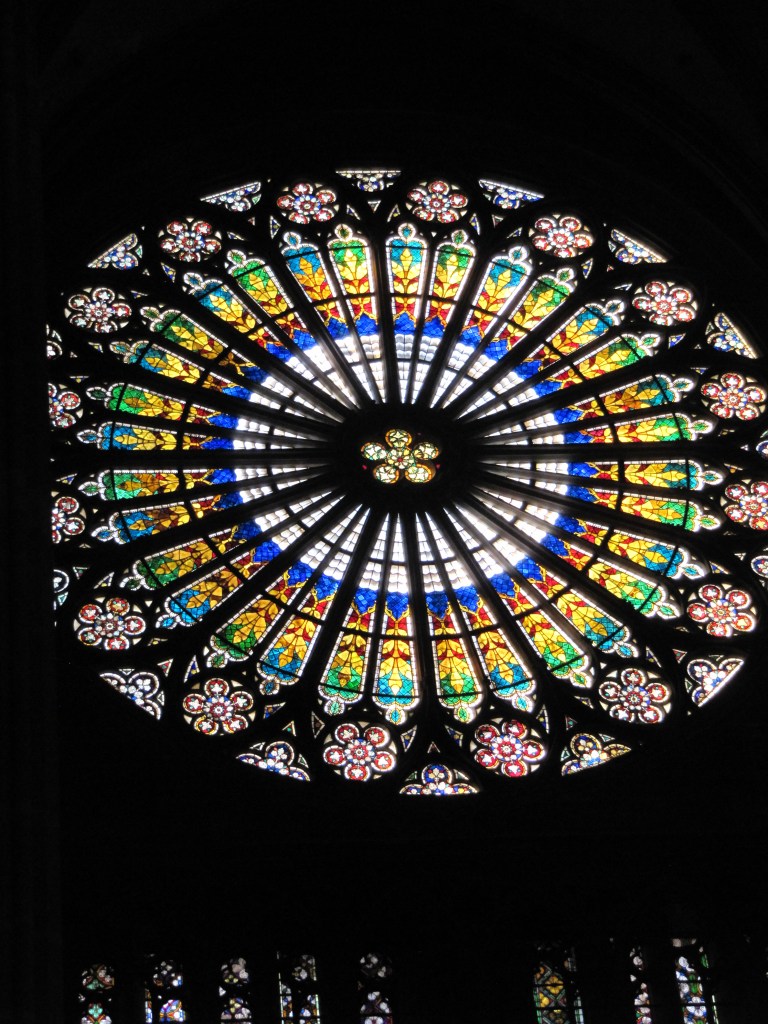
I know it’s hard to see life differently these days. That’s why we have beautiful stain glass windows. To remind us who live in the dark we are living in a new creation.

St. Gregory of Nyssa, an early saint, says in a sermon: 

“The reign of life has begun, the tyranny of death is ended. A new birth has taken place, a new life has come, a new order of existence has appeared, our very nature has been transformed! This birth is not brought about by human generation, by human will power or by the desire of the flesh, but by God.

Let me explain it in clear language. Faith is the womb that conceives this new life, baptism the rebirth which brings it into the light of day. The Church is its nurse; her teachings are its milk, the bread from heaven is its food. 

It’s brought to maturity by the practice of virtue; it’s wedded to wisdom; it gives birth to hope. Its home is the kingdom; its rich inheritance the joys of paradise; its end, not death, but the blessed and everlasting life prepared for those who are worthy.

We’re living in the day the Lord has made – a day far different from those made when the world was first created and which are measured by the passage of time. This is the beginning of a new creation. On this day, as the prophet says, God makes a new heaven and a new earth. 

On this day is created the true human being, made in the image and likeness of God. This day the Lord has made is the beginning of a new world. This day, the prophet says, is not like other days, nor is this night like other nights. 

But still we have not spoken of the greatest gift it brings us. This day destroyed the pangs of death and brought to birth the firstborn of the dead.

I ascend to my Father and to your Father, to my God and to your God. O what wonderful good news! For our sake he became like us in order to make us his brothers and sisters, now he presents to his true Father his own humanity in order to draw all of us up after him.

What is this new heaven? It is the firmament of our faith in Christ. What is the new earth? A good heart, a heart like the earth, which drinks up the rain that falls on it and yields a rich harvest.”

Strange, haunting words to hear in the jumble of daily news reports from the world of wars and politics. So different from the words and images we swim in these days. Faith is a womb, he says, bringing life and hope. We’re living in the day the Lord has made. 

An “Alleluia” comes to mind.