Category Archives: Religion

St. Pius X, AUGUST 21

August 21st is the Feast of St. Pius X.

Eamon Duffy in his fine study of the popes, “Saints and Sinners: A History of the Popes”, describes St. Pius X as a pope who looked forward and looked backward. His pastoral reforms of the liturgy, his encouragement of frequent Communion and reform of church prayers, for example, anticipated many of the liturgical reforms of the Second Vatican Council. In fact, he promoted the beginnings of the modern liturgical movement.

His fear for the integrity of church doctrine, on the other hand, slowed the church in adapting itself to a changing world. Like us all, popes have their strengths and weaknesses. Even saints have their strengths and weaknesses.

The pope’s reflection on the psalms, found in our liturgy today, reveals his love for the psalms, which are such an important part of our liturgy.

The psalms teach us how to pray. They provide a way to praise God and the words to bless God. 

“The psalms have also a wonderful power to awaken in our hearts the desire for every virtue. Athanasius says: Though all Scripture, both old and new, is divinely inspired and has its use in teaching, the Book of Psalms, like a garden enclosing the fruits of all the other books, produces its fruits in song… The psalms seem to me to be like a mirror, in which the person using them can see himself and the stirrings of his own heart; he can recite them against the background of his own emotions. 

Augustine says in his Confessions: How I wept when I heard your hymns and canticles. Those voices flowed into my ears, truth filtered into my heart, and from my heart surged waves of devotion. Tears ran down, and I was happy in my tears.

Who could fail to be moved by those many passages in the psalms which set forth so profoundly the infinite majesty of God, his omnipotence, his justice and goodness and clemency, too deep for words, and all the other infinite qualities of his that deserve our praise?

Who could fail to be roused to the same emotions by the prayers of thanksgiving to God for blessings received, by the petitions, so humble and confident, for blessings still awaited, by the cries of a soul in sorrow for sin committed? 

Who would not be fired with love as he looks on the likeness of Christ, the redeemer, here so lovingly foretold? His was the voice Augustine heard in every psalm, the voice of praise, of suffering, of joyful expectation, of present distress.”

St. Bernard August 20

St. Bernard, Perugina, 18th century

August 20th we remember St. Bernard, a spiritual teacher who never goes out of date and a major figure in the renewal of the church in the 12th century.

The image of Jesus communing with Bernard from a painting from 16th century Florence captures the spirituality of the saint. Bernard was attracted to the humanity of Christ, especially his love shown on Calvary. In this scene, Jesus bends down to Bernard to embrace him. The nails cannot hold him from loving the one kneeling before him. Christ’s love is stronger than the images of death, pictured beneath the cross. That has to be the City of Florence in the background. Christ’s love in never confined to one person or age or place.

Bernard lived in “an age of love”, which saw Jesus reaching out to humanity, not primarily humanity crippled by sin, but humanity as his beloved. It’s not surprising that Bernard’s sermons on “The Song of Songs” is considered his greatest work. “The Bridegroom’s love, or rather the love which is the Bridegroom, asks nothing in return but faithful love. Let the beloved, then, love in return. Should not a bride love, and above all, Love’s bride? Could it be that Love not be loved?… It is true that the creature loves less because she is less. But if she loves with her whole being, nothing is lacking where everything is given.”

Bernard was a leader in the 11th century Cistercian reform of Benedictine monasticism which emphasized simplicity of life and devotion to the humanity of Christ. He became a monk at the monastery of Clairvaux in 1112, and then its abbot. By the time of his death in 1153 the order numbered 339 monasteries throughout Europe.

Growth of the Cistercians was due to their support of church reform initiated by Pope Gregory VII, who enlisted monastic orders in his crucial efforts for reforming the papacy. Bernard played an important part in the Gregorian reform as advisor to popes, bishops and secular leaders.

He was a tireless writer whose letters and sermons inspired Christians throughout Europe. He was a healer whose presence drew crowds of people seeking healing. He was a powerful voice promoting the Crusades to rescue the Holy Land..

Here is how he advises we approach God::

“The first involves humbling ourselves before God: “Heal me, Lord, and I shall be healed; save me and I shall be saved. And again, Lord, have mercy on me; heal my soul because I have sinned against you.

Then, leaving sorrow and ourselves behind, it’s time to “abide rather in the Spirit of God with great delight. No longer do we consider what is the will of God for us, but rather what it is in itself.

Under the guidance of the Spirit who gazes into the deep things of God, let us reflect how gracious the Lord is and how good he is in himself. Let us join the Prophet in praying that we may see the Lord’s will and frequent not our own hearts but the Lord’s temple; and let us also say, My soul is humbled within me, therefore I shall be mindful of you.

These two stages sum up the whole of the spiritual life: when we contemplate ourselves we are troubled, but our sadness saves us and brings us to contemplate God. That contemplation in turn gives us the consolation of the joy of the Holy Spirit.

Contemplating ourselves brings fear and humility; contemplating God brings us hope and love.”

“Jesus, what made you so small? Love.”

Lord God,  you made Saint Bernard burn with zeal for your house,  and gave him grace to enkindle and enlighten others in your Church.Grant that by his prayer  we may be filled with the same spirit  and always live as children of the light.Through our Lord Jesus Christ, your Son,  who lives and reigns with you in the unity of the Holy Spirit,  one God, for ever and ever.Amen.

Some audio readings of St Bernard’s works: https://www.gutenberg.org/ebooks/21152

Jesus, what made you so small? Love

Will Wars Ever End?

Unfortunately we get use to war and then don’t question it. I was looking recently at what the Catholic Catechism says about war. It’s an evil we should never get used to. Here’s some of what our faith tells us:

“The fifth commandment forbids the intentional destruction of human life. Because of the evils and injustices that accompany all war, the Church insistently urges everyone to prayer and to action so that the divine Goodness may free us from the ancient bondage of war. 2307

All citizens and all governments are obliged to work for the avoidance of war. However, as long as the danger of war persists and there is no international authority with the necessary competence and power, governments cannot be denied the right of lawful self-defense, once all peace efforts have failed. 2308

The strict conditions for legitimate defense by military force require rigorous consideration. The gravity of such a decision makes it subject to rigorous conditions of moral legitimacy. At one and the same time: 

  • the damage inflicted by the aggressor on the nation or community of nations must be lasting, grave, and certain; 
  • all other means of putting an end to it must have been shown to be impractical or ineffective; 
  • there must be serious prospects of success;  the use of arms must not produce evils and disorders graver than the evil to be eliminated. the power of modem means of destruction weighs very heavily in evaluating this condition. 2309
  • The Church and human reason both assert the permanent validity of the moral law during armed conflict.The mere fact that war has regrettably broken out does not mean that everything becomes licit between the warring parties. 2312
  • Non-combatants, wounded soldiers, and prisoners must be respected and treated humanely.
  • Actions deliberately contrary to the law of nations and to its universal principles are crimes, as are the orders that command such actions. Blind obedience does not suffice to excuse those who carry them out. Thus the extermination of a people, nation, or ethnic minority must be condemned as a mortal sin. One is morally bound to resist orders that command genocide. 2313
  • Every act of war directed to the indiscriminate destruction of whole cities or vast areas with their inhabitants is a crime against God and man, which merits firm and unequivocal condemnation. A danger of modern warfare is that it provides the opportunity to those who possess modern scientific weapons especially atomic, biological, or chemical weapons – to commit such crimes. 2314
  • The accumulation of arms strikes many as a paradoxically suitable way of deterring potential adversaries from war. They see it as the most effective means of ensuring peace amongnations. This method of deterrence gives rise to strong moral reservations. the arms race does not ensure peace. Far from eliminating the causes of war, it risks aggravating them. Spending enormous sums to produce ever new types of weapons impedes efforts to aid needy populations; it thwarts the development of peoples. Over-armament multiplies reasons for conflict and increases the danger of escalation. 2315
  • The production and the sale of arms affect the common good of nations and of the international community. Hence public authorities have the right and duty to regulate them. 2316

Wouldn’t it be good if every day major news outlets like Fox News, CNN, The New York Times, the New York Post would publish one of those guidelines for reflection?

Barbarized by Continual Wars

The Jewish Encyclopedia describes the period of the Judges, the period we’re reading about this week in our lectionary, in this way:

“Israel remained for some time a rough people, barbarized by continuous wars. Sword law and the vendetta reigned supreme. Neither expeditions undertaken for pillage and plunder (comp. Judges xvii. et seq.), nor treacherous dealings with the enemy, as practiced by Samson, nor assassinations, as those committed by Jael and Ehud, gave offense; and even the lives of those nearest and dearest were sacrificed to satisfy a vow, as in the case of Jephthah.”

“Barbarized by continuous wars.” War became the only way to settle things at this time, and that led to warrior leaders, some more measured than others. The allegory of the trees which we will hear tomorrow from the Book of Judges ends with the buckhorn tree ruling over the people. That’s Abimelech, the vicious son of Gideon, who kills anyone in his way and, in turn, suffers a violent death. 

The Book of Judges was an admonition to the Jewish people to beware of seeing war and violence as a way of life. It creates a barbarous society. It’s a way to death.

An admonition to us too?

The Book of Judges

Most of this week the OT readings in our lectionary are from the Book of Judges, recalling the period after the Israelites, led by Moses and then by Joshua, took possession of the land of Canaan, the Promised Land.

It was not a vacant land; the Canaanites were strongly entrenched there. Instead of establishing themselves according to the commands of God, the Israelites decide to fit in, becoming isolated families rather than a united people, They intermarry with the Canaanites and even set up altars to Baal, the Canaanite god.

It’s one of the most violent times in Jewish history, a time of religious and political disorder. On Thursday of this week Jephthah kills his own daughter because of a vow he made to God. Not an easy story to make sense of. Hard to make sense of anything in this violent age. The leaders God raises up, judges, are not powerful enough to unite the community.. Gideon– his story’s told this week– is an example of a judge. The word “judge” is nowhere near what we associate with the word today.

Gideon’s a lonely farmer expecting an invasion by the Midianites, a tribe of nomads who periodically raided the land of Canaan. He’s busy saving some wheat from his fields before they come; then, he’ll hide. 

The angel of the Lord appears, calling him a “Champion of Israel,” but Gideon wants no part of championing Israel. He’s lost faith in the promises of God, with no big dreams to do anything except saving himself. Even when God gives him a sign, one sign isn’t enough. Gideon wants out.

“Go with the strength you have.”  That’s what the angel says to Gideon as he and so many others lose trust in God’s promises. The strength you have, not the strength you would like to have, or the strength you once had. Go with the strength you have.

That’s God’s command in the time of the Judges. Is it God’s command to us now?  

Go with the strength you have.

20th Sunday c: A Stiff-Necked People

For this week’s homily please watch the video below.

Joshua

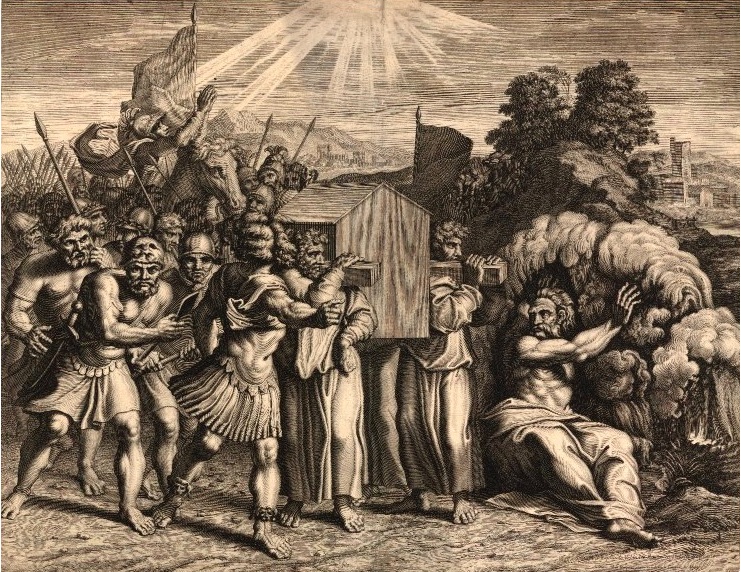
Robert Hecquet, Israelites Crossing the Jordan River, c. 1720-1775

Our Old Testament readings for the next few days are from the Book of Joshua, the successor of Moses. He was a man of battles and wars, who led the Israelites in their conquest of Canaan and their possession of the Promised Land. “Joshua fit the battle of Jericho, and the walls came tumbling down.”

As a warrior he was concerned with preparing troops for battle, getting weapons ready, strategizing for the battle, but Joshua begins his campaign by first reminding the people what’s more important than all that: “Remember who you are.”

Gathering the Israelites before the Jordan River, Joshua orders the priests to bring before them the ark of the covenant, God’s pledge that they are his people. They bring the jar of manna reminding them that God sustains them. They are God’s people, not insignificant slaves. They’re God’s children, cared for, with rights and privileges and promises.

Only by remembering who they are will they be able to cross the Jordan and break down the walls of Jericho and take possession of the land.

Remember who you are.

Where did the Feast of the Assumption come from?

Mary’s Tomb, Jerusalem

We celebrate the Feast of the Assumption of Mary into heaven August 15th. It’s the most important feast of Mary in the church’s calendar. Where did it come from?

There’s no account of Mary’s death or assumption into heaven in scripture. An account in the apocryphal body of literature called the Transitus Mariae, popular in the Christian churches of the east from the 5th century, describes the return of the apostles to Jerusalem for Mary’s burial and their discovery that her body was taken up to heaven. The writings attest to an early interest in the death of Mary in some parts of the early church.

The first liturgical celebrations of Mary’s death and assumption to heaven took place in Jerusalem at her tomb (above) on the Mount of Olives about the 5th century. The Roman Catholic Church draws her present belief from this early tradition and her conviction that Mary is “wholly united with her son in the work of salvation.” For scriptural support, the church looks to sources like Paul’s First Letter to the Corinthians–the second reading at Mass for August 15th – to understand this mystery.

Paul wrote that letter about the year 56 AD to Corinthian Christians who had questions about the resurrection of Jesus. Their precise difficulty seems to be that they saw only the soul surviving death and not the body, a common conception of the Greek mindset of the day. That belief brought a low appreciation of the body and the place of creation itself in the mystery of redemption.  The created world wasn’t worth much and was passing away, so let it go.

Paul countered that opinion with the belief he received, a belief from the beginning:  “For I handed on to you as of first importance what I also received: that Christ died for our sins in accordance with the scriptures; that he was buried; that he was raised on the third day in accordance with the scriptures; that he appeared to Cephas, then to the Twelve. After that, he appeared to more than five hundred brothers at once, most of whom are still living, though some have fallen asleep” (1 Corinthians 15: 3-6).

Jesus was raised bodily from the dead, Paul affirms, and we will rise bodily too. Jesus is “the first fruits of those who have fallen asleep.” Mary’s bodily assumption follows the bodily resurrection of Jesus. Because of her unique role in the mystery of redemption she is among the “first fruits of those who have fallen asleep.” Her assumption is part of the mystery of the resurrection; it’s an affirmation we will follow Jesus who rose body and soul.

In her prayer, the Magnificat – the gospel read on the Feast of the Assumption – Mary accepts her mission from God to share in the mission of her Son, the Word made flesh, who came to redeem the world.

The church gradually understood the mystery of Mary’s Assumption over time. A rising Gnosticism in the 3rd and 4th centuries certainly promoted appreciation of this mystery. Gnosticism promised escape from the limits of bodily life through a higher knowledge. As a result, human life and creation itself didn’t matter.

Mary’s Assumption claims they do.

The Roman Catholic Church formally defined the dogma of the Assumption on November 1, 1959, on the Feast of All Saints, but the belief was firmly held for centuries before:

“…the Immaculate Virgin, preserved free from all stain of original sin, when the course of her earthly life was finished, was taken up body and soul into heavenly glory, and exalted by the Lord as Queen over all things, so that she might be the more fully conformed to her Son, the Lord of lords and conqueror of sin and death.” The Assumption of the Blessed Virgin is a singular participation in her Son’s Resurrection and an anticipation of the resurrection of other Christians: ‘In giving birth you kept your virginity; in your Dormition you did not leave the world, O Mother of God, but were joined to the source of Life. You conceived the living God and, by your prayers, will deliver our souls from death'” (Catechism of the Catholic Church 966).

Mary’s Assumption was defined in a century when human life and the planet itself were threatened. World War I ended in 1918 after four years when millions perished. World War II, ending in 1945, left the real possibility that war and nuclear weapons could bring about the destruction of the human race. The Holocaust seemed to prove the capability of human evil.

Threats to human life continue and creation itself is increasingly endangered by climate change and consequent poverty. August 15, the date for the celebration of this feast from earliest times, is the time of harvest for most of the Western Hemisphere. Our belief in the resurrection of the body sees creation itself promised a share in this mystery. The readings and prayers of the feast describe Mary in heaven as the woman clothed with the sun, the moon and the stars beneath her feet. (Revelation 11)

The Feast of Mary’s Assumption is the oldest and most important of Mary’s feasts in our church calendar.

Feast of the Assumption of Mary: August 15

For this week’s homily please watch the video below.

Blessing Herbs, Medicines and Fields: August 15th

When I was a little boy, on August 15, the Feast of the Assumption of Mary into Heaven, my mother would tell me to go down to the Newark Bay, just a few blocks from my home in Bayonne, NJ, and go into the water. There’s a blessing in the water today, she told me. 

I learned later where that custom came from. In medieval Europe the Feast of the Assumption was the day the fields were blessed. The middle of August was harvest time, and on this day herbs were gathered from the fields and brought to the church to be blessed with water. After they were blessed they were brought home to be  medicines for the sick. We still get many if not most of our medicines today from herbs.

Customarily, a sprig was placed on the wall where children slept, asking God to keep them healthy and strong. 

We will have herbs, a small olive tree, fruits of the earth and flowers before our altar for the feast on August 15 and then we will have a procession to our Mary Garden to bless them..

Many important feasts of our church occur in one of nature’s cycles. The birth of Jesus Christ, December 25, is celebrated as darkness gives way to light in the Western Hemisphere. Easter, the celebration of the death and resurrection of Jesus takes place during the Passover celebration, which occurrs at the spring harvest. Mary’s Assumption, August 15th, falls as the summer harvest begins. 

You can see why Mary’s Assumption into heaven is a day to bless herbs and to bless the fields. It’s a feast of life. On this day Mary followed Jesus, her Son, into the mystery of his death and resurrection in a unique way. Mary’s body, her humanity, like the humanity Jesus assumed, like the humanity we all share, came from the earth.

We all come from dust, from creation, and to dust we shall return.“From dust you are, and to dust you shall return,” we are reminded on Ash Wednesday. But the promise we have from Jesus is that this dust will rise again to new life.

Mary witnesses to his promise in a unique was. Mary’s body, like the body of Jesus, never returned to the dust. She was assumed body and soul into heaven to become a sign of bodily resurrection. The promise of resurrection given to her is also given to us. Not only is it given to us, but to all God’s creation. Mary is the sign of a new creation, promised by God.

The first reading for her feast, from the Book of Revelation, describes Mary as a woman “ clothed with the sun, with the moon under her feet, and on her head a crown of twelve stars. She gave birth to a son, a male child, destined to rule all the nations.”  After his resurrection, Jesus was enthroned in heaven and Mary was taken up to heaven to join him.

The Assumption of Mary is a time to rejoice in “the resurrection of the body and life everlasting”, the whole created world also rejoices in the promise of a new creation. Listen to Psalm 96:

O sing a new song to the Lord, sing to the Lord all the earth. O sing to the Lord, bless his name. Let the heavens rejoice and earth be glad, let the sea and all within it thunder praise, let the land and all it bears rejoice, all the trees of the wood shout for joy at the presence of the Lord for he comes, he comes to rule the earth.

The Feast of the Assumption of Mary into Heaven offers a future so different than the bleak picture of life we’re tempted to see today. She visits us today as she did her cousin Elizabeth long ago announcing a great mystery. We are called, like Mary, to a heavenly place with Jesus her Son. Our world, so battered with the storms and disease, so threatened by a changing climate, wars and poverty, also sees a glorious future in her assumption into heaven.

Pray for us, O Holy Mother of God, that we may be made worthy of the promises of Christ.