Our garden here in Rome was once part of Nero’s extensive gardens that surrounded his Golden Palace. It’s filled with majestic pines, the pines of Rome. They’re trees that beg for a musical tribute, and Respighi did it with his musical masterpiece.
I’ll add a small tribute of my own, from our garden today:
The opening Mass prayer for St. Vincent’s feast day describes succinctly what made him a great saint:
O God, for the relief of the poor
and the formation of the clergy
you endowed the priest St.Vincent De Paul
with apostolic virtues.
grant, that afire with the same spirit
we may love what he loved
and put into practice what he taught.
God gave Vincent de Paul grace to reach out to the poor and form the clergy. Both the poor and the clergy in France needed the grace of God.
Vincent as a young priest, met a Protestant once whom he invited to convert to Catholicism. The Protestant said:
“You told me, Monsieur, that the Church of Rome is led by the Holy Spirit, but I find that hard to believe because, on the one hand, we see Catholics in the countryside abandoned to pastors who are ignorant and given over to vice, with so little instruction in their duties that most of them hardly know what the Christian religion is. On the other, we see towns filled with priests and monks who are doing nothing; there are perhaps ten thousand of them in Paris, yet they leave the poor country people in this appalling state of ignorance in which they are lost. And you want to convince me that all this is being guided by the Holy Spirit! I’ll never believe it.”
That’s a picture of the French church in Vincent’s time. One reason for its sad condition was that the French crown appointed bishops and they, in turn, appointed men from important French families who supported them. Political considerations largely influenced church appointments.
As a result, the priesthood in France was badly off, priests had little education, some could hardly read or write. For financial support, they looked for benefices, usually found in the larger cities among rich families, where they could say Mass and celebrate the sacraments. As a young priest, Vincent himself was chaplain for a wealthy family in Paris.
The decision to become a priest was mostly a family’s decision, which might designate one of its sons as its “offering” to God. The priesthood became a way to get a son some education and some social standing. Vincent’s own family, who were peasants, were influenced by motives like these. For many the priesthood was a job and not a call.
What Vincent did was to appeal to priests, religious, and even bishops, to begin to look at their roles spiritually. They were called by God to a vocation, not a job or career, They had a sacred mission to follow Jesus Christ. Vincent, in fact, called the community he founded the Congregation of the Mission (Vincentians), because they were to go to those neglected. He encouraged, not only priests, but communities of women to care for the poor, without living the usual cloistered life of that time. Vincent’s network embraced laypeople too, who worked for those Jesus called “the least.”
Through the efforts of this saint communities of Daughters of Charity, Societies of St. Vincent de Paul, are found throughout the world today.
The following reading for Vincent’s feast captures his powerful message:
Although in his passion he almost lost the appearance of a man and was considered a fool by the Gentiles and a stumbling block by the Jews, Jesus showed them that his mission was to preach to the poor: He sent me to preach the good news to the poor. We also ought to have this same spirit and imitate Christ’s actions, that is, we must take care of the poor, console them, help them, support their cause.Even though the poor are often rough and unrefined, we must not judge them from external appearances nor from the mental gifts they seem to have received. On the contrary, if you consider the poor in the light of faith, then you will observe that they are taking the place of the Son of God who chose to be poor.
Since Christ willed to be born poor, he chose for himself disciples who were poor. He made himself the servant of the poor and shared their poverty. He went so far as to say that he would consider every deed which either helps or harms the poor as done for or against himself. Since God surely loves the poor, he also loves those who love the poor. For when one person holds another dear, he also includes in his affection anyone who loves or serves the one he loves. That is why we hope that God will love us for the sake of the poor. So when we visit the poor and needy, we try to understand the poor and weak. We sympathise with them so fully that we can echo Paul’s words: I have become all things to all men. Therefore, we must try to be stirred by our neighbours’ worries and distress. We must beg God to pour into our hearts sentiments of pity and compassion and to fill them again and again with these dispositions.
It is our duty to prefer the service of the poor to everything else and to offer such service as quickly as possible. If a needy person requires medicine or other help during prayer time, do whatever has to be done with peace of mind. Offer the deed to God as your prayer. Do not become upset or feel guilty because you interrupted your prayer to serve the poor. God is not neglected if you leave him for such service. One of God’s works is merely interrupted so that another can be carried out. So when you leave prayer to serve some poor person, remember that this very service is performed for God. Charity is certainly greater than any rule. Moreover, all rules must lead to charity. Since she is a noble mistress, we must do whatever she commands. With renewed devotion, then, we must serve the poor, especially outcasts and beggars. They have been given to us as our masters and patrons.”
I wasn’t expecting to see a Mary Garden in Rome, but there it was in our monastery garden of Saints John and Paul on the Celian Hill. The garden, originally belonging to the impious Emperor Nero, faces the Colosseum and the Roman Forum below. Now it’s a monastery garden.
Today, a statue of Mary rests on an ancient Roman capital, surrounded by pines and plants that must have grown here centuries ago. A blanket of Shepherd’s Purses, known for medicinal benefits, covers the earth she stands on. Mary looks out over the centuries, claiming this place for her Son.
Just below here from the edge of the garden, you can see long lines of tourists on guided tours wending their way through the Colosseum. I wish they could find some of the wisdom found in this small quiet place, a wisdom Mary found and offers to us.
Pray for us, O holy Mother of God, that we may be made worthy of the promises of Christ.
We remember Saints Cosmas and Damian September 26th. Tradition says the two brothers practiced medicine in Syria in the fourth century and were martyred during the reign of Diocletian. They gave their medical services freely to anyone in need, and so followed Jesus’ teaching, “Freely you have been given, freely give. “ (Matthew 10:8) Besides caring for bodily needs they prayed for those they cared for.
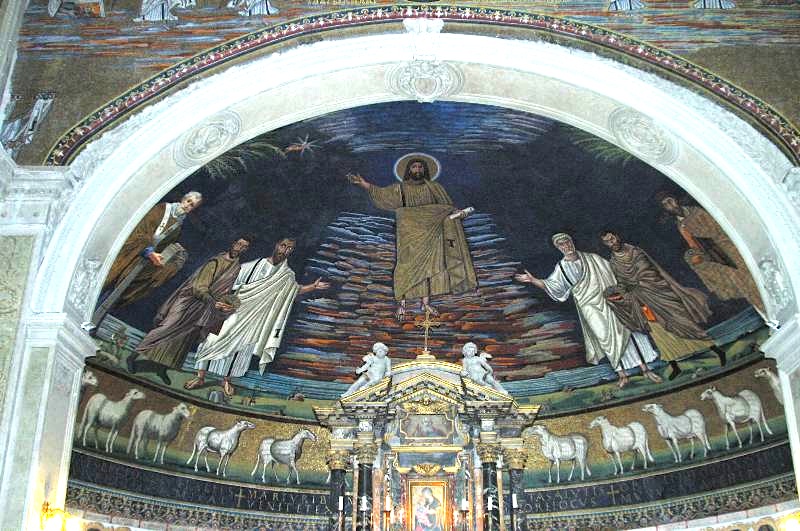
The brothers were honored widely from earliest times in the Christian churches of the east and west. In the 7th century mosaic in the church of Saints Cosmas and Damian in the Roman Forum they’re shown as good and faithful physicians being presented to Christ holding their medicine boxes in their hands. A reward waits for them.They’re patrons of doctors, pharmacists, nurses, barbers.
Though there is no exact historical information about them, Cosmas and Damian are examples of holiness. Care for the sick and suffering were an important part of the ministry of Jesus, who often cured them and returned them to their families and communities. In his ministry, Jesus had special care for the sick and suffering. He often showed his concern in miraculous cures that restored them to their families and communities. Those who heal and care for the sick and suffering– whether doctors, nurses, people involved in medical research, caregivers of every kind– follow him in what they do.
Cosmas and Damian remind us health care is more than a job you may– or may not – get paid for. It’s sharing in the divine power to heal. “I was sick and you visited me,” Jesus says at judgment time. Health care is vital to every society and culture.
The scant historical evidence about Saints Cosmas and Damian is more than compensated by their early popularity in the churches of the east and west. Why were they and the churches built to honor them, like that in Rome, so popular?
The church of Saints Cosmas and Damian in Rome stands a few hundred yards away from the Roman Senate, replacing a basilica honoring one of the gods of Rome. It was built in the 6th century by Pope Felix II, a relative of Gregory the Great, at a time when Rome’s economy plunged because of barbarian invasions. Hard times often affect the poor and the sick most.
Was the church a reminder to Rome’s leaders nearby that health care is a basic human right to be prioritized and supported. I think so. Health care is still a burning issue today as we expand our military budgets and pull away from our care of the planet and its poor.
A few days ago, I prayed the Benedictus, Zachariah’s prayer announcing the “Dawn from on high, breaking upon us”, not in a chapel, but looking from a plane window over the Alps on its way to Rome. Zachariah, like many people of old, experienced the dawn better than we do. We seldom look out the window as we awake, but prefer to listen to some device announcing news of the day. .
Zachariah saw the dawn announcing more than a day’s news. So many of the psalms prayed each morning do the same. God is present today, sure as the dawn. The dawn “from on high” takes possession of our day. God comes into our dark world. God has come in Jesus Christ.
We have to announce that too, like John the Baptist did. The Light has come.
Here’s his prayer and some pictures from a plane.
Blessed be the Lord, the God of Israel;
he has come to his people and set them free.
He has raised up for us a mighty savior,
born of the house of his servant David.
Through his holy prophets he promised of old,
that he would save us from our enemies,
from the hands of all who hate us.
He promised to show mercy to our fathers
and to remember his holy covenant.
This was the oath he swore to our father Abraham,
to set us free from the hands of our enemies,
free to worship him without fear,
holy and righteous in his sight
all the days of our life.
You, my child, shall be called the prophet of the Most High,
for you will go before the Lord to prepare his way,
to give his people knowledge of salvation
by the forgiveness of their sins.
In the tender compassion of our God
the dawn from on high shall break upon us,
to shine on those who dwell in darkness and the shadow of death,
Not much optimism in our world today. Too many signs of bad days ahead; in fact, are they already here?
We’re reading in our lectionary this week about the Period of Restoration, when some Jews returned to Judea and Jerusalem to restore Judaism, about 520 BC. Their dreams were fed by prophets like Jeremiah who promised: “Shouting, they shall mount the heights of Zion, they shall come streaming to the Lord’s blessings: the grain, the wine, and the oil, the sheep and the oxen; they themselves shall be like watered gardens, never again shall they languish.” (Jer. 31)
But their dreams were dashed by what they found, a city in ruins and some of their own people there wanted no part of them. The Prophet Haggai speaks to them:
“Thus says the LORD of hosts: This people says:“The time has not yet come to rebuild the house of the LORD.”(Then this word of the LORD came through Haggai, the prophet:) Is it time for you to dwell in your own paneled houses, while this house lies in ruins?Thus says the LORD of hosts: Consider your ways! Go up into the hill country; bring timber, and build the house that I may take pleasure in it and receive my glory, says the LORD.” (Haggai 1:1-8)
We’re a people too who were promised so much. World wars we fought would bring peace to our country and the world. Science promised a cure for everything and unlimited treasures from technology. I remember the heady days after the Second Vatican Council and the promise of a renewed church. Who expected Covid 19 and Climate Change, a fractious country and church, a world that’s a mess?
Yet, there’s more than Covid 19 and Climate Change going on in our world. God’s kingdom is coming, being built even now. Not a time for building paneled houses for ourselves. Time to “Go up into the hill country; bring timber, and build the house that I may take pleasure in it and receive my glory, says the LORD.”
Today the Passionists celebrate the feast of St. Vincent Strambi, CP (1745-1824). In his early years as a Passionist priest Strambi was a well known preacher, writer and spiritual director. He was a close associate of St. Paul of the Cross and wrote his biography after his death.
He was chosen to be bishop of Marcerata during tumultuous years in Italian history when Napoleon moved to take over Italy, the papacy and the Catholic Church. Strambi was an heroic supporter of the pope and fought for the freedom of the church.
To understand most saints you have to understand the times in which they lived. They’re antidotes for the poison of their time. Unfortunately historians pay little notice to the challenging times Vincent Strambi lived in.
In 1789, following the French Revolution, a Reign of Terror struck the church in France, religious orders were suppressed, priests and religious were imprisoned, exiled, put to death. Word of the terror quickly reached Italy and Rome; the defenseless Italian peninsula would be the next target for France’s fierce revolution.
Pope Pius VI asked for prayers that Rome be spared, and he called on Vincent Strambi, then one of the church’s best preachers, to prepare the people for a blow sure to come. In packed churches and piazzas in Rome Strambi promised that God would not abandon his people. The Roman people gained strength from his words.
In 1796 Napoleon Bonaparte turned to Italy, demanding heavy tribute from the Pope and the Papal States. The murder of the French General Duhot in Rome gave him the pretext for invading the city, deposing and imprisoning the pope and declaring the Papal States a Republic.
Religious houses were suppressed, their goods systematically confiscated. Strambi, a well-known opposition figure, fled to Monte Argentario, a Passionist sanctuary on the Mediterranean Sea.
In 1799 Pius VI died in exile and was succeeded by Pius VII who, in 1801, appointed Strambi bishop of Macerata and Tolentino, two important cities in the Papal States along Italy’s Adriatic coast, poverty-stricken from years of political and military turmoil.
The bishops of the Papal States were largely responsible for temporal as well as spiritual affairs and Bishop Strambi became a champion of the poor in his diocese. He lived sparingly himself, without signs of wealth or position. The poor were constantly on his mind. “Don’t you hear the cries of the poor?” he said one day to the treasurer of his seminary, looking out his window.
The education of poor children interested him especially and he urged his priests to care for them. In sermons he constantly looked to the Passion of Jesus for wisdom in the struggles of the time. His devotion to the Precious Blood of Jesus was influenced, at least in part, from reflection on the bloodshed the Napoleonic Wars brought to millions in Europe. Almost 4 million died as warfare rose to a level never seen before. Their blood was precious to God.
On May 5, 1809, after occupying Rome and most of the Papal States. Napoleon declared the region under French control and the temporal power of the pope abrogated. On June 6, 1809 Pius VII placed notices on church doors throughout Rome excommunicating anyone cooperating with the French. July 6, the French general Radet arrested the pope and brought him north to Savona.
Napoleon then demanded bishops sign an oath of loyalty to his new government. Refusal meant exile and imprisonment, signing was an act of disloyalty to the pope.
“I am ready for prison and for death. I am with the pope,” Strambi declared. On September 28,1808 he left his diocese under guard for northern Italy where he remained for 5 years under house arrest.
After Napoleon’s defeat in 1814 the church’s exiled leaders returned. Bishop Strambi returned to his diocese in May, 1814; immediately the pope asked him to come to Rome to preach a nine day “retreat of reconciliation” in late July and early August. Not all met the French invasion heroically.
In 1816 a typhoid epidemic followed invading armies. Food shortages and inflation spread through the bishop’s diocese. He opened hospitals for the dying and sought supplies for his suffering flock.
Physically frail from birth, Bishop Strambi became increasingly ill and found it harder to manage his diocese. By 1814, the world too had changed. The Papal States had no bishops in the long chaotic period of the Napoleonic invasion and new forces demanding change came to power. Strambi recognized it was too much for him.
In 1823 he asked the new pope, Leo XII, to allow him to retire. The pope accepted his resignation on one condition, that he come and live with him as an advisor in the Quirinal Palace, then the pope’s residence in Rome. A local commentator said of the departing bishop: “ He was a man who lived a holy life, giving alms to all and content with only the necessary for himself. We are sorry to see him go, for we lose a good pastor. The cries of the poor are especially loud, for they lose one who cared for and sustained them.”
Vincent died in Rome on January 1, 1824, having offered his life to the Lord in place of that of the pope who was seriously ill.
Pope Leo ordered the process for his canonization 8 days after his death. He was declared a Saint in 1950 and his relics now rest in Macerata, the city where he was a zealous pastor for twenty-two years.
St. Vincent Strambi’s room, Saints John and Paul Monastery, Rome
With the help of the Holy Spiirt, I on my part will do all I can that the living image of Jesus crucified be imprinted in the hearts of each of you. I do this gladly, not counting the cost. I consider myself fortunate to give my lifeblood so that Christ might be formed in you. I can say, like the apostle, that because of my love for you, I want to share with you “not only God’s message, but our very lives, so dear have you have become to us.”
I urge you, then, to look attentively on the Image of the Crucified, the bishop of your souls, on his throne of grace. In that way I shall fulfill my obligation to announce to you the death of the Lord, an obligation arising from my profession in the Congregation of the Holy Cross and Passion of our Lord Jesus Christ. I shall do all I can to urge you all to fulfill your duty to love him who first loved us, who offered himself on the altar of the cross for us, who shed his blood for us.
( Letter to the people of Marcerata on becoming their bishop)
September 23 is the feast of Padre Pio, the Italian Capuchin friar and a popular saints of modern times. I would say he’s a saint who’s a catechism. He was a stigmatic, who carried the wounds of Christ in his body. Church officials were wary of him;investigation after investigation questioned his credibility, but ordinary people recognized his holiness. To them he was a striking sign of God’s presence in an ordinary human being. Padre Pio taught, not by a book, but by himself.
People were the first catechism. They still are. Where do our printed catechisms come from? They’re recent instruments for forming people in their faith. Martin Luther was the first to compose a catechism in question and answers for ordinary people in the 15th century. In response to Luther, the Dutch Jesuit Peter Canisius composed the first Catholic catechism in 1555 followed by three others afterwards. The Council of Trent directed a catechism be written as a resource for the clergy and that appeared in 1556. Robert Bellarmine later composed an important catechism requested by Pope Clement VIII and after that bishops from all over the world composed catechisms for their people. I can still recite questions and answers from the Baltimore Catechism of my youth.
In earlier times, catechesis was done without relying on catechisms, through preaching, sacraments, the feasts and seasons of the year, and popular piety. People, like Padre Pio, are the most important catechism.
The Second Vatican Council changed the language of the liturgy from latin to the language of the people and revised the liturgical prayers and rites that they better serve as catechesis. Some today want to maintain the primacy of the catechism in catechesis but, while they’re still important, we need to catechize more through the liturgy, sacraments, feasts and seasons, and popular piety. It’s a task of the Second Vatican Council remaining to be done.
Don’t forget people.
In 2006 the bishops of the USA published the United States Catholic Catechism for Adults, which interspersed stories of saints and others as examples of the faith expounded in the book. They were acknowledging what we all know: people are better catechisms than books.
As I see it, some today want to restore America as a Christian nation, which means create a judicial, educational and political system favoring Christianity and all its privileges. It also means limiting the rights of non-Christians already here and limiting others like them from entering our country. Is that a fair summary?
We’re reading this week from Ezra, Nehemiah and Haggai, writers from the Period of Restoration, when some Jews returned to Jerusalem from exile anxious to restore Judaism. (522-486 B.C.). Good readings for today.
Judea was no longer a Jewish province then, but a Persian province. Jewish kings no longer reigned there and the temple was in ruins. A large number of foreigners and some Jews who never went into exile resided in Judea and Jerusalem, and so idealistic returnees didn’t have a free hand.
The Prophet Haggai, who only spoke for a few months, in 520 BC, advised the returning exiles to accept the present government and the present situation. At the same time he exhorted the Jews who stayed in Jerusalem to get out of their “paneled mansions” and build the temple. The Messiah will come at a future time we do not know. Until then, continue to rebuild the temple. God will be present there whatever it looks like, Haggai said.
There’s no perfect time or place; God is present in imperfect times and places like ours. The temple and the church are never finished in time, they’re always being built.
Ezra insisted on faithfully reading the scriptures. The consistent reading of God’s word Ezra gave people the the wisdom they needed; otherwise they would fall for the wisdom of the day.
God gives us wisdom day by day. Search for it.
Nehemiah was the brick and mortar figure of the Restoration, the practical person. Perfect buildings and the perfect places don’t exist, he believed, but do what you can day by day. Keep building.
The building of the Temple at the time of Ezra and Nehemiah is associated with the celebration of the Feast of Booths, when the Jews lived in tents for 40 years during their journey through the desert.






 The Victor's Place