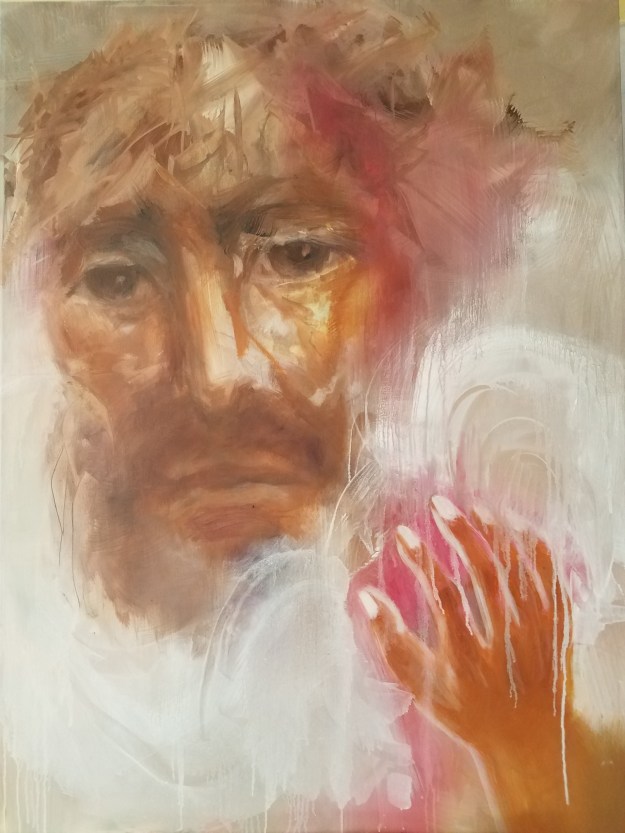
I spent several hours thinking about the last words of your reflection on Veronica and on Duk Soon Fwang’s painting about Veronica’s meeting Jesus on his way to the cross. I believe that Veronica saw the face of Jesus, as it was, before she pressed her veil to his face.
There Had To Be Veronica

    The inquisition,
            the scourging,
    the beating,
    the stripping of his garments,
    the mockery of the purple robe,
    the piercing pain of the crown
    forced onto head.

    The cobblestone road,
    torture on his bare feet,
    the beam across his shoulders,
    carried with his arms folded over it
    from back to front,
    sheer agony for his bones and muscles,
    the sweat and blood
    running from his head wounds
    blinding his eyes.

The woman who stepped out,
    against the screaming crowd
    of jeering and weeping humanity,
    removed her veil and raised it toward
    his suffering face,
    only her hand revealing her courage,
    her compassion,
    her love.

                Gloria Ziemienski
                March 2019
This is the first Commandment, Jesus said: Hear, O Israel! The Lord our God is Lord alone! You shall love the Lord your God with all your heart, with all your soul, with all your mind, and with all your strength. The second is this: You shall love your neighbor as yourself. There is no other commandment greater than these.”
We should expect to hear about love on a lenten friday. Believers recall the passion of Jesus on all the fridays of the year, but the lenten fridays are special days to prepare for the Friday called Good. That was a day that challenged the love Jesus had for us and for our world. We saw God’s wonderous love for us in him.
On that day Jesus fulfilled the great commandment he preached to others in a striking way. Historians, scholars, artists approach the mystery of his passion and death and resurrection of Jesus from many perspectives. The gospels and Christian tradition dwell on the mystery in great detail. It is a fascinating conclusion to a fascinating life.
Jesus could have experienced just humanity’s joys and creation’s beauty when he became flesh, leaving aside the sorrow that burdens humanity and creation. He could have loved us at our best. But when he became human he “bore our sorrows.” He bore our sorrows from his birth till he embraced the mystery of death on a cross. It was love he obeyed. “He was obedient unto death.”
Why did Jesus suffer such a death? A question only answered by recognizing it as fulfilling the command of love. The cross was not something Jesus endured; an absurd mystery before which he shut his eyes and to which he had no response. He embraced it with his whole heart, his whole mind and all his strength as his Father’s will. At his cross, we stand before Love.
Demons, devils and miracles are common in the bible, but we treat them suspiciously in our western world today. If something remarkable happens, as it does in Luke’s gospel read today, people tend to discount its mysterious origin. We’re uncomfortable with talk of demons, devils and miracles. Something’s behind it and we’ll discover it sooner or later. We’ll put experts on the case.
Miracles of healing were among the signs that established the identity of Jesus among his early hearers. They were proofs God gave. I wonder if we will see more miracles today in our unbelieving age. The experts won’t be able to understand it.
The great sign we receive this Lenten season is the sign of Jesus’ resurrection:
Peter says to the crowds in Jerusalem after Pentecost, “Listen to what I have to say to you about Jesus of Nazareth, a man attested to you by God with deeds of power, wonder and signs that God did through him among you, as you yourselves know,”
The apostle goes on from these signs of Jesus’ ministry to the culminating sign of his death and resurrection.
No human power can explain this mystery, surpassing all others. Jesus in his death and resurrection took on all human sorrows– the sorrow of the mute, the deaf, the paralyzed, the possessed, the dead, the sinner far from God. And he was raised up and gave his life-giving Spirit to the world.
Some deny this sign too. but it’s the great sign that we celebrate in this holy season.
In today’s gospel from Matthew (Matthew 5:17-19) Jesus speaks from a mountain, a place where sublime things are taught. Moses before him brought God’s word to the Israelites from a high mountain. Now, Jesus teaches as the New Moses, in the Sermon on the Mount.
He does not abolish what the great patriarch taught but brings it to fulfillment, Jesus says.
He makes sublime promises of a Kingdom; our God is gracious and near. But this part of the Gospel reminds us of little things, “the smallest letter or the smallest part of a letter,” the small steps, the “least commandments” we must keep to enter the Kingdom of heaven. Small things.
Lent—our reading reminds us—is not only for remembering great things but for remembering small things like a cup of cold water, a visit to the sick, feeding someone hungry, clothing someone naked, speaking a “word to the weary to rouse them.” They are important commandments of God.
So let’s think great thoughts and embrace great visions of faith these days, but don’t forget those small things that are so big in God’s law. We have to keep them in mind. The greatest in the kingdom of God are the best at that.
What small step do you want me to take today, O Lord?
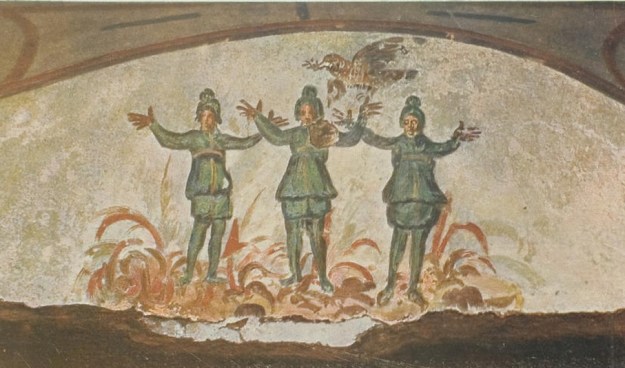
In today’s reading from Daniel, three young men are thrown into a fiery furnace by the Babylonian King Nebuchadnezzar because they won’t worship a golden idol. Still, “unfettered and unhurt” they walk freely in the fire, an angel at their side. They’re unharmed, saved by their faith in God.
Here’s Azariah’s prayer:
“Blessed are you, and praiseworthy, O Lord, the God of our ancestors,and glorious forever is your name. For you are just in all you have done;all your deeds are faultless, all your ways right, and all your judgments proper.For we have sinned and transgressed by departing from you,
and we have done every kind of evil. For your name’s sake, do not deliver us up forever, or make void your covenant. Do not take away your mercy from us, for the sake of Abraham, your beloved, Isaac your servant, and Israel your holy one,To whom you promised to multiply their offspring like the stars in heaven.
For we are reduced, O Lord, beyond any other nation, brought low everywhere in the world this day because of our sins. We have in our day no prince, prophet, or leader, no burnt offering, sacrifice, oblation, or incense, no place to offer first fruits, to find favor with you.
But with contrite heart and humble spirit let us be received;As though it were burnt offerings of rams and bulls,or tens of thousands of fat lambs, So let our sacrifice be in your presence today and find favor before you for those who trust in you cannot be put to shame. And now we follow you with our whole heart, we fear you and we seek your face. Do not put us to shame.”
(Daniel 3, 26,27,29,34-41)
The young men in the furnace are from a Jewish community in exile, with no priest, prophet or leader, no temple to offer sacrifice, but they willingly shoulder the world that’s come down from past generations. They also have sins and mistakes of their own.
Their world has become a fiery furnace, but the young men with few spiritual resources of the past still believe in God’s promises: they’ll have offspring like the stars in the sky and the sands of the sea. “We follow you with our whole heart, we fear you and seek your face. Do not put us to shame.”
Is their prayer a good prayer for our church today? Today can seem like a fiery furnace, with diminished resources but hoping in God’s promises, trusting and uncomplaining, we too can walk in the fire, “unfettered and unhurt.”
On Monday this week we celebrate the Solemnity of the Annunciation of the Lord when, at the invitation of the angel, Mary consented to become the mother of Jesus Christ. To help us understand the mysteries of faith, the church celebrates them as concretely as possible, and so this mystery of Jesus is celebrated on March 25th, 9 months before Christmas, December 25th, the traditional date of Jesus’ birth. In some ancient church calendars March 25th is also the day Jesus was crucified. All the major Christian churches celebrate this important feast.
The Roman Catholic calendar also suggests reflecting on the scripture readings on the meeting of Jesus with the Samaritan woman, from John’s gospel, some day this week. An important reading in the Lenten catechesis.
The following readings may be used on any Lenten day this week, especially in Years B and C when the Gospel of the Samaritan Woman is not read on the Third Sunday of Lent: Ex 17:1-7/Jn 4:5-42 (236).
20
31 SUN FOURTH SUNDAY OF LENT violet or rose Jos 5:9a, 10-12/2 Cor 5:17-21/Lk 15:1-3, 11-32 (33)or, from Year A, 1 Sm 16:1b, 6-7, 10-13a/Eph 5:8-14/Jn 9:1-41 or 9:1, 6-9, 13-17, 34-38 (31) Pss IV
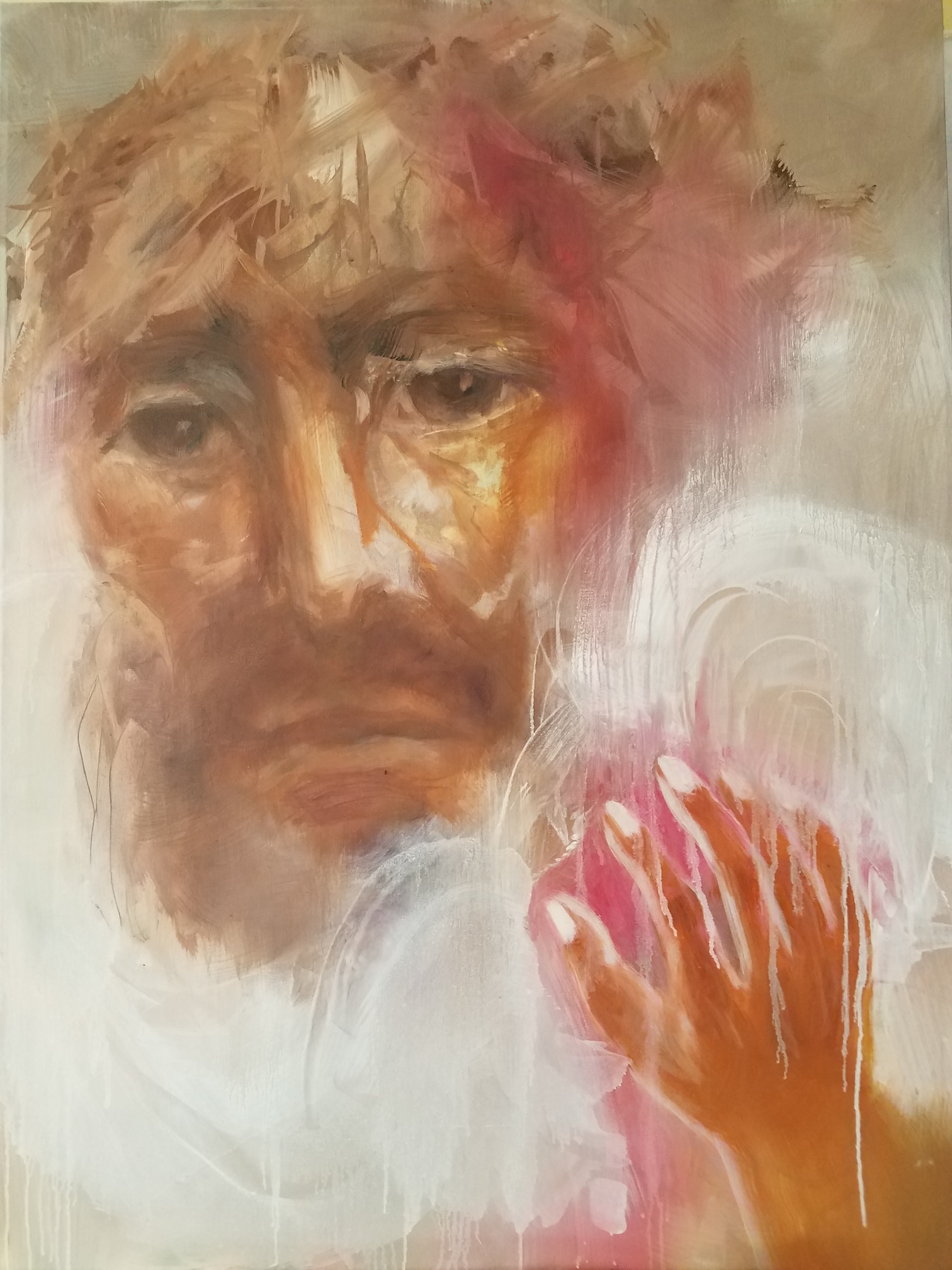
The painting above of Veronica wiping the face of Jesus was done recently by Duk Soon Fwang, an artist whom I have always admired. I asked her the other day what inspired her to paint it.
She told me she liked Veronica, the woman who shoved her way through the crowd, braved the Roman soldiers, took off her head covering and gave it to Jesus to wipe his face, on the way to his death. What courage she had!
Duk Soon wanted to capture the moment when Jesus responded as her hand reached out to him. Some picture his face imprinted on her veil, she said, but she wanted to see his face as he looked at Veronica.
It’s not important what Jesus looks like, Duk Soon continued, it’s what he did that counts, but she found she could not paint his face as a white man, as most western artists do. To her his face is the face of a hardworking Mexican immigrant.
She couldn’t paint his eyes, at first, but then she painted them. Jesus sees the woman who wiped his face. “I was in need and you reached out to me.”
Artists have their way of exploring the mysteries of God.
I’m interested in the gospel accounts of the Passion of Jesus. How did they come about? Some want to see them only as factual accounts of what happened then. Indeed, this isn’t a made up story; Jesus was crucified under Pontius Pilate.
But the story of Veronica, though it didn’t make it into the gospels, is a reminder there were other influences behind the gospels. There were eyewitnesses to the Passion of Jesus; scribes who wrote their stories, apologists who made a point from it, thinkers who saw God’s great designs in it. There were also mystics, artists and ordinary people who saw the human story in the story of Jesus.
The rich man in St. Luke’s parable today is so absorbed in himself and his “good” life that he sees nothing else, not the poor man at his door nor his own inevitable death. The scriptures, like Psalm 49, often point to the same blindness: “In his riches, man lacks wisdom; he is like the beasts that are destroyed.”
The warning is not just for the rich, however. The same psalm calls for “people both high and low, rich and poor alike” to listen. A small store of talents and gifts can be just as absorbing and make us just as shortsighted as a great store of riches. Whether we have much or little, we have to see the poor at our gate.
We also have to see a life beyond this one as our destiny and what we do and how we live here will count there. There will be a judgment.
But Jesus‘ parable offers another reminder. God has given us a sign in his resurrection from the dead that we have been called to share in his risen life. A great gift has been given, greater than anything we have here. Yet as the sign of Jonah indicates, some will not believe the sign Jesus Christ, risen from the dead, gives to us.
“We” are going up to Jerusalem, Jesus tells his disciples in Matthew’s gospel today and they follow him. They’re weak and human, but together they’ll be renewed by God’s grace.
We’re on our way to Jerusalem too. I may think that Lent is a personal journey I make for 40 days to be renewed in faith, but it’s more than that. Lent is a time we’re renewed by God together.
The disciples were far from perfect on the journey described in the gospel. Look how weak they are in the story told today. The mother of James and John wanted to get her two sons a good place in the kingdom Jesus promised. “Command that these two sons of mine sit, one at your right and the other at your left, in your kingdom.” She’s looking for power and prestige for her sons and for herself.
Jesus reminds her that his followers are not to be served, but to serve. Serving others won’t make them rich; it will cost them, for “the Son of Man did not come to be served but to serve and to give his life as a ransom for many.”
The other disciples are indignant when they hear about the mother’s request, but she wont be the last to look for human gain in the gospel. A lot of people think following Jesus brings success. That’s why Jesus’ words are so important to hear during Lent. Faith doesn’t bring power and success. Following Jesus is about serving others. Serving others is a good part of the cross we bear.

 The Victor's Place