Category Archives: Religion

Jesus Abandoned

In the gospels for Monday to Thursday in Holy Week Jesus is not with the crowds in the temple area, sometimes hostile, sometimes friendly. He is with “his own” at a meal.  In Bethany six days before Passover he eats with those he loved: Martha, Mary and Lazarus, whom he raised from the dead. In Jerusalem before he dies he eats with the twelve who followed him. “His own.”

During the meal in Bethany, Mary anoints his feet with precious oil in a beautiful outpouring of her love. At the meal in Jerusalem, on Thursday, he meets betrayal. The gospel readings for Tuesday and Wednesday offer a harsh picture. Judas betrays him for thirty pieces of silver and goes out into the night; Peter will deny him three times; the others flee. Jesus faces suffering and death alone. Friends that followed him abandon him.

The gospels are not just about long ago; they’re also about now. We are “his own” to whom he gives his life on a cross, in the waters of baptism and in the Bread at the table.  Are we unlike the others?  Are we sure we will not go away?

We think saints exaggerate when they say they are great sinners and question themselves, but they know the truth. That’s the way St. Paul of the Cross described himself in his account of his forty day retreat as a young man:

“I rejoiced that our great God should wish to use so great a sinner, and on the other hand, I knew not where to cast myself, knowing myself so wretched. Enough! I know I shall tell my beloved Jesus that all creatures shall sing of his mercies.”  (Letter 2)

Be my rock of refuge

a stronghold to give me safety.

For you are my rock and my fortress,

O God, rescue me from the hand of the wicked.  Ps 71

LET’S CELEBRATE HOLY WEEK

APRIL 15  Monday of Holy Week

Is 42:1-7/Jn 12:1-11 (257) Pss II

16 Tuesday of Holy Week

Is 49:1-6/Jn 13:21-33, 36-38 (258)

17 Wednesday of Holy Week

Is 50:4-9a/Mt 26:14-25 (259)

18 Thursday of Holy Week (Holy Thursday)

Chrism Mass: Is 61:1-3a, 6a, 8b-9/Rv 1:5-8/Lk 4:16-21 (260)

Evening Mass of the Lord’s Supper: Ex 12:1-8, 11-14/1 Cor 11:23-26/Jn 13:1-15 (39) Pss Prop

19 Friday of the Passion of the Lord (Good Friday)

Is 52:13—53:12/Heb 4:14-16; 5:7-9/Jn 18:1—19:42 (40) Pss Prop

20  Holy Saturday

Vigil: Gn 1:1—2:2 or 1:1, 26-31a/Gn 22:1-18 or 22:1-2, 9a, 10-13, 15-18/

Ex 14:15—15:1/Is 54:5-14/Is 55:1-11/Bar 3:9-15, 32—4:4/Ez 36:16-17a, 18-28/ Rom 6:3-11/Lk 24:1-12 (41)

21 EASTER SUNDAY OF THE RESURRECTION OF THE LORD

Solemnity

Acts 10:34a, 37-43/Col 3:1-4 or 1 Cor 5:6b-8/Jn 20:1-9 (42) or Lk 24:1-12 (41) or, at an afternoon or evening Mass, Lk 24:13-35 (46) Pss Prop

Most of us are home, no place to go. Why not celebrate Holy Week? There are no church services, but we have the church readings each day. How about celebrating Holy Week looking at them? .

The gospel readings for Holy Week are mostly from the Gospel of John, the gospel least like Mel Gibson’s movie “The Passion of the Christ.” We may want to know exactly what happened to Jesus on the days of Holy Week, but the evangelists, who knew the basic facts, wanted to know more. What was behind it all? Why did Jesus, the Son of God, suffer and die. They turned to the Jewish scriptures, the Old Testament, because that was how Jesus explained what happened after he rose from the dead.

On Monday we’re in Bethany. where Martha, Mary and Lazarus who was raised from the dead.

Tuesday and Wednesday, his betrayal by Judas is recalled but, as our readings indicate, all his disciples abandon him. 

On Thursday, Jesus brings his disciples to the table and as a servant washes their feet. We continue reading from this part of John’s Gospel, which explores the mystery of our union with Jesus Christ, throughout the Easter season.  Our second reading from Paul’s First Letter to the Corinthians, recalls that on this night he was betrayed, Jesus took bread and wine and gave them to his disciples as his body and blood. The Eucharist is an enduring gift by which Jesus remains with his church.

The Good Friday readings from Isaiah tell of the Suffering Servant who gives his life for others, and Psalm 22 which recalls his suffering. Jesus is our High Priest in Jesus who always intercedes for us, the Epistle to the Hebrews says. The Gospel of John sees Jesus as a King who conquers as he suffers and dies. For a commentary on the Passion Narrative of John by Fr. Donald Senior, see here.

On Holy Saturday evening parts of the scripture are read, from Genesis on, that speak of Jesus and his mission to save us. On Easter the various gospels, beginning with John announce his resurrection. He has risen! And the waters of baptism are honored as a sign that we shall rise too.

Palm Sunday: A Triumphal Journey

Jesus was troubled as he entered Jerusalem on Palm Sunday, the gospels say. And why not? The fear he felt so intensely in the garden was already seeping into his soul. 

He disturbed Jerusalem’s religious establishment by his words and actions; they noticed the people flocking to him and worried it would threaten the delicate balance they negotiated with the Romans who occupied their land. He had just raised Lazarus to life; his popularity was growing–one more reason for stopping him.

Entering the city, Jesus could see patrols of Roman soldiers brought in to keep peace during the Passover feast; he knew how harshly the Romans treated those who threatened their peace.

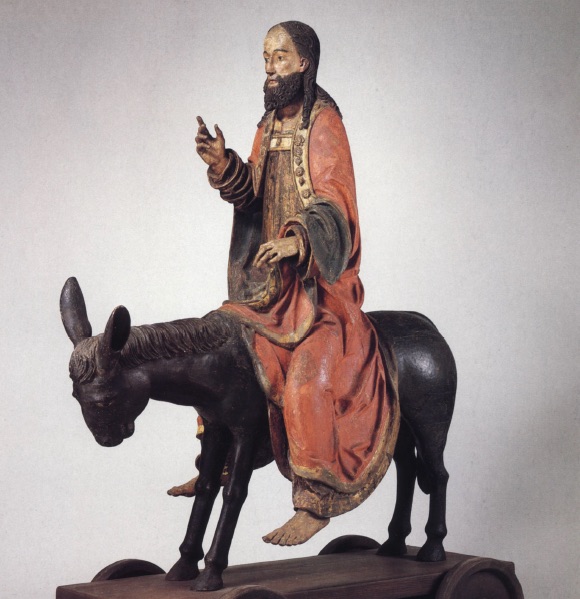
Yet, as he entered the city’s gates, crowds of people, ordinary people, greeted him with shouts of joy: “Hosanna, blessed is he who comes in the name of the Lord.” They scattered palm branches before him as he rode in on a donkey, carrying their hopes that God’s kingdom was coming.

Holy Week begins with this triumphal procession and it will take us into days of suffering and sorrow, when Jesus will be arrested, judged unjustly, scourged and beaten, made to carry a cross, and then die on a hill outside the city gates. 

But the journey will go on. Those who welcomed him on Palm Sunday were right. Death will not claim him. Rising from the dead, Jesus promises life to the world.

Speaking the Truth

Our previous lenten gospels record Jesus’ words during the Feast of Tabernacles in the temple area. It was hardly a public square, an open space where you could say anything; certainly not the freer space of Galilee or other places where Jesus taught and did great works. 

The temple area was under the tight control of the authorities and his audience was often hostile. At times, they cry out to arrest him and they pick up stones to kill him. 

Yet, Jesus will not be silenced. “Amen, amen, I say to you, before Abraham came to be, I AM,” he says to them. He proclaims fearlessly his divine status:  “I am always there.” Jn 8, 51-59

Are we fearless enough to tell his story, to repeat his message, to proclaim him everywhere, even where he and his works are rejected? “I know him,” Jesus says about his Father, “and if I should say that I do not know him, I would be like you a liar. But I do know him and I keep his word.”

The world today, especially our western world, can be hostile to Jesus Christ. Are we brave enough to witness where his name is ridiculed or ignored?

Lord Jesus,

you speak the truth,

even when others rejected your word.

Make me your zealous witness,

never fearful to speak your name 

and help me live according to your teaching. 

Lazarus Raised from the Dead

Lent 1


Readings (Please read further for Spanish and Swahili versions)

The wonderful story of the death and resurrection of Lazarus (John 11,1-45) leads us to the mystery of Jesus’ death and resurrection. Lazarus belongs to an influential family that welcomed Jesus to their home in Bethany, a village about two miles from Jerusalem. Martha and Mary were his sisters. Jesus stayed with them when he visited the Holy City.

When Lazarus died some days before the Passover, Jesus had left Jerusalem because of threats to his life and was staying in the safety of the Transjordan, the region where John the Baptist had baptized. Notified of his friend’s death, Jesus returned to Bethany, unconcerned for himself.
Death in its many forms was what Jesus came to take away, our gospel wants us to understand, and the dead Lazarus was a sign of what he wishes to do for all humanity. Lazarus was his friend, but Jesus, the Word made flesh, befriends the whole human race.

In the stirring conclusion of today’s gospel, Jesus calls the dead Lazarus from the tomb and “the dead man came out,” bound with the burial cloths that claimed him for death. “Untie him and let him go,” Jesus says. Those powerful, hopeful words are said to us too. We are called, not to die, but to live.

Later, on Calvary Jesus himself becomes our sign. A painful death does not claim him, nor will the grave hold him. He is our hope.

Spanish

The same hope nourished Paul of the Cross: “ You ask me how I’m doing. I’m more sick than well and full of ailments. I can hardly write this…(but) I find it very good. Bearing the chains, the ropes, the blows, the scourges, the wounds, the thorns, the cross and death of my Savior, I fly to the bosom of the Father, where the gentle Jesus always is, and I allow myself to be lost in his immense Divinity.” (Letter 1925)
Like Martha, the sister of Lazarus, O Lord,
I believe you are the Resurrection and the Life.

5to domingo de Cuaresma, Año A
Juan 11, 1-45

El maravilloso relato de la muerte y resurrección de Lázaro nos ayuda a apreciar el misterio de la muerte y resurrección de Jesús, Lázaro pertenecía a una familia con influencia que le dió la bienvenida a Jesús a su hogar en Betanía, una aldea a unas dos millas de Jerusalén. Marta y María eran sus hermanas. Jesús se quedó con ellos cuando él visitó la Ciudad Sagrada.

Cuando Lázaro murió algunos días antes de la Pascua, Jesús había dejado a Jerusalén debido a las amenazas contra su vida, y estaba aguardándose en la seguridad del Transjordán, la región donde Juan el Bautista había bautizado. Notificado de la muerte de su amigo, Jesús retornó a Betanía, despreocupado por sí mismo.

Nuestro Evangelio quiere que nosotros comprendamos que la muerte en sus muchas formas era lo que Jesús vino a remover, y que el Lázaro muerto era un signo de lo que Él quiere hacer por toda la humanidad. Lázaro era su amigo, pero Jesús, el Verbo hecho carne, es amigo de toda la raza humana.

En la conmovedora conclusión del evangelio de hoy, Jesús llama al difunto Lázaro de la tumba y “el muerto salió” atado con las vendas funerales que lo habían atrapado en la muerte. ” Desátenlo y déjenlo ir,” Jesús dice. Esas poderosas palabras, llenas de esperanza, son dichas para nosotros también. Somos llamados, no a la muerte sino a la vida.

Después en el Calvario Jesús mismo se convierte en un signo para nosotros. Esa muerte dolorosa no lo reclama, ni tampoco la tumba lo aguantará. Él es nuestra esperanza.

La misma esperanza sustentó a San Pablo de la Cruz: “Tú me preguntas como me va. Estoy más enfermo que bién y lleno de dolencias. Casi ni puedo escribir esto…[pero] encuentro esto algo muy bueno. Soportando las cadenas, las ataduras, los golpes, los latigazos, las heridas, las espinas, la cruz y muerte de mi Salvador, yo vuelo hacia el regazo del Padre, donde el dulce Jesús siempre está, y me dejo perder en su inmensa Divinidad.”

Lent

Como Marta la hermana de Lázaro, O Señor, yo creo que tú eres la Resurrección y la Vida.
Amén

Padre Evans Fwamba Cp

Jumapili ya tano ya kwaresima Yohana 11:1-45
Hadithi nzuri sana kuhusu kifo na kufufuliwa kwa Lazaro inatuonyasha fumbo la kifo na ufufuko wa Yesu Kristu. Lazaro alikuwa katika familia maarufu na ya ushawishi mkubwa sana. Walimkaribisha Yesu nyumbani kwao kule Bethania, kijiji kilicho kuwa umbali wa maili mbili kutoka Yerusalem. Marita Na Maria walikuwa dada zake Lazaro. Yesu alibaki nao alipotembea mji mtakatifu.
Lazaro alipokufa siku chache kabla ya karamu ya mwisho, Yesu aliondoka Yerusalem kwa sababu ya vitisho viliyotishia maisha yake. Alibaki kwenye sehem ya amani Transjordan, eneo ambalo Yohana mbatizaji alimbatiza yesu. Baada ya kupata taarifu ya kifo cha rafiki yake, Yesu alirudi Bethania, bila kujali usalama wake.
Yesu alikuja kuondoa aina zote za kifo, injili inataka tuelewe kifo cha Lazaro ni alama ambayo Yesu alifanya kwa ajili ya wanadamu wote. Lazaro alikuwa rafiki wa Yesu aliyetwaa ubinadamu wetu. Amekuwa rafiki wa wanadamu wote.
Kwa ujumla katika injili ya leo, Yesu anamuita Lazaro aliyekufa kutoka kaburini na “mtu akatoka nje,” akiwa amefungwa sanda za kuzikwa zizoanyesha alikuwa mfu.. “Mfungue na mueche aende” Yesu alisema. Haya maneno yenye nguvu, matumaini yanasikika kwetu pia. Tumeitwa ili tuishi na siyo kufa.
Badae katika mlima wa kalvari Yesu mwenyewe alikuwa alama. Kifo na maumivu hakimtangazi Yesu wala kaburi halitamsuia Yesu, ni matumaini yetu.
Kwa hayo matumaini yalimuimarisha Mt. Paulo wa Msalaba.
“Unaniuuliza ninaendeleaje. Niko mgonjwa kuliko mwenye afya, nimejaa na maradhi. Ni vigumu kuandika haya… lakini naona vizuri kubeba pingu, kamba, ngumi, mijeledi, vidonda, miiba, msalaba na kifo cha mkombozi wangu, nakimbia kwenye kifua cha baba, kwenye undani wa kimungu.
Kama Marita dadake Lazaro.
Ee bwana,ninaamini ufufuko na uzima.” Barua1925, November 26, 1770
The Man Born Blind

Lent 1


The story of the blind man receiving his sight (John 9,1-41) is a dramatic gospel, not only because of the miracle, but because of the heated exchanges found in it. Jesus and his disciples, the blind man himself, his parents and neighbors and a divided group of Pharisees all interact vigorously in the story. It’s one of the most important of the gospels to be read during lent.

Unlike others, the blind man did not approach Jesus. Rather, Jesus approached him. And remarkably, the miracle did not just restore the man’s sight. Blind from birth, he never before had the power to see. Could he represent those who can do nothing for themselves? Nothing at all, except wait for the power of God? He could be all of us.

At the sight of the woebegone beggar, Jesus’ disciples wondered: did he do something to deserve it? Some sin he or his parents had committed? No, Jesus replied. “He was born blind so that God’s power might be displayed in curing him.”

It was Jesus’ message always: God wills to display his power in the poor. God’s power — healing, restoring, creating — goes out to the blind man and others like him. And as Jesus dispensed this power, so too he told his disciples “to carry on while daylight lasts the work of him who sent me.”
God’s power, not our own, is given to the poor. As Jesus’ disciples, we must work to share it with others. Then, perhaps, some of its blessing will fall on us. After all, aren’t we poor too?

“Humbly see your nothingness, never lose sight of it. Then, when His Divine Majesty makes it disappear in the Infinite All that is himself, stay there lost without seeing who you are any more. It’s not important. Follow his divine inspirations. The less you understand, the more ignorant you are in this school, the more learned you become. Neither you or any creature can know the grandeur of God and the divine impression he makes on humble hearts because he delights in them.” ( St. Paul of the Cross: Letter 929)

Lord,
I am blind;
Help me to see.


Lenten Images


        By Orlando Hernandez                                                                                                                  

    Every Lent, my wife and I watch the religious movie “The Shack”. This year I was especially drawn to a scene where the man is weeping bitterly over his unspeakable tragedy. Sarayu (“a Wind that goes where It wills”), a female representation of the Holy Spirit, takes this beautiful “tear flask” and carefully puts it to his face. She says, “This is one thing I do, I collect your tears.” She sure does this! And I venture to say, quite often she is the One that inspires them. Lately folks have been telling me how their greatest prayer moments are when they are driven to tears. 


    Later in the film, Sarayu (the Spirit) sprinkles those tears upon the ground and a beautiful tree, symbolic of love, forgiveness, life and joy, grows miraculously. I am reminded of psalm 126. This psalm, which was read on the 5th Sunday of Lent says:
 When the Lord brought back the captives of Zion, we were like men dreaming.
 Then our mouths were filled with laughter, and our tongue with rejoicing.
 Then they said among the nations, “The Lord has done great things for them.”
 The Lord has done great things for us; we’re glad indeed.
 …..Those that sow in tears shall reap rejoicing.
  Although they go forth weeping, carrying the seeds to be sown,
   they shall come back rejoicing, carrying their sheaves. 


    On April 6, Fr. Rogie Castellano, CP spoke to our group about the “paradox of the Cross”, how strength can be found in weakness, how our God can bring joy and healing out of the greatest sorrow. Fr. Rogie courageously shared with us his own story, his own cross, which had just about everyone in the place shedding tears. To really “finish us off” he played a short video of a Catholic wedding ceremony taking place in a hospital. The lovely bride held the hand of her emaciated, dying groom, who, in his bed would drift in and out of consciousness. A Sacrament was taking place. The bridesmaids, the family, sang and cried and laughed. Children ran around and danced by themselves. The bride tenderly stroked the hair of her new husband. He opened his eyes and smiled at her and then looked straight into the camera. I knew in my very heart that his beautiful smile was the smile of our Beloved Jesus, filling us with His love, right there in that church hall. I walked out drying my face, feeling peace, and well, I don’t know what else. I was “like men dreaming.”


    It has felt like this all Lent, a jumble of emotions and attitudes, joy and sorrow, love and anger, guilt and peace, intense prayer and bone-dryness. The only thing that has held steady has been the obsession with what I used to call “my cross”, you know, the one I wrote about two weeks ago. I might have built this cross, but it is no longer mine. It belongs to the many people who have written their prayers all over it, on both sides. It belongs to the ones who have carried it in prayer, who have embraced it and kissed it. I am in awe of them. My wife Berta and I have stood in front of churches and chapels and invited people to write their prayers with the Sharpees that we would offer them. Some people have passed us right by, looking the other way. Others simply said “No”. But many were so enthusiastic to do this, so grateful.  


    A young man had walked into Mass to get the keys to his apartment from his uncle. He had not gone to Mass in years, but he asked us “Do you feel Him? Do you feel God? You must, if you are doing this. I went to Catholic school all the way to high school. I used to feel Him, but things happened to me in college, and now I don’t.”  He wrote at the very top of the cross, “Please God , help me find my way back to You.” 


    A fast-walking man passed me by. When I asked him if he wold like to write a prayer on the cross he said, “Naa, I don’t do that.” He started walking up the stairs and suddenly turned around and asked me, “Give me one of those pens.” After he finished writing his prayer he started telling me about how worried he was about his grandson who is being bullied in school. We spoke for a while. The story has stuck to my mind. There are so many others.
    A child wrote, “God bless America and every person in the whole world.” So many people wrote about their love and gratitude for God. Others wrote names of people in need. Many wrote about the need for peace and forgiveness. A group of priests, deacons, and ministers of faith formation wrote such beautiful things. I read these prayers and feel like going down on my knees before the beauty of God’s people. These prayers seem like signs of His Mystical Body on this rough, home-made cross. Wow! Does He love me! 


    We brought the cross for our small Wednesday evening prayer group ( 15 people). It was standing over us. It seemed that day everyone was feeling down for some reason. Most of them have demanding jobs. We started singing the songs in a way that made me think this was going to be a rather dreary prayer meeting. I really did not want to be there, just go home and forget about everyone and everything, even God. I closed my eyes and tried to ignore everyone and just look for God “within me”. Of course He was there. I opened my eyes and to my surprise just about everyone was standing up, moving their bodies and singing with joy. I remained sitting and closed my eyes again, but then I heard a man’s deep voice singing behind me. The thought came, “Jesus, is that You?” I turned around and it was actually Matthew, a young energetic member of our group, who had snuck in late. I started laughing, got up, and told him what had just happened to me. We laughed together and sang together with everyone. It turned out to be one of the finest prayer meetings we have had in a long time.  Sarayu not only collects tears. She revels in our joy. 


    We took a picture around the wooden cross where they too had written their prayers, and we looked like fun people at a party. How could we feel so good around this wooden symbol of suffering and death? We all know why. This is, more than anything, the symbol of God’s wonderful love for us. The next Sunday the same group carried this cross, and we prayed the Stations outside of the Passionist Monastery in Jamaica, Queens. They did not look so happy then. They were remembering His suffering. The intensity of their reverence was overwhelming to me. They love God so much! They are such a source of hope and faith in my life. I find myself asking , “How did my life turn into this incredible dream? Who are these people? Why are they in my life?  Who are You? Why do You love me so? Why am I on my knees before You? What is this mystery that I live in You?

Orlando Hernandez

Possession

by Orlando Hernandez


     This Lent I have been asking myself, “What is the essence of this life in Jesus that I seek and often eludes me?” In the second reading (Phil 3:8-14) for the 5th Sunday of Lent, St. Paul writes about his pursuit of holiness that leads to eternal life with Jesus. Paul acknowledges his lack of “righteousness of my own.” It is God’s gift of faith that gives him hope and strength to go on:


     “That which comes through faith in Christ, the righteousness from God, depending on faith to know Him and the power of His resurrection and the sharing of His sufferings by being conformed to His death, if somehow I may attain the resurrection from the dead. It is not that I have already taken hold of it or have already attained perfect maturity, but I continue my pursuit in hope that I may possess it, since I have indeed been taken possession of by Christ Jesus. Brothers and Sisters, I for my part do not consider myself  to have taken possession. Just one thing: forgetting what lies behind but straining forward to what lies ahead, I continue my pursuit toward the goal, the prize of God’s upward calling, in Christ Jesus.”


    This great saint was still “straining forward,” like all of us! In paragraph 7 of his Apostolic Exhortation “Gaudete et Exsultate” , Pope Francis writes:           “I like to contemplate the holiness present in the patience of God’s people: in those parents who raise their children with immense love, in those men and women who work hard to support their families, in the sick, in elderly religious who never lose their smile. In their daily perseverance I see the holiness of the Church militant. Very often it is a holiness found in our next-door neighbors, those who, living in our midsts, reflect God’s presence. We might call them ‘the middle class of holiness.’ Let us be spurred on by the signs of holiness that the Lord shows us through the humblest members of that people which shares also in Christ’s prophetic office, spreading abroad a living witness to Him, especially by means of a life of faith and charity.”


     Since I met her 9 years ago, I have always thought of Marie Claude Menuau,TOC, as one of those “saints next door”, an incredibly powerful example of what it means to live in God. Every time I would go to the eleven o’clock Mass at the Passionist Monastery in Jamaica, New York she was always there. She would have everything ready for the celebration of this public Mass. She would even help the priests with their vestments. As I would sit there, I would see her kneel before the Tabernacle after making sure there were enough Consecrated Hosts. She would do this with such reverence and devotion that I was truly touched.

I just knew that I was in the presence of someone especially close to God. Just by her quiet example she inspired me in those early days when I was re-discovering my faith. She would graciously let me do the readings for the Mass, when I asked, and whenever there was no-one else, she would also do this job, speaking in a clear, reverent manner, singing the psalms for us. She would even do the Holy Wash at home (the washing and ironing of the cloths used during Mass) every week.   

 Marie Claude was so totally focused on her ministry and her prayer before and after Mass that we never got a chance to talk. Even though I hardly knew her, when I went to the Holy Land in 2011, I found myself getting her a cross at one of the shops. She accepted it, quietly smiling, with such humble dignity.     About a year ago, she stopped coming to the eleven o’clock Mass most days. Other folks were taking over for her. I wasn’t sure, but did I see a look of pain in her face every time she came to do her job? Was she quietly carrying a very painful cross? She told my wife, Berta, that she could no longer do this job. My wife thought it had to do with the Holy Wash, but after this we never saw her again. A friend of hers told us she was very sick and went to a nursing home in Long Island, near her family. I missed her always at the eleven o’clock Mass, but life went on.

Why didn’t I get to know her better? I began to forget about her until the end of this March, when we found out that she had passed away. It seems so true, what the Bible says abut our being like chaff in the wind. We disappear from each other’s lives so quickly and completely. I have kept her all these weeks in my thoughts and prayers. I found myself daring to ask her for her intercession in Heaven, for I am sure she is a saint in God’s arms.      

I realize now that I was not the only one who had great admiration for this quiet woman of God. On April 5, a luminous Mass was celebrated in her name at Immaculate Conception Church, in Jamaica, Queens. Five priests that she had worked with were there. A large group of Lay Carmelites came to represent her, a beloved member of the order. Her fellow friends at the Legion of Mary  were there. A large number of lovely relatives were present to honor her and to participate in the Liturgy of the Word. But there were so many fellow parishioners at the service, who, like me, were drawn to the light of her memory.    

 Her niece spoke eloquently about her life. Marie Claude had been a teacher and school principal in her country of Haiti, and a librarian in New York City until she retired. She then dedicated her time to God, participating at her parish in so many ways, and bringing communion to home-bound folks and in nursing homes.   

 What a mystery each human being is. What a marvel, miracle. We are as “nothing”, like St. Paul of the Cross says, and yet, some of us are so possessed by Jesus that we cannot help but keep our eyes on that “goal, the prize of God’s upward calling, in Christ Jesus.” Some people, agents of God, help light the way for us. Thank you so much, Marie Claude Menuau. Please pray for us! 
Orlando Hernandez

The Story of Suzannah

The story of Suzanna from the Book of Daniel is one of our readings for Monday, the 5th week of Lent. It would made a great TV special.  You can’t listen to it without thinking of present efforts to stop violence against women and the problem of sexual abuse.

Her story is about, first of all,  an abuse of power. The two old men, judges with lots of power; think they can do anything they want. Abuse of power, combined with lust, is still behind so many of our sexual problems today. It’s found in the workplace, in politics, in the celebrity and sports world, and also unfortunately in the world of religion. 

Suzannah refuses to give in to their advances and she finds a champion in Daniel who faces up to these powerful men. 

That’s the second thing to remember about this story. It’s important to stand up for the truth and to fight against abuses of power wherever we find them. Jesus gives us an example in the mystery of his passion. We have examples too in Suzannah and Daniel.