Category Archives: Religion

The Book of Judges

Most of this week the OT readings are from the Book of Judges, which recalls the time when the Israelites, after being led by Moses and then by Joshua,  take possession of the Land of Canaan, the Promised Land.  

It’s not vacant land. The Canaanites who lived there before still live there, strongly entrenched. Instead of establishing themselves according to the commands of God, the Israelites decide to fit in. They split into isolated households rather than living as a united people, They begin to intermarry with the Canaanites and even set up altars to Baal, the Canaanite god. 

This is a time of religious and political disorder. One of the worst times in Jewish history. On Thursday of this week we hear how Jephthah kills his own daughter because of a vow he made to God. Not an easy story to make any sense of. Hard to make sense of anything in this age.

God raises up leaders, judges, but they’re not powerful enough to give the community the direction it needs. 

Gideon– his story is told this week– is an example of the kind of leader the judges were. He’s a lonely farmer expecting an invasion by the Midianites, a tribe of nomads who periodically raided the land of Canaan. He’s busy trying to save some wheat from his fields before they come, and probably hide. 

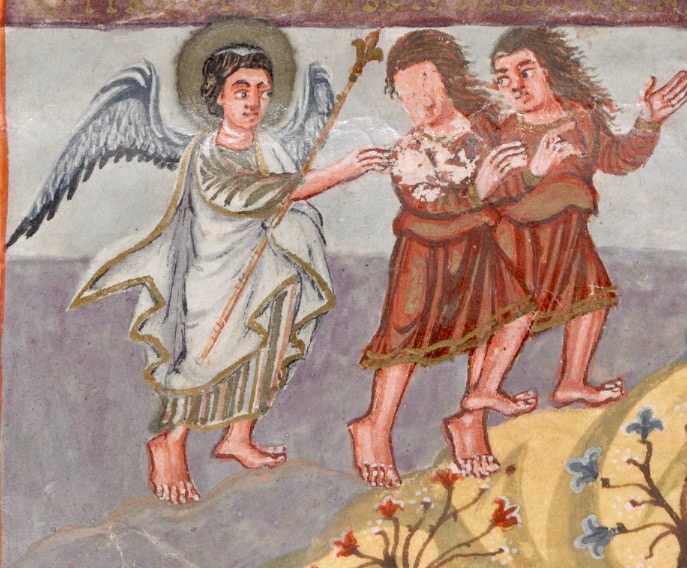
The angel of the Lord appears and calls him a “Champion of Israel,” but Gideon wants no part in championing Israel. He’s a man who’s lost faith in the promises of God. He has no big dreams or ambition to do anything except save himself. Even when God gives him a sign, one sign isn’t enough. Gideon wants no part in it.

“Go with the strength you have.”  That’s what the angel says to Gideon at a time when he and so many others have lost their trust in God’s promises. The strength you have, not the strength you would like to have, or the strength you once had. Go with the strength you have.

That was God’s command in the time of the Judges. Is it God’s command to us now?  
Readings for the 20th Week of the Year

AUGUST 19 Mon Weekday [Saint John Eudes, Priest]

Jgs 2:11-19/Mt 19:16-22 

20 Tue Saint Bernard, Abbot and Doctor of the Church

Memorial Jgs 6:11-24a/Mt 19:23-30 

21 Wed Saint Pius X, Pope Memorial

Jgs 9:6-15/Mt 20:1-16 

22 Thu The Queenship of the Blessed Virgin Mary

Memorial Jgs 11:29-39a/Mt 22:1-14 (422)

23 Fri Weekday [Saint Rose of Lima, Virgin]

Ru 1:1, 3-6, 14b-16, 22/Mt 22:34-40 (423)

24 Sat Saint Bartholomew, Apostle Feast

Rv 21:9b-14/Jn 1:45-51 

25 SUN TWENTY-FIRST SUNDAY IN ORDINARY TIME

Is 66:18-21/Heb 12:5-7, 11-13/Lk 13:22-30 (123) Pss I

20th Sunday C: The Religious Voice

For this week’s homily please play the video below:

Otter Cliffs

Acadia National Park, Mount Desert Island, Maine


Family of three

You, our baby, and me.

She’s not so small

Not after all.

She takes the lead

Going up first.

A graceful Kelly

An onlooker calls.

No more artificial walls!

Long strong fingers

Stretched out wide.

Smacking below

An unforgiving tide.

Tourists blot the opposing coast

As if a beach that could be combed.

The gull rides the thermal grove

And our little one ascends.

To be lowered

And begin again.


—Howard Hain

August, 16, 2019

What is Goodness?

8/11/19     Maine Woods / Rome / Belgrade / Great Pond / 6am

Being clean. Being alone. The need to be clean. To need to be alone.

It’s what’s missing or absent that is most noticeable. I used to. Used to do or think so many things. Now, No. I do think of her. No, not think, No. I see her. Mainly her face. Plain Jane.

She’s good. And God said so. What is Goodness?  What is that beauty that comes forth from Goodness? It’s not physical beauty yet it makes one so. Much so. Attractive. Deeply attractive. Richly. Fundamentally attractive. Fundamentally is an ugly word. As is core, and basic. Goodness is not an inner entity. It’s not a treasure within a chest. It’s not a heart within a cavity. Not a potion within a vessel. Goodness is not a power that overcomes its barrier. Not a filament shining through a bulb. Not a fragrance permeating a crystal. It doesn’t overcome its hiddenness. It’s as much going in as it is coming out.  And yet in truth it doesn’t go or come into or anywhere. It’s bigger but not in size. It’s an action within a state. A state within an action. Neither. Therefore. To write about Goodness is silly. To capitalize the word is trite. To name the concept is petty. To claim it exists is to misunderstand it contains any place for one to be beneath. It’s when and where and how and why she smiles. It is who smiles.

—Howard Hain

19th Sunday of the Year C: Abraham


For this week’s homily please play the video below.

Readings for the 18th Week of the Year

5 Mon Weekday

[The Dedication of the Basilica of Saint Mary Major]

Nm 11:4b-15/Mt 14:13-21 

6 Tue The Transfiguration of the Lord Feast

Dn 7:9-10, 13-14/2 Pt 1:16-19/Lk 9:28b-36 

7 Wed Weekday

[Saint Sixtus II, Pope, and Companions, Martyrs; Saint Cajetan, Priest]

Nm 13:1-2, 25—14:1, 26-29a, 34-35/Mt 15:21-28 

8 Thu Saint Dominic, Priest Memorial

Nm 20:1-13/Mt 16:13-23 

9 Fri Weekday

[Saint Teresa Benedicta of the Cross, Virgin and Martyr]

Dt 4:32-40/Mt 16:24-28 

10 Sat Saint Lawrence, Deacon and Martyr Feast

2 Cor 9:6-10/Jn 12:24-26 

11 SUN NINETEENTH SUNDAY IN ORDINARY TIME

Wis 18:6-9/Heb 11:1-2, 8-19 or 11:1-2, 8-12/Lk 12:32-48 or 12:35-40

Feast days, as the Old Testament readings last week reminded us, are our teachers. We begin this week with the Dedication of the Basilica of St. Mary Major in Rome, and important church built to honor Mary for her  role in the disputes over the nature of Jesus in the 4th century. Mary is the witness that Jesus is human and divine.

Interesting saints all this week. I’ll comment on them as we go along.

18th Sunday of the Year c: A Journey of Mercy

For this week’s homily please play the video below.

A Garden is Our Second Home

A Garden was our first home, but the human family was banished from that garden, Genesis says. Yet the ancient story offers hope in God’s call through the Jews, first of all. Then, Christianity further proclaims God’s promise of life, through Jesus Christ, God’s Son..

The psalms constantly recall the promise of God in the imagery of Genesis. Psalm I is an example:

The just are like “a tree

planted near streams of water, 

that yields its fruit in season; 

Its leaves never wither;

whatever they do prospers.” (Psalm 1) 

“The just shall flourish like the palm tree.

They shall grow like a cedar of Lebanon.

planted in the house of the LORD,

they shall flourish in the courts of our God.” 

The temple in Jerusalem continued to recall the Garden of the Lord, according to Psalm 80 and the Prophet Ezekiel. (Ez. 48)

As God banishes the human family from the first garden, God also makes a promise in the Book of Genesis itself: 

“I will put enmity between you and the woman,

and between your offspring and hers;

They will strike at your head,

while you strike at their heel.” (Genesis 3,15)

More than just a declaration of  enmity between the human family and the devil, or hostility of humanity towards snakes, Christianity saw the promise of Jesus Christ in these words. He blesses the human family and all creation again.

Jesus rose from the dead in a garden; the Cross he died on was a tree of life. Mary, his mother, is the new Eve, “mother of all the living.” In Christian tradition, she’s often represented crushing the serpent beneath her feet. 

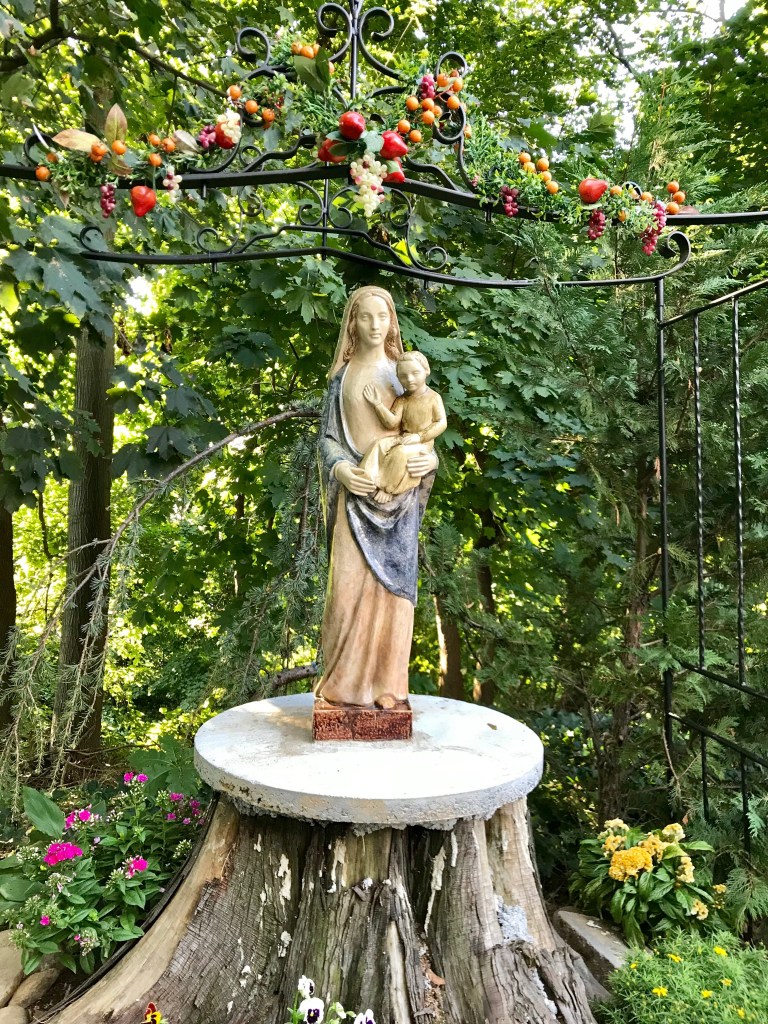
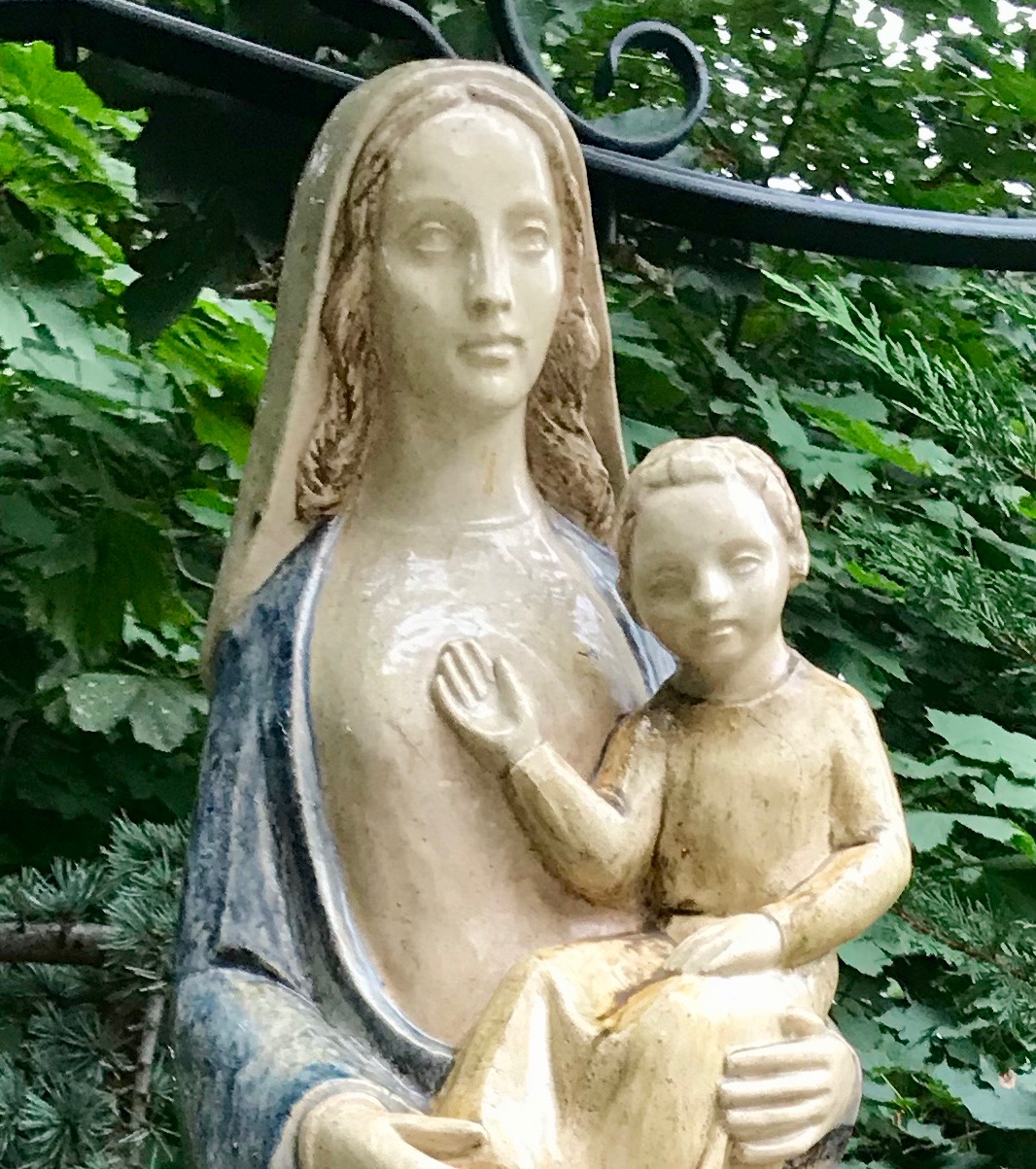
Our Mary Garden expresses this Christian vision. Mary holds her Son, who looks out on the garden as a place of promise, under the sky, through the seasons of summer, winter, spring and fall. 

Millions of years ago, volcanic rock thrust up from the underland; a glacier brought rocks here from far to the north thousands of years ago. Flowers bloom for a season, trees and plants weather the days and the nights. 

And the human family comes to this garden to remember what God has done and to pray.  

At the name of Jesus every knee must bend, in the heavens, on earth and under the earth, and every tongue profess to the glory of God the Father–Jesus Christ is Lord!

Hail Mary, full of grace, the Lord is with you. Blessed are you among women, and blessed is the fruit of your womb, Jesus.

Holy Mary, Mother of God, pray for us sinners, now and at the hour of our death Amen.

Mary in Our Garden

Mary stands in our garden holding her Son. Do we make too much of her?

We call Mary Mother of God in our prayers and creeds.  “Hail Mary, full of grace, the Lord is with you…Holy Mary, Mother of God, pray for us sinners, now and at the hour of our death.” She is “our life, our sweetness and our hope.”

We honor Mary because her role in the life and mission of Jesus Christ is beyond any other creature’s. We pray to her that “we may be made worthy of the promises of Christ.” She leads us to him.

Mary, Witness to his Life, Death and Resurrection

Mary witnessed the life, death and resurrection of Jesus. She knew him, like Peter and the other disciples, but she knew him in a unique way.  How do we know of Jesus’ birth and early life unless from her? She stood by the cross of her Son on Calvary. “She kept all these things in her heart and pondered over them,” St. Luke says. She was among the witnesses of his resurrection who gathered after he rose from the dead, the same evangelist states. Her memories of Jesus surely have a special place in the gospels.

Mary knew Jesus in a unique way. She knew him as his mother; he was subject to her as her son. When he began his public ministry and called disciples, she remained in Nazareth– although John’s gospel says she had a key role in his first miracle at Cana in Galilee, when he changed water into wine. As Jesus drew followers and performed great deeds, she was in Nazareth, living among those who mostly rejected him. 

Mary was especially involved in two periods of Jesus’ life: his birth and early life at Nazareth, and his death on the cross and resurrection. Both periods belong mostly to his hidden life when his power was concealed. The Word of God humbled himself, taking the form of a slave, St. Paul says, hidden except from those with eyes of faith. Mary knew him by faith, and she guides those who walk by faith to know her Son. 

Mary’s Mission in the Church

Mary has a special place in the communion of saints, who from their place in heaven, “guide us still.” When doubts and confusion occurred in the early church about the identity of Jesus, Mary was called on to give witness, and she spoke through the Spirit that Jesus, her Son, was both human and divine. By the 5th century, churches and feasts honoring Mary, the Mother of God, appeared throughout the Christian world. 

Through the centuries Christians called on her to be their companion and guide in prayer and in faith. They recognized the graces she received and her place among the blessed. She was conceived without sin and assumed body and soul into heaven. She reveals the sublime destiny awaiting us, “poor banished children of Eve.” 

Mary, the new Eve, “mother of all the living”, has a special role when her children’s faith is threatened. Her appearances in recent times of unbelief to children and ordinary individuals at Fatima and Lourdes raised their hopes, and those of the church, in the promises of Christ.

What about today? We seem to be entering an age when, in face of climate change, not only faith is God is questioned, but also faith in science and in the earth itself is shaken.

In the 14th century, when the Black Death took countless lives in Europe, Christians turned to Mary. They prayed the rosary. They planted Mary Gardens, reminders of Eden, where God blessed the first human family with blessings. Mary had a special role in renewing their faith in a God of Life.

Read again the Book of Genesis and other promises of faith, Pope Francis said in his Encyclical Laudatò Si, about climate change and the care of the earth.  Mary is the woman of faith, who holds in her arms the God of Life.

She belongs in our garden.