Category Archives: Religion

Major and Minor Saints

Who doesn’t know saints like Francis, the apostles Peter and Paul, and of course Mary, the mother of Jesus? The major saints. But what about the others, most unknown to us, even many we’ve lived with? What about them, the minor saints?

The Calendar today for October 9th lists St. John Leonard,  St. Denis and Companions, who lived many centuries ago. They’re remembered in Italy and France, respectively, but they’re not well known to us. The reason they’re in the Calendar, besides their appeal to a nation or region, is they’re minor saints. Minor saints are part of the saintly communion; a necessary part.

I think we buried one here today.

We buried Father Theodore Walsh, CP, a classmate of mine. I preached at his funeral.

“I sat next to Theodore Walsh for meals and prayers for 8 years in student life. For 8 years when a baked potato came around for a meal, I took the skins from him and he took the insides from me. For 8 years we played basketball together on half days. He was a wonderful athlete, great to have on your side, but watch out when he played against you. He had a quickness you wouldn’t suspect. One minute you had the ball, the next you didn’t. I learned never to underestimate him. He was a quiet, humble man, and he could be underestimated.

After ordination Theodore volunteered to go to the Philippines as a missionary. A big move for someone just ordained. Not only that, but Theodore became the first novice master for our community in the Philippines. It wasn’t easy setting up that novitiate. The housing arrangements were extremely poor. Two young Filipinos finally applied, but when the Provincial from the States came over on visitation he didn’t like the situation, not professional enough, he said, and he told Theodore to send the boys home and close the place.

Father Theodore Foley, the Passionist general came through a short time later and told Theodore to get those boys back and open the place again. The young men became the first Filipino Passionists, Fr. Gabriel and Fr. Nonito. 

Theodore really believed in our community and the Passionist vocation. We saw his love for vocations in these last few years here in Jamaica when he would hobble out on his walker at the 10 AM Mass and after Communion ask a family in the congregation to take home a vocational crucifix and pray for vocations the next week.  Vocations were important for him.

Preaching was important too. He was a very good preacher. For many years, after returning from the Philippines, he and Fr. Kenan preached missions and retreats together in this area in the spring and fall and Florida in the winter, where they would go from parish to parish.

 I went with him on a number of parish missions. I thought he was a great preacher; his preaching was simple, homey, deliberate, sincere, no notes, excellent material. He was an excellent missionary. 

As his health declined he loved being able to preach at the 11 o’clock Mass in the public chapel in Jamaica and to stay on to talk to people and give them his blessing. He heard confessions here every week. 

He began writing homilies for the Province website, and gradually, when he couldn’t preach at Mass,  he read the scriptures during Mass in that deliberate way of his that made every word count.  

Theodore was a contemplative, someone who could spend hours in his own room reflecting and praying. The perfect vacation for him during the summer was to go to Shelter Island and sit on the shore looking out on the water, then take a swim. 

It wasn’t that he neglected people, though.  He loved his family, his sister Maureen, and his deceased brother John’s children and grandchildren. He was on the phone with them all the time. He visited with them as often as he could. Unfortunately, as for so many others, the Covid 19 epidemic prevented them from visiting him in his last illness and attending his funeral.

He loved the Passionist community, the people in it, the things it did. Usually, the first thing he said to me when we met was “What’s going on?” He wanted to know what was happening, how people were doing. “Is there anything new on the bulletin board?” he would ask as he got weaker. He wanted the community to flourish here and in the world. 

I guess I could say about Father Theodore what our wise classmate, Fr. Paul Cusack said about him awhile ago:  “He was the holiest of us all.” 

Now we won’t see Theodore here in the chapel, at meals, in his room on the 2nd floor any more.  Death is a time of closure. Some say death is a complete closure. He’s gone, all that’s left are memories of him, and they will die soon enough.

But that’s not true. For Christians, death is not the end. Life is changed, not ended. We don’t see it with our eyes or hear it with our ears. But there’s life ahead. We believe what Jesus says in the gospel. There are dwelling places prepared for us and he’ll lead us to them. There’s a dwelling place for Theodore Walsh, and Jesus is leading him there. 

Life is changed, not ended. Let’s not forget that that changed life is still connected to this one. The dwelling places Jesus promises are not gated communities separating us from the world where we were born. 

There’s a communion of saints. Saints who care for us. Saints who cared for our world when they were here and care for it now,  saints who were zealous for spreading the gospel in their lifetime and still are zealous for spreading the gospel now. Saints who lived with us, and still do.

There’s a communion of saints. Those who leave us don’t turn away from us. They don’t leave us orphans. They keep us in mind. Theodore Walsh will still be asking “What’s going on.?”

I think this is important to remember today when so many in our world think we are all alone, on a lonely planet, with dwindling hopes. 

But we know, our our scriptures today remind us, that from the mountains, those who see directly, before their eyes, the Lord restoring Zion, bring us comfort. From the places prepared for them, those who go before us guide us still. 

We are not alone. There’s a communion of saints. Great saints whom we never knew, but also saints who were our companions in life and are our companions still. 

Saints of God, pray for us.
 

Fratelli Tutti

On the vigil of the Feast of St. Francis, October 3, Pope Francis traveled to Assisi, where St. Francis is buried, to issue a social encyclical, “Fratelli Tutti” inspired by the same saint who inspired him to write Laudato sí, his letter on the environment. 

The pope hopes,  “in the face of present-day attempts to eliminate or ignore others, we may prove capable of responding with a new vision of fraternity and social friendship that will not remain at the level of words. Although I have written it from the Christian convictions that inspire and sustain me, I have sought to make this reflection an invitation to dialogue among all people of good will.

7. As I was writing this letter, the Covid-19 pandemic unexpectedly erupted, exposing our false securities. Aside from the different ways that various countries responded to the crisis, their inability to work together became quite evident. For all our hyper-connectivity, we witnessed a fragmentation that made it more difficult to resolve problems that affect us all. Anyone who thinks that the only lesson to be learned was the need to improve what we were already doing, or to refine existing systems and regulations, is denying reality.

8. It is my desire that, in this our time, by acknowledging the dignity of each human person, we can contribute to the rebirth of a universal aspiration to fraternity. Fraternity between all men and women. “Here we have a splendid secret that shows us how to dream and to turn our life into a wonderful adventure. No one can face life in isolation… We need a community that supports and helps us, in which we can help one another to keep looking ahead. How important it is to dream together…

By ourselves, we risk seeing mirages, things that are not there. Dreams, on the other hand, are built together”.[6] Let us dream, then, as a single human family, as fellow travelers sharing the same flesh, as children of the same earth which is our common home, each of us bringing the richness of his or her beliefs and convictions, each of us with his or her own voice, brothers and sisters all.”

A community of “dreamers”, “fellow-travelers”, children of the same earth,” in which “we can help one another to keep looking ahead.”

Looks like he is continuing “Laudato sí”.

http://w2.vatican.va/content/vatican/en.html

27th Sunday Ordinary Time Cycle A

For this week’s homily please play the video below:

26th Sunday a: God Is Still With Us

For this week’s homily, please watch the video below.

How Do We Learn and Pray Now?

Education is up in the air these days. Our schools are struggling. How will kids be educated?

Our faith formation programs are struggling too. The Mass and sacraments–ordinary ways we pray–are drastically curtailed. What do we do?

Could our homes and families become our churches? Can we find teachers and  temporary sacraments there?

A friend of mine was in prison for awhile and ended up once in solitary confinement after a fight he had with another inmate. He told me he remembered in the dark what a nun had told him about the rosary. Ten Hail Mary’s and an Our Father. He started counting the prayers on his fingers and, after awhile, he found a great peace came over him, so much so that after getting out of confinement he asked the chaplain for a rosary. It led to a profound conversion. He was changed by the experience there in the dark.

We’re living in the dark these days, but do these days have to diminish us? Maybe we can learn to pray more simply these days. Simple prayers we may have abandoned, maybe there’s a bible or a prayerbook lying forgotten in a drawer. Simple prayers are always the best,  because God takes simple form to come to us. Jesus came “in the form of a slave,” remember, he used simple things like bread and wine to bring us his greatest gift. 

This could be a time to pray simple prayers and to teach them to our kids. You never know when they’ll bring them peace.

Remembering My Grandfather

neil

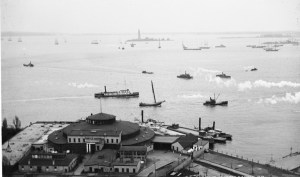
Neil O’Donnell, a small farmer from Donegal, Ireland, where the crops had failed for years, came to the United States in 1882 and landed at Castle Garden at the Battery in New York City along with countless others looking for work and a home.

Castle Garden 1880s

Castle Garden 1880s

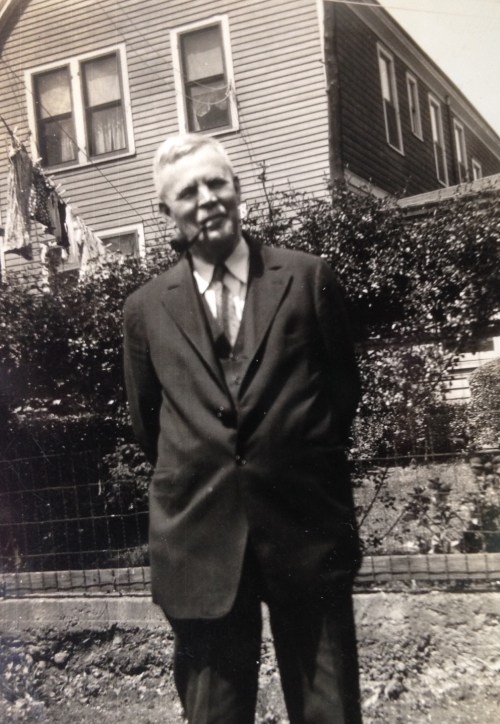
Among my boyhood memories, I remember sitting in the summer on the front porch with the old man in the picture above with a pipe in his mouth. “Allo Bye,” he would shout out to passers-by in a thick Irish brogue. His sight was failing, but once the passer-by was known a lively conversation began about families, friends, the weather and everything else going on in close-knit Bayonne.

Neil died in 1942. I remember kneeling with my family, friends and neighbors outside his room next to the kitchen saying the Rosary as he was dying. I was at his big funeral at St. Mary’s church. Irish funerals were always big then, but this one was special I felt. A patriarch had died.

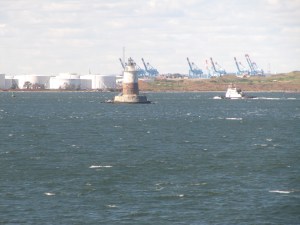
Neil didn’t look far for a job or a home when he got off the boat at Castle Garden. From the Staten Island Ferry, near the docks at St. George, you can still see today oil tanks at Constable Hook on the western shore of the harbor in Bayonne, NJ. In Neil’s day this was The Standard Oil Company of New Jersey, but for him then it was “Hughie Sharkey’s oil works” where he got the job he held all his working life. Hughie Sharkey was the guy who got Neil and Irishmen like him a job.img_1923

Neil married Sarah Givens, also from Donegal. They had six kids, four boys and two girls. Sarah died after the last was born and Neil brought his sister Mary out from Ireland to take care of the kids, but unfortunately she died shortly afterwards too.

“We made our way up in the world,” my mother often said. From a small house on 19th Street in Bayonne, they made their way to a two decker house on the Boulevard about a half-mile away. The first three kids had a minimal education, but the last three got more. My mother was the first to graduate from high school; the last two boys were sent to the Jesuit St. Peter’s High School in Jersey City. One became a priest, the other a New Jersey State Trooper.

A close immigrant family in a solidly Catholic neighborhood, the O’Donnells took care of each other and watched out for their neighbors too. Regularly, they brought others out from Ireland and helped them find jobs and homes of their own. They remembered where they came from.

With all our talk about immigrants these days, I think of Neil, the small farmer from Donegal where crops were failing, who found in America a job and a place to raise a family. His hours were long and his work was tough. The Standard Oil Company of New Jersey fiercely resisted workers’ demands for unionization and better working conditions in his day; in fact, it hired strike breakers to squash workers’ protests. My mother remembered when she was a girl a terrible day some workers were shot and killed near their home.  But Neil and his boys working at the Hook never missed a day.

They never missed church either. With simple unquestioning faith they prayed at St. Mary’s church on 14th. St. They reverenced the priests and sisters there; they were especially fond of the Passionists priests who preached and served the parishes of Hudson County from their monastery in nearby Union City. Faith was never a small part of their lives.

Neil could scarcely read when he came to this country, my mother said, and one thing he wanted was to read the Bayonne Times like everyone else. She taught him how to read. I remember the old man, newspaper in hand, bent on getting the news of the day, like everyone else.

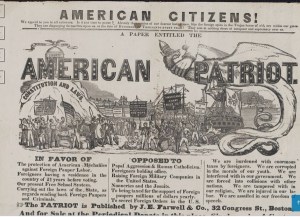
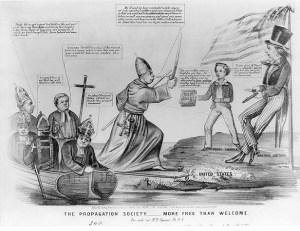
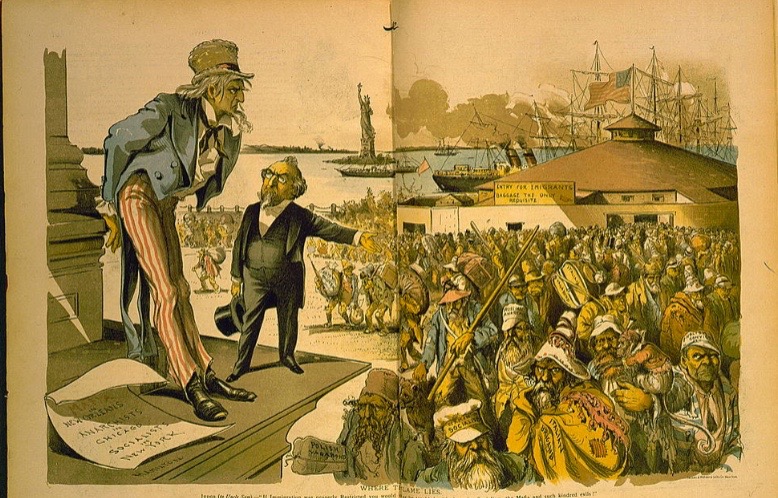
Not everyone in America appreciated Neil and immigrants like him, however. Nativist sentiments affected much of the country then as large numbers of foreigners, especially Irish Catholics, came to our shores. To some they brought poverty, disease and crime to America. Laws were proposed advocating literacy requirements and denial of voting rights to them. Catholics were denied jobs and access to political offices. Neil would never have made it here if the Know-Nothings and nativists had their way.

We celebrate our country’s generosity and openness to the world; but we can’t forget the ugly side of our history. You can see it here in some Nativist broadsheets and cartoons from the time, voices Neil must have heard. They’re still with us today in more subtler forms.

Nativist 1

Nativist 1840

Nativist 4

Nativist 2

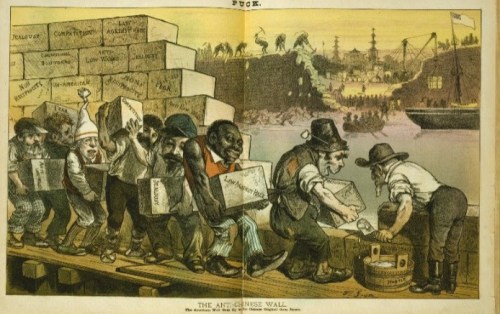
Among the anti-immigrant material I found, I came upon one that made me stop and wonder some more. In the 1880s the United States was pushing China for access to her markets. We wanted free ports and free trade with that land and demanded she take down her walls.

At the same time, Chinese laborers were entering our country, chiefly the west coast, to work on the railroads. They were cheap labor, competing with the Irish, the Italians and other immigrants for jobs. In 1882 Congress prohibited Chinese laborers from entering the country.

A Punch cartoon from that time saw the irony of the situation. We demand walls be pulled down and put up walls ourselves. Look carefully, though, at who brings the bricks for our wall. Immigrants like the Irish and others who came here, often not welcomed themselves.

Nativist wall 1882

I wonder what Neil would say about this? I wonder what his descendants are saying about immigration today? We who come from an immigrant church.

24th Sunday of the Year a: Forgiveness

For this week’s homily please watch the video below:

Jesus, Rescue Us

by Orlando Hernandez

In the Gospel (Lk 6: 27-38) for Thursday of the 23rd week in Ordinary Time our Lord gives us a splendid, demanding portrait of who He is, and of how we could become more like Him: 

“Love your enemies, do good to those who hate you, bless those who curse you, pray for those who mistreat you….. Do to others as you would have them do to you….. Stop judging and you will not be judged….. Stop condemning and you will not be condemned. Forgive and you will be forgiven.”

What a wonderful world this would be if we just stop looking at it with eyes of negativity and hopelessness! In the reading (Lk 6:39-42) for the next day, Friday of the 23rd week in Ordinary Time, this Gospel of Luke continues:  

“Why do you notice the splinter in your brother’s eye, but do not perceive the wooden beam in your own?…. You hypocrite! Remove the wooden beam from your eye first; then you will see clearly to remove the splinter in your brother’s eye.”

I think on this Gospel and realize that a splinter in the eye can actually feel like a huge, heavy piece of wood (a beam!). It is indeed blinding and terribly distressing. The irritation paralyzes  us and makes us stop whatever we are doing. For an instant, we feel helpless. I remember that more than once as a small child, walking with my father on a dusty, windy street, a painful object would find its way into my eye. Through my blinding tears I would try to reach out to my father, Orlando Sr., and would cry for him. His touch would calm and reassure me, but I was still hurting and scared. He would say soothing words, carefully open my agonized eye, and lightly reach in with his handkerchief. There was a second of pain and the object was out. As my tears would subside, I could see his handsome, smiling face in front of me. Wow, I felt relief, love, gratitude, and increased trust in him.

Now I realize, of course, that my Lord Jesus does something like this for me every time that I fall into the sinful state of prejudice, fear, and resentment of those I judge to be “bad.” This political season in our country feels like a whirlwind of dust and flying splinters all over the land. We judge politicians, and sadly, look negatively upon our relatives and neighbors, people we love, who support them, argue on their behalf, and criticize our “own” politicians. We might even think, “What is wrong with these persons? Have they lost their moral compass?  Are they blind?”

This situation can be very upsetting and depressing, irritating, like a splinter in the eye. Cutting down on the news on the TV helps a little, but the only cure, the only relief for me is to reach out for Jesus my Lord, who in prayer mercifully comes to rescue me, and removes all that garbage from my eye. In prayer His Spirit soothes me, and begins to once again patiently teach me how to see with His eyes, the eyes of Love. I’m not sure, I think it was Buddha, who said, “If you want peace on earth you have to start by finding peace within yourself .” Well, for me, Christ the Prince of Peace is the one that makes this possible. It’s simple. I just try to relax, take a deep breath, call on His name, long for Him, and there He is, my Father, Brother, Doctor, Friend and Savior. 

The splinter in the eye can come insidiously at any time. Last night in the nightly news there were three successive segments on devastating fires— the ones in California, the new fires eradicating even more of the Brazilian rain forest, and the one that totally destroyed the tent city where thousands of refugees crowded in the Island of Lesbos in Greece. My wife, Berta looks at me and says, uncharacteristically, “Where is God in all this?” I shake my head, and in my mind I see this image of a dying Earth, burning, afflicted by disease, hatred, extinction of life, abuse, poverty… being held by emaciated, pierced, bleeding hands. And those hands are what gave me hope. Suddenly my wife and I looked into each other’s eyes and remembered Who it is that holds us in the Palm of His Hand, Who is in charge, and His healing of the eyes of our hearts again began. Lord, what would we do without You?

That night, in our virtual prayer meeting, the Scriptural theme consisted of just four lines from the Book of Proverbs, Ch 3: 5-6: 

“Trust in the Lord with all your heart,
on your own intelligence do not rely;
in all your ways be mindful of Him,
and He will make straight your paths.”

Jesus good Shepherd, Healer of eyes, lead us through these troubled times. Clear our eyes so we can see You in everyone we meet. 

23rd Sunday a: How do you tell people they’re wrong

For this week’s homily, please watch the video below.