Category Archives: Religion

Praying with the Creed

I often find myself these days praying the Apostles’ Creed and dwelling especially on that first statement: “I believe in God the Father Almighty, creator of heaven and earth.” I need to strengthen my belief  that God created our world, sustains it in being and guides it to glory.

Two different versions of the creed have come down through the centuries. The Apostles’ Creed is the oldest, still in use today. It’s a summary of faith given to men and women who were being baptized in the early church to help them remember Christian belief. It summarized a faith taught by the apostles.

I like that creed because it’s so simple. In the Catholic church it can be used in the liturgy during Lent and at other times in place of the Nicene Creed. It’s traditionally said at the beginning of the rosary. Prayer books recommend we say it at the beginning of prayer. Good idea.

In a sermon preached in 4th century to prepare people for baptism, St. Cyril of Jerusalem said the creed is related to the scriptures and the rest of the things in church.

“Although not everyone is able to read the Scriptures, some because they have never learned to read, others because their daily activities keep them from such study, still so that their souls will not be lost through ignorance, we have gathered together the whole of the faith in a few concise articles…

“So for the present be content to listen to the simple words of the creed and to memorize them; at some suitable time you can find the proof of each article in the Scriptures. This summary of the faith was not composed at man’s whim, the most important sections were chosen from the whole Scripture to constitute and complete a comprehensive statement of the faith.

“Just as the mustard seed contains in a small grain many branches, so this brief statement of the faith keeps in its heart, as it were, all the religious truth to be found in Old and New Testament alike. That is why, my sisters and brothers, you must consider and preserve the traditions you are now receiving. Inscribe them in your heart.”

The creed sums up all our belief; like a searchlight it gives power to see so much more, it leads us into the most profound  mysteries, and at the same time in its simplicity it helps us find our way through an often bewildering world. The creed is something we can fall back on to go forward.

Here’s  the Apostles’ Creed:
I believe in God, the Father almighty,
creator of heaven and earth.
and in Jesus Christ, his only Son, our Lord.
who was conceived by
the Holy Spirit,
born of the Virgin Mary,
suffered under Pontius Pilate,
was crucified, died and was buried;
he descended into hell;
on the third day he rose again
from the dead.
He ascended into heaven
and is seat at the right hand
of God the Father almighty;
from there he will come to judge
the living and the dead.
I believe in the Holy Spirit,
the holy, catholic Church,
the communion of saints,
the forgiveness of sins,
the resurrection of the body
and life everlasting. Amen
 

The Last Days

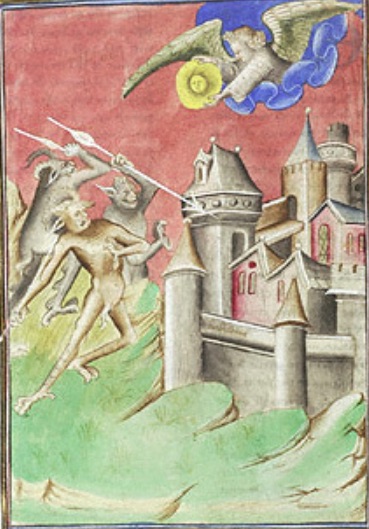
15th Century Apocalypse

During the final weeks of the church year our weekday readings at Mass for the 33rd and 34th weeks of the year are from the Book of Revelation, which describes the last days when God fulfills his promise of a kingdom. The Gospel readings for these weekdays are from Luke 17-21, also about the coming of God’s kingdom. Appropriate readings for our seemingly apocalyptic times.

The author of the Book of Revelation is John, who writes from the prison island of Patmos to the churches of Asia Minor. In strong, imaginative and often violent images, John pictures the final triumph of Christ after a decisive battle between Christ and his followers and Satan and those who follow him. For John, Satan’s kingdom is Rome, the new Babylon.  He tells the churches of Asia Minor to resist this evil empire without compromise. The battle is enjoined and the kingdom is coming soon.

John is invited to behold God’s glory in heaven’s court, portrayed resplendent with gems and other traditional symbols expressing God’s majesty. This is where God wants us to be. A great assembly praises God “who created all things” and the triumphant Christ, the Lamb who was slain and reveals the plan of God:

“Worthy are you, O Lord, to receive the scroll

and break open its seals,

for you were slain and by your Blood you purchased for God

those from every tribe and tongue, people and nation.

You made them a kingdom and priests for our God,

and they will reign on earth.” (Revelation 12,10-12)

John in his writings borrows from Jewish apocalyptic writings before him, Daniel, Ezechiel and others. He writes to give hope to a people in crisis, suffering like him. Commentators say he is possibly a disciple of John, the apostle, whom tradition associates with the church in Asia Minor, and they date the book to the time of a Roman persecution under the Emperor Domitian (A.D. 81–96). 

Some commentators challenge seeing the book responding to the Roman persecution under Domitian. They claim, instead, that Revelation is directed against Christians in Asia Minor who have become too much at home in Roman society. Following the Pastoral Epistles of Paul, the churches of Asia Minor, according to John,  have lost their zeal for the gospel and need to be warned about increasing mediocrity. (cf. Revelation, Wilfrid J. Harrington, OP, Sacra Pagina, Liturgical Press 1993)

The writer of Revelation warns against seeking a comfortable life here on earth. Christ is not just an earthly companion seeing us through the day; he calls us to a life beyond this.  

“‘Behold, I stand at the door and knock.

If anyone hears my voice and opens the door,

then I will enter his house and dine with him,

and he with me. I will give the victor the right to sit with me on my throne,

as I myself first won the victory.

and sit with my Father on his throne.” ( Revelation 3, 14)

The best commentators on scripture are often the scriptures themselves, St. Augustine taught, and so perhaps as we read the Book of Revelation these last days we should also hear Jesus in Luke’s gospel. He kept calling sinners as he made his way to Jerusalem, even as he died on the cross. He never told Zachaeus the publican to give up his job. He warned against burying your talent in the ground while the Master’s away. He also said not to search into the time and the day the Son of Man will come. Keep your eye on the daily cross that’s yours.

But Jesus also told us he’s coming again.

33rd Week of the Year: Readings and Feasts

NOVEMBER 14 Mon Weekday Rv 1:1-4; 2:1-5/Lk 18:35-43 

15 Tue Weekday (St Albert the Great, Bishop Doctor] Rv 3:1-6, 14-22/Lk 19:1-10 

16 Wed Weekday [St Margaret of Scotland; St Gertrude] Rv 4:1-11/Lk 19:11-28 

17 Thu St Elizabeth of Hungary, Memorial Rv 5:1-10/Lk 19:41-44 

18 Fri Weekday [ Dedication of Basilicas of Sts Peter and Paul, Apostles;

USA: St Rose Philippine Duchesne, Virgin] Rv 10:8-11/Lk 19:45-48 

19 Sat Weekday Rv 11:4-12/Lk 20:27-40 

20 SUN Christ, the King Solemnity 2 Sm 5:1-3/Col 1:12-20/Lk 23:35-43 

Readings from Luke’s gospel this week begin with Jesus’ ascent to Jerusalem from Jericho where he meets the blind beggar and Zacchaeus, the publican. As the Messiah ascends to the city he gathers those who sit in darkness and sin. As he enters the city, we weeps over it and cleanses it. The Messiah comes.  

During the final weeks of this church year the first readings at Mass for the 33rd and 34th weeks are from the Book of Revelation, which describes the last days when God fulfills his promise of a kingdom. They complement the gospel readings for these weekdays from Luke 17-21, also about the coming of God’s kingdom.

Margaret of Scotland, Gertrude, Elizabeth of Hungary the Rose Philippine Duchesne are saintly women remembered this week. Interesting, they represent women intellectuals, women missionaries and women who govern.

The Feast of Christ the King, next Sunday,  ends our church year.

33rd Sunday of the Year: The End of Time

For this week’s homily please watch the video below.

St. Joseph and Michael

One of the New York Times’ political  columnists in the 1960s, Walter Lippmann, once wrote “We’re living through a revolution nobody understands.” That was true in the 1960s and it’s still true today. We’re living through times we hardly understand. Who could predict a Covid Epidemic, a war in Ukraine, a changing climate, a fractured political system, an endangered economy? Who could predict the changes in our church?

Yesterday, I went over to Union City, New Jersey, to celebrate Mass at the Church of St. Joseph and Michael. Originally it was St. Joseph’s Parish, founded by the Passionists. Just up the street from St. Joseph’s was the Monastery and parish of St. Michael. St. Michael’s monastery was the center for the Passionist community for over a hundred years.

Cardinal Tobin, the bishop of Newark, celebrant of  the Mass yesterday, decribed the union of the two parishes through the image of two streams of water, each bringing life,  uniting in one body. He spoke of the water that came from side of Christ on the Cross that brings life to our world. 

But water can also bring death. St. Michael’s monastery, church and parish were closed by 1982. Just up the street from the present  St. Joseph and Michael  the massive monastery church stands empty and deteriorating. Hard to understand.

I wrote about St. Michael’s in 2012 when we left Union City. The contribution of the Passionists to the city and the surrounding area, yes even to the American church, is hard to measure. As we experience this “revolution nobody understands” we search to understand the plan of God. It’s there, hidden, small, confusing, like mustard seed slowly growing. As we hear in our readings from Luke, Jesus says to look for the signs of the times. 

In our morning prayer from Isaiah today, God says:

I will lead the blind on their journey

By paths unknown I will guide them

I will turn darkness into light,

And crooked ways straight. 

32nd Week of the Year: Readings and Feasts

NOVEMBER 7 Mon Weekday Ti 1:1-9/Lk 17:1-6 )

8 Tue Weekday Ti 2:1-8, 11-14/Lk 17:7-10 

9 Wed Dedication of the Lateran Basilica Feast

Ez 47:1-2, 8-9, 12/1 Cor 3:9c-11, 16-17/Jn 2:13-22 

10 Thu St Leo the Great, Pope Doctor  Memorial

Phlm 7-20/Lk 17:20-25 

11 Fri St Martin of Tours, Bishop Memorial 2 Jn 4-9/Lk 17:26-37 

12 Sat St Josaphat, Bishop Martyr Memorial 3 Jn 5-8/Lk 18:1-8 

13 SUN THIRTY-THIRD SUNDAY IN ORDINARY TIME

Mal 3:19-20a/2 Thes 3:7-12/Lk 21:5-19 

The weekly readings and feasts are a wonderful way to explore our faith. We’re reading from St. Luke’s Gospel most days this week. The scriptures are our first catechism. 

Then, the feasts and saints this week. The Dedication of the Lateran Basilica in Rome (Nov 9), the first of the great churches built after Constantine brought an end to Christian persecutions in the 4th century. Why do we have churches anyway? This feast offers some reasons.

Pope Leo (Nov 10) is called great because he led a church threatened with destruction by barbarian armies. God always provides the leaders we need.

Martin of Tours(Nov 11), the soldier who gave half of his cloak to a freezing beggar, later revealed to be Christ. What are we doing for the poor? November 11 was chosen for his feast because it was when European farmers were butchering their cattle, getting ready for the winter. Martin reminded them to put aside something for the poor. Are we doing that?

Josephat (Nov 12)  was a bishop seeking the unity of Orthodox and Roman Catholic Churches. He suffered martyrdom for his efforts. Keeping our church together is a big task that concerns us all. Pope Francis was in Bahrain last week in dialogue with Moslem leaders. The religions of the world need to be in dialogue. Pope Francis is promoting that dialogue.

The readings and feasts are our catechism. Study them day by day.

32nd Sunday c: Now and at the Hour of Death

For this week’s homily please watch the video below.

All Saints Day: November 1st

For this week’s homily, please play the video below.

31ST WEEK OF THE YEAR: Readings and Feasts

OCTOBER 31 Mon Weekday Phil 2:1-4/Lk 14:12-14

NOVEMBER 1 Tue ALL SAINTS Solemnity  Rv 7:2-4, 9-14/1 Jn 3:1-3/Mt 5:1-12a

2 Wed ALL SOULS Wis 3:1-9/Ro 6:3-9/Jn 6:37-40 

3 Thu Weekday [St Martin de Porres, Religious] Phil 3:3-8a/Lk 15:1-10 

4 Fri St Charles Borromeo, Bishop Memorial Phil 3:17—4:1/Lk 16:1-8 

5 Sat Weekday [BVM] Phil 4:10-19/Lk 16:9-15 

6 SUN 32ND SUNDAY IN ORDINARY TIME

2 Mc 7:1-2, 9-14/2 Thes 2:16—3:5/Lk 20:27-38 or 20:27, 34-38

Two important feasts are celebrated this week: All Saints and All Souls. What lies ahead?  Where does this life end? Is there anything beyond this? Important questions these feasts address.

First reading most of this week is from Paul’s Letter to the Philippians, another letter he writes from prison. Our gospel reading continues Jesus’ journey, as he draws near to Jerusalem.

St. Martin de Porres and St. Charles Borromeo, two saints from vastly different backgrounds. One a Dominica lay brother who worked caring for the poor, the other a learned theologian who was an leading figure at the Council of Trent. Bless them all.

31st Sunday c: God’s Mercy is Everywhere

For this week’s homily, please watch the video below.