Category Archives: lectio divina

John Neumann, January 5

Neumann
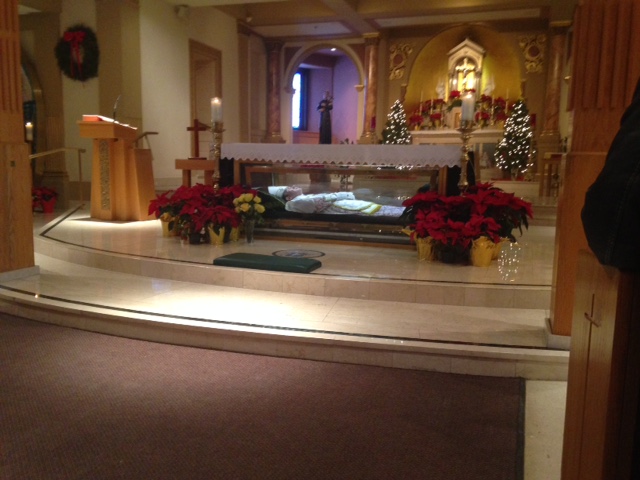
Shrine of St.John Neumann, St. Peter’s Church, Philadelphia

Today’s the feast of St. John Neumann,. “The sacrament of Holy Orders is at the service of the communion of the church.” (Catechism of the Catholic Church). John Neumann served the church in an heroic way as a priest and bishop. He’s one of the founding figures of the church in the United States.

Born in Bohemia in 1811, John Neumann was drawn to serve the church in the new world as a young seminarian. Arriving in New York City in 1835, he was immediately accepted for ordination by Bishop Dubois and ordained at Old St. Patrick’s Cathedral.

Canals and railroads were transforming the new nation then. The Eire Canal, completed in 1828, connected New York harbor and the Atlantic Ocean to the Great Lakes region, causing an explosive population growth in the cities and towns along its route. Bishop Dubois sent the newly-arrived priest to minister to the many Catholic immigrants settling there.

First as a diocesan priest and then as a Redemptorist religious, Neumann founded  numerous parishes and missions in the cities and towns along the canal and railroad lines in Pennsylvania, Ohio, Maryland and New York.

He spoke a number of languages and learned to speak others, even Gaelic, as he reached out to the diverse immigrant population, many poor Irish workers on the canal. He wore himself out in his tireless efforts and joined the Redemptorist Order looking for the support and stability that a religious order provided, yet as a Redemptorist he continued establishing churches and parishes through the northeastern United States as a preacher and catechist.

In 1852 Neumann was appointed bishop of Philadelphia, where the Catholic population was rapidly growing. He was a tireless shepherd, building over 100 new schools and 50 churches, until his death in 1860. Convinced that young people needed good formation in the faith, Neumann fostered Christian education and wrote two catechisms. He preached continuously, administered the sacraments and encouraged the Forty Hours Devotion and other devotional practices in his diocese.

John Neumann served the church as a zealous priest and bishop. He left his own homeland to work tirelessly to build the Catholic Church in the United States. He was a true missionary of Christ.

We need priests and missionaries like him today. Not only priests who leave their own homeland to minister in different countries, but priests who minister in an evolving church where the boundaries are not fixed.

O God, who called the Bishop Saint John Neumann, renowned for his charity and pastoral service, to shepherd your people in America, grant by his intercession that, as we foster the Christian education of youth and are strengthened by the witness of his brotherly love, we may constantly increase the family of your Church.                       Through Jesus Christ, our Lord. Amen.

Mary’s Visits: Fatima

When Mary visited her cousin Elizabeth she said “all generations shall call me blessed, the Almighty has done great things for me, and holy is his name.” All generations know her; at times over the years Mary visits some in apparitions. 

Three prominent apparitions of Mary in the last 500 years are commemorated in major Marian shrines –in Mexico City, Lourdes and Fatima. In 1531, she appeared to the Mexican peasant Juan Diego on a hillside outside of Mexico City. In 1858 Mary appeared to 14 year old Bernadette Soubirous in Lourdes in France as she was gathering firewood. In 1917 Mary appeared to three shepherd children in Fatima in Portugal. These are major pilgrimage sites today. Three liturgical feasts in our church calendar honor these apparitions.

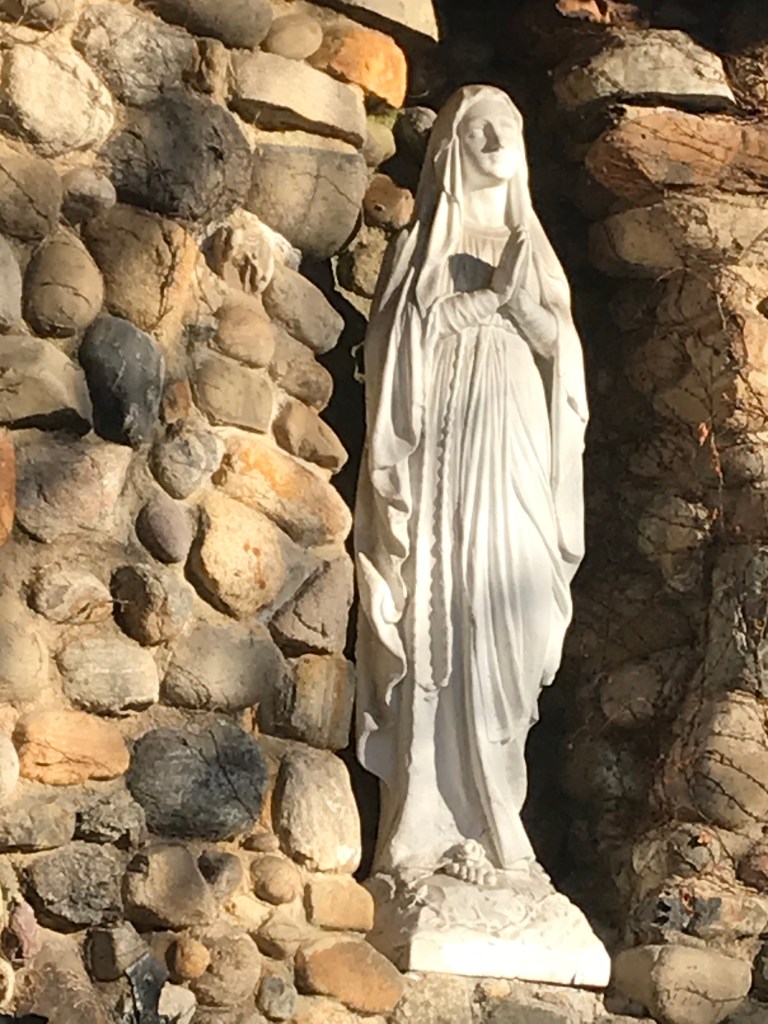
The depictions of Mary in art follow closely, if not perfectly, the accounts the visionaries gave of the apparitions. Mary, arms folded in prayer, prays for her children on earth and encourages them to pray with her in the Fatima appearance.  

The statue of Our Lady of Lourdes made by Fabisch in 1864 and placed in the grotto at Lourdes in France is a model for the many statues of Our Lady of Lourdes in churches and shrines throughout the world. We have one in our Lourdes Grotto in Jamaica, NY. (below)

Various images of Our Lady of Fatima exist; we have one in our monastery chapel.(above) Her bright white garments witness to the glory the visionaries saw surrounding her. She brings the glory of heaven to brighten the earth, as Jesus did at his transfiguration. “And he was transfigured before them, and his clothes became dazzling white, such as no fuller on earth could bleach them.” (Mark 9:2-3)

Images of Our Lady of Guadalupe show her in the native dress of the time; she identifies with the native peoples then under colonial subjugation.

Contemporaries of Bernadette and the children of Fatima faced trials of another kind than the native peoples of Mexico. Secularizing governments promoted unbelief in society and wars were increasing in number and intensity. Mary’s appearances were not only the occasion of physical cures and healing. To ordinary people then and afterwards Mary’s appearances brought reassurance and renewed faith in the promise of God’s glorious power and presence. Their faith was real.

In his letter Laudato si’ Pope Francis calls upon Mary to visit us today as we struggle to care for the earth we have neglected. I like this image of Mary, holding her Son, which we have in our Mary Garden. Creation seems to raise its voice in praise. Her Son, Jesus Christ, offers us life-giving Wisdom. “We can ask her to enable us to look at this world with eyes of wisdom,” the pope says. May she hold in her hand our wounded world.

The Prayer of Abel: Genesis 4: 1-15

Cain and Abel. James Tissot. Brooklyn Museum

God was pleased with the sacrifice of Abel, rather than that of Cain. St. Ambrose explains why:

“Jesus told us to pray urgently and often, so that our prayers should not be long and tedious but short, earnest and frequent. Long elaborate prayers overflow with pointless phrases, and long gaps between prayers eventually stretch out into complete neglect.

Next he advises that when you ask forgiveness for yourself then you must take special care to grant it also to others. In that way your action can add its voice to yours as you pray. The apostle also teaches that when you pray you must be free from anger and from disagreement with anyone, so that your prayer is not disturbed or broken into.

The apostle teaches us to pray anywhere, and the Saviour says ‘Go into your room’ – but you must understand that this “room” is not the room with four walls that confines your body when you are in it, but the secret space within you in which your thoughts are enclosed and where your sensations arrive. That is your prayer-room, always with you wherever you are, always secret wherever you are, with your only witness being God.

Above all, you must pray for the whole people: that is, for the whole body, for every part of your mother the Church, whose distinguishing feature is mutual love. If you ask for something for yourself then you will be praying for yourself only – and you must remember that more grace comes to one who prays for others than to any ordinary sinner. If each person prays for all people, then all people are effectively praying for each.

In conclusion, if you ask for something for yourself alone, you will be the only one asking for it; but if you ask for benefits for all, all in their turn will be asking for them for you. For you are in fact one of the “all.” Thus it is a great reward, as each person’s prayers acquire the weight of the prayers of everyone. There is nothing presumptuous about thinking like this: on the contrary, it is a sign of greater humility and more abundant fruitfulness.”