Category Archives: Environment

The Daughters of Jesus


To listen to today’s homily, please select the audio file below:

In this Sunday’s gospel, the evangelist Mark runs two stories together. A synagogue official, Jairus is his name, goes to Jesus pleading that he come and cure his little daughter who’ s dying. Jairus is obviously an important figure in that area; people know him and immediately a crowd gathers to follow the synagogue official and Jesus to the house.

That story is interrupted by the story of a woman– we don’t know her name– who has had hemorrhages for twelve years and spent all her money on doctors. Obviously she’s poor, broke and stressed out. She pushes through the crowd on the way to Jairus’ house and touches Jesus cloak and is cured. Jesus recognizes her and calls her. “In fear and trembling” she approaches him. “Daughter,” Jesus says to her, “ your faith has saved you. Go in peace and be cured of your affliction.” To Jesus the woman is his “daughter,” like the daughter of Jairus, someone who is dear to him.

Then the gospel returns to the first story. Jesus reaches Jairus’ house, the little girl is dead. They’re all mourning loudly. He raises the little girl up to life and tells them to give her something to eat.

It’s easy to say which of those two stories would make the 6 o’clock news tonight or the Daily News headlines tomorrow. Daughter of Synagogue Official Saved from Death.

You wonder why Mark’s Gospel runs those stories together the way it does? The unknown woman’s story seems to interrupt the far more dramatic story about the synagogue official’s little girl who dies and is brought back to life. Yet, Mark’s gospel puts the two stories together, seemingly to indicate that both them must be told and are somehow interconnected.

I’m thinking of these stories in the light of Pope Francis’ new encyclical, Laudato Si, on the environment, which was published last week. That encyclical has a lot of interconnected stories too. You can concentrate on one of its dramatic highlights, like it’s urgent call to do something about climate change and either agree or disagree with the pope and pass over all the rest. But the pope’s encyclical is many sided. There’s a great deal in it. It’s about more than climate change or carbon credits or the impact it may have on our American political scene.

The pope is asking us to examine the way we look at things, the way we look at life, the way we look at nature, our common home. He wants us to examine ourselves in the light of our faith, but also in the view of the realities of life today. The encyclical is addressed primarily to Catholics, but he’s asking all people to look at what it means to live together on this planet now.

Encyclicals are long letters, densely constructed, and this one is too, 184 pages. But if you take your time and go through it slowly, and that’s hard because so many of us like our news in sound bites, you will find it’s stimulating and challenging. I’m sure we are going to be exposed to the “stories” in this encyclical in the months and years to come. I don’t think it’s going to go away.

The encyclical is on the internet. You can get it on the Vatican website, and I’m sure you’ll find it in print very shortly.

The pope’s language is strong, but remember the pope’s a preacher, and they say a preacher is supposed to “Comfort the afflicted and afflict the comfortable.”

It’s not just governments, or corporations and communities and systems he’s challenging. It’s all of us. We “have grown up in a milieu of extreme consumerism that makes it difficult to see the world as it is, particularly the world of the poor.” He’s asking us to see the world as it’s interconnected.

For the pope, the environment is not just nature, but nature and human society together. He’s calling, not just for awareness, but an awareness that translates into new habits. (209) He’s asking for an “ecological conversion. It’s not enough to think about these things; we need to change our ways.

And changing our ways and our lives is always hard. We get used to the way we live, the ways we think and the way we are.

On final thing to remember about this encyclical: the pope wants us to look at things with an eye on the poor, the poor that are close by and the global poor who live in places we never see or hear about. In his letter, the pope sometimes refers to poor as the “excluded,” they don’t enter into our world or our planning or our thinking. But they should.

And maybe that’s why this Sunday’s gospel is so pertinent. The two stories in it are about two worlds. Jairus the synagogue official is someone people know. He has a name, and Jesus goes to his house and raises his daughter to life. The poor woman who comes up to Jesus in the crowd has no name. She lives in fear and trembling. But Jesus calls her “daughter,” she’s his daughter too, and she will not be turned away.
Laudato Si

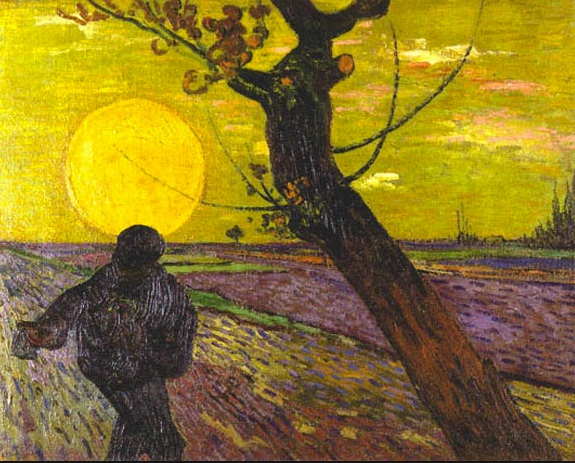
Sower

Be awhile before I get through Pope Francis’ encyclical, Laudato Si, filled as it is with thought provoking words. He says in this encyclical that we need to slow down, our world is too fast paced. This is a work to go through slowly.

He quotes from many sources, religious and secular. I found a little gem in a quotation Francis takes from a Sufi mystic: We need to regain and develop a mystical appreciation of the earth”

[159] The spiritual writer Ali al-Khawas stresses from his own experience the need not to put too much distance between the creatures of the world and the interior experience of God. As he puts it: “Prejudice should not have us criticize those who seek ecstasy in music or poetry. There is a subtle mystery in each of the movements and sounds of this world. The initiate will capture what is being said when the wind blows, the trees sway, water flows, flies buzz, doors creak, birds sing, or in the sound of strings or flutes, the sighs of the sick, the groans of the afflicted…” (EVA DE VITRAY-MEYEROVITCH [ed.], Anthologie du soufisme, Paris 1978, 200).

Francis urges us to feel the pain of our earth and those society ignores, like the unseen immigrants searching for a home somewhere. The Passion of the earth is a theme the Passionists have been addressing recently, influenced by the work of Fr. Thomas Berry, CP, who must be smiling from above at the pope’s efforts.

There’s something for everyone here.

26th Sunday: Knowing Jesus

To hear the audio of today’s homily please select the audio below:

Religious education programs begin in most parishes this month. Many of the programs involve young people, of course, but we are all called to grow in faith, no matter how old we are.

Unfortunately, adults often see faith as something you learn as a child and that’s it.

The Catholic writer Frank Sheed once said the problem with adult Catholics is that they don’t keep engaged in the faith they learned as children. He used the example of our eyes. We have two eyes. Let’s say one of them is the eye of faith; the other is the eye of experience. 

As children we may see the world with two eyes; but as adults we may see the world only with the eye of experience, losing the focus that faith gives, another dimension. Faith helps us to see.

Jesus said to his disciples “you are all learners.” Not only children learn, all of us learn. We’re lifelong learners, lifelong believers, even till the end.”

I was talking to a man last week who said “You know, I go to church pretty regularly; I try to live a good life, but I would like to know Jesus.”

I told him that’s what we’re trying to do all our lives–to know Jesus.

I told him to get a good bible, like the New American Bible, and start reading it. Listen to the readings in church that tell us what Jesus said and did. This is a time he reveals himself to us, as one of the Eucharist prayers says it so well:

“You are indeed Holy and to be glorified, O God, who love the human race and always walk with us on the journey of life. Blessed indeed is your Son, present in our midst when we are gathered by his love, and when as once for the disciples, now for us, he opens the scriptures and breaks the bread.”

From what we know of Jesus, he bravely faced the issues of his time and its questions and challenges.  Knowing Jesus, then, means that we face the issues and challenges of our time as bravely as we can. 

Let me point out one of today’s challenges– our changing climate.  Last Tuesday evening at the United Nations Summit on Climate Change,  the Vatican Secretary of State Cardinal Pietro Parolin brought a message from Pope Francis.

He said that after thirty years of study we have to admit there are critical days ahead. We know that “the entire international community is part of one interdependent human family…There is no room for the globalization of indifference, the economy of exclusion or the throwaway culture so often denounced by Pope Francis,”

Our faith “warns agains the risk of considering ourselves the masters of creation. Creation is not some possession that we can lord over for own pleasure; nor, even less, is it the property of only some people, the few: creation is a gift, it is the marvelous gift that God has given us, so that we will take care of it and harness it for the benefit of all, always with great respect and gratitude” (Pope Francis, General Audience, 21 May 2014).

It’s not just a matter of some technical changes like emission reductions, the cardinal continued. We need “ to change our lifestyles and the current dominant models of consumption and production.”

Knowing Jesus means living as Jesus would if he were with us today.

We’re all learners. The consoling thing is that we can start anywhere, anytime to know Jesus. The gospel readings for this week and last week tell us that. The workers going into the vineyard and two sons in today’s reading tell us the invitation is always there, so let’s take it.

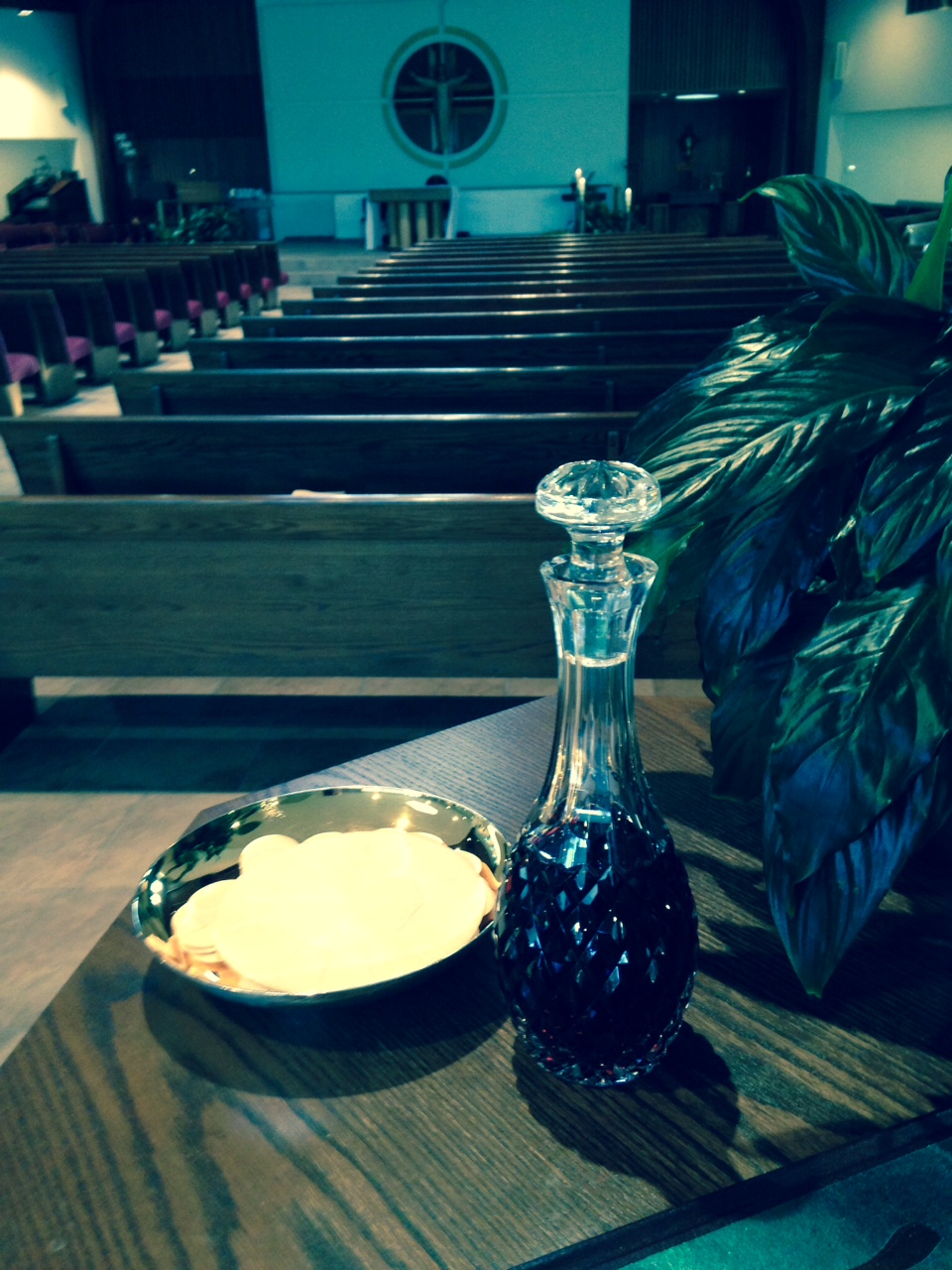
Bread and Wine

photo

The German theologian Romano Guardini years ago recommended in a little book “Sacred Signs” that we let the signs and the words of the liturgy guide our prayer. He was a key figure in initiating recent liturgical reforms in the Catholic Church, which made the signs and prayers of the liturgy better able to communicate the mysteries we celebrate.

I suspect, though, that in our liturgical prayer today the words of the liturgy–the scripture readings and the homily–get more of our attention than the signs.

Maybe we need to pay more attention to signs like bread and wine. They’re sacred signs we can take for granted.

In our prayer over the bread at Mass we say: “Blessed are you, Lord God of all creation, for through your goodness we received the bread we offer you, fruit of the earth and work of human hands, it will become for us the bread of life.” The bread we offer is the fruit of the earth and work of human hands. It’s a sign of all creation, of everything that the “God of all creation” gives us, of everything our hands have fashioned.

“The word bread stands for everything,” Augustine said in one of his commentaries on the Lord’s Prayer. (Epistle to Proba) Early commentators like Tertullian, Cyprian and Origen wrestled with that petition, “Give us this day our daily bread.” Does it mean just the food we eat, or does it mean the wisdom we need? Is Jesus Christ our daily bread? I like Augustine’s explanation because it’s so open-ended.

Scientists say that our universe came into existence about 15 billion years ago. About 3.5 billion years ago life began on our planet. Bread and wine represent that universe; they’re brought to the altar to tell its story.

About 200,000 years ago human life emerged on our planet. 200,000 years of human life are represented in the bread and wine, and our lives are part of the human story represented in bread and wine.

We believe that God created our world and it’s good, according to the Book of Genesis. There’s a plan for this universe, a plan conceived in God’s wisdom and love. In its opening chapters, Genesis poetically describes the beginning of our universe, but then turns quickly to the journey of the human family from its beginnings .

God’s plan, however, involves, not just the human family, but also the universe itself. All creation is waiting for the kingdom of God to be revealed. The bread and wine are signs of it.

Certainly human beings have an important role in the coming of God’s kingdom, as the incarnation of Jesus Christ makes clear. We’re not slaves, cogs in the wheel, as life grinds on. We represent God here in the universe and have to exercise a godlike care of this world. Each of us has a part to play that God’s kingdom come. We share in the promise.

We know too that the mystery of evil is at work in our world, a mystery also represented in the bread and wine. When Jesus took bread into his hands at the Last Supper, he saw a sinful world ready to put him to death, but he still took the bread in his hands. His blood would be poured out, but he still took the chalice to drink from it.

How magnificent is his response. He takes all created reality, all human existence, the goodness and evil of life in his hands, embracing them all with God’s love and care. From his hands he gives them to us, blessed by his presence.

“This is my body.” “This is my blood.” Incarnate in this great universe he gives life to it and to us.

In communion, Jesus gives himself to us in bread and wine, the signs of the world in which we live. We’re to live in that great world and have a role in it to fulfill. The Word made flesh is our bread of life, our food and drink, who gives wisdom and power to us.

Father Thomas Berry, a Passionist priest who taught me long ago, had a passionate love of the universe and a concern that the universe story enrich our way of looking at life. In one of his writings he saw the universe story enriching our understanding of the sacraments. It does.

St. Gabriels, Toronto

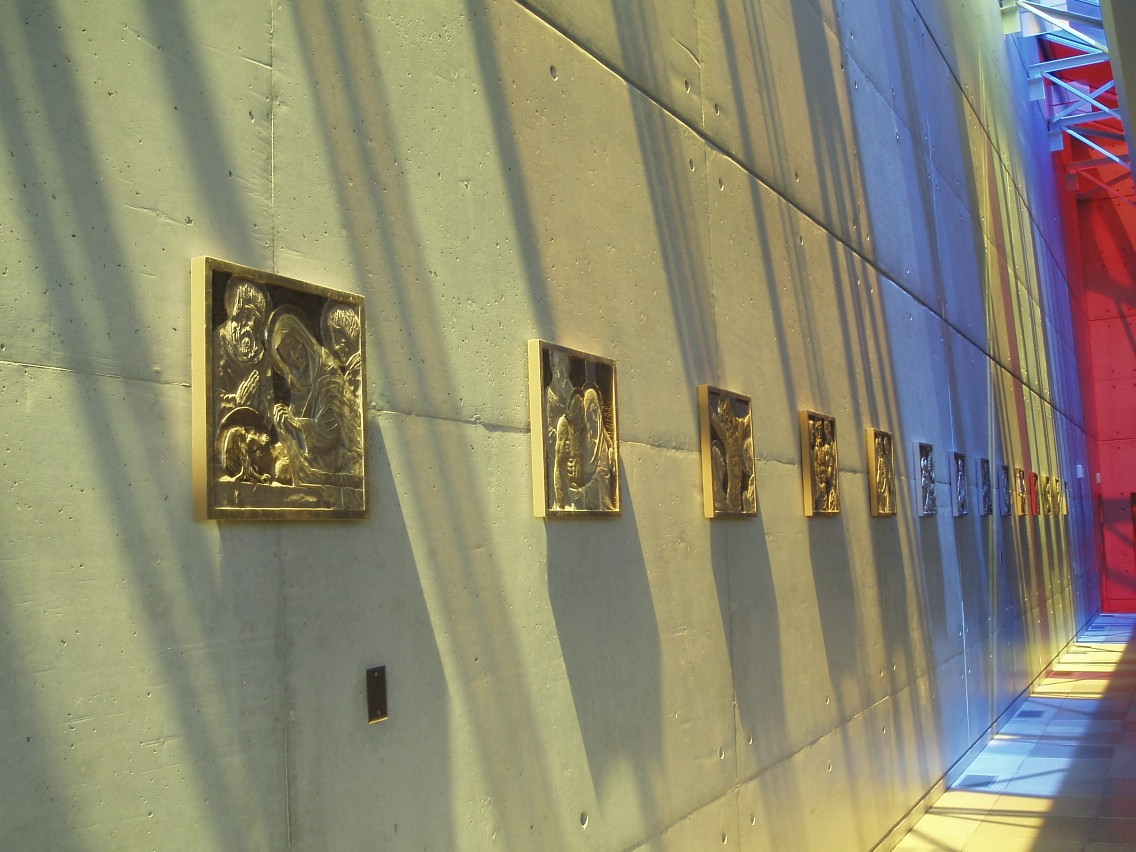
I’m spending a few days in Toronto with our Canadian Passionists, who minister at St. Gabriel Church, a new church built in 2006 which reflects the eco-theology of Fr. Thomas Berry, a Passionist who died a few years ago. He believed we need to foster a life enhancing relationship with the earth and the whole cosmos.

The church is located in a booming area along Sheppard Avenue in North York where high-rise condos and a new subway line are recent additions to this growing prosperous Canadian city. It’s a showplace for human technology and building skills. What better place for a  reminder of things beyond the human?

The church and its surroundings are almost swallowed up by the great buildings around it; a modest sign along busy Sheppard Avenus beckons you into St. Gabriels.

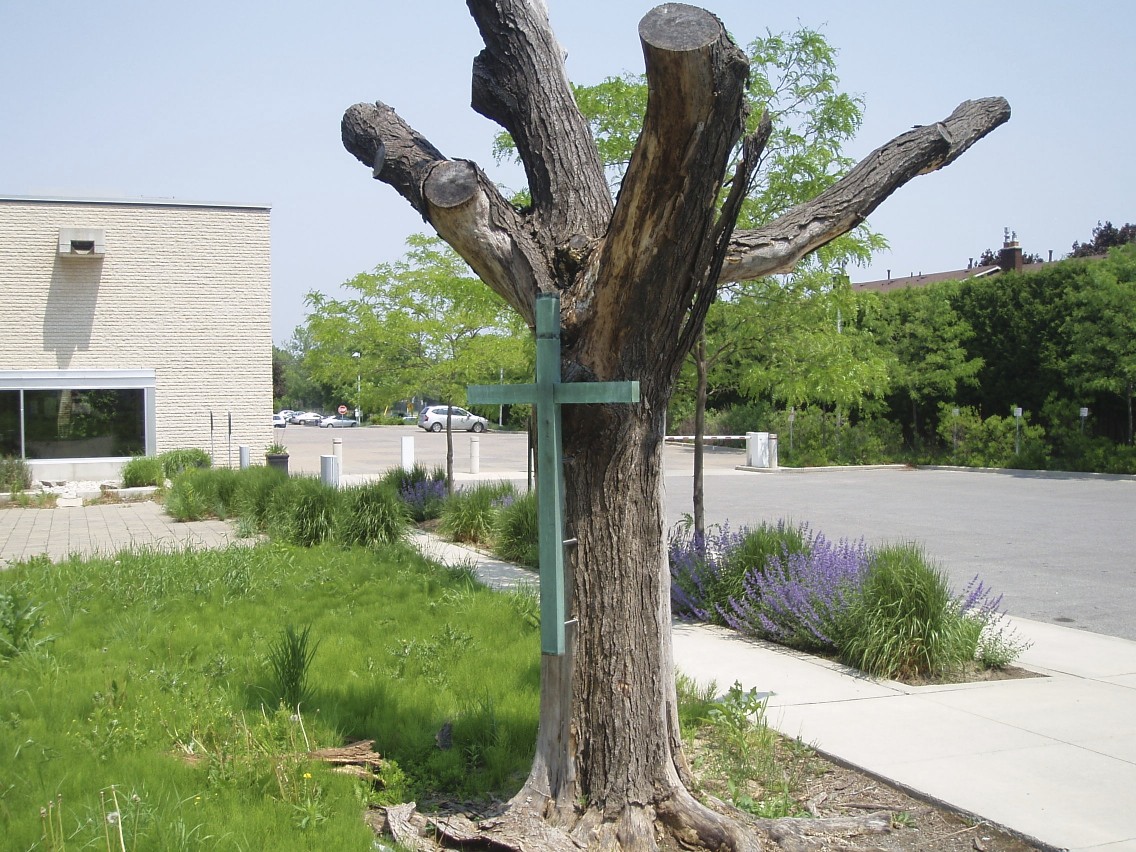
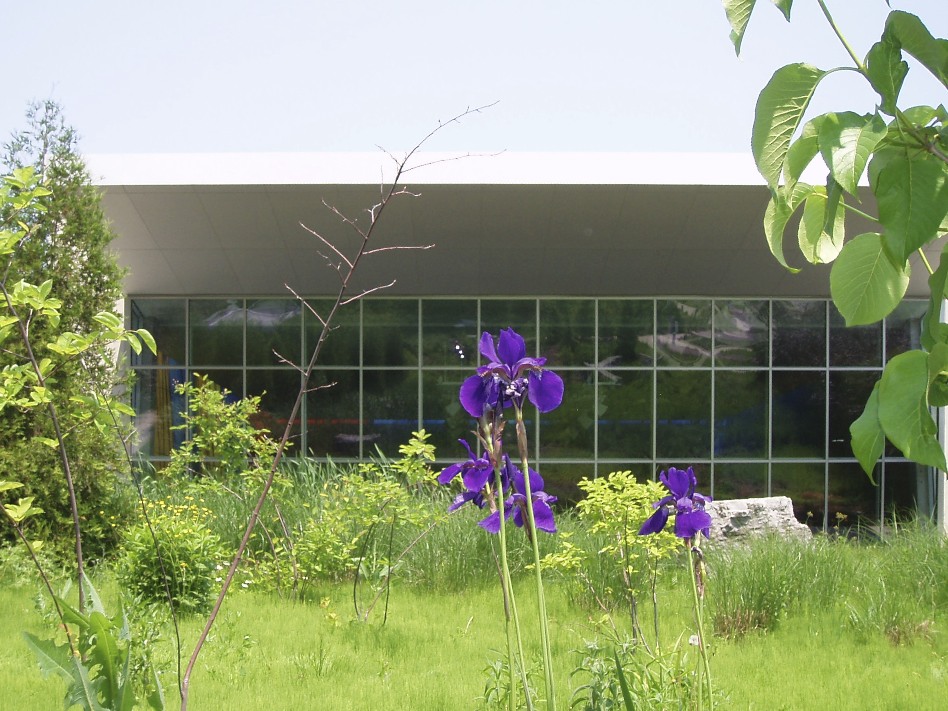
It’s not a church you would expect. No steeple skyward, no shrines of saints outside. A solitary statue of Christ stands on the roadway toward it. The entire south facade of the church is clear glass welcoming sunlight into the worship space within and a garden where the story of creation is retold from its beginning. Rocks, flowers, trees and grasses face the glass wall that dominates the new building,  A large tree trunk cut from a land development nearby stands at the edge of the outdoor garden, signed with a green cross. It signifies the Passion of the Earth, which the human community, recklessly exploiting the earth’s resources, has inflicted on the natural world.

Looming beyond the garden are the tall buildings of our modern human world.

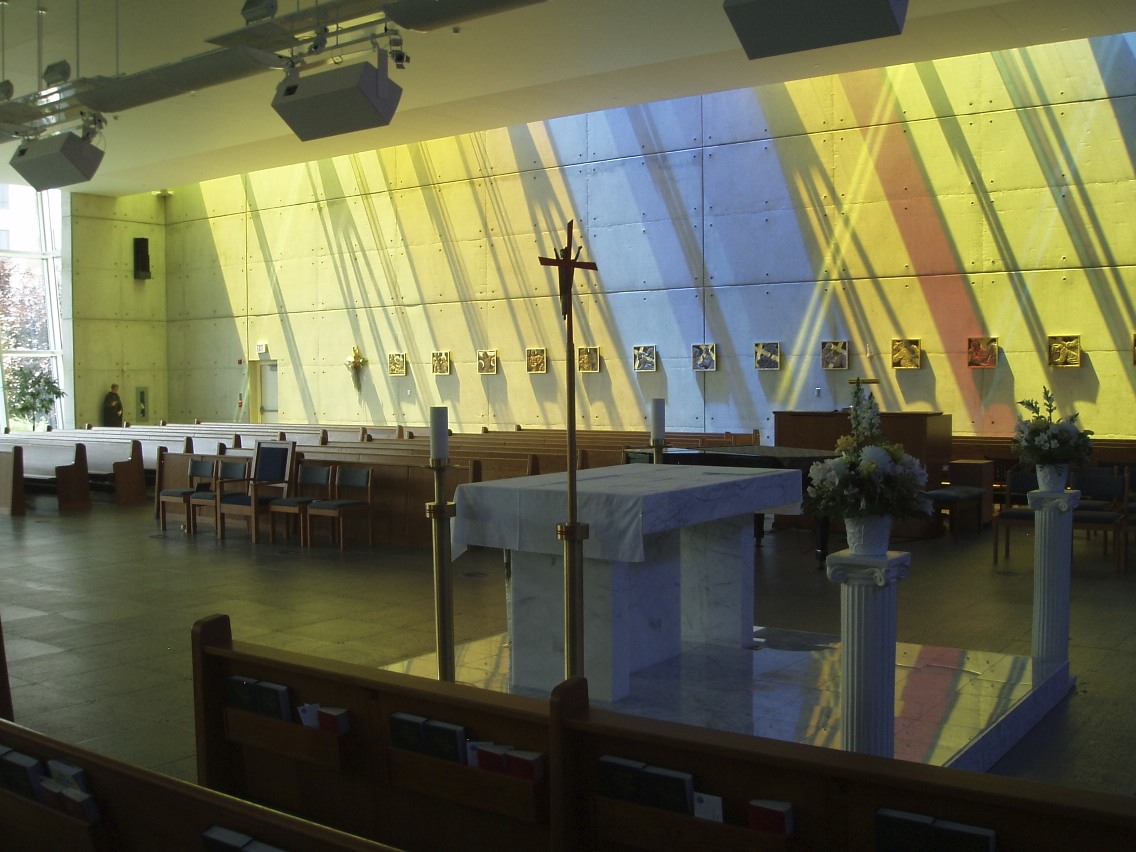
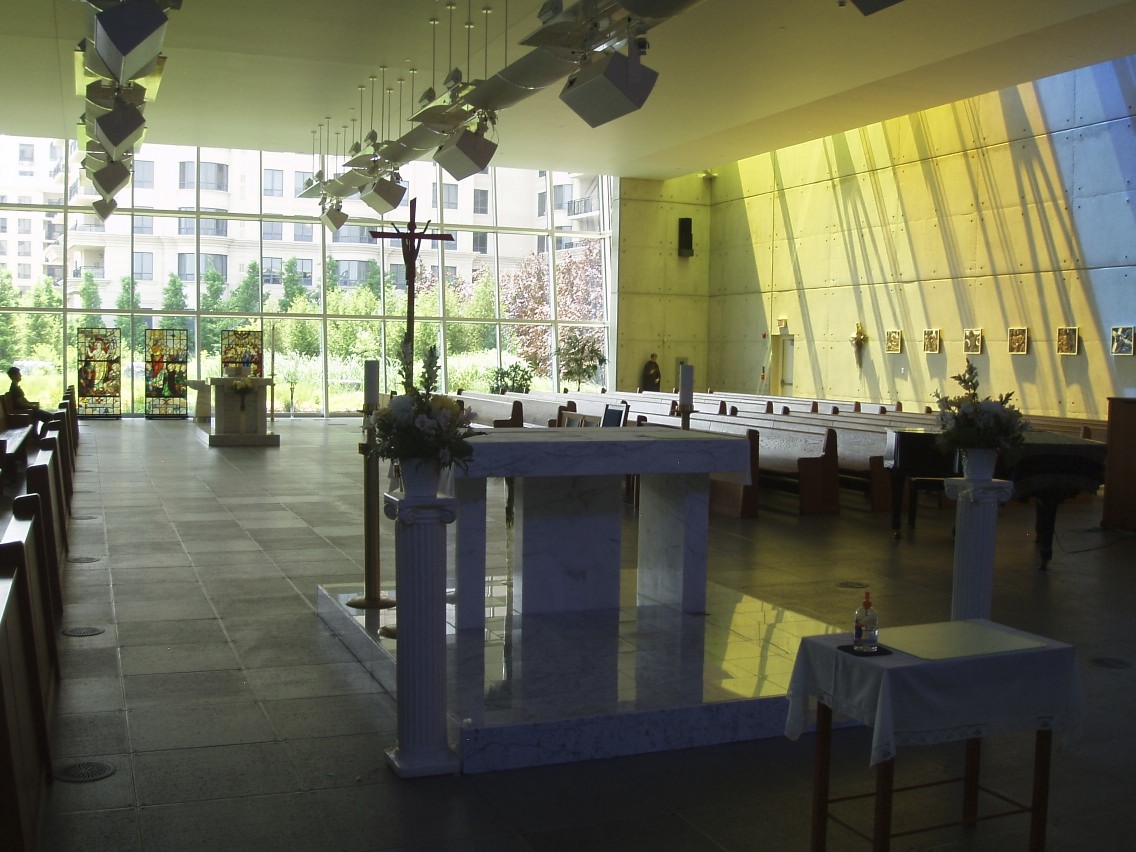
Sunlight through its expansive southern window and upper windows plays through the interior space of the church by day and over the seasons. This is not a church cut off from the world outside but in harmony with it.

The church pews, salvaged from an earlier church, are arranged antiphonally facing the baptismal fount near the southern glass wall, the ambo where the gospel is proclaimed, and the altar where the Eucharist is celebrated. A chapel where the Blessed Sacrament is reserved is situated in the northern part of the worship space. The Word who made the universe; the Savior sent to redeem us is present here in this church.

The baptismal fount, also from the earlier church, has water flowing from it; a rainspout on the outside southern wall delivers rainwater to a simple river bed below. The two remind us of our dependence on water as well as light.

The church seats 750 people; the present parish membership comes from all the continents and many nations. A parallel narthex provides a meeting place for these “living stones” who form the church today.

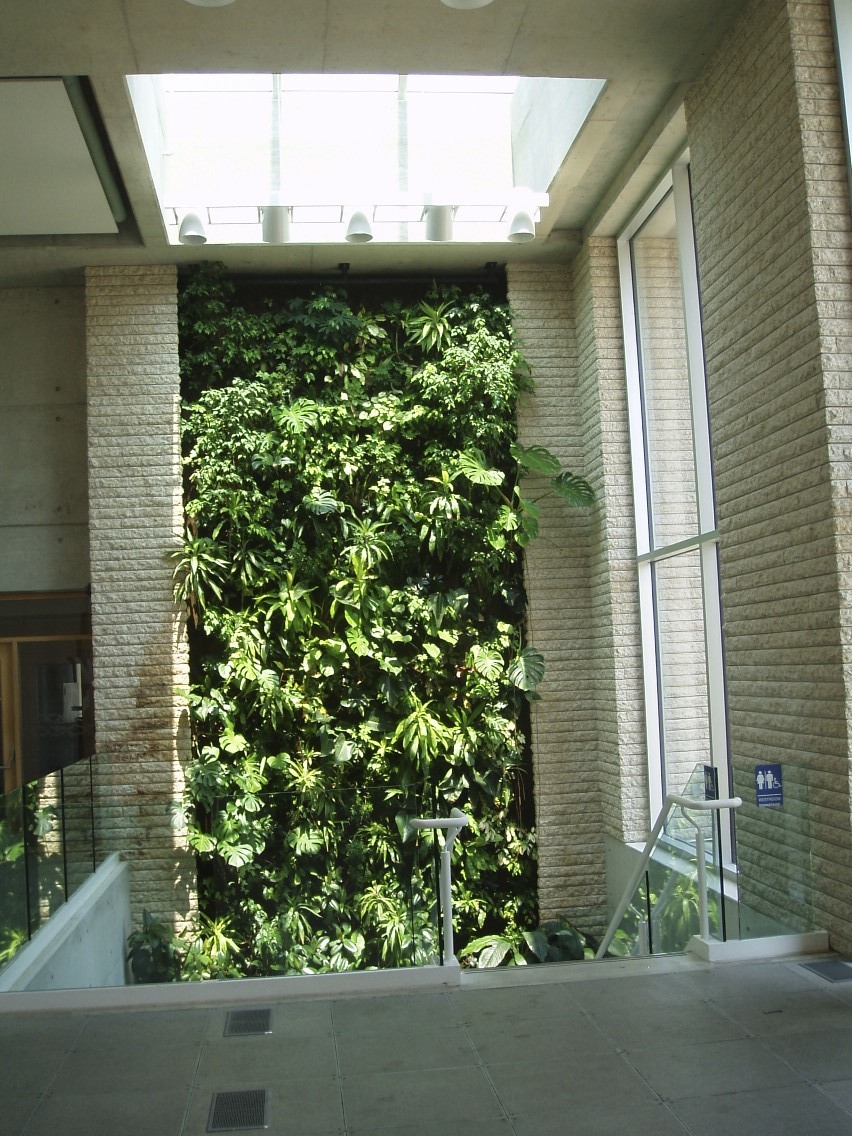
The church was built to be energy efficient. Most of its parking area is located beneath the church. Parishioners ascending from the underground parking face a large bank of plants, which serve to purify the air as well as remind them of the importance of the rain forests for the earth.

”Imaginative and creative,” Aloysius Cardinal Ambrozic, Archbishop of Toronto, Canada, called the new Passionist church of St. Gabriel, when he dedicated it on Sunday, November 19, 2006. The Jesuit magazine AMERICA featured the church in a recent issue on church architecture.

The parish website is http://stgabrielsparish.ca/

A Youtube video is here: http://www.youtube.com/watch?v=GasOYiK1l68

The Arrogance of Science

“Teach us the meaning and value of creation, so that we may join its voice to ours as we sing your praise.”

That’s from the church’s morning prayer today. I thought of the article I read in yesterday’s New York Times called “A Country’s Lasting Aftershocks,” by Satoru Iekuchi, Genichiro Takahashi and Mitsuyoshi Numano. It’s was about science’s arrogance, which is a division of human arrogance.

Here’s an excerpt from that Japanese article:

“The physicist Torahiko Terada wrote in 1934, “The more civilization progresses, the greater the violence of nature’s wrath.” Nearly 67 years later, his words appear prescient.

Humans have become increasingly arrogant, believing they have conquered nature. We build ever larger, ever more concentrated, ever more uniform structures. Scientists and engineers think that they are responding to the demands of society, but they have forgotten their larger responsibilities to society, emphasizing only the positive aspects of their endeavors.

The catastrophe facing the Fukushima Daiichi nuclear power plant epitomizes this phenomenon. Although earthquakes are so frequent in Japan that it has been described as “a nation lying atop a block of tofu,” we have built some 54 nuclear reactors along the coast, vulnerable to tsunamis. It should have been foreseen that an earthquake of this magnitude might occur, and if the plant could not withstand such an event, it should not have been constructed.” For more…

We usually think of Lent in terms of human reconciliation, how we relate to our neighbor. How about our relationship to creation?

4th Sunday of Advent

The readings for the 4th Sunday of Advent would have us look at small, insignificant things– a little town in Judea, Bethlehem, and a visit of two women, Mary and her cousin Elizabeth.

Faith sees meaning here. A mystery, a great mystery,  hidden in this place and in these people.

Bethlehem, some say, means “House of Bread,” and with eyes of faith, we believe that the Bread of Life, Jesus Christ, was born in that humble town. The women, visiting together, were holy women who brought Jesus Christ, the Son of God, into the world and were among the first to recognize him.

With eyes of faith we look back and see.

But eyes of faith are not just for looking back; they help us see life today and discover God’s presence and call now.

Along with our scriptures, the signs and prayers of the Mass  help us see. Like our readings they point to great meaning in small things.

Look at the bread and the wine. Jesus took these small signs into his hands the night before he died and made them  bearers of important mysteries. As we bring them to the altar after our Creed and take them into our hands and ourselves, we ask:  What do they mean?

They’re food and drink, we say, and so they are. Real food and real drink, Jesus said, giving life beyond what we hope for and joys we cannot imagine. God feeds us, as a mother feeds a child, as a father giving daily bread to his children. The bread and wine reveal God’s love for us in Jesus Christ.

They point, though, to other realities too. They tell us of our relationship to God, but they also point to our relationship to the universe made by  God our Creator.

“Blessed are you, Lord, God of all creation, through your goodness we have this bread to offer, which earth has given and human hands have made. it will become for us the bread of life.”

“Blessed are you, Lord, God of all creation, through your goodness we have this wine  we have this wine to offer, fruit of the vine and work of human hands, let it become our spiritual drink.” (Offertory prayers)

Bread and wine are symbols of creation, our prayers say. We don’t live apart from the created world.  We receive God’s gifts through it. God comes to us through it. Creation’s story is our story too.

Both the bible and science tell that story, but in different ways, the Book of Genesis in poetic language;  scientists in the language of science.

As scientists tell it, after probing into space with instruments like the Hubble telescope and sifting through the earth’s crust,  our universe began 15 billion years ago. Then, about 3.5 billion years ago primitive life began on our planet. 200,000 years ago human life emerged. We humans come lately into the story of creation.

However, we late-comers have an important role in the well being and development of our universe. The Book of Genesis describes Adam and Eve, the first of our human family, as cultivators and leaders of the earth community. God made them stewards of the earth and its gifts.

Today the human role as stewards of  the universe has become critical. The recent meeting on climate control in Copenhagen, Denmark, called the human family from all  parts of the earth, to come together and decide what changes must be made in the way we humans live, so that the environment of our world does not deteriorate further.

Sadly, the meeting ended with its goals unmet.

Pope Benedict XVI was one of those who sent a message to the leaders of the conference:

“Can we remain indifferent before the problems associated with such realities as climate change, desertification, the deterioration and loss of productivity in vast agricultural areas, the pollution of rivers and aquifers, the loss of biodiversity, the increase of natural catastrophes and the deforestation of equatorial and tropical regions?”

“It is becoming more and more evident that the issue of environmental degradation challenges us to examine our lifestyle and the prevailing models of consumption and production, which are often unsustainable from a social, environmental and even economic point of view,” the pope said.

“Protecting the natural environment in order to build a world of peace is thus a duty incumbent upon each and all. It is an urgent challenge, one to be faced with renewed and concerted commitment; it is also a providential opportunity to hand down to coming generations the prospect of a better future for all,”

“If you want to cultivate peace, protect creation.”

As we take the bread and wine at Mass, let’s remember God who blesses us in Jesus Christ, but let’s also remember the earth they represent. These small signs point to a universe we are called by God to protect.

July 4th

DSCN1791

A spectacular fireworks display over the Hudson River tonight, against the New York City skyline. (You can see the Empire State Building peeking through the night sky in red,white and blue) We went out on the roof of our building here in Union City to watch it. One of the benefits of our location.

Henry Hudson came through in 1609. There’s a wonderful exhibit on his voyage and the Dutch presence in New York at the Museum of the City of New York. Some change since then, right?

DSCN1680

Thomas Berry, CP, Funeral

Here are video excerpts from the funeral of Fr. Thomas Berry, CP, at Jamaica, NY. June 6,2009. The homilist was Fr. Stephen Dunn, CP , an associate of Fr. Berry. His niece, Ann Berry Somers, offered some remarks.