Our selections in our liturgy from the Book of Sirach end Friday and Saturday with an old man’s reflections on growing in faith from his childhood. Far from rote learning, Sirach saw his faith grow through prayer and celebrating the Jewish feasts. This kind of prayer brings wisdom and joy. Saturday’s reading says:
“When I was young and innocent, I sought wisdom openly in my prayer. I prayed for her before the temple and I will seek her until the end…My heart delighted in her, my feet kept to the level path because I was familiar with her.”
The journey of faith begins from childhood. Fortunate for those, like Sirach, who get to know faith from the beginning of their lives and never cease to be instructed in her “secrets”. They will keep to the right path. I wonder if young parents today realize that?
In Friday’s reading Sirach sees the example of holy people forming us in faith. I will paraphrase some of his words:
Now will I praise those godly men and women, our ancestors, each in their own time. But of others there is no memory, for when they ceased, they ceased. And they are as though they had not lived, they and their children after them. Yet these also were godly women and men whose virtues have not been forgotten; Their wealth remains in their families, their heritage with their descendants; Through God’s covenant with them their family endures, their posterity, for their sake.
Thank God for the example of holy people in your life. Learn from them. They are often, “the saints next door”, a phrase Pope Francis used to described the familiar saints, like mothers and fathers, neighbors and all.
Sirach, “Ecclesiasticus”, was a staple source in the catechesis of the early Christian church. You can see why. The learning Sirach describes is not knowing short questions and answers and then you got it. Catechesis, as you see in Sirach, introduces us to the mystery of God from childhood and carries on until the end. It’s not a lesson in human behavior. It’s a prayerful search into what was, what is and what ever shall be. It goes far beyond the human world, but embraces the human world.
It’s learning by doing in the everyday classroom of life. Blessed are those who embrace this kind of “great instruction”.
“All generations shall call me blessed,” Mary says as she visits Elizabeth and praises God for his gift and the mission God gives her. There are signs of her blessed presence in all generations. Sometimes she comes to bless people through someone she appears to, as she did when she appeared to Juan Diego in Mexico City in the 16th century, to Bernadette Soubrious in France the 19th century and to the children at Fatima in the 20th century. The apparitions at Mexico City, Lourdes and Fatima are especially significant.
For more than 2000 years Mary has been a steady presence in the church and in the world.
What’s Mary’s mission? Why do generations call her blessed? Mary brings joy to the world by announcing the presence of her Son, the child of womb, Jesus Christ, who came to take away our fears and offers his promise. She brings wisdom for each generation to live wisely in its time.
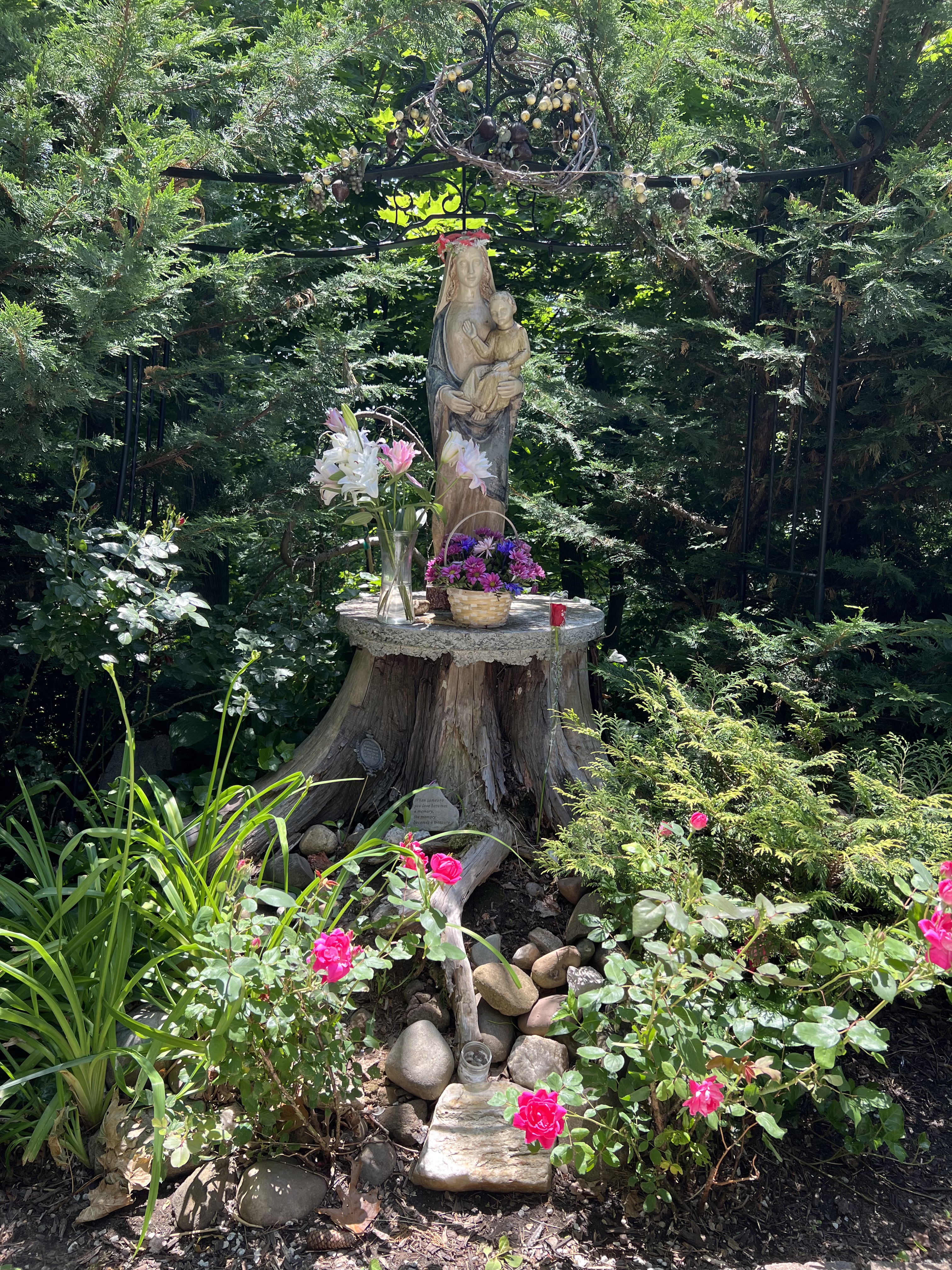
Yesterday, we celebrated the Feast of the Visitation with Mass and then a procession to our Mary Garden. In our generation, I think Mary’s mission is to make us aware that our world is a garden we should love and care for. We seem so uncaring and unloving to creation today, especially to the poor.
In the 14th century, the Black Death took countless lives in Europe, and many saw the earth itself the cause of the pandemic. In response, Mary Gardens were planted next to religious houses and churches. They were reminders of the Garden of Eden, where God first blessed the human family with the blessings of creation. God saw creation as good, a place of blessing.
Mary has a special place in creation. She has a special place renewing faith in the God of life. Our procession to our Mary Garden yesterday was a simple way of asking her help today, when creation in endangered.
She stands in our Mary Garden with her mighty Child in her arms, looking out on creation. Don’t lose hope in this planet of ours, she says. Care for it, cherish it, and pray that God, the Creator of heaven and earth, will move the hearts of the children of Adam and Eve, so that all the creatures of the earth, the birds of the sky, the fish of the sea will flourish.
“Pray for us, O Holy Mother of God, that we may be made worthy of the promises of Christ.”
More than a book of do’s and dont’s, of memorized commandments or little gems of human wisdom, Sirach puts human life and creation itself in the context of God’s plan. You can see that in Thursday’s reading:
“How beautiful are all his works!
even to the spark and fleeting vision!
The universe lives and abides forever;
to meet each need, each creature is preserved.
All of them differ, one from another,
yet none of them has he made in vain,
For each in turn, as it comes, is good;
can one ever see enough of their splendor?” (Sirach 42:20-25)
The simplest, smallest thing that passes quickly away, like a spark or fleeting vision, is beautiful–like the small pollinators at work now in our garden or the spring fireflies in our night sky, Each thing has its place in the universe, Sirach says. “All of them differ, one from another, yet none of them has God made in vain.”
Sirach sees creation as Pope Francis does in Laudato si’. “For each in turn, as it comes, is good; can one ever see enough of their splendor?” “Creation is given to us, not to be exploited or judged by our needs, but to reveal God’s glory. We live in a world of mutuality and interconnectedness, where the smallest have a place.”
Look at creation that way and look at humanity that way, Sirach tells the next generation, which may be looking ahead rather than seeing the present, especially the humble present. Be humble and don’t miss those who live humbly, the poor, the widow, the suffering, the sick. Be honest and truthful and generous and kind. See God in humanity, especially where God is often in disguise. See God in the smallest things of creation.
An old catechetical work, does Sirach offer a framework for catechesis today, which may be too humanly oriented in its approach? I think it does.
This week we’re reading selections in the lectionary from the Book of Sirach, a 2nd century BC writing. Sirach is a compilation of a Jewish father’s or grandfather’s advice to his son or grandson. Formerly, it was called the Book of Ecclesiasticus, because it was used extensively by the church to teach catechumens and young people about right living and morality.
What’s the advice to the young in this first reading?
In a generous spirit pay homage to the LORD, be not sparing of freewill gifts. With each contribution show a cheerful countenance, and pay your tithes in a spirit of joy. Give to the Most High as he has given to you, generously, according to your means.
My guess is its advice to give yourself generously to society, whether it’s the government, the church, the school, the neighborhood, or the world itself. In times like ours, particularly, the young may pull away from establishments, looking critically at their obvious flaws– many as they are.
Don’t choose isolation. Don’t give up on the world you live in, Sirach seems to say. It’s your world where you’re meant of find meaning and purpose. It’s your world where you’re meant to serve God.
Today we marked the 8th anniversary of Laudato Si’ , Pope Francis’ major encyclical on the environment, by an ecumenical prayer service in our garden, where we blessed our new solar panels. Children from Immaculate Conception Academy sang and offered reflections on the “Cry of the Earth” . Faith Leaders, Fr. James O’Shea, Sr. Teresa Fitzpatrick, Pandit Yoganand Ramnarain, and Fr. Luis Daniel Guivas offered prayers. Our local Congressman James Gennaro was also present and commented on our garden’s privileged place in the geologic development of this area of New York City.
Dan Misleh, from Catholic Climate Covenant and Page Gravely from Mission Energy led the blessing of our solar panels.
The Passionists, responding to Pope Francis’ call, have repositioned our retreat center here in Jamaica, New York – Thomas Berry Place, named for Passionist Thomas Berry, a leading figure in understanding the new story of our environment.
Appropriately, most of those who participated in the event today were young people, who inherit a world now crying out from wars and our poor care of creation and its most vulnerable members. I could not help but think that the trees surrounding us, the fresh green earth, the sparkling sun today was offering the promise of something better and beautiful.
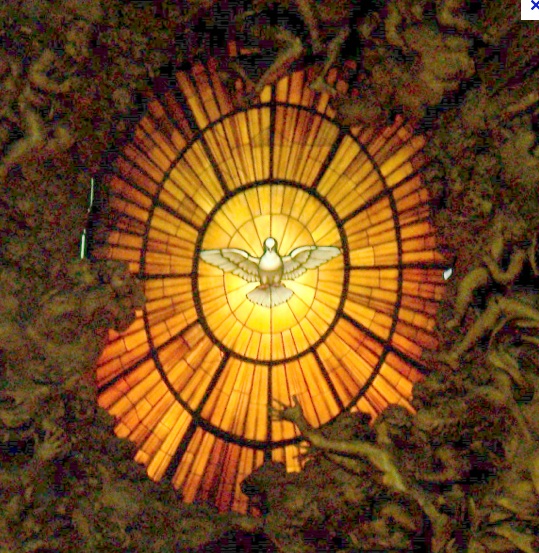
Jesus ascends into heaven and sends the Holy Spirit. Even as we try to grasp who Jesus is and what he has done, we are told the Spirit comes.
God is a mystery and we must respect the mystery of God as it is revealed: Father, Son and Holy Spirit. Jesus himself promises that the Holy Spirit will remain with us to “complete his work on earth and bring us the fullness of grace.”
How describe the Holy Spirit? I like this description of the Holy Spirit St. Cyril of Jerusalem gives in his catechetical homilies. Masterful catechist that he is, he adopts concrete language to approach mystery. Like Jesus, he uses two things we know: water and light.
“The water I shall give will become a fountain of living water, welling up into eternal life. This is a new kind of water, a living, leaping water, welling up for those who are worthy.
But why did Christ call the grace of the Spirit water? Because all things depend on water; plants and animals originate in water. Water comes down from heaven as rain, and always the same, it produces many different effects, one in the palm tree, another in the vine, and so on through all of creation. It does not come down, now as one thing, now as another, but remaining essentially the same, it adapts itself to the needs of every creature that receives it.
In the same way the Holy Spirit, whose nature is always the same, simple and indivisible, apportions grace to each one as he wills. Like a dry tree which puts forth shoots when watered, the soul bears the fruit of holiness when repentance makes it worthy of receiving the Holy Spirit. Although the Spirit never changes, its effects, by the will of God and in the name of Christ, are many and marvellous.
The Spirit makes one a teacher of divine truth, inspires another to prophesy, gives another the power of casting out devils, enables another to interpret holy Scripture. The Spirit strengthens one’s self-control, shows another how to help the poor, teaches another to fast and lead a life of asceticism, makes another oblivious to the needs of the body, trains another for martyrdom. The Spirit’s action is different in different people, but the Spirit is always the same. In each person, Scripture says, the Spirit reveals his presence in a particular way for the common good.
The Spirit comes gently, known by his fragrance, not a burden, but light, very light. Rays of light and knowledge mark his approach. With the tenderness of a true friend, the Spirit comes, and as a protector saves, heals, teaches, counsels, strengthens, and consoles. The Spirit comes first to enlighten the mind of one who receives him, and then, through him, the minds of others as well.
As light strikes the eyes of those coming out of darkness into sunlight enabling them to see what they could not see before, so light floods the soul of those called worthy of receiving the Holy Spirit and enables them to see things beyond human vision, things hitherto undreamed of.”
I know it’s not 9 days of a novena, but the gospel readings and other prayers for the 7th week of Easter prepare us for the feast of Pentecost very well. From Monday to Thursday they bring us to the Supper Room where Jesus spoke to his disciples. We can hear his promises to them made to us too.
Friday and Saturday they take us to the Sea of Galilee where Jesus, after his resurrection, forgave Peter for his denial and called him to “feed my sheep.” All the disciples shared Peter’s forgiveness and call. Now, we do too.
Monday the disciples say confidently, “Now you are talking plainly, and not in any figure of speech. Now we realize that you know everything and that you do not need to have anyone question you. Because of this we believe that you came from God.”
Now they know the full plan of God, now they see without “figures of speech.” “Do you believe now?” Jesus says, “Behold, the hour is coming and has arrived when each of you will be scattered to his own home and you will leave me alone.”
They don’t see or know, and we are like them. They needed the Holy Spirit to come. We have that same need. “Come, Holy Spirit, teach us the ways of God and be our Guide.”
In the Supper Room, Jesus promised his disciples peace in a troubled world and told them “take courage, I have conquered the world. “ (John 16:29-32) “Lord, you promise us too.”
Jesus prayed for this apostles in the Supper Room, the readings for Tuesday, Wednesday and Thursday tell us. He prays for us too. He will always pray for his own who are in the world, and we are his own. Prayer is one of the ways we hear his voice and know his promises. “Lord, teach us to pray.” ( John 17:1-19)
Friday and Saturday, we join the disciples at the Sea of Galilee where they went fishing, yet caught nothing. It was after they had scattered in the hour of his Passion and saw him risen from the dead, but now they had gone home, wondering, cautiously wondering, what was yet to come.
“Do you love me, Simon, son of John,” Jesus said to Peter. “Yes, Lord, you know I love you,” Peter answered. “Feed my lambs, tend my sheep,” Jesus said. (John 21: 1-19)
Jesus gave him forgiveness and called him to follow him. The others received the same gracious gift. We do too. He gave them the Holy Spirit, to renew them and renew the face of the earth.
Come, Holy Spirit, fill the hearts of your faithful and renew the face of the earth.
A devotional church before Vatican II depended on novenas, tridua and other prayers to celebrate the great church feasts. The renewed liturgy of Vatican 11 provides a richer preparation for the feast in the days that precede and follow them. It’s our novena for Pentecost.
May 22 Mon Easter Weekday [St Rita of Cascia,] Acts 19:1-8/Jn 16:29-33
23 Tue Easter Weekday Acts 20:17-27/Jn 17:1-11a
24 Wed Easter Weekday Acts 20:28-38/Jn 17:11b-19
25 Thu Easter Weekday [St Bede Venerable, St Gregory VII; St.t Mary Magdalene de’ Pazzi, Virgin] Acts 22:30; 23:6-11/Jn 17:20-26
26 Fri St Philip Neri, Acts 25:13b-21/Jn 21:15-19
27 Sat Easter Weekday [St Augustine of Canterbury,]
28 SUN PENTECOST SUNDAY Acts 2:1-11/1 Cor 12:3b-7, 12-13/Jn 20:19-23
The readings and feasts of this week are a wonderful preparation for the Feast of Pentecost on Sunday.
Luke in the Acts of the Apostles describes Paul hurrying through the Roman world in answer to the command of Jesus: “Go out into the whole world and preach the gospel. ” He’s inspired by the Spirit, like Jesus.
Like Jesus, Paul bids farewell to his followers, the elders from Ephesus, and urges them to continue the ministry given to them by the Spirit. ( Tuesday and Wednesday) “I know that after my departure savage wolves will come among you, and they will not spare the flock. And from your own group, men will come forward perverting the truth to draw the disciples away after them. So be vigilant.”
Like Jesus, Paul must go up to Jerusalem (then to Rome). “ Compelled by the Spirit, I am going to Jerusalem. What will happen to me there I do not know, except that in one city after another the Holy Spirit has been warning me that imprisonment and hardships await me. Yet I consider life of no importance to me, if only I may finish my course.
Paul experiences the passion of Jesus as he clashes with the Jewish leadership and appears before the Roman tribunal where Festus, judging him innocent yet in a quandary over the religious issues that are raised, sends Paul, at his own request, to be judged by the Emperor in Rome. (Thursday and Friday)
In the gospel readings through the week from John, Jesus bids farewell to his disciples and promises to be with them, no matter what. “In the world you will have trouble, but take courage, I have overcome the world.” (Monday) He will send them his Spirit.
“I pray for them,” Jesus says. “I do not ask that you take them out of the world, but that you preserve them from the Evil One.” (Wednesday) “I pray not only for these, but also for those who will believe in me through their word, so that they may all be one, as you, Father, are in me and I in you, that they also may be in us, that the world may believe that you sent me.” (Thursday)
Friday and Saturday’s gospel readings from John takes us to the Lake of Galilee where Jesus commissions his apostle Peter to feed his sheep. Peter will stretch out his hands and be led where he did not want to go–“signifying by what kind of death he would glorify God.” Paul too will be led to death like Peter. He will follow Jesus.
If we look hard enough we can find ourselves in the readings of Mass. Our first reading today of the Feast for the Ascension from the Acts of the Apostles says that Jesus appeared to his disciples for forty days after he rose from the dead, proving he was alive and speaking about the Kingdom of God. Yet as he speaks of the Kingdom of God, his disciples ask him “Is this time you will restore the kingdom to Israel.” Are you going to kick the Romans out of our land? They hardly appreciate the momentous truth he promises. He is ascending into heaven; they’re thinking only of the earth. (Acts 1:1-11)
Like his first disciples, our understanding of what God reveals to us in Jesus Christ is so limited.
I watched a PBS special the other day: “Searching: Our Quest for Meaning in an Age of Science.” The narrator was Alan Lightman, a theoretical physicist. Lightman began the program by describing an experience he had one night when he was out alone in a small boat on a lake. As he looked up into the stars he suddenly felt as if the world stood still. He became absorbed in something greater than himself. He was part of the universe.
As a scientist Lightman couldn’t explain the experience. Were did it come from? Could he have it again? So he asked some top scientists if something in our brains creates this experience? Can we create a form of life that helps us to hold on to such an experience? How does the brain work; how is formed from matter? How was the universe formed? Could they tell him?
Their answer was they’re studying the question. They promised they would find out the answer– someday.
Instead of looking for the meaningful life through science, some people today look for it in drugs, or sex or in a wholehearted pursuit of worldly success.
That’s why the Feast of the Ascension of our Lord into heaven is so important. It tells us to look for life in Jesus Christ. Our final destiny is heaven. Creation itself looks for its renewal in him.
The Ascension is part of the Easter mystery. On Easter Sunday, Jesus rose from the dead and for forty days, the scriptures say, he ate and drank and met with his disciples to build up their faith. Then, he ascended into heaven.
Rising from the dead on Easter was not the end of his story. He rose from the dead but did not continue to live on earth. No, after rising from the dead he ascended into heaven to “sit at the right hand of the Father”, our creed says. He entered another world beyond this one, a world greater than this one. There, from a place of great power, he fulfills his promise and extends his power to us here on earth. He promises us, as he promised his disciples, not to leave us orphans. He will come and take us to a home he has prepared for us.
Why don’t we know more about heaven? We have God’s promise: “Eye has not seen, or ear heard, or has it entered the human mind, what God has prepared for those who love him.” It’s a mystery we hope for. A poet once said that the happiness of heaven has been concealed from us so that we might endure life.
So often we pursue life solely on earth, and see death ending it all. Death is not meant to be our end. Heaven is our destiny, where tears are wiped away, where sadness is no more, where wrongs are righted, where reunion with those we love takes place, where we enjoy the presence of God and all the saints.
For now, we have only hints of that destiny. We have only the assurances of faith. Listen to those assurances in the prayers we say. We end our creed: “ I believe of the communion of saints, the forgiveness of sins, the resurrection of the body, and life everlasting.”
Listen to the prayer we say at Mass after we remember Jesus gives us his body and blood: “Remember our brothers and sisters who have fallen asleep in the peace of your. Christ, and all the dead, whose faith you alone have known, Admit them to rejoice in the light of your face, and in the resurrection give them the fulness of life. And grant also to us, when our earthly pilgrimage is done, that we may come to an eternal dwelling place, and live with you forever.”
Listen again to what St. Paul writes in his Letter to the Ephesians: “May the eyes of your hearts be enlightened, that you may know what is the hope that belongs to his call, what are the riches of glory in his inheritance among the holy ones, and what is the surpassing greatness of his power for us who believe, in accord with the exercise of his great might, which he worked in Christ, raising him from the dead and seating him at his right hand in the heavens,”





 The Victor's Place