Our readings from St. Matthew this week deal with the growing opposition to Jesus as he preaches and performs miracles in Galilee. IT foreshadows his final rejection in Jerusalem. Concluding this section, Matthew adds another source of opposition to Jesus that may surprise us. His own family from Nazareth seems to oppose him.
“While he was still speaking to the crowds, his mother and his brothers appeared outside, wishing to speak with him. [Someone told him, “Your mother and your brothers are standing outside, asking to speak with you.”]*But he said in reply to the one who told him, “Who is my mother? Who are my brothers?” And stretching out his hand toward his disciples, he said, “Here are my mother and my brothers. For whoever does the will of my heavenly Father is my brother, and sister, and mother.” (Matthew 12,47-50)
A little about family life at the time of Jesus may help us appreciate this gospel. For one thing, in Jesus’ day nuclear families– a mother, father and children living alone– were not the norm. In Jesus day families were extended families or clans, living and working together.
And so, the picture we sometimes have of the Holy Family– Mary, Joseph and the Child Jesus all by themselves in a small house in Nazareth– is not a realistic picture. Families in Nazareth, as we know from excavations in towns like Capernaum, lived in compounds, as they often do today in the Middle East, working together in the fields or in a business and offering each other support.
There were obligations to your extended family or clan. Everyone had to help in the harvest; you were expected to promote your family’s interest. The mother of James and John approaching Jesus looking for a good place for her sons in his kingdom was only doing what she was expected to do.
What we see in this gospel is the extended family of Jesus descending on him as he speaks to the crowds to remind him of his family obligations. What did they want to remind him of, we wonder? Were they off to a wedding or a funeral of a relative and were telling him to come along? Or, was the wheat harvest ready at Nazareth and they came looking for help? Or, they just wanted him for themselves for awhile? From Mark’s gospel we know some thought he was out of his mind.
Whatever it was, Jesus said that his family was those before him h meant to be with them. “ I belong here now,” Jesus seems to be saying to them. The kingdom of God, God’s family, God’s purpose, is greater than his family’s interests.
Today, of course, individualism is our predominant value, and it often stands in the way of family interests. It’s what “I” want that counts. But even today, family interests, family pressure can be strong and can get in the way of what God wants. Sometimes those closest to us, our own family, can be hard to manage, even though they want the best for us.
For the next three weeks we’re reading the Book of Exodus in our lectionary recalling the exodus of the Israelites from Egypt. We might tend to see the Israelites in Egypt only as poor helpless people captured by the Egyptians and given back-breaking work building their cities and farming their fields as slaves. But that’s not quite the way the Egyptians saw them, the words of today’s reading says. A Pharaoh, with no appreciation of the accomplishments of Joseph, doesn’t see them that way. He sees them as a powerful, growing threat to the Egyptian empire.
They can’t be trusted. They could sell us out. They’re such a threat that Pharaoh decides to eradicate them as a people, killing their males and enslaving their females.
The Hebrew title for the Book of Exodus is Shemoth (“Names”), from the book’s opening phrase, “These are the names of the sons of Israel who, accompanied by their households, entered into Egypt with Jacob.” They are the same sons of Israel who tried to kill their brother Joseph. They are offspring of Jacob and his wives, not poor, helpless people at all. They’re a powerful people. Moses recognizes repeatedly their destructive tendencies; they’re a “stiff-necked people. He calls them God’s, “degenerate children, a perverse and crooked race! … a stupid and foolish people” who pursue their own aims and not God’s will. (Deut 32: 1-12)
Yet God choses them for his own and leads them out of Egypt. The mystery of the Exodus is greater than the rescue of a poor helpless people. It’s God’s rescue of stubborn, foolish, sinful humanity.
We may also simplify the Exodus to one decisive act of God who opens the Red Sea and takes his people out of Egypt while destroying their enemies. But the 40 chapters of the book remind us the Exodus originally didn’t take place in a day, it was a long, complex process that had its ups and downs. Pharoah wasn’t a pushover; Moses had his doubts, his “stiff-necked” people backed down again and again. It was complex mystery, but God works in complexity.
The Exodus is an abiding mystery, still at work in us and our world. We especially remember it in the breaking of the bread.
18 Tue Weekday [USA: St Camillus de Lellis] Ex 2:1-15a/Mt 11:20-24
19 Wed Weekday Ex 3:1-6, 9-12/Mt 11:25-27
20 Thu Weekday [St Apollinaris, Bishop and Martyr] Ex 3:13-20/Mt 11:28-30
21 Fri Weekday [St Lawrence of Brindisi] Ex 11:10—12:14/Mt 12:1-8
22 Sat St Mary Magdalene Sg 3:1-4b or 2 Cor 5:14-17/Jn 20:1-2, 11-18
23 16th SUNDAY Wis 12:13, 16-19/Rom 8:26-27/Mt 13:24-43 or 13:24-30
This year in July our first readings are all from the Old Testament. From the 15th to 17th week of the year we will be reading from the Book of Exodus, the story of the exodus of the Israelites out of Egypt, lead by Moses. The mystery of the exodus is at the heart of the gospel story of Jesus. This is the only long scriptural narrative of the exodus story in our liturgy, so it’s worth attention.
On the Sundays of July we’re also following the Gospel of Matthew from chapters10-12. We’re reading Matthew 11-12 this week; same gospel readings are read twice this month.
Mary Magdalene, the first to announce the mystery of the Lord’s resurrection is remembered this Saturday.
In today’s gospel from Matthew 13, 1-23, Jesus offers a parable that interprets the mounting opposition he faces from many sides early in his ministry. For one thing, people in Chorazin, Bethsaida, Capernaum–cites and towns along the Sea of Galilee that received him warmly for his miracles and his teaching– begin to turn away from him. (Matthew 11,16-24)) The Pharisees and scribes, the Jewish religious leaders, accuse him of breaking Jewish laws and being possessed by the devil. (Matthew 12,22-34) Some of his own family from Nazareth come to take him home because they think he’d out of his mind. (Matthew 12, 46-50) Finally, his own disciples don’t seem to understand him.
What explains the desertion, opposition, lack of understanding towards him and his ministry that began with great acclaim?
The parable of the seed and the sower is Jesus‘ answer to what he faced, but also what the Word of God faces continually from humanity. God’s Word is received by the human heart like seed received in the ground.
The seed is life-giving, but if it falls on rocky ground it’s eaten right away by the birds of the air. If it falls on thin soil it fails after awhile because it has no roots; if it falls among thorns and weeds they choke it. But if it falls on good ground the seed produces fruit beyond anything you expect.
The parable first applies to the world Jesus faced, but it’s also a picture of how humanity in every age receives the Word of God. Our hearts can be hard, fickle, vain, proud, unheeding, but we can also accomplish great deeds. The seed’s not at fault, it’s the ground it falls on.
Still, the sower never stops sowing seed. life-giving seed. That’s also important to remember. God never withholds his grace.
In a poem called “Putting in the Seed” Robert Frost describes a farmer’s love affair with the earth. It’s spring and getting dark, yet the farmer keeps working his field. Someone from the house goes to fetch him home. Supper’s on the table, yet he’s a
“ Slave to a springtime passion for the earth.
How Love burns through the Putting in the Seed
On through the watching for that early birth
When, just as the soil tarnishes with weed,
The sturdy seedling with arched body comes
Shouldering its way and shedding the earth crumbs.”
Is Frost’s farmer zestfully casting seed on the waiting earth an image of God, the Sower, casting saving grace onto the world, in season and out, because he loves it so ?
Jesus’ parable of the seed and the sower seems to suggest it. The land surrounding the Sea of Galilee where Jesus ministered is still a fruitful land where crops grow in abundance, as they did in his time. It’s a blessed place. In a place like that, the sower scatters his seed confidently, not afraid where it goes: on rocky ground, or amid thorns, or on the soil that gives a good return. Because of his love and trust of the land, the sower keeps sowing.
Can we say that God the Sower sows blessed seed, no matter how badly our human world appears, or how badly it receives? Like the seasons that bring snow and rain, grace is never withheld. God, who loves it so, blesses the earth and all of us.
The sower still sows; the snow and rain still fall. That brings us hope.
Those who compiled our lectionary of scriptural readings after the 2nd Vatican Council had some decisions to make. The most important was how much of the scriptures should we read in the liturgy. One suggestion was to keep the one year lectionary we had and simply increase the yearly readings.
Catholics weren’t used to the scriptures, some said, so it would be better not to give them too much. The one year lectionary existed for centuries and it wasn’t unfamiliar to the people.
But the committee – about 20 or 30 experts in liturgy, scripture and catechetics– decided that wasn’t what the Second Vatican Council had in mind. It wanted the treasures of the scriptures opened up to the people of God in their fulness, and so they presented the three years lectionary we have today.
Another decision they had to face was how much of the Old Testament should we read. If Catholics were not familiar with the New Testament, they were less familiar with the Old Testament. There is a lot of “unedifying” material in the Old Testament and so whatever readings chosen should be “edifying.” if you look at our Old Testament readings, like the stories of Jacob, his wives and his sons– our readings this week– you can see they chose the more edifying stories of Jacob and his clan.
The committee also recognized that priests were less likely to make the Old Testament the subject of their homilies.
And so we began the story of Jacob last Saturday as Jacob steals the blessing of his father Isaac from his brother Esau, with the help of his mother, Rebekah. Then, this week we read about his dream of God showing him a stairway to heaven at Bethel, and his struggle in the dark wrestling with a mysterious stranger, then his son Joseph’s rises to power in Egypt after being betrayed by his brothers, then Jacob enters Egypt with his sons, finally on Saturday we read about his death and burial.
The readings tend to be edifying.
I quoted Robert Alter in a previous blog, who describes the unedifying ways of Jacob, his wives and his sons. Yet “God is the God of Abraham, Isaac and Jacob,” Alter concludes.
Can the Jewish scriptures help us face our own times, complicated and unedifying as they are? I think they can. God engages humanity, sinful as it is, and mercifully guides it towards the Promised Land. “In you and your descendants all the nations of the earth shall find blessing. Know that I am with you; I will protect you wherever you go, and bring you back to this land. I will never leave you until I have done what I promised you.”
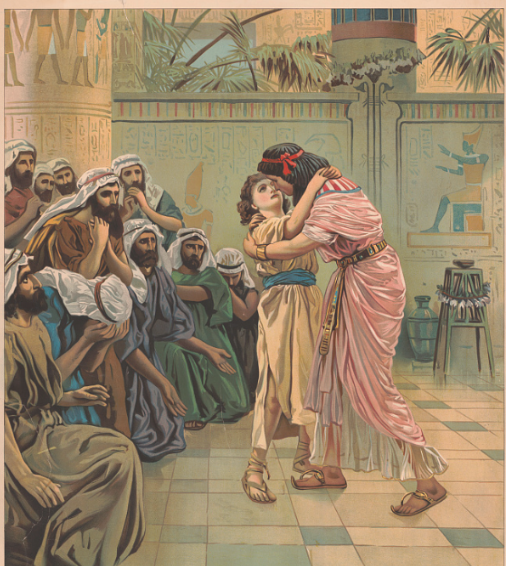
You can see too why Christian tradition saw the story of Joseph so important in the story of the Passion of Christ. In today’s reading, instead of disowning his lethal family, Joseph embraces them. “I am Joseph, your brother.” That’s what Jesus said to the world in the days of his passion, death and resurrection. “I am Jesus, your brother.” And he embraces us.
12 Wed Weekday Gn 41:55-57; 42:5-7a, 17-24a/Mt 10:1-7
13 Thu Weekday[Saint Henry] Gn 44:18-21, 23b-29; 45:1-5/Mt 10:7-15
14 Fri USA: Saint Kateri Tekakwitha, Virgin Memorial Gn 46:1-7, 28-30/Mt 10:16-23
15 Sat St Bonaventure, Gn 49:29-32; 50:15-26a/Mt 10:24-33 (388)
16 SUN FIFTEENTH SUNDAY Is 55:10-11/Rom 8:18-23/Mt 13:1-23 or 13:1-9
The Jewish Scriptures this week are about Jacob who, helped by his mother, secures the blessing of his father Isaac and enters into a convenant with God. We have only a few readings in our lectionary from Jacob’s story. I wonder if it’s because so much of it is complicated and unedifying. We should see his story for what it is: God engages humanity, sinful as it is, and mercifully guides it towards the Promised Land. “In you and your descendants all the nations of the earth shall find blessing. Know that I am with you; I will protect you wherever you go, and bring you back to this land. I will never leave you until I have done what I promised you.”
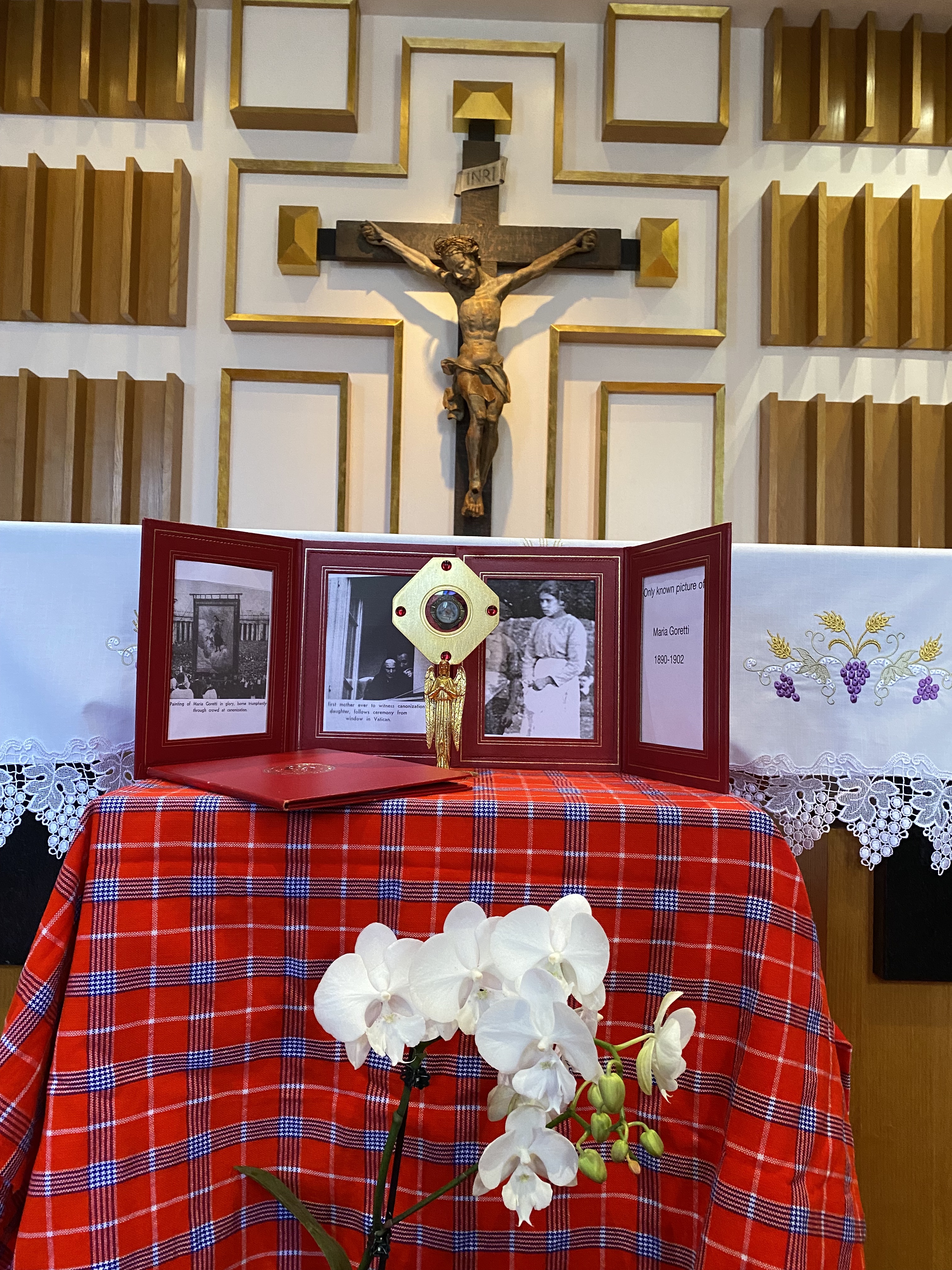
Maria Goretti was an 11 year old Italian girl who was killed today, July 6, 1902, during an attempted rape. She was the third of seven children in a family of migrant workers who worked on the farms near Nettuno, a city south of Rome.
Maria was minding her younger sister, Teresa, while her mother and the others were working in the fields, when a young man who lived in the same building, Alessandro Serenelli, tried to rape her. Maria was alone.
Alessandro attempted to seduce her a number of times before, but Maria resisted his advances. “God does not want this,” she said to him. The young man, enraged, stabbed her 14 times.
Maria survived for 24 hours and expressed forgiveness for Alessandro and promised to pray for him. For three years he was in prison unrepentant, and then he spoke of a vision he had of Maria, who offered him lilies, which he claimed “burned in his hands.”
Alessandro was released from prison and went to beg forgiveness from Maria’s mother, Assunta Goretti. She forgave him and the next day the two of them went to Mass and received Communion together.
They both attended Maria’s canonization as a saint in St. Peter’s Basilica in Rome. 500,000 people are present at her canonization.
Our first reading today, God’s command that Abraham sacrifice his only son, is particularly appropriate for today’s feast of Maria Goretti. Abraham is “our father in faith.” What are the limits of faith? Are we willing to give our life or the life of someone dear to us in answer to God’s will?
The article in Wikipedia on Maria Goretti is well done and worth reading.
What does it mean to believe? Abraham is “our father in faith,” and we read his story at the Easter Vigil, where it’s as a key reading, and in odd years from Monday of the 12th week of the year to Thursday of the 13th week of the year.
God invites us through the gift of faith to a life far beyond what we have now. “The Lord said to Abram: ‘Go forth from the land of your kinsfolk and from your father’s house to a land I will show you.’” It’s not a land we discover, but a land God gives. We have to leave a land we know and enter a land unknown.
Faith is a challenge as well as a gift. Genesis 22,1-19 begins: “God put Abraham to the test.” There no greater test for Abraham than to take his son, Isaac, “your only one, whom you love,” and go up a high mountain and “offer him up as a burnt offering.”
Intimations of the Passion of Jesus are here: “the high mountain… the only son, whom you love.” Approaching the mountain, Abraham takes “the wood for the burnt offering and laid it on his son Isaac’s shoulders.” “God will provide the sheep.” Abraham tells Isaac. He builds an altar and arranges the wood. “Next he ties up his son Isaac, and put him on top of the wood on the altar.” All suggesting the Passion of Jesus.
But when Abraham takes his knife, God stops him. “I know how devoted you are. You did not withhold from me your beloved son.” And God blesses him. “I will bless you abundantly and make your descendants as the stars of the sky and the sands of the sea.”
The Letter to the Hebrews says, “By faith Abraham, when put to the test, offered up Isaac, and he who had received the promises was ready to offer his only son of whom it was said, ‘Through Isaac descendants shall bear your name.’ He reasoned that God was able to raise even from the dead and he received Isaac back as a symbol.” (Hebrews 11,18-19)
“He reasoned that God was able to raise even from the dead.” He’s not a dumb executioner, immune to what he was to do, but “he reasoned,” he believed deep within that God was a God of life. Like Jesus, Abraham faced an absurd death and yet he believed in a God of love and promise. Like Jesus, his answer was “Not my will, but yours be done.”
The commentator in the New American Bible describes Abraham’s test. “… after the successful completion of the test, he has only to buy a burial site for Sarah and find a wife for Isaac. The story is widely recognized as a literary masterpiece, depicting in a few lines God as the absolute Lord, inscrutable yet ultimately gracious, and Abraham, acting in moral grandeur as the great ancestor of Israel. Abraham speaks simply, with none of the wordy evasions of chapters 12 and 21. The style is laconic; motivations and thoughts are not explained, and the reader cannot but wonder at the scene.”
We ask for Abraham’s faith.
Abraham’s sacrifice is portrayed frequently in the Christian catacombs of Rome where believers also faced the mystery of death. (above)
A medieval book for artists, “Speculum humanae salvationis,” the prime resource medieval artists used for comparing New Testament stories with the Old Testament, pairs the story of Abraham bringing Isaac to be sacrificed with the story of Jesus carrying his cross to Calvary, as shown in the example below:





 The Victor's Place