Author Archives: vhoagland

Tents, Temples, Churches and Chapels

“The tent, which was called the meeting tent, Moses used to pitch at some distance away, outside the camp. Anyone who wished to consult the LORD would go to this meeting tent outside the camp.” (Exodus 33:7)

God came down from a remote mountain top to a tent outside the camp, we hear in today’s reading from Exodus. The tent is taken down and pitched again as his people journey through the desert. Moses asks the Lord. “If I find favor with you, O LORD, do come along in our company.This is indeed a stiff-necked people; yet pardon our wickedness and sins, and receive us as your own.”

God comes along as his stiff-necked people pitch their tents. What a beautiful way to put it!

Eventually the tent becomes a temple, as the Israelites settle in the land. Psalm 15 sees the two together. “O Lord, who can abide in your tent? Who can dwell on your holy hill? Those who walk blamelessly, and do what is right, and speak the truth from their heart. ( Psalm 15.1–2)

N.T. Wright, in his book “The Case for the Psalms” comments on how unbelievable this presence of God seems in today’s world that, like the Epicureans of old, can only accept gods who are remote and uninvolved, or like the Stoics can only accept gods who are hidden in a pantheistic universe. 

The tent and the temple are not convenient gathering places “ they are the place of promise, the place of presence, the place out of all the earth where the living God has chosen to live.”

“The Temple turns out to be an advance foretaste of YHWH’s claim on the whole of creation. We are to see the Temple as establishing, so to speak, a bridgehead for God’s own presence within a world that has very determinedly gone its own way. It is a sign that the creator God is desiring not to provide a way to escape from the world (though it may sometimes feel like that) but to recreate the world from within, to set up a place within his creation where his glory will be revealed and his powerful judgments unveiled.”

(Wright, N. T.. The Case for the Psalms (pp. 91-92). HarperOne. Kindle Edition.) 

Can we see our churches and chapels in that light? Tents for God’s “stiff-necked people”. Temples where he always dwells. Churches that point to a recreated world.

17th Week: Readings and Feasts

JULY 31 Mon St Ignatius of Loyola, Ex 32:15-24, 30-34/Mt 13:31-35 

AUGUST 1 Tue St Alphonsus Liguori, Ex 33:7-11; 34:5b-9, 28/Mt 13:36-43 

2 Wed Weekday [St Eusebius of Vercelli; St Peter Julian Eymard ] Ex 34:29-35/Mt 13:44-46

3 Thu Weekday Ex 40:16-21, 34-38/Mt 13:47-53 

4 Fri St John Vianney Lv 23:1, 4-11, 15-16, 27, 34b-37/Mt 13:54-58 

5 Sat Weekday [Dedication of Saint Mary Major; BVM] Lv 25:1, 8-17/Mt 14:1-12

6 SUN TRANSFIGURATION OF THE LORD Dn 7:9-10, 13-14/2 Pt 1:16-19/Mt 17:1-9 

Readings from Exodus and Leviticus this week remind us how important the events at Sinai were for the Jewish people and, consequently, for us. God enters into a covenant with his people who receive a way of life. Still, they turn away looking for false gods. Moses intervenes for his errant people. I like his simple prayer: 

“If I find favor with you, O LORD, do come along in our company.This is indeed a stiff-necked people;  yet pardon our wickedness and sins, and receive us as your own.”

Jesus, High Priest of the new covenant and the new Moses, intercedes for us .

Matthew’s gospel this week offers readings from Jesus’ lengthy teaching by the sea. Parables summarize what he taught during his public life. At this point in the gospel, as Jesus faces increasing opposition, his disciples aware of the gathering storm ask about the meaning of the parable of the weeds and the wheat, a parable about the persistent power of evil in the world.(Tuesday)

Matthew’s readings conclude with the death of John the Baptist, (Saturday), a sign of Jesus’ approaching death. 

St. Ignatius Loyola, St. Alphonsus Liguori, St. John Vianney are important saints celebrated this week.

Sunday we celebrate the Feast of the Lord’s Transfiguration, which we can see linked to the Feast of Mary’s Assumption on August 15th.

Readings at : www.usccb.org

17th Sunday a: Treasures are out There

For this week’s homily, please watch the video below.

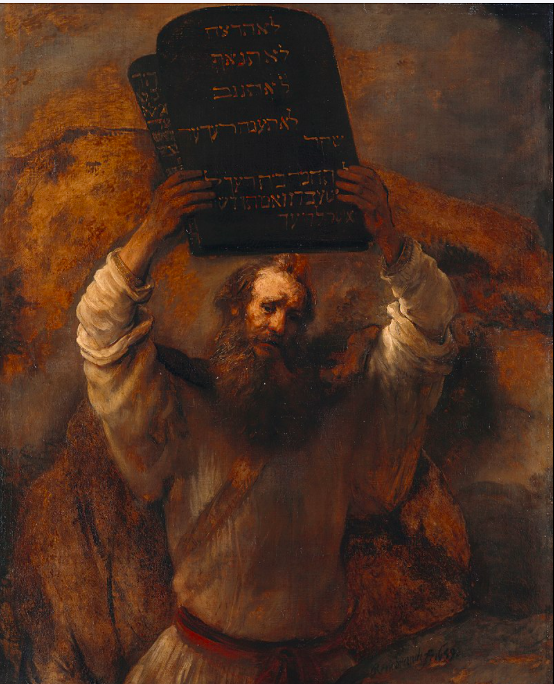
Keeping the Commandments

In those days:
God delivered all these commandments: “I, the LORD, am your God, 
    who brought you out of the land of Egypt, that place of slavery.
You shall not have other gods besides me. (Exodus 20:1)

We keep our covenant with God by keeping God’s law as outlined in our reading today from the Book of Exodus. “We should know that the ten commandments are fulfilled in the two precepts of the gospel: love of God and love of neighbor.” St. Caesarius of Arles says, “the Lord said in the gospel, ‘On these two commandments depend the whole law and the prophets.’

Moses proclaimed God’s law from the mountain to those on the desert road to the promised land after escaping Egypt. Jesus proclaimed that same law in his time. That law applies to us on the road today. The language may be old, but the message is not.

Years ago a man who had been away from church for years came to see me about returning.  I asked him why he was coming back. He told me that his daughter had asked him not long before why he wasn’t going to church, and he told her he was living a good life and didn’t need anything else.

She asked him what he believed, and he told her.

“That sounds like the ten commandments,” she said, “You’re missing the help you need to live that life you want.” 

“She was right,” he said. 

In Matthew’s gospel Jesus begins his ministry on the mountain, proclaiming the commandments as blessed teachings bringing happiness to us and to our world. Then he goes down to the people who “live in darkness and the shadow of death” to bring them life. A simple description of our church. 

Sustainable Development Goals:2023


In September 2015 world leaders at the United Nations agreed to work for 17 Sustainable Development Goals by 2030. The goals aim to “eliminate poverty, fight inequality and tackle climate change, while ensuring no one is left behind. They recognize that ending poverty must go hand-in-hand with strategies that build economic growth and address a range of social needs including education, health, social protection, and job opportunities, while also tackling climate change and environmental protection.” https://www.un.org/sustainabledevelopment/development-agenda/

The United Nations will convene a summit on the Sustainable Development GoalsDG 18-19 September 2023 at its Headquarters in New York, during the General Assembly high-level week. The goals at this point “are in deep peril. For the first time in decades, development progress is reversing under the combined impacts of climate disasters, conflict, economic downturn and lingering COVID-19 effects. The SDG Summit serves as a rallying cry to recharge momentum, for world leaders to come together, to reflect on where we stand and resolve to do more. It is a moment to recommit to a vision of the future that ensures no one is left behind. Fundamental shifts in commitment, solidarity, financing and action must put us back on track to end poverty, realize just societies and reset a balanced relationship with the natural world.” (UN report)

Cities are still an important focus for Sustainable Development, because today more than half the world’s population lives in cities and that number is expected to reach two-thirds by the year 2060. In cities “the battle for sustainability will be won or lost,” one UN expert remarked. https://www.un.org/sustainabledevelopment/blog/2018/07/un-forum-spotlights-cities-struggle-sustainability-will-won-lost/

The 11th goal of Sustainable Development is “making cities safe, inclusive, resilient and sustainable by 2030. Sustainability differs from city to city, but quality of life means among other things, adequate housing, work and employment, clean water and air, access to public transportation.

Today many countries are at war, building walls and wondering only about themselves. Why not think big? What can we do? The USA ranks 39th in fulfilling the goals. Our church, at least here in the US doesn’t seem active enough. Maybe better said: we’re not active enough. Yesterday’s blog was on the Israelites grumbling in the desert. Could be us.

Here’s the current report on the goals: https://sdgs.un.org/gsdr/gsdr2023

Water in the Desert

Water is a simple gift hardly noticed, until you are in the desert. At Mara, three days into the wildernes, “the people grumbled against Moses, saying ‘What are we to drink?’ Moses cried out to the LORD, who pointed out to him a piece of wood. When he threw it into the water, the water became fresh.” (Exodus 15)

Later, no water again, the people grumbled against Moses, saying, “Why then did you bring us up out of Egypt? To have us die of thirst with our children and our livestock?”

So Moses cried out to the LORD, “What shall I do with this people? A little more and they will stone me!”

The LORD answered Moses: Go on ahead of the people, and take along with you some of the elders of Israel, holding in your hand, as you go, the staff with which you struck the Nile. I will be standing there in front of you on the rock in Horeb. Strike the rock, and the water will flow from it for the people to drink. (Exodus 17: 2-6)

Moses striking the rock with his staff is a favorite painting in the ancient catacombs of Rome. Why, we wonder? Is it a reminder that the waters of baptism promise life, even to the dead? Water is a sign of more than physical life; it promises a journey to eternal life. Jesus makes it so.

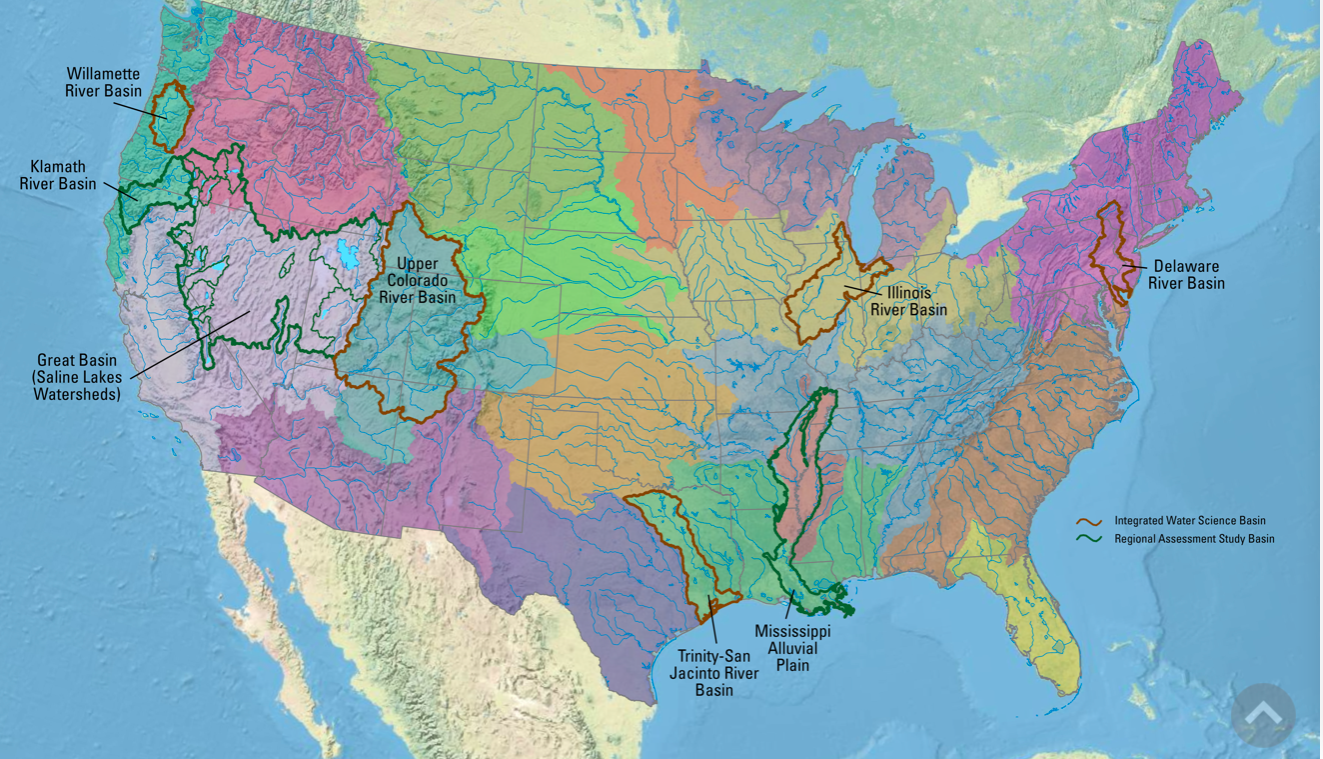
A map I came across recently showing the water sources that feed our country reminds me our own country could be a lifeless desert without water.

USGS. gov

Ann of the A,B,C’s

Ann and Mary,

Last Sunday was the 3rd World Day for Grandparents and the Elderly. Pope Francis began that celebration three years ago, to be celebrated on the 3rd Sunday of July,  linking it to today’s Feast of Sts. Joachim and Ann, July 26. 

This year he linked the celebration with the upcoming World Youth Day, August 1-6 in Lisbon, Portugal. 

Speaking at the Angelus on Sunday, Pope Francis appeared at the window of the Apostolic Palace together with a young man and his grandmother, and invited the crowd in St. Peter’s Square to give them a round of applause.

“May the proximity of the two World Days offer us an invitation to promote a much-needed covenant between generations, because the future is built together, as we share experiences and as young people and the elderly care for each other,” he said.

Don’t forget the contributions of grandfathers and grandmothers, Francis said. Earlier in his homily at Mass for the World Day for Grandparents and the Elderly, the pope called on politicians everywhere to implement policies that protect the rights and health of the elderly. 

Crowded cities, he said, risk becoming “centers of loneliness” if societies forget their elders or “banish them as unprofitable waste”. 

“May we not chase after the utopias of efficiency and performance at full-speed,” said the Pope, “and become incapable of slowing down to accompany those who struggle to keep up. Please, let us mingle and grow together.”

The pope uses popular religion, the liturgy and the daily scriptural readings in a masterful way to give meaning to life. He knows the words to say, the gestures to use, the simple beautiful human acts that touch minds and hearts.

Yesterday, I was on the phone with a cousin of mine who was taking care of her little grandson, Patrick. She told me she was helping to potty-train him and teaching him to say his prayers. She even had Patrick say some of the Our Father for me. Appropriately, her name is Nancy, a nickname for Ann. 

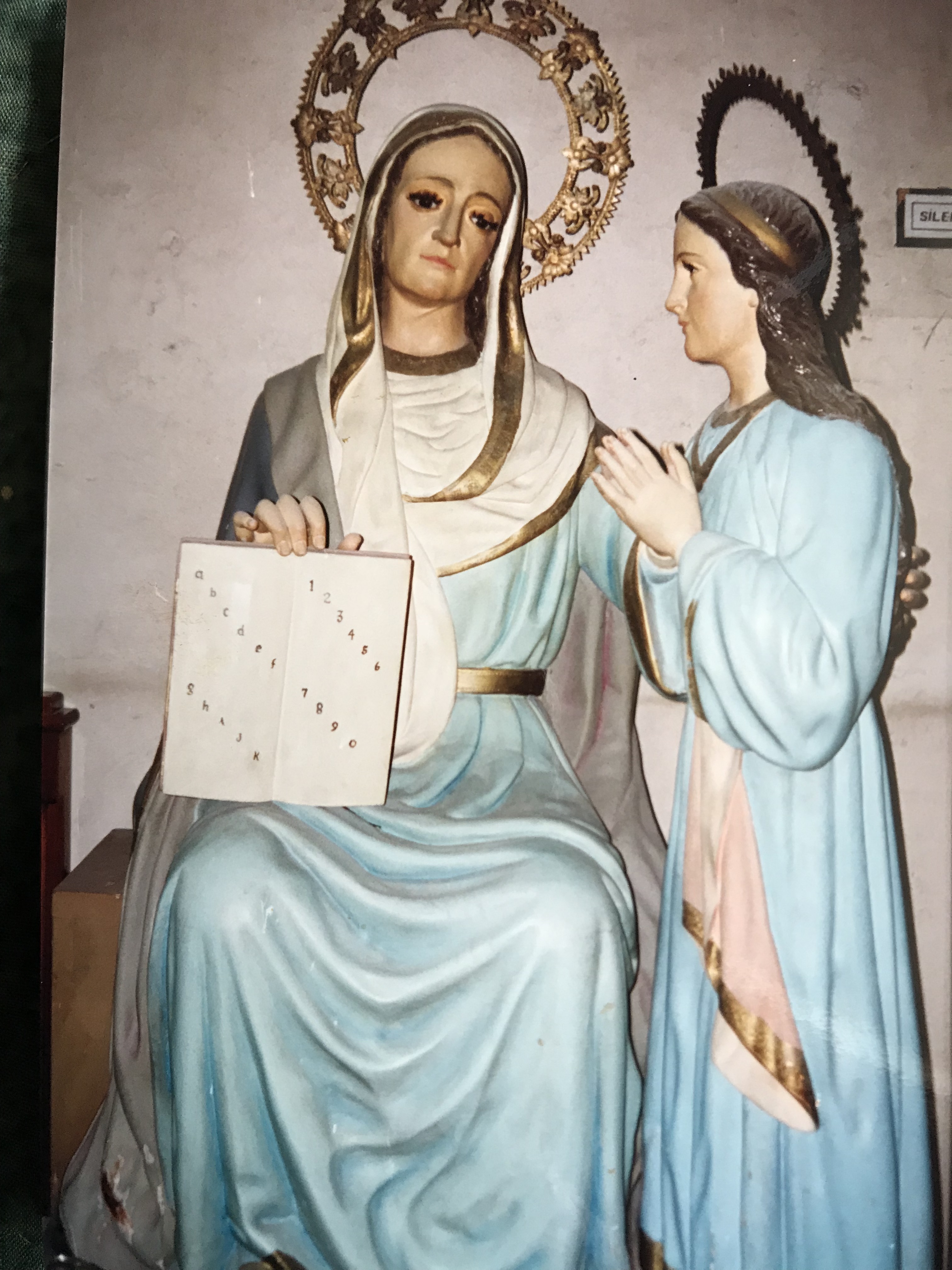
Years ago, in the ancient cathedral in Tegucigalpa, Honduras, I saw a large statue of St. Ann teaching her child Mary from a book. (Above) Usually statues like this show Ann teaching Mary how to read the Bible, but this was something different. Ann was pointing out 1,2,3,4 and A,B,C D– the numerals and the letters of the alphabet. 

Saints like Ann and Joachim, grandmothers and grandfathers, have the power to throw light in the simplest of ways on our lives and our times. Holiness is as simple as teaching a child A,B,C’s and all the rest. Don’t forget them.

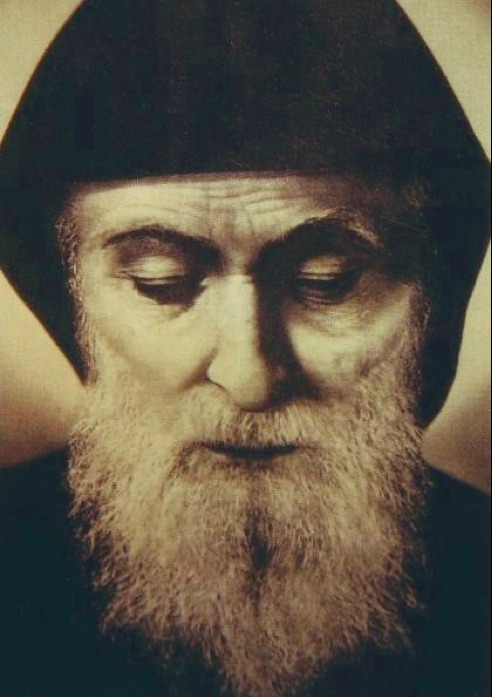
St. Sharbel Makhlouf (1828-1898)

Born in Lebanon, Sharbel Makhlouf was brought up in a tight knit village community high up in the mountains by an uncle who didn’t approve of his love of prayer and solitude and had other plans for him. Sharbel broke from family and village to enter the monastery of St. Maron where he became a monk and then a priest.

Then, following the example of the desert saints, Sharbel became a hermit, distancing himself further for the next 23 years from the society he lived in.

But like the desert saints– like St. Anthony of Egypt who attracted others into the desert by his life of prayer and solitude– Sharbel became a trusted guide and friend to those who came to the small rooms he provided in his hermitage for those seeking his wisdom.

They found him free from the lure of success, the love of money, the demands of society and family expectations. He reminded them of what’s above all: Love God and love your neighbor as yourself.

Many miracles occurred after his death. Pope Paul VI said of him at his canonization in 1988: ” May he make us understand, in a world largely fascinated by wealth and comfort, the paramount value of poverty, penance and asceticism, to liberate the soul in its ascent to God.”

16th Week: Readings and Feasts

JULY 24 Mon Weekday [Passionist Martyrs of Damiel, St Sharbel Makhlūf,] Ex 14:5-18/Mt 12:38-42 

25 Tue St James,  2 Cor 4:7-15/Mt 20:20-28 

26 Wed Sts Joachim and Anne Ex 16:1-5, 9-15/Mt 13:1-9 

27 Thu Weekday Ex 19:1-2, 9-11, 16-20b/Mt 13:10-17 

28 Fri Weekday Ex 20:1-17/Mt 13:18-23 

29 Sat Sts Martha, Mary and Lazarus Ex 24:3-8 /Jn 11:19-27 

30 17TH SUNDAY  1 Kgs 3:5, 7-12/Rom 8:28-30/Mt 13:44-52 or 13:44-46

We continue to read from the Book of Exodus. Pharaoh chases after the Isrealites and suffers a disastrous defeat, but still there’s a long way to go. They reach Sinai, where God speaks from the mountain and initiates a convenant with his people.

Matthew’s gospel describes the opposition Jesus faces and his response in parables. He is the Sower. The weekday gospel on Saturday repeats the Sunday gospel of the weeds and the wheat.

The Passionists remember on July 24, the Martyrs of Damiel, 26 religious killed in the Spanish Civil War. An inspiring story.

July 25th is the Feast of St. James, the apostle celebrated this month. July 26 is the popular feast of Joachim and Ann, parents of Mary.

July 29th we celebrate the family that welcomed Jesus to their home in Bethany: Martha, Mary, and their brother Lazarus. Once just the feast of Martha, the feast is extended now to include Mary, and their brother Lazarus. The new designation makes clear that Mary of Bethany is not the same as Mary Magdalene.