Author Archives: vhoagland

27th Week: Readings and Feasts

Luke’s Gospel, read this week, counts the journey of Jesus to Jerusalem not in miles, but in people. The earnest scribe on Monday, Martha and Mary on Tuesday, Mary his mother on Saturday. 

On Friday Jesus faces the charge of blasphemy on his journey to Jerusalem. The mystery of his Passion also takes place on the journey to Jerusalem.

Prayer is necessary on the journey to Jerusalem. Jesus teaches the Our Father and patient prayer on Wednesday and Thursday.

Three readings from Jonah, the reluctant prophet, this week

27th Sunday a: Tenants in the Vineyard of the World

For this week’s homily, please watch the video below.

Laudato Deum: the Climate Crisis

Today,  October 4th, the Feast of St. Francis of Assisi, 8 years after his encyclical Laudato Si’, Pope Francis released his exhortation “Laudato Deum” on the climate crisis. 

In our first reading tomorrow the priest Ezra assembled the people to renew their loyalty to God’s covenant and learn the law of God. (Nehemiah 8:1-12) He called all the people to the critical task of rebuilding God’s Temple. 

It isn’t just about climate change Pope Francis speaks; it’s climate crisis. “The world in which we live is collapsing and may be near the breaking point.” You can’t miss the urgency for action in his letter. “No one can ignore the fact that in recent years we have witnessed extreme weather phenomena, frequent periods of unusual heat, drought and other cries of protest on the part of the earth that are only a few palpable expressions of a silent disease that affects everyone.”

Some ridicule the claims of danger; Francis takes them seriously and lays out the facts the scientific world provides. He also points out the responsibility of the richer countries for this situation and deals with the arguments for inaction that are raised, even by members of the Church.

“ I feel obliged to make these clarifications, which may appear obvious, because of certain dismissive and scarcely reasonable opinions that I encounter, even within the Catholic Church. Yet we can no longer doubt that the reason for the unusual rapidity of these dangerous changes is a fact that cannot be concealed: the enormous novelties that have to do with unchecked human intervention on nature in the past two centuries.”

There’s a growing belief, the pope says, that thinks “as if reality, goodness and truth automatically flow from technological and economic power as such”. [14] As a logical consequence, it then becomes easy to accept the idea of infinite or unlimited growth, which proves so attractive to economists, financiers and experts in technology”.

Pope Francis outlines the efforts the nations of the world have made so far to deal with the crisis and finds them lacking. He calls for a new level of power to arise, from the grassroots, to energize the situation of political inertia. At the same time, he calls for the nations of the world to fulfill their responsibilities at the upcoming meeting on the climate,  COP28 in Dubai.

Finally, like Ezra, Francis speaks to people of faith to embark on “ a pilgrim of reconciliation with the world that is our home,”  to build it to be a beautiful home.

One interesting point for us in the United States. The pope begins his exhortation quoting from the US Bishops: “This is a global social issue and one intimately related to the dignity of human life. The Bishops of the United States have expressed very well this social meaning of our concern about climate change, which goes beyond a merely ecological approach, because ‘our care for one another and our care for the earth are intimately bound together. Climate change is one of the principal challenges facing society and the global community. The effects of climate change are borne by the most vulnerable people, whether at home or around the world’”.

He ends his exhortation with this observation: “If we consider that emissions per individual in the United States are about two times greater than those of individuals living in China, and about seven times greater than the average of the poorest countries, [44] we can state that a broad change in the irresponsible lifestyle connected with the Western model would have a significant long-term impact.”

A Synodal Church

The Catholic Church’s Synod on Synodality opens tomorrow, the Feast of St. Francis of Assisi. It’s purpose is to bring about a church that is more “synodal.” What does that mean?

The prophets Zechariah, Nehemiah and Baruch, our readings this week, may help understand its meaning. They wrote during the Restoration Period, when some Jews returned to Jerusalem from exile about 540 BC hoping to restore the Temple. Some Jews who remained in the city did not think it was time to rebuild at all. Others wanted it rebuilt as a temple for Jews alone. 

Zechariah, like other prophets then, saw a temple that was home for all nations. “In those days ten men of every nationality, speaking different tongues, shall take hold, yes, take hold of every Jew by the edge of his garment and say, ‘Let us go with you, for we have heard that God is with you.’ (Zech 8:23)

I believe this synod has been called by Pope Francis to make the Catholic Church a home for all nations. For that reason, those gathered for the synod are bishops, as well as men and women, from all nations.

Some are worried the synod is going to change basic church beliefs and practices. Five cardinals recently expressed doubts, which Pope Francis answered publicly yesterday on the Vatican website. (https://www.vaticannews.va/en.html) Their doubts were about changing church doctrines, marriage, women’s ordination, church structure and forgiveness. 

The media seems mainly interested in the issues of same sex marriage and the ordination of women. Here’s Pope Francis’ answer to their question about marriage. The cardinal’s wanted a “yes or no” answer, but the pope presented a more nuanced response. 

I ended my homily today at the 11 AM Mass with a question. “What kind of church will your kids like to belong to?” I think Pope Francis is pointing it out.

26th Sunday a: Where is God is All of This

For this week’s homily please watch the video below.

26th Week: Readings and Feasts

We hear this week from Zechariah, like Haggai, a prophetic voice in the Restoration Period. He (scholars say there are two writing under the name)  urges the temple be rebuilt and promises if it’s rebuilt Jerusalem will regain its place among the nations. In fact all nations will come to make it a greater kingdom,  but it will not be soon. Joining Zechariah are Nehemiah and Baruch, prophets who spoke also during the Restoration Period.

They tell us we’re called today to rebuild the church and the world.

We begin this week reading the long portion of Luke’s gospel describing Jesus’ journey from Galilee to Jerusalem–chapters 9,51-18,14. The journey ends in his Resurrection. One sentence dominates these chapters: “Follow me.” Another teaching we hear repeatedly: “Don’t look back.”

Some saints we honor this week are honored by the whole church: St. Jerome, St. Therese and St. Francis of Assisi. We’re reminded too of a world beyond ours where angels dwell. Some of them look after us. We even have Guardian Angels.

25th Sunday a: The Harvest is Great

For this week’s homily, please watch the video below.

24th Sunday a: Forgiveness

For this week’s homily please watch the video below.

Blessed be God for Olive Trees

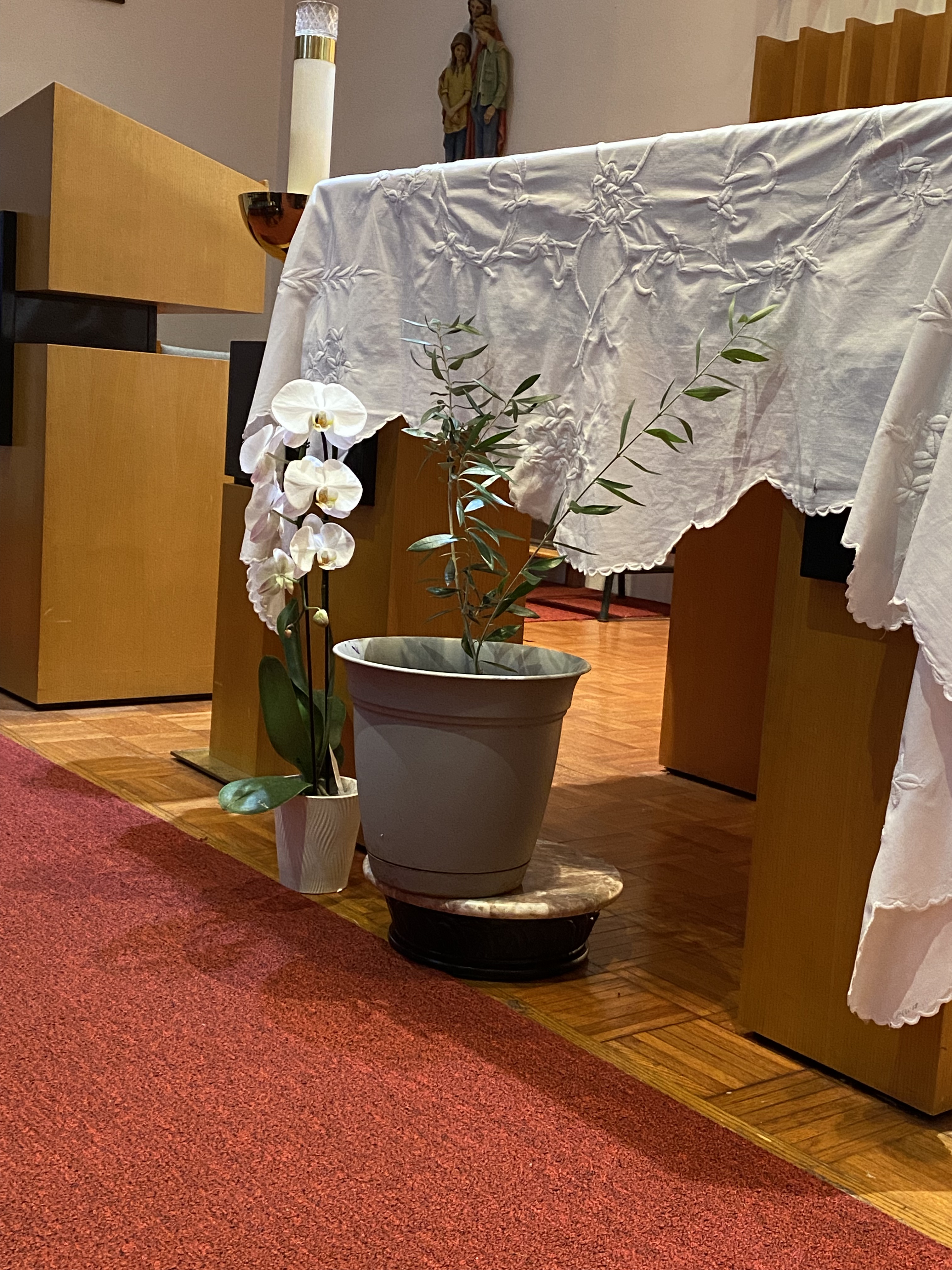
We have an olive tree before our altar today. Olive trees were highly prized in biblical times and centuries  afterwards for oil that nourishes and heals. They bring life. For the ancients an abundance of olive trees was a sign of God’s blessing; their destruction or lack of fruitfulness was a test of faith.

The Prophet Habakkuk, for example, saw the disappearance of olives testing his faith, yet still he rejoiced in the Lord, “though the yield of the olive fail, and the terraces produce no nourishment, though the flocks disappear from the fold and there be no herd in the stalls.” (Habakkuk 3)

Faith is tested in different ways in different times. In the first three centuries Roman persecutions led to martyrdom. By the 4th century, Roman authorities drove Christian bishops who disagreed with them into exile and tried replacing them with more pliable leaders. For bishops like John Chrysostom– whose feast we celebrate September 13 – Athanasius, Basil, Gregory Nazianzen, exile was their test of faith. 

Faith is always tested. How is it tested today? Are we being tested by radical change affecting our society, our church and creation itself?

Blessed be God for Chinese Maples

The Chinese, or Japanese Maple ( Acer palmatum) is not a native of North America but,  as its name suggests, of Asia. 

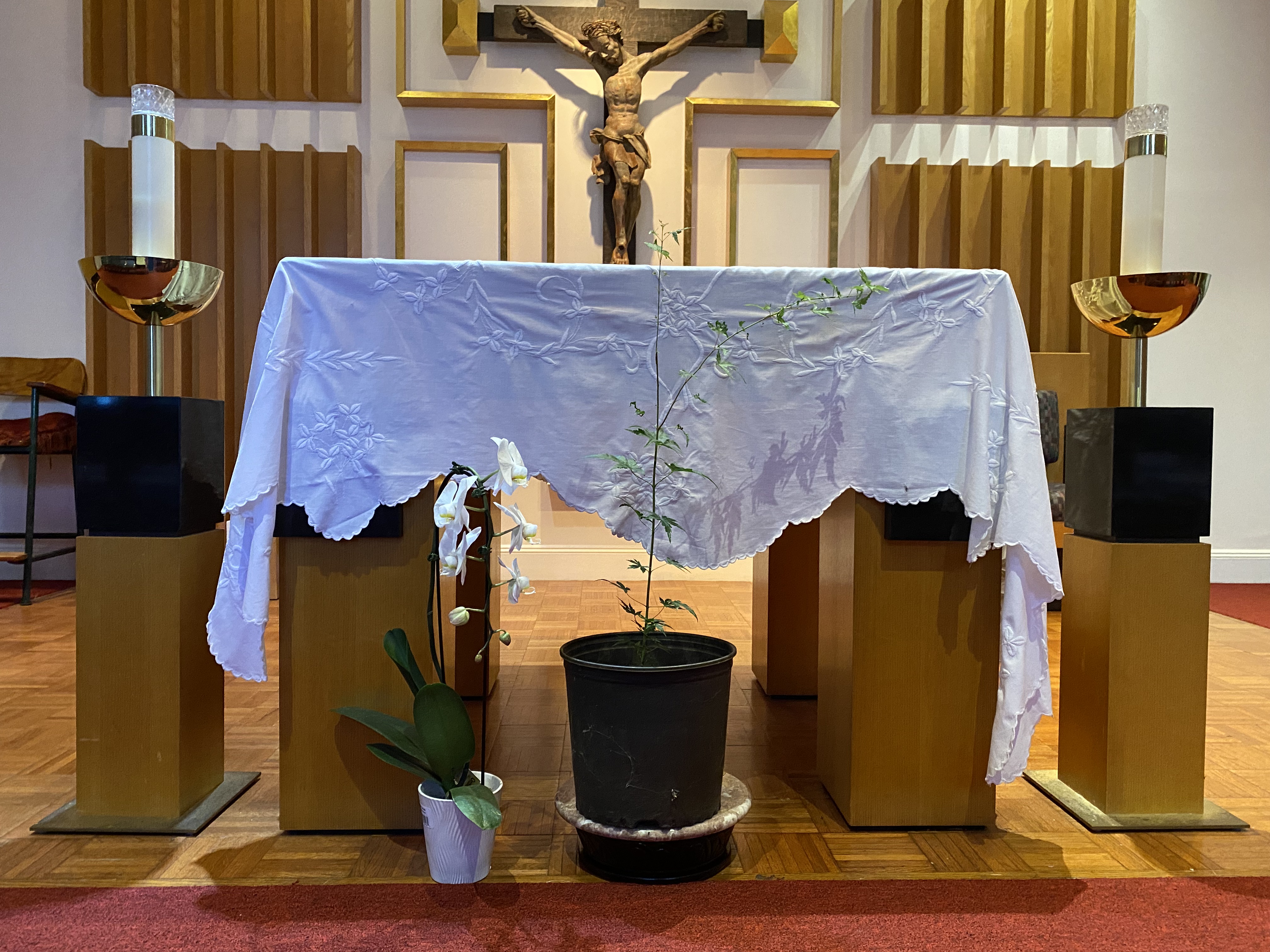
The Chinese maple at our altar today during the Season of Creation is a descendant of the Chinese Maple planted at Fr. Thomas Berry’s research center in Riverdale, NY, by Brother Conrad Fiederspiel, CP, one of Tom’s devoted friends and assistants. Conrad gave a cutting of that tree to my sister, who planted it in her back yard about 25 years ago. It’s now provided a shoot for us.

The Chinese Maple grows to the height of 15 to 20 feet. It has an interesting growth pattern in its limbs and brilliant leaves in the fall, something like the pattern in Thomas Berry’s own life. 

So many of our plants, flowers and trees are like the Chinese Maple – immigrants in new lands. They witness to the connectedness of creation. They bring new refreshing life. We can’t live without them. Only a few might we call “invasive species.”

Victor Hoagland, CP