Desire for God is at the heart of prayer, St. Augustine says, and so we need to “pray always with unwearied desire.” Prayer does not begin with a list of needs for God who already knows them. Prayer begins with our thirst for the One who loves us and gives us life.
We set aside certain times to eat because we’re not always aware of our hunger; we set aside times to pray because we’re not aware of our desire. We need to put aside certain times to pray.
“At set times and seasons we pray to God in words, so that by these signs we may instruct ourselves and mark the progress we have made in our desire, and spur ourselves on to deepen it. “
The words of prayer are teachers of prayer, we grow in prayer by paying attention to them.
“The more fervent the desire, the more worthy will be its fruit. When the Apostle tells us: Pray without ceasing, he means this: Desire unceasingly that life of happiness which is nothing if not eternal, and ask it of him who alone is able to give it.” (Letter to Proba)
“O Lord, open my lips.” “O God, come to my assistance.”
The liturgy begins with short prayers like this, asking God to stir up the gift of prayer in us.. Open our lips, come to help. Stir up the desire we have for you, O God. Desire is itself your gift.
”The heavens declare the glory of God; the firmament proclaims the works of his hands. Day unto day pours forth speech; night unto night whispers knowledge.There is no speech, no words; their voice is not heard. A report goes forth through all the earth, their messages, to the ends of the world.” (Psalm 19: 2-5)
Without words, creation speaks of the glory of God and reveals the One who made it. Day by day, night by night it whispers knowledge. Through things small and great, God’s creation reveals its Creator.
“Ever since the creation of the world, his invisible attributes of eternal power and divinity have been able to be understood and perceived in what he has made.” Still, human beings turn from the God of creation, creating gods of their own, St. Paul says in his Letter to the Romans,
Yet, God bestows glorious blessings through his Son, Jesus Christ, who comes as God’s Word made flesh and dwells among us. In the fullness of time he comes; in humble flesh he comes and taking the form of a slave, died on a cross.
He is exalted and all creation is exalted in him. His death brought life to the world. His passion is the sign of God’s love for humanity and all that was made.
Jesus Christ calls us to follow him.
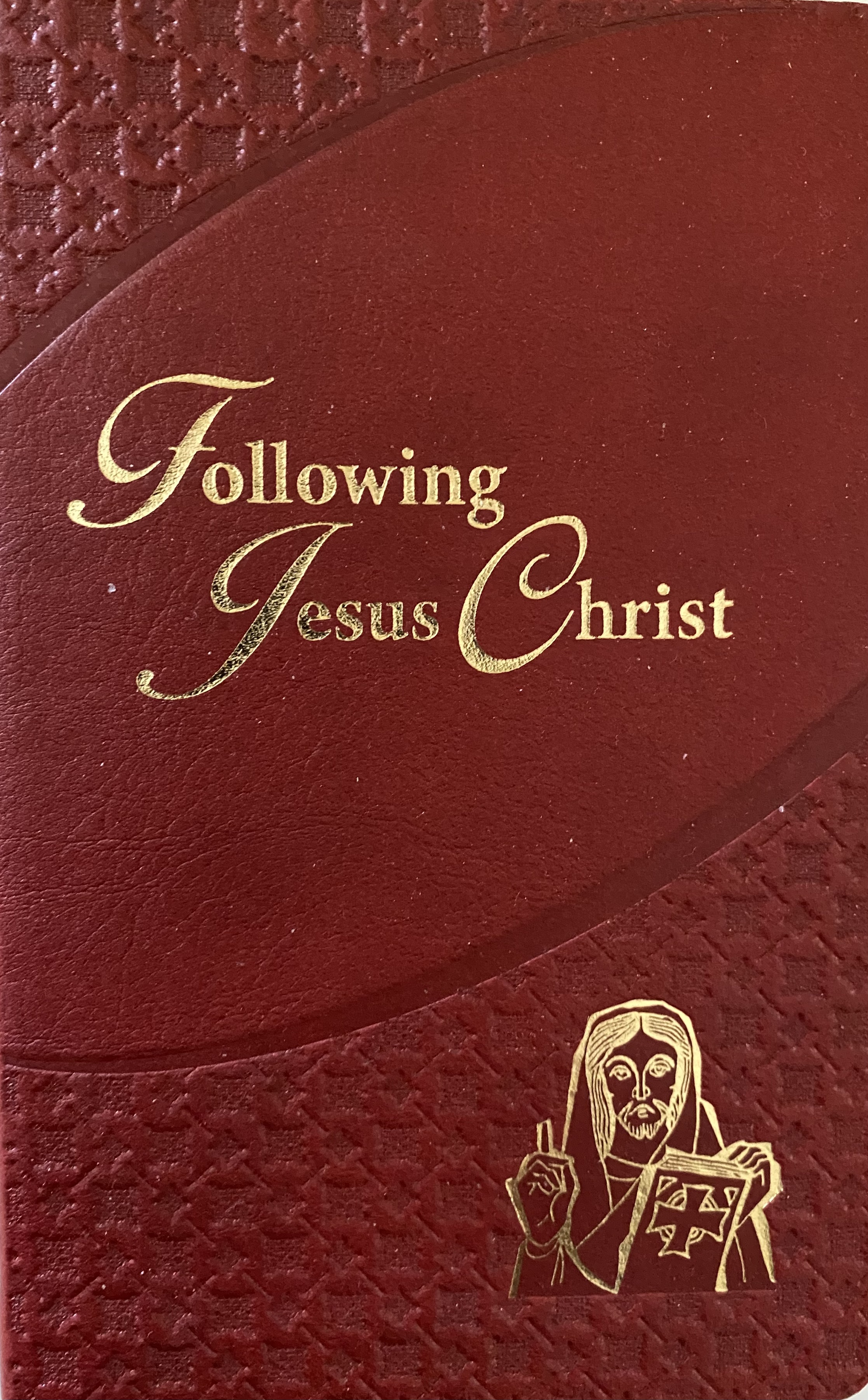
The revised edition of Following Jesus Christ, a prayerbook I edited, will be available this week. The preface follows the thought of Paul’s Epistle to the Romans. I’m more and more aware of letting creation whisper knowledge of God to us. Jesus entered humbly into our world and brought God’s saving grace to it. Here’s a picture of the prayerbook which has the four gospels of the Passion, meditations of the Passion of Jesus, morning and evening prayers, the mysteries of the Rosary, prayers for our needs, and other prayers. $12. 00
God reveals himself in creation, Paul the Apostle reminds us as he begins his Letter to the Romans. “Ever since the creation of the world, his invisible attributes of eternal power and divinity have been able to be understood and perceived in what he has made.” (Romans 1:16-25) God reveals himself in creation, not just to one people, the Jews, but to all people.
“The heavens declare the glory of God,” our psalm response for Tuesday declares. Yet human beings, blind to the God of creation, turn from this revelation and create gods of their own, and they lose sight of the One who made all things.
As an apostle sent by God into a world blinded by this sin, Paul announces a message of recreation and grace. God sends Jesus Christ, his Son, as our Savior and Lord.
Paul’s message takes on added meaning in a world failing to care for creation itself.
In his letter Laudato sí , on caring for the earth our common home, Pope Francis notes that certain times in history provoke a spiritual crisis which leads to a deeper faith in God. The Babylonian captivity when the Jewish people went into exile in the 6th century before Christ and the fierce Roman persecution of Christians at the beginning of the 4th century AD are examples he cites.
These crises led to “a growing trust in the all-powerful God: ‘Great and wonderful are your deeds, O Lord God the Almighty! Just and true are your ways ‘ (Rev 15:3). The God who created the universe out of nothing can also intervene in this world and overcome every form of evil.” (74)
Our world now is paralyzed and will not be the same. Are we at one of those crucial moments? Will God intervene? God, the Father, Creator of heaven and earth, God who is surprisingly creative?
Don’t forget God, the Creator, the pope says. If we do ” we end up worshipping earthly powers, or ourselves usurping the place of God, even to the point of claiming an unlimited right to trample his creation underfoot. The best way to restore men and women to their rightful place, putting an end to their claim to absolute dominion over the earth, is to speak once more of the figure of a Father who creates and who alone owns the world. Otherwise, human beings will always try to impose their own laws and interests on reality.” (75)
Important as it is, science alone is not enough, the pope says. We need to look also to our own tradition for hope and inspiration. Our prayers, our sacraments, currents of our spirituality waiting to be recognized and developed can guide us now to what God has planned from eternity.
Paul’s Letter to the Romans speaks for today as well as yesterday.
If sacred history tells us anything, God the Creator never stops fashioning a beautiful unknown.
Paul’s Letter to the Romans, a basic statement of faith, is timely. We need to follow the path that leads to creation.
As we look at the Holy Land and the poor city of Gaza today, here are some reflections of Fr. Joachim Rego, Passionist Superior General on the Feast of St. Paul of the Cross, coming up this week.
“Recently, during the International Theological Congress on The Wisdom of the Cross in a Pluralistic World which our Congregation hosted at the Pontifical Lateran University in Rome, I was introduced to a woman who, as I tried to find out more in our conversation about why she was participating in the Congress, revealed that she was a medical doctor who had been working with an NGO in the Tigray region which is the northernmost regional state of Ethiopia. You may be aware that there has been an ongoing civil war in that region since the beginning of November 2020 which has left thousands dead and more than 350,000 people displaced and suffering from famine, disease and shortage of medicines. For many weeks this conflict was international headline news until some more deserving or sensational news took centre-stage.
In our brief conversation, the lady doctor, with much emotion, said to me that no one was speaking about Tigray. She said: “There are thousands of children I was treating who are suffering terribly and who will die unless they get anti-coagulant drugs and essential medicines. We hear nothing about them.” Feeling somewhat paralysed in the face of such a statement, I said what I thought might have been the answer. “How can we help?”, I asked. “Is there a way of sending some money to help?”
At this, the doctor broke down in tears, without accepting my generous offer of financial assistance and was not able to speak anymore. Struck by her love and concern for the suffering children of Tigray for whom I felt she was weeping, I could find no words to speak either, but was also choked and moved to tears myself. She simply said: “Father, my children will die because they cannot get the basic medicines and we hear nothing about them.” With these words we parted.
As I reflected on this encounter which moved me so much, I thought, obviously, for this woman money was not “THE” issue, nor “THE” answer. Her comportment spoke of a much deeper love, concern and connection with “her children” and people in faraway Tigray who are suffering and dying. And who is speaking about them or remembering them? Like it tends to happen, they become “the forgotten”, mere victims and statistics of war and violence, poverty and injustice, abuse and disadvantage. They are the nameless, un- fortunate and discarded in our world. “We hear nothing about them”. Usu- ally after an initial short period of focus, mainly through news outlets, which can temporarily move our hearts with sorrow and sadness, their plight disappears from the limelight, and we hear nothing much anymore…and life goes on. I couldn’t help but think of my own advantage and privilege in being assured of my supply of medicines every month to keep me comfortable, secure and breathing!
The reaction and demeanour of this woman doctor, however, spoke to me of a person who had a HEART for those who are suffering – a heart of flesh filled with compassion, a heart that suffers with those who are suffering, a heart that weeps for those who feel abandoned. And even though she did not say why she was participating in the Congress, I understood innately that she was seeking the “wisdom” that comes from and is contained in the Cross – the power of God’s love and compassion. Her compassionate heart (fruit of the wisdom of the Cross) was in touch with and was able to reach out to “her children” in faraway Tigray, connecting her in a spiritual way with them and assuring them that they are not just statistics or forgotten, but fellow human beings who are loved and remembered as real persons with dignity: children, mothers, fathers, brothers and sisters. In this way the Memory of the Passion is kept alive.
Of course, the essence of compassion is LOVE and, as St Paul of the Cross said: “Love is a unifying power and it makes the pain of the beloved its own.” – L.1, 489 The quality of compassion must be our brand, style, way of being, relating and acting as Passionists. However, compassion as presented in the Gospels, comes with a cost; it requires us to “suffer with” another.
After all, the passionate (loving & suffering) heart is a prominent symbol in our spirituality and the sign which identifies us. And so, we Passionists need to check our hearts regularly, making sure that they are not hardening, corroding or becoming insensitive to the cries, joys and sorrows of people, creation and our planet which can so easily happen in our busy, distracting and unreflective age. In prayerful contemplation, we are called to make our stance in life at the foot of the Cross where we contemplate that Crucified Heart of Jesus which does not seek pity for itself, but instead empties itself in solidarity and compassion (suffers with) for all the ‘crucified’ of the universe. Our seeming ‘useless’ standing by the Cross re quires a strength and resilience to be present and let our heart connect with the Heart of the Crucified One, drawing from it the gift of compassion (God’s gift, not our doing). This is what enables and moves us to similarly look with pity, draw near, embrace, include, forgive and carry the lost, abandoned and forgotten of this world. We create room for them in our hearts and support them in spirit, prayer and kind.
A reporter covering the tragic conflict in the middle of Sarajevo saw a little girl shot by a sniper. He threw down his note pad and pencil, rushed to the man holding the child, and helped them both into his car. As the reporter stepped on the accelerator, racing to the hospital, the man holding the bleeding child said: “Hurry, friend, my child is still alive.” A moment or two later he said: “Hurry, friend, my child is still breathing.” A moment later he said: “Hurry, friend, my child is still warm.” Finally, he cried: “Hurry, oh God, my child is getting cold.” When they got to the hospital, the little girl had died. Later, as the two men washed the blood off their hands and clothes, the man turned to the reporter and said: “There is a terrible task waiting for me. I must go and tell her father that his child is dead. He will be heartbroken.” The reporter was amazed. He looked at the grieving man and said: “I thought she was your child.” The man looked back and said: “They are all our children.”.
May the Passion of Jesus be always in our hearts.
May the blessings and prayers of St Paul of the Cross lead us to God’s Heart.
Our church recognizes the Rosary as an excellent prayer to Mary, the Mother of God. The Rosary is a contemplative prayer whose peaceful rhythm allows our minds to linger over the mysteries of the Lord’s life, death and resurrection. October is the month to recall this beautiful prayer.
“Hail Mary, full of grace.” Mary, full of grace, knew Jesus intimately through all his human life and after he rose from the dead. She’s with us as we pray. She guides us into the deepest mysteries of God. The Rosary is her “school”.
Tradition suggests certain mysteries to meditate on while praying the Rosary: the Joyful, Sorrowful, Glorious and the recently added Luminous mysteries.
Tradition suggests certain days of the week to pray these mysteries. Remember, however, the Rosary is a flexible prayer that can be adapted to different times and circumstances. It’s not a rigid prayer. We can pray the Rosary in different ways.
One suggestion for praying the Rosary, besides the schedule of Joyful, Sorrowful and Luminous mysteries, is to follow the church calendar as the mysteries of Jesus Christ unfold in the year. In the Advent season, for example, we may wish to meditate on the waiting world that Mary knew so well, described in the scriptures read on the Sundays and weekdays of that season.
The Christmas season recalls the birth of Jesus in detail, the flight into Egypt, the slaughter of the Innocents, the return to Nazareth and the hidden years. “The Word was made flesh,” St. John writes. What God reveals in his mysterious plan for his only Son can help us see and understand God’s plan for us and our times as well.
The seasons of Lent and Easter offer further revelations of God in Jesus Christ. Mary was among the women who went up with Jesus and his other disciples from Galilee to Jerusalem. She was there when he was taken to be crucified; she stood beneath his Cross. Then, she witnessed his resurrection and the beginnings of his church. She can open up the scriptures that speak of him.
The Rosary is a beautiful prayer. Originating in the scriptures it leads us into the mysteries and promises contained in them. It also guides us into the unfolding joys and sorrows, the contradictions and questions of our own lives. “Hail Mary, full of grace.” Mary quietly, gracefully, as a mother and wise friend brings us into the presence of God.
Saturdays of the year are days associated with her, because she kept vigil that day after the death of her Son. Every month of the year a feast of Mary occurs on our calendar, reminding us of her continual presence in the unfolding plan of God.
Pray for us, O holy Mother of God, that we may be made worthy of the promises of Christ.
OCTOBER 16 Mon Weekday [St Hedwig; St Margaret Mary] Rom 1:1-7/Lk 11:29-32
17 Tue St Ignatius of Antioch, Rom 1:16-25/Lk 11:37-41
18 Wed St Luke, 2 Tm 4:10-17b/Lk 10:1-9
19 Thu Sts John de Brébeuf and Isaac Jogues, Rom 3:21-30/Lk 11:47-54
20 Fri St Paul of the Cross Rom 4:1-8/Lk 12:1-7
21 Sat Weekday Rom 4:13, 16-18/Lk 12:8-12
22 29th SUNDAY Is 45:1, 4-6/1 Thes 1:1-5b/Mt 22:15-21
We’re reading St.Paul’s important letter to the Romans for the next three weeks. “Of all the letters of Paul, that to the Christians at Rome has long held pride of place. It is the longest and most systematic unfolding of the apostle’s thought, expounding the gospel of God’s righteousness that saves all who believe (Rom 1:16–17); it reflects a universal outlook, with special implications for Israel’s relation to the church (Rom 9–11).” (Introduction, New American Bible)
Most of us look at the gospel and stop there. Fr. Frank Matera is his book “Preaching Romans” points out the benefit of taking a look at the letter, not in a classroom setting, analyzed exegetically, but in a worship setting that offers other readings, sacraments and saints that may throw light on its meaning.
The semi-continuous reading of Romans is interrupted this week by important saints, like St. Paul of the Cross, this week. Still, it retains its own importance.
We can’t give attention to every reading and every saint. The liturgy is a feast and we have to choose our meal for the day, as it were. But the lectionary is also a school; it’s good to broaden the courses it offer. Also, like a school, it’s open tomorrow, next week, next year.
In the United States the feast of St. Paul of the Cross was transferred to October 20th. The North American Jesuit martyrs keep the October 19th date.
Every Sunday we have three readings at Mass. The first is often from the Old Testament, the second often from the epistles of Paul and the third from one of the gospels.
Usually we look at the gospel, but today let’s look at the short second reading from St. Paul’s Letter to the Philippians, which begins “I know how to live in humble circumstances.” We all have to live at times in humble circumstances, so what can we learn from St. Paul?
The church in Philippi to whom Paul writes his letter was a Roman town in northeastern Greece that Paul visited on his second missionary journey. There’s a wonderful account of Paul’s visit to Philippi in the 16th chapter of the Acts of the Apostles. ( Acts 16: 12-40)
When he came to a new town, Paul usually went to a Jewish synagogue to preach the gospel, but he doesn’t do that in Philippi. Evidently there are hardly any Jews there, so Paul went down to the river where there was a place of prayer, and among the women praying there he meets a woman named Lydia, a wealthy business woman who receives God’s word. She and her household were baptized, and afterwards she persuades Paul and those with him to stay at her house.
At this place of prayer Paul also meet another woman, a slave and a fortune-teller. He frees her from an evil spirit, which so enraged the men who owned her that they had Paul arrested, beaten and thrown into jail as a Jewish trouble-maker.
In the jail in Philippi Paul converts the jail keeper and his family during an earthquake. Eventually he gets freed and goes to another town.
The letter to the Philippians is a letter Paul writes to Lydia and the Christians in her house and to the jailor and the Christians in his house. He’s telling them he’s in jail again – Paul was in jail a good number of times. Probably the jail is in Rome, where Paul was under house arrest, shortly before he was put to death.
Overall, Paul in his letter indicates that he’s doing all right. That’s what the short section of the letter read today says:
Brothers and sisters:
I know how to live in humble circumstances;
I know also how to live with abundance.
In every circumstance/ and in all things
I have learned the secret of being well fed
and of going hungry,
of living in abundance/ and of being in need.
I can do all things in him who strengthens me.
Paul’s “in humble circumstances”, he writes to the Philippians, but he’s doing OK.
We are living in very difficult days, for sure, our world is not a peaceful world at all. So we should ask what was Paul’s secret – how do you live in humble circumstances? How do you live in a world that seems to be falling apart? How do you live in a world of one war after another? How do you live in a world where even the natural world seems unstable, with its storms, its floods, its climate swings?
First of all, as we see from his letter, Paul feels God is with him, strengthening him. His Letter to the Philippians has that beautiful hymn which says that Jesus did not hold on to the form of God but took on the form of a slave. He humbled himself, he lived in humble circumstances, even dying on a Cross. He entered into the darkest places of human life.
Paul must have felt Jesus was with him in the dark places he found himself. God was with him. Even in his need, in humble circumstances, he wasn’t alone. Jesus was with him sustaining him and promising resurrection, raising him up.
Another thing we might learn from Paul’s letter. He keeps thanking people for supporting him. He knew the value of friends and human support. That’s something we should know too, how to reach out to others to support them and to find our support in them. We need to stick together. Other people keep us going.
Faith keeps us going. Paul at the end of his letter speaks of the “supreme good of knowing Christ Jesus my Lord.” He depends on faith to know him and the power of his resurrection and sharing of his sufferings
During these difficult days, we need be believe in God who made our world, who guides our world, who saves our world. We shouldn’t forget God is with us. We need to keep it in mind.
If we do those things, we’ll also experience Paul’s secret: “I can do all things in him who strengthens me.”
Jonah and signs of redemption. Roman Sarcophagus , 4th century
In the gospels Jesus usually bases his teaching on the Old Testament. Even a prayer that seems uniquely his, like the Lord’s Prayer in Luke’s gospel today, is inspired by Jewish prayers, like the psalms.
New Testament writers also use Old Testament stories freely for their own purpose. The 4th century sarcophagus illustrates the practice. Luke’s use of Jonah, in the 11th chapter of his gospel read next Monday, is also an example. Jesus says to those demanding a sign “ no sign will be given it, except the sign of Jonah. Just as Jonah became a sign to the Ninevites, so will the Son of Man be to this generation… At the judgment the men of Nineveh will arise with this generation and condemn it, because at the preaching of Jonah they repented, and there is something greater than Jonah here. (Luke 11:29-32)
All nations– even the Ninevites who enslaved the Jews– are offered divine mercy in Jesus Christ.
We look to the scriptures to discover ourselves, but we also discover in them the church and the world we live in. The Old Testament readings from Jonah, Malachi and Joel, read this week, were written in post exilic times, commentators say, when Jews returning from exile were set on creating a safe, exclusive religion in their homeland.
Jonah and the post-exilic prophets remind them God’s plans are greater than theirs. God wants to save Nineveh. Luke sees in his gospel the same plan of God. All nations are called.
A reminder for our church and our world today as well?


 The Victor's Place