Five women saints are remembered this week. Mother Cabrini, Margaret of Scotland, Gertrude, Elizabeth of Hungary and Rose Philippine Duchesne. Two of them, Mother Cabrini and Elizabeth of Hungary, are celebrated as memorials, the rest are optional memorials.
The distinction between memorial and optional memorial comes from the reform of our calendar after the 2nd Vatican Council which called for prioritizing the mysteries of Christ over the saints and for removing from the calendar any saints that cannot be historically verified.
It also recognized that some saints are more widely honored than others. Some are important for a region, local area or religious community, but may not have universal importance. Mother Cabrini is an important saint for the church in North and South America, for example, but not in Europe.
Elizabeth of Hungary is a memorial celebration because of her connection with an important nation in the western church. Margaret of Scotland is an optional memorial in our calendar, but I would bet she is a memorial celebration in the calendar of the church in Scotland and the British Isles.
I would also bet Gertrude, called Gertrude the Great, is a memorial in the calendars of the Germanic churches. Besides her influence in that world she is also a powerful witness as a theologian and mystic to the role of women in the Middle Ages.
Rose Philippine Duchesne was a missionary from France to the infant church in the USA. Women’s communities like hers were crucial for founding the church in our land.
(On All Souls Day I visited the grave of a friend of mine, Fr. Theodore Walsh, who died a few years ago, and afterwards I found this short reflection of his. He was a friend who always listened to me.)
A spiritual writer beautifully described a listening heart at prayer. “Here I am, Lord. I hear you knocking at my door, as each person or event comes across my life”. How may I grow into this listening person.
A listening heart, first of all, is a heart that is open; namely, open to the heart of God, open to the heart of another person, open to the heart of our world. As someone put it: “When you listen, check your worries at the door”.
Secondly, when we deeply listen, we are also touched by the other. We weep with those who weep, we rejoice with those who rejoice. We are listening not just to their words but also to their feelings.
Finally, a listener responds to the other. Listening is not passive but active. Sometime ago there was a middle age gentleman, who was single and had his own business. He was invited by friends on a pilgrimage. The first evening there was the rosary. During the service, a thought came to him which he never had before: “Be a Priest”. When he returned home, the thought remained with him. He sought the counsel of a priest. The priest encouraged the gentleman. In time he sold his business, his home and entered the seminary. Today he is a Passionist Priest. He had a listening heart. He was open to the word, he was touched by that word, and he responded fully to the word.
The art of listening can have many faces. For example it can be a way of ministry. How often a person might say to us: ‘Thank you for listening’.
Listening can also be a way of being ministered to. We are blessed to have a confidant or friend who is there for us.
Finally, listening is a way of prayer. How often we might see an elderly couple sitting quietly with each other. A beautiful image of the soul with God.
Speaking of prayer, we end the way we began. “Here I am, Lord. I hear your knocking at my door, as each person or event comes across my life”.
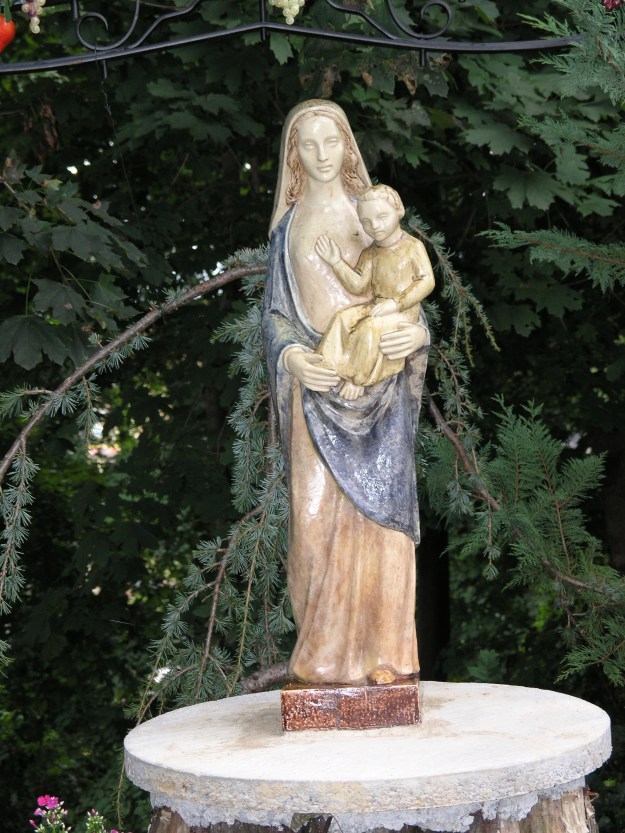
Mary, the Mother of Jesus, is our model for daily prayer. Every day about 20 of us gather in our chapel for morning prayer and Mass at 7:45 and evening prayer at 5 PM. The first prayer we say together before beginning the liturgy of the hours is the Angelus: “The angel of the Lord declared to Mary, and she conceived by the Holy Spirit…” The prayer recalls the announcement by the angel that God wished Mary to be the mother of his Son and Mary’s acceptance of the angel’s invitation. (Luke 1, 26-38)
That day in Nazareth would never be repeated, but it changed the way Mary lived afterwards. “The angel left her,”so St Luke’s gospel ends his story of their meeting, and no angel came again, the gospels say, but Mary carried that message of grace with her for the rest of her days. Everyday.
The angel’s message was meant for us also. God’s grace, the Lord is with us too. Everyday.
“How can this be?” Mary asks. Questions were always there in the days that followed the angels visit. Faith is never without them. Everyday.
Are we without them?
“Be it done to me according to your word,” Mary said. “Your will be done,” Jesus said in the daily prayer he prayed and taught. Simple words that bow before God, putting ourselves in God’s hands and the time and place that’s there. Everyday.
“The Word was made flesh and dwelt among us.” The Word made flesh dwells among us, who was hidden during his days in Nazareth, not clearly seen in the days of his ministry, abandoned in the days of his Passion and Death. Now, he is with us in the days of his resurrection, calling us to follow him. Everyday.
We say the Angelus everyday, our first prayer.
“Hail Mary, full of grace, the Lord is with you. Blessed are you among women and blessed is the fruit of your womb, Jesus. Holy Mary, Mother of God, pray for us sinners, now and at the hour of our death. Amen.
11 Sat St Martin of Tours, Rom 16:3-9, 16, 22-27/Lk 16:9-15
12 32n Sunday Wis 6:12-16/1 Thes 4:13-18 or 4:13-14/Mt 25:1-13
We’re coming to the end of Paul’s Letter to the Romans this week, the longest and most theological of his letters. In chapter 15 he speaks about his mission to Spain, (Friday) assuring the Romans he’s coming to Rome as a visitor, not to be part of their church. He hopes they’ll support him on his Spanish mission, so that he can bring the gospel to the whole world.
But Paul never gets to Spain; he will die in Rome.
We may find it strange that Paul in his letters doesn’t offer extensive references to incidents in Jesus’ life, such as his miracles, or quotations from his teaching or his parables. We do that as a matter of course in teaching or preaching about faith.
True, the gospels were not written when Paul wrote, likely in 56 to 58 from Corinth, but certainly the stories of Jesus’ life and summaries of his teaching were important in Christian preaching at the time. Why doesn’t Paul utilize them?
Does he see the gospel, especially the mystery of the death and resurrection of Jesus, as an immediate mystery, taking place now? The gospels bring us back to the time of Jesus, the events of his life and the words of his teaching. Paul saw them, not just as events and words of the past, but a mystery happening now. Jesus was not dead, but living in the world and in him. Now.
Is that why Paul’s letters are read with the gospels? So that we may understand they are happening now, in our time, in us?
NOVEMBER 1 Wed ALL SAINTS Rv 7:2-4, 9-14/1 Jn 3:1-3/Mt 5:1-12a
2 Thu All Souls Day Any readings from no. 668 or from the Masses for the Dead
3 Fri Weekday (Saint Martin de Porres,] Rom 9:1-5/Lk 14:1-6
4 Sat St Charles Borromeo Rom 11:1-2a, 11-12, 25-29/Lk 14:1, 7-11
5 31st SUNDAY Mal 1:14b—2:2b, 8-10/1 Thes 2:7b-9, 13/Mt 23:1-12
All Saints Day and All Souls Day begin the month of November, when the fall reminds us that life passes away. But does life end or does it change? “Life is changed, not ended” our faith says.
St. Martin de Porres (Friday) reminds us of the holiness found in those who care for the sick and the needy.
St. Charles Borromeo (Saturday) was a reformer of the Catholic Church at the time of the Reformation. He promoted the movement of reform that followed the Council of Trent.
Readings from the Letter to the Romans conclude this week with interesting greetings to various members of the Roman church, both Jewish Christians and Greeks.
I celebrated Mass at the Maritime Academy in King’s Point, NY, this morning at 9 AM. Half the student body was on their way to sea duty. There were also exams this week. Here’s the homily I preached:
30th Sunday a
When I was a boy years ago over in Bayonne, NJ –that’s the first city in New Jersey you see as you come into New York Harbor– there was a phrase they used to describe new immigrants. “They just got off the boat.” Immigrants came to our country then by boat.
Our first reading today from the Book of Exodus tells us about immigrants and how to treat them. “Thus says the LORD ‘You shall not molest or oppress an alien, for you were once aliens yourselves in the land of Egypt.’” Look at where you came from, God says, and ask how you would be want to be treated. The lesson: Don’t mistreat immigrants, you were once an immigrant yourselves..
My grandfather came to this country from Ireland in 1872. Times there were bad then and he came looking for work. When he got off the boat he got a job in the oil refinery in Bayonne. He married and had five kids; he had to raise them himself when his wife died shortly after the birth of their last child.
My mother, his second daughter, said he couldn’t read or write when he came here. She taught him. She said he never missed a day of work or Mass on Sunday. He lived with us before he died. I remember him sitting on the porch in the summer, proudly reading the Bayonne Times, the local newspaper. He wanted to know what was going on. He seemed to know everyone going by and enjoyed passing the time of day with them. He was thankful for this country and he did his best to make it better.
In the gospel today the Pharisees ask Jesus what the greatest commandment is. He said,”You shall love the Lord, your God, with all your heart, with all your soul, and with all your mind. This is the greatest and the first commandment. Then be added a second commandment. The second is like it, he said.”You shall love your neighbor as yourself.”
When they asked Jesus “Who is my neighbor?” you remember his answer. Your neighbor is everyone who’s making the journey of life with you,whether they look like you or not, whether they talk like you or not, whether they think like you or not – they are your neighbor.
Wouldn’t our world be great if we treated each other that way, as neighbors, the same as us, no matter how different we all may seem. Our world today doesn’t seem like that at all, does it?
A few years ago, Pope Francis wrote a letter entitled “Fratelli Tutti”, an extended reflection on the parable of the Good Samaritan. In the letter, the pope goes beyond how we treat our neighbor as individuals. He speaks of how the nations of the world need to be neighbors to one another.
Our world is not a good neighborhood now. “ For all our hyper-connectivity, we witness a fragmentation that made it more difficult to resolve problems that affect us all.” We facing a changed world where all the nations of the world need to work together, as neighbors, not grudgingly, but dreaming together.
“Today, in many countries, hyperbole, extremism and polarization have become political tools. Employing a strategy of ridicule, suspicion and relentless criticism, in a variety of ways one denies the right of others to exist or to have an opinion. Their share of the truth and their values are rejected and, as a result, the life of society is impoverished and subjected to the hubris of the powerful. Political life no longer has to do with healthy debates about long-term plans to improve people’s lives and to advance the common good, but only with slick marketing techniques primarily aimed at discrediting others. In this craven exchange of charges and counter-charges, debate degenerates into a permanent state of disagreement and confrontation.
Let us dream, then, as a single human family, as fellow travelers sharing the same flesh, as children of the same earth which is our common home, each of us bringing the richness of his or her beliefs and convictions, each of us with his or her own voice, brothers and sisters all.”
“Love your neighbor as yourself” has many meanings..
One reason I like coming over here to the Maritime Academy to help Fr. Gilbert when he’s away is that I think you are boat people; your neighborhood is the sea. Some of.you will be on boats soon taking you to all parts of the great sea that connects many nations and peoples. 90% percent of the world’s trade takes place on the sea. Nations are fighting over trade routes on that sea now. Commercial interests are trying to mine it for its riches. Like the rest of our world, the sea is an uneasy neighborhood now.
It needs people who love it and care for it. The commandment of Jesus has many meanings. As we celebrate Mass today, ask the Lord to keep you safe as you go to sea, but also ask God to make the dream of the Creator your dream. God, who created heaven and earth, the sea and all that is in it, made it good. Love your neighbor, the sea. Keep the dream alive.
St.Paul describes the mission of the Holy Spirit in our current reading from his Letter to the Romans as “the Lord, the Giver of Life.” We can call God, the creator of heaven and earth, “Abba, Father!” God is Creator of heaven and earth and all things. We are God’s adopted children, “joint heirs with Christ”, sharing in his glory, “if only we suffer with him.” The Spirit helps us become children of God. (Romans 8)
The Spirit also helps creation which “awaits with eager expectation the revelation of the children of God.” It “groans in labor pains” until that day when there will be a “new heaven and a new earth.” Just as we are awaiting the fruit of our adoption, creation waits to share in our adoption, in “the redemption of our bodies.”
“The Spirit comes to the aid of our weakness; for we do not know how to pray as we ought, but the Spirit himself intercedes with inexpressible groanings.” The Spirit aids us in weakness, our personal weakness, the weakness of our world, the weakness of all creation.
We pray for the help of the Holy Spirit, whom Jesus promised to send, for all those dimensions of weakness, which are so apparent today. Come, Holy Spirit, and renew the face of the earth.


 The Victor's Place