Author Archives: vhoagland

Advent and Christmas Time

God works in time. The Jewish prophets knew this. However faithless their people, however dark and desolate their land, they believed God was at work. God’s kingdom was coming.

Christianity knows this, too. The sower’s seed grows in time; the field has a treasure to be found, servants have gifts to trade til their master’s return. God’s plan unfolds in time. “In the fullness of time God sent his Son.” (Galatians 4:4) 

However, we get tired waiting and, like the servants in the parable, we fall asleep.

Feasts and seasons waken us. The four weeks of Advent and the days of Christmas and Epiphany waken us to the presence of God, who is within and around us. Advent begins a holy time. Let’s welcome it.  “Today if you hear God’s voice, harden not your hearts.” 

What message awakens us?  Jesus Christ, God’s only Son, true God and true man, born of a woman, revealed to all people, has come to save our world. He came once and he will come again “to judge the living and the dead and his kingdom will have no end.” 

We’re slow to know the mysteries of God, however. (Luke 24:25) Only little by little, as time goes by, does an awareness come that can” ransom the time being from insignificance.” (W.H. Auden)

What to look for in Advent and Christmas?

Mary of Nazareth, John the Baptist and the Prophet Isaiah point out the significance of Advent time and the great feasts of  Christmas and Epiphany. Listen first to Isaiah, a priest in the temple in eighth century Jerusalem, when powerful Assyrian armies ravaged the kingdoms of Israel and Judah. In the worst of times he had a message of hope.

God came to him in a vision in the temple’s Holy of Holies (Isaiah 6) and Isaiah was overwhelmed by a Presence more powerful than any on earth. Human plans and schemes were not the answer, he realized; reliance on God was. No matter how bad the times, God is “Emmanuel,” “God with us.”

This was Isaiah’s message then, and it’s still his message today. 

“I heard the voice of the Lord saying, ‘Whom shall I send? Who will go for us?’ ‘Here I am,’ I said; ‘send me!’” (Is: 6:8) 

Isaiah’s prophecies pervade the Sundays and weekdays of Advent time, beginning with the first week. They may seem unreal to us, as they must have seemed to those who first heard them when Assyrian armies were laying waste to Palestine. Will all nations  stream toward the mountain of the Lord’s house, laying down their arms of war and seeking wisdom?  Will all peoples, all nations, all races ever live in harmony and peace? 

John the Baptist, Mary of Nazareth and Joseph, her husband speak from the 2nd week of Advent till Christmas, announcing this mystery.  

Today, in our splintered world, the promise of Advent seems an impossible dream, but this holy time revives and expands our hope, not just hope for ourselves and those dear to us, but hope for the whole world. God loves the world and sent his Son to save it. Hard to imagine, but God’s kingdom to come will bring our world and all creation peace.

Sin is behind the fragmentation of our world, but sin is destroyed by God’s grace. ‘The grace of God has appeared,” the Child born to us is our Savior and Lord. “He will come to judge the living and the dead, and his kingdom will have no end.” The peaceable kingdom, seemingly impossible, is not impossible for God.

Advent and Christmas time ends with the Feast of the Epiphany and the Baptism of Jesus, who manifests himself to the gentiles and calls all nations into his kingdom. Our calendar continues into Lent, Easter and Pentecost, where the great mysteries of God are further revealed. 

Where did Advent and Christmas come from?

Where did Advent and the two great feasts expressing its meaning, Christmas and Epiphany, come from? “Advent” is a word revealing different aspects of God’s plan. It announces the birth of Christ in Bethlehem, born “in human likeness.’ His birth is also an epiphany, a revelation of God. Finally, Advent announces the final coming of the Kingdom of God through Jesus Christ. 

In the Roman Catholic Church an Advent season preparing for the Feast of Christmas is first mentioned in Roman documents from the middle of the 6th century. Earlier sources from 336 cite only the Feast of Christmas, days for  celebrating Lent, Easter, Pentecost and commemorations of martyrs and other saints, so the days of Advent were added afterwards to the Catholic calendar. 

In our present calendar, Advent is the four weeks before Christmas. An expanded  selection of readings and prayers focus on the twofold coming of Jesus Christ. This season is rich in customs and practices that bring out the significance of this season for even the least. The Advent wreath, the Christmas tree, the Christmas crib, the Christmas carols and music– all contribute to the beauty and meaning of the Advent season. 

Internet Resources

Liturgical Calendar: http://www.usccb.org/calendar/

Liturgical Readings: http://www.usccb.org/bible/liturgy/

New American Bible: Revised Edition:

 http://www.usccb.org/bible/books-of-the-bible/

Overview of Isaiah:  http://www.usccb.org/bible/scripture.cfm?bk=Isaiah&ch=

The Last Days

In a week that began with  the Feast of Christ the King we’re reading from the Old and New Testament about the last days. It’s a world turned upside down, but we share in the kingly power of Jesus, even in floods, earthquakes, plagues and famines, when “awesome sights and signs will come from the sky.” (Luke 21,11) Our days even now can seem like the last days.

It’s no accident the Feast of Christ the King opens this week. By baptism we share in the kingly, priestly and prophetic power of Jesus, so it’s  not enough  just to hold on. We should face these days bravely, Jesus says, they’re a time to give testimony. Don’t worry about what words to say or what you are going to do:  “I myself shall give you a wisdom that all your adversaries will not be able to refute.” Don’t worry, “not a hair of your head will be destroyed.”

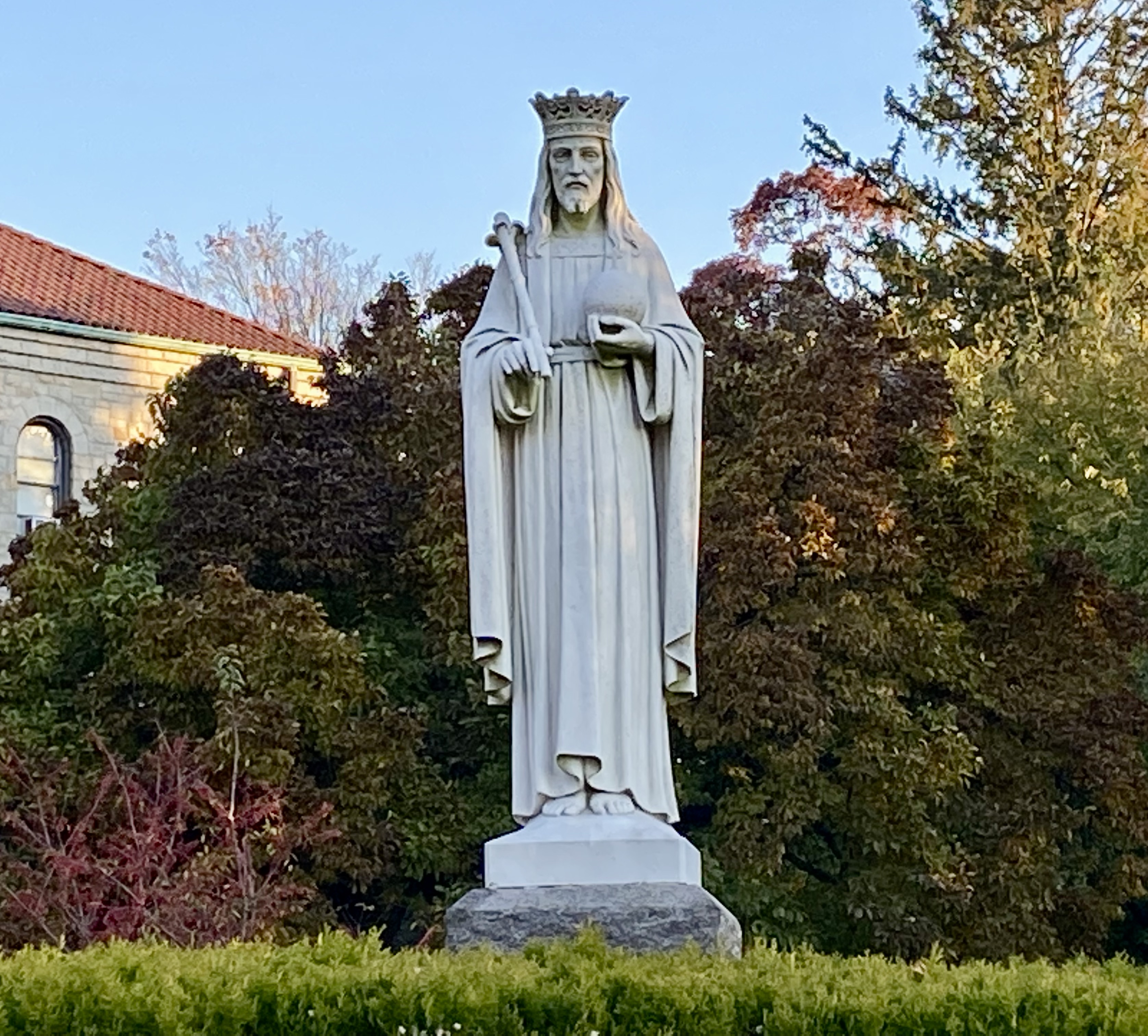
We have this majestic statue of Christ the King in our garden. Don’t forget, too, as the gospels for the Feast of Christ the King remind us, Jesus was king, priest and prophet on Calvary. He holds the world in his hands. 

34th Week: Readings and Feasts

NOVEMBER 27 Mon Weekday Dn 1:1-6, 8-20/Lk 21:1-4 

28 Tue Weekday Dn 2:31-45/Lk 21:5-11 

29 Wed Weekday Dn 5:1-6, 13-14, 16-17, 23-28/Lk 21:12-19 

30 Thu St Andrew,  Rom 10:9-18/Mt 4:18-22

DECEMBER 1 Fri Weekday Dn 7:2-14/Lk 21:29-33 

2 Sat Weekday Dn 7:15-27/Lk 21:34-36

3 1st  SUNDAY OF ADVENT Is 63:16b-17, 19b; 64:2-7/1 Cor 1:3-9/Mk 13:33-37 

The church year ends this week with readings from the Book of Daniel and apocalyptic sections of St. Luke’s gospel about the future, the day of the Lord, when the kingdom of God finally comes and humanity and all creation reach the goal intended by God from the beginning. No easy readings for us who live now, even as wars, earthquakes and the cries of nature warn us of the fragile nature of creation.

Luke’s gospel is careful to remind his hearers against expecting an immediate coming of the kingdom. Use the one golden talent given to you. That will get you through.

The Book of Daniel brings us to Babylon and the three young Jewish exiles  in the service of King Nebuchadnezzar. Daniel gives Nebuchadnezzar an unexpected picture of the future. His kingdom has clay feet; it will collapse and fall to the ground. The only kingdom that endures is God’s kingdom, a stone hewn from a mountain.

Hanukkah and Christmas

Hanukkah, an eight day Jewish celebration, which can occur in late November to late December, and Christmas, the Christian celebration on December 25th, are celebrated close together in time. Are they connected beyond that?

The quick answer usually given is no, but think about it a little. Hanukkah celebrates the rededication of the temple in Jerusalem after its desecration by Antiochus Epiphanes IV in 167 BC. After conquering Judea, the Syrian leader plundered the temple, ended Jewish services and erected an altar to Zeus in it.

Leading a Jewish revolt, Judas Maccabeus reconquered the city, cleansed the temple and initiated an eight day celebration in memory of the event. Eight lights lit successively call people to God’s holy place.

Christmas celebrates the birth of Jesus Christ approximately 167 years later.

Both of these feasts are about the Presence of God. For the Jews God was in the temple as Creator and Savior. For Christians God reveals his presence in Jesus Christ, who proclaimed himself God’s Son, “the light of the world” as he celebrated the Jewish feasts in the temple. (John 7-10)

All the gospels report that Jesus cleansed the temple  and spoke of himself replacing it. Luke’s gospel  begins in the temple with the promise to Zechariah of the birth of John the Baptist and ends as the Child Jesus enters his “Father’s house.” (Luke 1-2) Our readings today link the restoration of the temple by Judas Maccabeus and the Jesus cleansing the temple: 1 Mc 4:36-37, 52-59/Lk 19:45-48

Far from being separate, Hanukkah and Christmas are connected in their celebration of God’s presence. Hanukkah reminds us of the temple, the place of God’s provisional presence. The Christmas mystery reminds us of the abiding presence of God with us in Jesus Christ, Emmanuel, the Light that never fails, who gives life to all nations.

The Gift of the Old: 1 and 2 Maccabees

This week our first readings at Mass are from the First and Second Books of Maccabees commemorating the Jewish revolt against Antiochus Epiphanes, successor to Alexander the Great. The revolt led to the rededication of the temple by Judas Maccabeus after its profanation by foreign invaders.  The Jewish Feast of Hannukah recalls the event. (Thursday) The revolt took place over a hundred years before the time of Jesus.

The Maccabean revolt is one reason why the times of Jesus were so politically sensitive. On his journey to Jerusalem, some “thought that the kingdom of God would appear there immediately.” (Luke 19,11)  A number of his disciple probably thought that would happen by an armed uprising against the Romans, like the revolt  against Antiochus Epiphanes.

Our readings this week, however, are not battle accounts from the uprising but rather stories of two elderly faithful Jews: Eleazar, a scribe who refused to assimilate to the culture of the conquerors, and a mother who inspired her seven sons to resist the invaders. (Tuesday and Wednesday)

All Eleazar had to do was pretend to eat the meat of sacrifice, but the ninety-year old chose to die rather than give bad example to the young.
“I will prove myself worthy of my old age, and I will leave to the young a noble example of how to die willingly and generously for the revered and holy laws.” (2 Maccabees 6. 30-31)

The Jewish mother, seized with her seven son and witness to their torture and death,  urged them to keep their faith and persevere:
“I do not know how you came into existence in my womb; it was not I who gave you the breath of life, nor was it I who set in order the elements of which each of you is composed. Therefore, since it is the Creator of the universe who shapes each man’s beginning, as he brings about the origin of everything, he, in his mercy, will give you back both breath and life, because you now disregard yourselves for the sake of his law.” (2 Maccabees 7,1, 21-31)

Pope Francis often speaks of the wisdom and influence of the elderly.  We rely on them. Maybe now more than ever.

33rd Sunday a: How Did Jesus Pray?

For this week’s homily please watch the video below.

The Liturgy: A Way to Belief

“Lex orandi, lex credendi”. That latin sentence can be understood in a number of ways, but what it comes down to is this, I think: our liturgy guides the way we pray and the way we believe. Courses in theology, scripture, spiritual books and devotions are fine but they don’t supplant the liturgy of the church for building our faith.

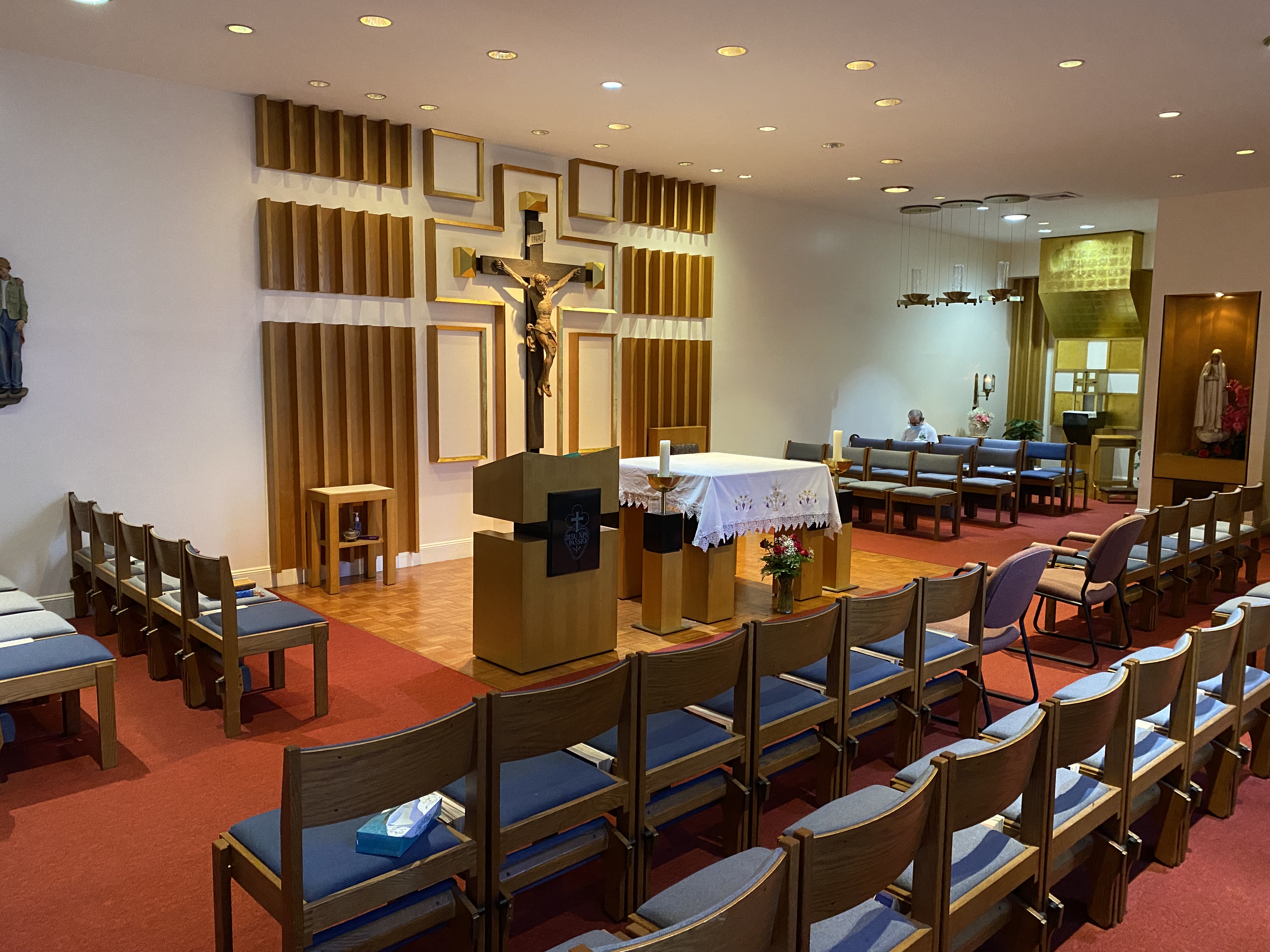
The liturgy is the most important way to explore our faith and grow in faith. It’s a catechism were called to follow through its feasts, its seasons, its prayers and the example of the saints. The chapel above is my present classroom.

Our recent feasts, for example. The Dedication of the Lateran Basilica in Rome (Nov 9). First of the great churches built after Constantine brought an end to Christian persecution in the 4th century. Why do we have churches anyway? We seem to be closing them in this part of the world, or going to them less and less.

Pope Leo (Nov 10) is called great because he led a church threatened by barbarian armies who were chopping into pieces the Roman world in the 5th century. Yet there he was firm as a rock in a storm. Does his feast tell us God always provides the leaders we need, especially in a storm?

Martin of Tours(Nov 11), the soldier who gave half of his cloak to a freezing beggar, later revealed to be Christ. Martin asks: what are you doing for the poor? November is a month we prepare for winter. Are we putting aside something for the poor?

Josephat (Nov 12)  was a bishop seeking the unity of Orthodox and Roman Catholic Churches. He suffered martyrdom for his efforts. We’re challenged to work for the unity of our churches, keeping them big, not small.

Mother Cabrini ( November 13) a dynamic little Italian nun,  championed poor Italian immigrants who came to the United Stats expecting streets paved in gold, but found hard cold cobblestones instead. Who’s championing immigrants today? 

The saints are part of our catechism. They’re joined by daily readings from the scriptures that bring us the wisdom of the Old and New Testament. We bring them our questions, and they question and challenge us in return.

Above all, the liturgy brings us into the mystery of the death and resurrection of Jesus Christ.The liturgy is a school that has Jesus Christ as its Teacher and Lord. We are blessed.