For this week’s homily please watch the video below.


Though he’s known best for his portrayal of the Dutch world of his time, Rembrandt was very interested in stories from the Bible, both from the Old and New Testament. Possibly one third of his work is devoted to biblical subjects, about 700 drawings among them.
What led him to paint and draw biblical events? It wasn’t mainly a patron’s commission, as was the case of his contemporaries– Rubens, for instance. Rembrandt seems genuinely attracted to the bible and felt compelled to draw from the biblical narrative, not because he could make money on it, but because it spoke to him and his situation in life.
“Rembrandt’s relation to the biblical narrative was so intense that he repeatedly felt impelled to depict what he read there. These sketches of Rembrandt have the quality of a diary. It is as though he made marginal notes to himself…The drawings are testimonies, self-revelations of Rembrandt the Christian.” (Rembrandt’s Drawings and Etchings for the Bible. p. 6)
It seems this interest in the bible came, in part, from his mother, a devout woman, who had a Catholic prayerbook that featured the Sunday gospels with illustrations on facing pages. As she prayed from this book, did she show them to her little boy growing up?
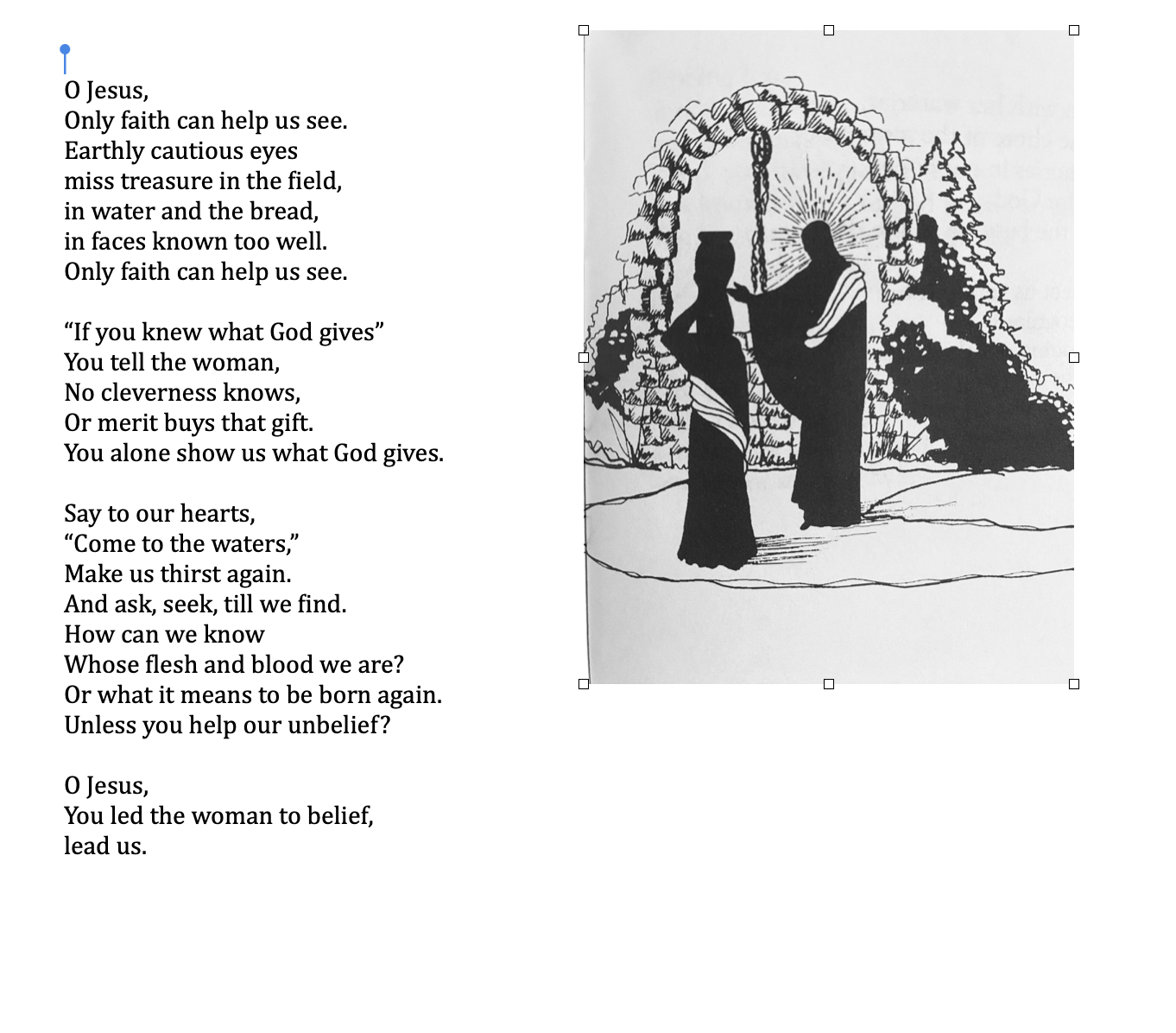
His portrayal of scriptural stories are so insightful. Just look at his portrayal of Jesus at the well with the Samaritan woman, which is found in John’s gospel. Jesus deferentially asks for a drink of water, bowing to the woman as he points to the well. And she stands in charge, her hands firmly atop her bucket. She’s a Samaritan and a woman, after all. He wont get the water until she says so. Jesus looks tired, bent over by the weariness of a day’s long journey.
Certainly, this is no quick study of a gospel story. Obviously, Rembrandt has thought about the Word who made our universe and humbled himself to redeem us. Perhaps he’s also thinking of the way Catholics and Protestants at the time were clashing among themselves, their picture of Jesus a strong, vigorous warrior. But here he stands humbly outside a little Dutch village that the artist’s contemporaries might recognize. Some of them may be pictured looking on at the two.
Artists have a powerful role in relating truth and beauty.
And what about Rembrandt’s mother? A 19th century French Sulpician priest, Felix Dupanloup, who had a lot to do with early American Catholic catechetical theory said to parents:
“Till you have brought your children to pray as they should, you have done nothing.”
Looks like she did her job.

The Samaritan woman and Naaman the Syrian, two individuals we read about this third week of Lent. Aren’t they complicated people? Surely the woman with five husbands, who goes alone to Jacob’s well for water, who stands up to a Jewish man, is a complicated woman. She’s also a powerful voice in her world, as she persuades the people of her town to come and see a Prophet who promises living water.
Naaman is also a person of many dimensions. He’s a general in the Syrian army, seemingly their most important general, but he has leprosy. His journey to Israel causes a political uproar, as the King of Israel wonders what the political consequences of his visit might be.
So he comes as a political figure, from the messy world of Middle East politics. But he’s a man who knows he’s in need.
He is dismayed when he’s not welcomed by the prophet, and told to wash in the waters of the Jordan, a small stream in comparison to the rivers of Syria. But the waters of that small stream, the waters of faith, the water of baptism will give him life.
Faith is a challenge to complicated people, like the woman with five husbands and the man highly invested in the power politics of the day.
But God calls them both.
We pray during Lent for the complicated people of our world.
Lord, speak to them.

Last week’s weekday readings ended with the story of the Prodigal Son; this week’s end with the tax collector who prays in the temple and finds mercy. There are also readings from the Book of Hosea this week; he’s the prophet whose unbroken love for his unfaithful wife reminds us of God’s relationship with humanity. God wants us back.
The Sunday’s readings from cycle A, the Temptation of Jesus and his Transfiguration are basic catechetical teachings. The 3rd Sunday readings, from the Book of Exodus and John’s multi-leveled account of the meeting of Jesus and the Samaritan woman at the well, prepare us to meet him in sacraments.
The story of Naaman the Syrian general (Monday) is also a multi-leveled story. Naaman’s appreciation of the saving water of the Jordan recalls the mystery of baptism, celebrated in the Easter mysteries.
Naaman and the Samaritan woman, both interesting characters, remind us that sacraments are meant for complicated people who are drawn gradually into the mysterious reality of God’s grace.
Sacraments can be easily forgotten or unappreciated, simple signs as they are. They draw on the natural world, which can also be unappreciated, as we are learning today.
Can a renewed appreciation of nature lead to a greater understanding of the sacraments? Can figures like the Samaritan woman and Naaman Can figures like the Samaritan woman and Naaman remind us that the sacraments are meant for people immersed in their own time and place?
3rd Sunday of Lent a

 Today is the feastday of St. Gabriel Possenti, the young Italian Passionist who died in 1862 and was canonized in 1920. I’m interested in his connection with Fr. Theodore Foley (1913-1974), an American Passionist whose cause for canonization was recently introduced in Rome. As a young boy of 14, Theodore read about St. Gabriel and decided to become a Passionist; other young men joined the community in the early 1920s and 30s also influenced by the young Italian saint.
What was St. Gabriel’s appeal ?
The cause for beatification of Father Theodore Foley, C.P. (1913-1974) opened officially on May 9, 2008 in Rome, just two years after the North American Passionist Province of St. Paul of the Cross and affiliate members met in a provincial chapter, which endorsed a proposal requesting that Father Theodore, a member of St. Paul of the Cross province and former superior general of the community, be considered as a candidate for canonization. Appreciation for him has grown steadily over time, for Father Theodore exemplifies the quiet, steady loyal holiness needed today– rooted firmly in the past and reaching with Christian hope to the future. In his preface to Saint Gabriel, Passionist, a popular biography by Fr. Camillus, CP published in 1926, the powerful archbishop of Boston ,William Cardinal O’Connell, denounced the “flood of putrid literature which, for the past ten years of more, has deluged the bookshelves and libraries of our great cities, fueling disappointment and emptiness in a false romanticism.” He urged young Catholics to reject this falseness and live in the real world, like St. Gabriel:
“To live a normal life dedicated to God’s glory, that is the lesson we need most in these days of spectacular posing and movie heroes. And that normal life, lived only for God, quite simply, quite undramatically, but very seriously, each little task done with a happy supernaturalism,-that such a life means sainthood, surely St. Gabriel teaches us; and it is a lesson well worth learning by all of us.”
Young Theodore Foley took Gabriel’s path. He followed the saint into the undramatic life of the Passionists.
Gabriel Possenti’s decision to enter the Passionists has always been something of a mystery, even to his biographers. Did he choose religious life because he got tired of the fast track of his day? And why didn’t he enter a religious community better known to him, like the Jesuits, who could use his considerable talents as a teacher or a scholar? Why the Passionists?
Gabriel–and Theodore Foley after him– was attracted to the Passionists because of the mystery of the Passion of Christ. It was at the heart of God’s call.
The Passionists were founded in Italy a little more than a century before Gabriel’s death by St. Paul of the Cross, who was convinced that the world was “falling into a forgetfulness of the Passion of Jesus” and needed to be reminded of that mystery again. Paul chose the Tuscan Maremma, then the poorest part of Italy, as the place to preach this mystery, and there he established his first religious houses for those who followed him. He chose the Tuscan Maremma, not to turn his back on the world of his day, but because he found the mystery of the Passion more easily forgotten there.
When Gabriel became a Passionist, the community like others of the time, was recovering from the suppression of religious communities by Napoleon at the beginning of the century. In one sense, it had come back from the dead . The congregation was now alive with new missionary enthusiasm. Not only were its preachers in demand in Italy, but it had begun new ventures in England (1842) and America (1852).
Paul of the Cross, the founder, was beatified in 1853. Ten years earlier, the cause of St. Vincent Strambi, a Passionist bishop, was introduced. Dominic Barbari, the founder of the congregation in England, would receive John Henry Newman into the church in 1865; the English nobleman, Ignatius Spencer, who became a Passionist in 1847, began a campaign through Europe in the cause of ecumenism. New communities of Passionist women were being formed.
Respected for their zeal and austerity, the Passionists were a growing Catholic community, and their growth in the western world continued up to the years when Theodore Foley became their superior general and then saw its sharp decline.
Success was not what drew Gabriel–and Theodore Foley after him–to the Passionists. Their charism–the mystery of the Passion of Christ– was at the heart of God’s call.
As a boy growing up, Gabriel Possenti understood this mystery, even as he danced away the evening with his school friends. Twice he fell seriously ill and, aware that he might die, promised in prayer to serve God as a religious and take life more seriously. Both times he got better and forgot his promises. Then, in the spring of 1856, the city of Spoleto where he lived at the time was hit by an epidemic of cholera, which took many lives in the city. Few families escaped the scourge. Gabriel’s oldest sister died in the plague.
Overwhelmed by the tragedy, the people of Spoleto gathered for a solemn procession through the city streets carrying the ancient image of Mary, the Mother of Jesus, who stood by the Cross. They prayed that she intercede for them and stop the plague, and they also prayed that she stand by them as they bore the heavy suffering.
It was a transforming experience for Gabriel. Mysteriously, the young man felt drawn into the presence of the Sorrowing Woman whose image was carried in procession. Passing the familiar mansions where he partied many nights and the theater and opera that entertained him so often, he realized they had no wisdom to offer now. He took his place at Mary’s side. At her urging, he resolved to enter the Passionists.
Can we speculate, then, how the life of the Italian St. Gabriel drew the young American Theodore Foley to the Passionists? What similarity was there between them? What grace led him on?
Brought up in a good family and a strong religious environment , Theodore Foley still felt “dangers and temptations” around him. No, he didn’t experience the social life that tempted Gabriel Possenti a century before. But he did experience the new mass media then sweeping the country. By 1922 movies, and to a lesser extent the radio, became powerful influences in people’s lives, and Hollywood’s heroes preached a new gospel of fun and success. Through the new media, the “Roaring Twenties” came to Springfield as it did to other prosperous parts of America when Theodore Foley was growing up. Did it bring the “the dangers and temptations” he feared?
Theodore Foley must have sensed the selfishness, the carelessness about others, the failure to appreciate suffering and weakness and sin in this new gospel. It promised life without the mystery of the Cross, but that was not real life at all. Only 14, he entered the Passionists.
Last Sunday, the 1st Sunday of Lent, we remembered the Temptation of Jesus in the desert. The 2nd Sunday of Lent, we celebrate his transfiguration in glory on the mountain.
The gospel writers, Matthew, Mark and Luke, say Jesus appeared in glory after telling his disciples he was going to suffer and die in Jerusalem. They’re deeply troubled and saddened by that announcement, and so Jesus reveals his glory, the glory of his coming resurrection, to strengthen their faith.
This gospel is also meant to strengthen our faith.
Jesus’ message about carrying the cross was not just a hard message for his disciples then, it’s a hard message for us now. Carrying a cross is something we back away from. The teachings of Jesus can seem hard : Love your enemies; do good to those who sin against you. Turn the other cheek when someone strikes you. Forgive your brother or sister, not seventy times but seventy times seven. Think better of others than yourself. Bear the burdens of others. Be simple like little children. Never say a word against someone else. Take the last place instead of the first. Be the salt of the earth and the light of the world.
So many of Jesus’ teachings seem to go beyond what we are able to do. Let’s be reasonable about this, we say. So we’re tempted to lower our sights and even give up on trying to reach them.
For us today, this feast promises there’s glory ahead, no matter how bad our personal lives may be, or how bad our world might seem to be, or how impossible the message of the gospel sounds.
We may not experience what the three disciples experienced, but we’re promised experiences of God’s glory, experiences of a lesser kind, intimations of God’s glory, to strengthen us to keep going, following Jesus Christ.
But we can’t pass over our first reading this Sunday, God’s call to Abraham to sacrifice his own son, Isaac, on Mount Moriah. That’ s also a hard reading to understand. Abraham, ”Take your son Isaac, your only one, whom you love, and go to the land of Moriah. There you shall offer him up as a holocaust on a height that I will point out to you.”
Why would God ask for such a thing, that a father take his son, his only son, the son he loves, and put him to death? In that command we can see all the mysterious sufferings wonder about in life.
Why did my son, my daughter, my friend die? Why these wars that take the lives of children and destroy families and nations. Why this violence in our country and all over the world. Why can’t we get along in our country? So much suffering seems unjust.
Why does God permit it? Why doesn’t God do something?
The mystery of the Passion of our Lord is God’s answer to questions like that. He sends his only Son, the Son that he loves, and he experiences the evils of our world, and he dies and rises again.
We ask for the faith of Abraham. His faith was so strong. He believed in God’s ultimate love and justice. We ask for the faith of Mary, the Mother of Jesus, whose faith also was so strong. She saw her only son, the son she loved, suffer and die. We ask for the faith of our church, that we may believe, that God will strengthen our faith.
For this week’s homily please watch the video below.
Our pilgrimage on earth cannot be exempt from trial. We progress by means of trial. No one knows himself except through trial, or receives a crown except after victory, or strives except against an enemy or temptations.
But we are not left on our own. Christ chose to foreshadow us, who are his body, by means of his body, in which he has died, risen and ascended into heaven, so that the members of his body may hope to follow where their head has gone before.
He made us one with him when he chose to be tempted by Satan. We have heard in the gospel how the Lord Jesus Christ was tempted by the devil in the wilderness. Certainly Christ was tempted by the devil. In Christ you were tempted, for Christ received his flesh from your nature, but by his own power gained salvation for you; he suffered death in your nature, but by his own power gained glory for you; therefore, he suffered temptation in your nature, but by his own power gained victory for you.
If in Christ we have been tempted, in him we overcome the devil. Do you think only of Christ’s temptations and fail to think of his victory? See yourself as tempted in him, and see yourself as victorious in him. He could have kept the devil from himself; but if he were not tempted he could not teach you how to triumph over temptation.”
Commentary on Psalm 60, St. Augustine

My dear Brothers, Sisters and Friends in the Passionist Family,
Greetings of peace and hope of God’s closeness to you all!
Once again, we are confronted by the special season of Lent, during which we hear the call to ongoing conversion (metanoia), by which we are challenged to turn away from sin and choose to grow closer to God by loving Him and loving our neighbor as ourselves. The Gospel passage which is given at the beginning of Lent each year as a roadmap for our Lenten journey, places before our attention: prayer, almsgiving, and fasting as means by which we can love God and our neighbor as ourselves (cf. Mt. 6:1-6,16-18). This season is filled with the promise of new opportunities and new beginnings, powered by God’s grace and presence. Let us seize this precious moment. As St. Paul urges: “…we urge you not to let your acceptance of God’s grace come to nothing. As God said, ‘At the time of my favor, I have answered you; on the day of salvation, I have helped you’. Well, now is the real time of favor; now the day of salvation is here.” (2Cor. 6:1-2).
In this Lenten message, I would like to focus and share some reflections with you on the subject of PRAYER, particularly since Pope Francis has announced this year to be a Year of Prayer, in preparation for the Jubilee Year next year (2025).
Lent is an opportunity for our spiritual formation and discipline. To seize this opportunity, we need to be led and guided by the Spirit who facilitates our encounter with God. Like Jesus, we want to respond by accepting the call to go into the ‘desert’, driven by the Spirit (Mt. 4:1-13; Lk. 4:1-11). God is waiting for us, expecting us, offering us a time of restoration…a time of RETREAT…the chance for a fresh start in the spiritual life (cf. Hosea 2:16-17). The goal of this time is to seek and find the will of God over and beyond all the movements of our heart. St. Ignatius of Loyola says that two things are needed for this: i) magnanimity, i.e. a wide and open mind which is not confined to narrow horizons of small interests, and ii) generosity, i.e. the readiness to give without conditions and limits.
“Lent is an occasion, not so much for increased time given to prayer, as for a different prayer:
a prayer with that distinctive flavor which arises from a realization of who I am ‘in Christ’,
the unlimited potential in me for growth into Christ,
and the possibility of achieving it because of his power as risen Lord.”
~ Gregory Manly, CP/Anneliese Reinhard, MSC
Driven by the Spirit, God’s intention in the ‘desert’ is not to punish us but to purify us. In the desert, God will want to purify us of any excessive attachment we may have to consolation in prayer. If in prayer God blesses us with a lot of consolation (“spiritual highs”), there is a danger that we may seek and love “the consolations of our God more than the God of our consolations”, said St Teresa of Avila. In general, prayer in the desert will become less of us, and more of God.
The following are good indicators that our experience of ‘spiritual desert’ (dryness in prayer) is the purifying work of God:
As Jesus was led into the desert by the Spirit (Mt. 4:1) to face the great issues of his life and mission before he entered into his ministry, so also, we too enter into this Lenten time to face the great issues of our life – God’s invitations and the evil attractions and allurements. In the solitude of the desert, we are meant to find the clarity and firmness which we shall need in the turmoil of actual life.
We read in all the gospels that Jesus would withdraw to deserted places and pray. While prayer was a common practice of his culture, Jesus nevertheless sought times of quiet, times of solitude. For any Christian who aspires toward union with God, SOLITUDE holds an extremely important place in life in that it is a pre-requisite for the communion one must keep both with God and with other people. Christian solitude is never a solitude from people, but a solitude for people.
“The desert does not mean the absence of people,
it means the presence of God.”
~ Carlo Carretto
The Trappist monk, Thomas Merton said: “It is in deep solitude that I find the gentleness with which I can truly love my brothers…Solitude and silence teach me to love my brothers for what they are, not for what they say.” ~ The Sign of Jonas
As Passionists, we know that one of the pillars upon which our Congregation is founded by St. Paul of the Cross, is solitude. For Paul, solitude was a cyclic journey into his human heart (self), to the Divine Heart (God), to every human heart (others). It is linked to a call to community and evangelization. In a letter written to Canon Felice Pagliari in 1768, Paul of the Cross wrote:
“Our Congregation is established on this foundation…the vocation which God has given to her…our Rule obliges us after missions, retreats etc. to withdraw immediately into the Retreats of our solitude in order to recollect our spirit in prayer and fasting. Believe me, an evangelical worker who is a man of prayer, a friend of solitude and detached from all created things accomplishes more than a thousand others who are not such men…”
~ L III, 13 February 1768
Lent gives us the opportunity to re-encounter prayer which brings us face-to-face with God who already delights in us. Prayer is an encounter with God. The goal and mentality of prayer is not success or conquest, but surrender. The goal is to give oneself away completely and to remember how much the Lord will love you when you fail and try again. I offer you this Prayer for Lent composed by St. Ambrose of Milan (339 – 397):
O Lord, who has mercy upon all,
take away from me my sins,
and mercifully kindle in me
the fire of Thy Holy Spirit.
Take away from me the heart of stone,
and give me a heart of flesh,
a heart to love and adore Thee,
a heart to delight in Thee,
to follow and enjoy Thee,
for Christ’s sake. Amen.
May these reflections assist your Lenten journey and enrich your preparation and participation in the celebration of the Paschal Mystery of Christ. May the Passion, Death, and Resurrection of Jesus Christ be always in your heart.
~ Fr. Joachim Rego, C.P.
Superior General
 The Victor's Place