The Advent season closes today December 24th. The Christmas season begins with the vigil Mass this evening.
Advent is a season rich in the scriptures. Isaiah speaks strongly throughout the season, calling Jewish exiles and all nations to the holy mountain and God’s banquet with his people and all creation. “Swords will be turned into plowshares and spears will be turned into pruning hooks and they will not train for war again.”
John the Baptist and his parents Zachariah and Elizabeth have important roles in the coming of the Child born of Mary. Of course, Mary and Joseph are key figures responding to the messengers of God.
Faith and hope do not come easily, the Advent season tells us. Political unbelief appears in Ahaz who “will not tempt the Lord.” Zachariah, a priest, is struck dumb for his unbelief. John the Baptist asks if Jesus is really “the one who is to come.” Mary wonders “how can this be?”
The gospel reading today, Zachariah’s song of belief, seems to promise faith and hope conquers in the end.
“Blessed be the Lord God of Israel, he has come to his people and set them free.
Christmas carols, more than the scriptures seem to dominate the Christmas season. They bring the shepherds from the dark hills and magi from the east to the Child. They also speak of those who not believe, like Herod who goes in search of the Child. But people of faith, like Simeon and Anna, welcome the Child in the temple and take him into their arms.
Advent and Christmas are seasons rich in the wisdom of faith. A faith that leads to great truths, as the feast of John the Apostle reminds us. A faith one should die for, as we are reminded by the feasts of the Holy Innocents and Stephen the first of many martyrs.
Thomas Merton wrote a wonderful article on St. John of the Cross, his favorite saint, and begins by recommending a look at El Greco’s view of Toledo (above), where the artist lived as a contemporary of John of the Cross. Somewhere in that city John was imprisoned in a dark cell by fellow religious angered by his work for his community’s reform.
Toledo “is full of spiritual implications. It looks like a portrait of the heavenly Jerusalem wearing an iron mask. Yet there is nothing inert about these buildings. The dark city built on its mountain seems to be entirely alive. It surges with life, coordinated by some mysterious, providential upheaval which drives all these masses of stone upward toward heaven, in the clouds of a blue disaster that foreshadows the end of the world.”
Toledo “wearing an iron mask” was filled with God’s life-giving grace. Did Isaiah, Jeremiah and other Advent prophets we’re reading these days see Jerusalem in these same terms? Are our cities now like Toledo “wearing an iron mask” also filled with God’s grace?
Certainly John of the Cross found nothing humanly life-giving in his small prison room in the city. But he emerged from it carrying a canticle of praise he wrote there, which became one of the greatest poems in the Spanish language.
Merton translated a portion of the poem:
My Beloved is like the mountains. Like the lonely valleys full of woods The strange islands The rivers with their sound The whisper of the lovely air!
The night, appeased and hushed About the rising of the dawn The music stilled The sounding solitude The supper that rebuilds my life. And brings me love.
Our bed of flowers Surrounded by the lions’ dens Makes us a purple tent, Is built of peace. Our bed is crowned with a thousand shields of gold!
Fast-flying birds Lions, harts and leaping does* Mountains, banks and vales Streams, breezes, heats of day And terrors watching in the night:
By the sweet lyres and by the siren’s song I conjure you: let angers end! And do not touch the wall But let the bride be safe: let her sleep on!
John found himself safe in God’s presence. “But let the bride be safe: let her sleep on!”
In his study, Merton recognizes that “St. John of the Cross is not everybody’s food. Even in a contemplative monastery there will be some who will never get along with him—and others who, though they think they know what he is about, would do better to let him alone. He upsets everyone who thinks that his doctrine is supposed to lead one by a way that is exalted. On the contrary, his way is so humble that it ends up by being no way at all, for John of the Cross is unfriendly to systems and a bitter enemy of all exaltation.”
At the same time John “ is one of the few saints who can gain a hearing in the most surprising recesses of an impure world. John of the Cross, who seems at first sight to be a saint for the most pure of the Christian elite, may very well prove to be the last hope of harlots and publicans.”
You can find the Merton’s masterful study of the spirituality of a great saint here. The Wixipedia article on John of the Cross gives details of his life.
John of the Cross is an important teacher of the spirituality of the Incarnation. “Jesus did not deem equality with God something to be grasped. Rather he emptied himself and took on the form of a slave, being born in the likeness of men, and it was thus that he humbled himself , obediently accepting even death, death on a cross.” Philippians 2
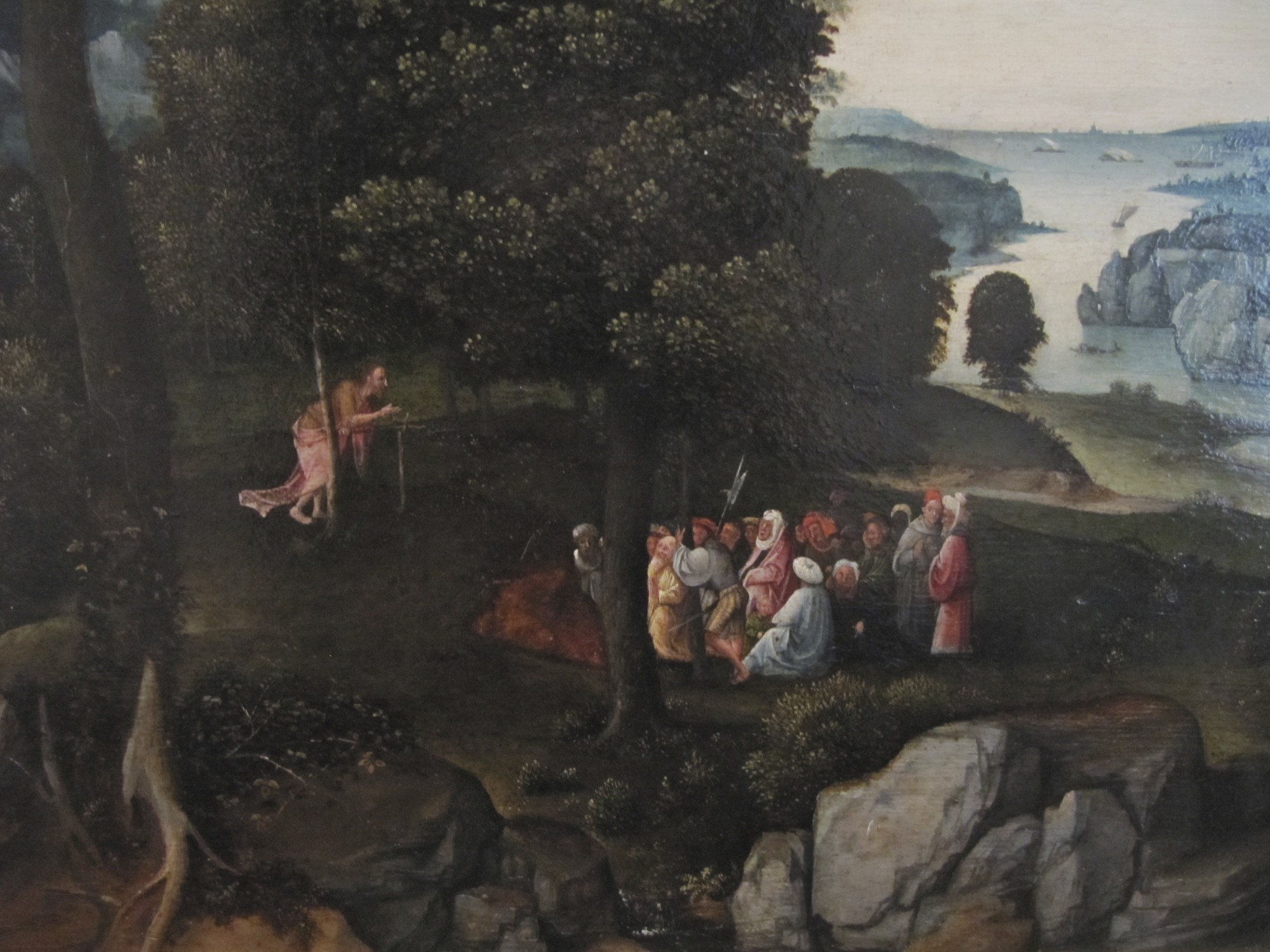
The artist who painted John the Baptist preaching near the Jordan river obviously had no idea what Palestine and the place of John’s ministry looked like, but he gets the story right anyway, I think.
The people listening to John are surrounded by an over-powering wilderness. They’re on their way to Jerusalem, but will they ever get there? There are no well marked trails in sight, no civilized world close by for food and lodging. Only a man preaching to them.
Our readings today from the Old and New Testament point out Elijah and John the Baptist as guides God sent to care for his people, the vine he planted. There were guides then and there will always be guides.
John sent those who listened to him in the wilderness on their way. He baptized them with water and pointed out the path. His words were food for their spirits and brought joy to their hearts. He gave them hope. They’ll find their way.
St. Ambrose, born in the 4th century into a Christian family, was a lawyer and high official in the Roman government in northern Italy until he was called by popular acclaim to be bishop of Milan. He had not yet been baptized! Eight days after his baptism he was ordained bishop, becoming one of the church’s great bishops and teachers. Ambrose was a leader in a critical time.
He found wisdom and joy studying the scriptures and preaching the word of God, and he recommended that same source to a bishop who faced troubles in his own church. “Whoever reads much and understands much, is filled. And whoever is full, refreshes others…Drink, then, from Christ, so that your voice may also be heard.”
Ambrose told the bishop, overwhelmed by problems, God’s graces increase when storms beat upon us. Good thing to remember today.
“You pilot the ship against the waves. Take firm hold of the rudder of faith so that the severe storms of this world cannot disturb you. The sea is mighty and vast, but do not be afraid, for as Scripture says: he has founded it upon the seas, and established it upon the waters.”
Ambrose saw and example of strong faith in Mary, who was energized by the angel’s message and set out “in haste” to visit Elizabeth. She goes “in haste” because she has a mission. Faith was not a burden, it empowered her. She’s blessed.
“You too, my people, are blessed,” comments Ambrose, “ you who have heard and who believe. Every soul that believes — that soul both conceives and gives birth to the Word of God and recognizes his works.
Let the soul of Mary be in each one of you, to proclaim the greatness of the Lord. Let the spirit of Mary be in each one of you, to rejoice in God. According to the flesh only one woman can be the mother of Christ, but in the world of faith Christ is the fruit of all of us.”
Let the soul of Mary be in each of us. A beautiful Advent prayer.
The Advent wreath and its four candles, for the four Advent weeks, is a traditional devotion for this season. It originated in the folk practices of the pre-Christian Germanic peoples who gathered wreaths of evergreen and lit fires during the cold December darkness as a sign of hope for spring and new light.
Christians kept these popular traditions. By the 16th century Catholics and Protestants throughout Germany used these symbols to celebrate their Advent hope in Christ, the everlasting Light. From there, the Advent wreath spread to other parts of the Christian world.
Traditionally, the wreath consists of four candles in a circle of evergreens. Each day at home, the candles are lighted, perhaps before the evening meal– one candle the first week, and then another each succeeding week until December 25th. A short prayer may accompany the lighting.
Prayers for an Advent Wreath
The day the wreath is lit the leader may say:
Our nights grow longer and our days grow shorter. We look at this candle and green branches– and remember God’s promise to our world: Christ, our Light and our Hope, will come.
Here are the words of Isaiah the prophet:
The people that walked in darkness have seen a great light; on those who lived in a land as dark as deatha light has dawned. You have increased their joy and given them gladness; We rejoice in your presence.
Let us pray:
O God, we rejoice as we remember the promise of your Son,
Jesus Christ,
His light shines on us,
brightening our way, guiding us by his truth.
May Christ our Savior bring light into the darkness of our world,



 The Victor's Place