Does ordinary time, the days after Pentecost, mean that every day is the same? They’re not. Graces, challenges, joys and sorrows, hints of things, “our daily bread” are all there. We have to notice them. The Carmelite nun, Jessica Powers, ends a poem calling the day “my beautiful unknown.” We just need eyes to see and ears to hear
You have heard that it was said, ‘An eye for an eye and a tooth for a tooth.’But I say to you, offer no resistance to one who is evil. When someone strikes you on [your] right cheek, turn the other one to him as well. If anyone wants to go to law with you over your tunic, hand him your cloak as well. Should anyone press you into service for one mile,* go with him for two miles. Give to the one who asks of you, and do not turn your back on one who wants to borrow.
Retaliation is often built into our legal systems and the way we think. “You do this, and you’ll get that.” “An eye for an eye and a tooth for a tooth.”
Jesus asks for something more than getting back at someone. God is merciful. He turns the other cheek, he walks more than a mile with us, he opens the door when beggars like us knock.
Jesus offered an example of this when he suffered and died at the hands of others. “Father, forgive them, for they know not what they do.”
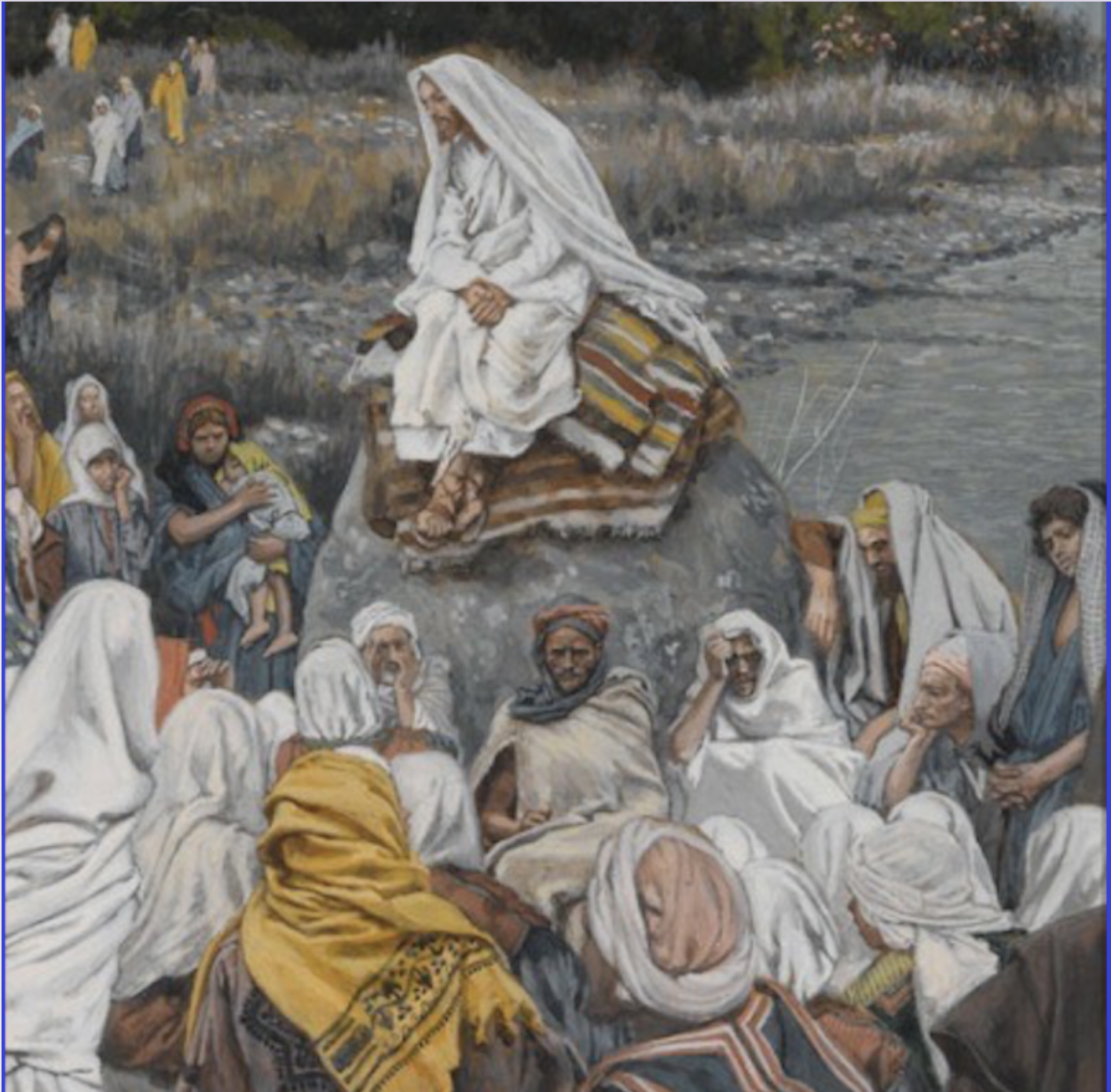
I have Tissot’s picture of Jesus teaching on most of the blogs these days. Those listening to him are not a picked group; everybody’s represented there. Some are still coming to hear him. Jesus does not wait for the perfect moment or the perfect audience. He teaches, continually. The Sower scatters seeds, even on uncertain ground.
We continue this week reading from the Sermon on the Mount, a summary of the teaching of Jesus found in chapters 5-7 in Matthew’s Gospel. After promising beatitudes (Mt. 5:1-16), Jesus calls for addressing anger, lust, vengeance and our tendency to lie more deeply than we may like, We must go beyond the scribes and pharisees in keeping God’s law, Matthew says. (Mt. 5:21-27) The Sermon on the Mount was considered the basic catechism of the Church from earliest times. It’s still teaches what we believe and hope for.
Jesus warns against giving alms to be seen and teaches prayer in chapter 6. The great prayer, the Our Father, is found in the Matthew 6: 7-15, read this Thursday. We will be quoting from S.t Cyprian, one of the greatest commentators on the teaching of Jesus on prayer.
We’re reading from the Sermon on the Mount until Friday of the 12 Week of the Year. On that day, Jesus comes down from the mountain. He enters a world that’s “troubled and abandoned.” There, people are “like sheep without a shepherd.” Even though a number of feasts interrupt the continuous reading from the Sermon on the Mount, it’s important to reflect on this important part of Matthew’s gospel.
The Nativity of John the Baptist is celebrated this Saturday.
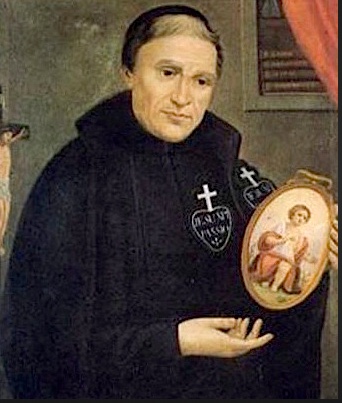
There’ s surprising range of pictures of St. Anthony of Padua. In some he blissfully holds the Christ Child in his arms, which is how someone saw him one day towards the end of his life. At times he’s pictured holding a book in his hand. Some pictures and statues portray him holding the Child and the book together and giving a loaf of bread to a poor man.
Pictures and statues say a lot about him.
Anthony was born in Portugal in 1195 and died near Padua, Italy in 1291, acclaimed for his preaching and virtues. Canonized shortly after his death, he’s invoked as a miracle-worker, especially good at finding something lost. But Anthony’s more than a miracle-worker.
His world was the complex, changing world of the 13th century when Europe’s economy was expanding, military crusades against the Muslim powers were in full swing in Spain, Sicily and the Holy Land, and new religious movements like the Franciscans were bringing reform and new vigor to the western church.
Anthony entered the Augustinian community in his birthplace, Lisbon, and studied at the renowned theological center of Coimbra. Just decades before, Portugal had been freed from the control of the Moors, but then, unfortunately, the victors started fighting among themselves for power and spoils from the crusades.
Anthony rejected the violence and avarice he saw in feuding leaders of church and state; he was a crusader of another kind. When the bodies of some Franciscan missionaries martyred in Morocco in 1219 while preaching the gospel were brought back to Portugal, Anthony decided to join the new community. He became a Franciscan and went to Morocco, hoping to preach the faith to the Muslims there, but illness caused him to leave, first for Sicily, then to Italy, where he became a Franciscan missionary and teacher.
Only a few years before, in 1206 in Assisi, young Francis Bernadone stripped himself of his trendy, stylish clothes and put on the dress of a poor man, to follow the poor Man of Nazareth, Jesus Christ. Thousands followed him and the movement he began quickly spread through the Christian world. Like others, Anthony was attracted to this movement, eager to bring the gospel “to the ends of the earth.”
The Franciscan movement began with a dedication to absolute poverty and a simple life, but as church leaders requested them to preach the gospel throughout the world its members needed books, education, training and places of formation. Anthony emerged as a model Franciscan preacher and teacher.
Through northern Italy, then through France, Anthony’s vivid, down-to-earth preaching stirred people’s hearts and minds and showed other preachers how to preach. At the time, the Franciscan movement was not the only movement attracting the people of Europe. Through northern Italy and especially in France, Albigensian teachers were preaching a message of simplicity and release from the burdens of life to believers dissatisfied with the church. They denied that Jesus was divine, they questioned the gospels and painted the world as an evil place.
“Wise as a serpent and simple as a dove” Anthony disputed their message in his preaching. Gifted with an extraordinary memory for the scriptures and an ability to illustrate his talks with homey examples simple people understood, he spoke “with a well-trained tongue.” Thousands came to hear him. The world was not evil, Anthony taught, Jesus, the Word of God was made flesh and dwelt among us.
Artists capture Anthony’s spirit in their portraits of him. As a preacher and teacher, he carries of book, most likely a psalter holding the Jewish psalms. St. Augustine, whom Anthony studied as a youth, always carried this one book of the bible with him, as a summary of the scriptures.
Some say this book is also clue to Anthony’s gift for finding lost things. He probably kept his notes for teaching and preaching in it. If he lost it–some say one of his students stole it– he lost something valuable to him. He found it, so he knows what it means when someone loses something too. “Good St. Anthony, come around, something’s lost and can’t be found.”
The Christ Child Anthony holds in his arms was more than a momentary vision he had. Anthony was deeply attracted, as St. Francis was, to the mystery of the Incarnation. The Word became flesh. God became a little child, who grew in wisdom and age and grace in the simple world of Nazareth. He died on a cross, accepting it as his Father’s will. Then, he rose from the dead.
Human life and the world itself has been blessed by this mystery. Because of it, life can never be small or inconsequential. Even suffering and death have been changed. “The goodness and kindness of God has appeared.” We hold it in our hands.
I suppose this is why a picture of St. Anthony is down in our laundry where we wash sheets and towels and clothes. He speaks to this world.
I’m sure Anthony, a man of words, worried about being captivated by words. That’s why he wrote this:
Someone filled with the Holy Spirit speaks in different languages, different ways of witnessing to Christ, such as humility, poverty, patience and obedience. These are the languages that reveal who we are. Actions speak louder than words; let your words teach and your actions speak. When we’re full of words but empty of actions, we’re cursed by the Lord, as once he himself cursed the fig tree when he found no fruit but only leaves. Gregory says: “A law is laid upon the preacher to practice what he preaches.” How useless if you preach about the law yet undermine it by your actions.
Are Catholic religious communities like the Passionists, down in numbers at least in our part of the world,, on their way out? Numbers don’t always predict the future. More importantly, does the community produce saints and foster holiness? That’s a lesson to learn from Blessed Lorenzo Salvi, a Passionist whose feast is June 12th.
Lorenzo Salvi was born in Rome on October 30, 1782, professed a Passionist in 1802, and ordained a priest in 1805. These dates point to difficult, unpromising times. As Lorenzo entered the Passionists, Napoleon was carrying out his campaign to create a grand new world with France and himself at its center. He saw the Catholic church, particularly the papacy, in his way and he tried to cripple the church and the popes.
Napoleon invaded the Papal States in 1787, then again in 1798 when he declared a Roman Republic and drove Pope Pius Vi into exile where he died in 1799. Napoleon also ordered religious orders like the Passionists suppressed, their religious houses closed and their members sent back to their families or wherever they could find a place for themselves. Most Passionist houses were closed for a year or more at the time.
Not a good time to join the Passionists, you would think. But Lorenzo did.
In 1802 the body of Pius VI was brought back to Rome in 1802, the year Lorenzo made his vows. Many people said then that the papacy had come to an end. The future didn’t look good.
In 1799 the new pope, Pius VII appointed Father Vincent Mary Strambi, a distinguished Passionist preacher and teacher, as bishop of Marcerati, to shore up a tottering diocese in the tottering papal states. Later, Strambi would be declared a saint. Certainly the move benefited the church, but perhaps not so much the Passionists who lost a religious deeply involved in forming their young people, like Lorenzo.
You wonder what the young man felt facing the future at a time like that.
Far from losing hope, Lorenzo’s spirit seemed to soar and his call strengthened during the Napoleonic suppression. The young priest worked to restore the church in Italy and his own congregation. Napoleon’s plans failed.
Lorenzo Salvi was a forceful preacher who had a great devotion to the Child Jesus. “Unless you become like little children, you cannot enter the kingdom of heaven,” Jesus said. Lorenzo had the heart of a child. He believed no one can destroy God’s kingdom.
The Passionists experienced a surprising growth after the Napoleonic suppression. Lorenzo, an inspiring preacher and holy priest, was one of those leading the community into a new era.
Pray for saints like Lorenzo today. Pray that the Passionists have new recruits like him.
Lord, you granted Blessed Lorenzo Maria Salvi an intense and penetrating knowledge of the mystery of your Word made flesh through his devout contemplation of the Child Jesus. Through his intercession grant that we, too, walking in the ways of spiritual childhood, may come to eternal life in your Son. We ask this through our Lord Jesus Christ, your Son, who lives and reigns with you and the Holy Spirit one God, forever and ever.
We will be reading on weekdays for the next two months from Matthew’s Gospel, chapters 5-24. Then we start reading from Luke. Reading the scriptures daily is the church’s way of praying, recommended especially since the Second Vatican Council. Day by day God’s word is our most important guide.
Each of the gospels —and the rest of the scriptures— offers wisdom of its own. What can we learn from Matthew? Throughout his gospel Mathew notes that God’s plan is being fulfilled, even if human plans or Satan’s power seems to prevail. God’s plan is unfolding. In chaotic times like ours, Matthew has a message we need to hear.
Jesus is a Teacher in Matthew’s Gospel, a new Moses. He calls us to hear him as he speaks to us in his Sermon on the Mount, chapters 5–7. Then, in chapter 10 he directs us to join him in his mission. In chapter 13 he teaches in parables. In chapter 18 he describes who a disciple must be.Finally, in chapters 24-25 he speaks of the end times.
Yes, we heard it before, but we are forgetful listeners and grasp only so much. The liturgy is a patient school. It has a patient Teacher.
Green is the liturgy’s color for ordinary time. Not white, the bright light of Eastertime, or red the color of blood and fire. or purple the color of penance. Green is earth’s color, color of slow growing trees and grasses, of ordinary time.
An unknown 4th century spiritual writer describes the ordinary ways the Holy Spirit works in us.
” ‘In varied and different ways’ invisible grace leads us. Ordinary time doesn’t mean that every day’s the same. Sometimes we find ourselves sad at the state of things; sometimes we joyfully hold the whole world in our arms. Sometimes we feel helpless; sometimes we think there’s nothing we can’t do. Sometimes we’re brave; sometimes we escape into the supposed safety of ourselves looking for peace.
.. The soul becomes like any other human being.”
Which means, I guess, that we don’t feel spiritual at all.
Far from taking us away from the human condition, the Spirit leads us by human steps in human time. Ordinary time is the natural roller-coaster of life, all right, but the Spirit leads us on.
That’s why the psalms are such wonderful prayers. They’re the prayers of ordinary time. They take us from one human experience to another. If you don’t experience what a certain psalm describes, wait awhile–you will.
Green is the Season
Green is the season after Pentecost. The Holy Ghost in an abstracted place spreads out the languid summer of His peace, unrolls His hot July. O leaves of love, O chlorophyll of grace. Native to all is this contemplative summer. The soul that finds its way through Pentecost knows this green solitude at once as homeland. Only the heart, earth held and time engrossed, dazed by this unforeknown and blossoming nowhere, toubles itself with adjectives like “lost”.
Jessica Powers, 1954
Green is the season after Pentecost.The Holy Ghost in an abstracted placespreads out the languid summer of His peace,unrolls His hot July.O leaves of love, O chlorophyll of grace.Native to all is this contemplative summer.The soul that finds its way through Pentecostknows this green solitude at once as homeland.Only the heart, earth held and time engrossed,dazed by this unforeknown and blossoming nowhere,
Matthew’s Gospel offers many indications of the Jewishness of Jesus. Some are found in the readings for this week, his Sermon on the Mount ( Matthew 5) , where he speaks as a loyal, practicing Jew, fully involved in his religion and culture. He celebrates Jewish feasts and observes Jewish laws; he prays in the synagogue every Sabbath.
Yet, Jesus criticized the Jewish world he lived in. That’s evident in the Sermon on the Mount.
Some of his words seem harsh to us– “If your right eye causes you to sin, tear it out and throw it away…And if your right hand causes you to sin, cut it off and throw it away.” Jesus spoke as Jewish prophets spoke; extreme words made their point.
Like them, Jesus spoke strongly when religious standards were neglected and unfulfilled. “I came not to abolish the law or the prophets but to fulfill them.” (Wednesday) His criticism was directed especially to the Jewish leadership of his day.
He criticized life focused simply on externals–and sometimes just a few externals– and divorced from an inner spiritual awareness.
For example, the commandment “You shall not kill…. whoever kills will be liable to judgment.” (Matthew 5: 26 Thursday) There are other ways you can to kill, Jesus teaches. You may not go to jail for them either, but you can destroy people by anger or by regarding them as fools. Strong words make a point, not just for his time but for ours as well.
“ ‘You shall not commit adultery.’ But I say to you, everyone who looks at a woman with lust has already committed adultery with her in his heart.” (Matthew 5:27, Friday) Again, you may not go to jail for your thinking, but your thoughts can poison your appreciation of people. I think that’s what pornography does. It poisons your mind and lessens your respect for others.
Watch your thinking and your judging, Jesus says. The way you think influences the way you live. The way you look at things influences the way you do things.
Jesus also teaches about divorce procedures and taking oaths in the Sermon on the Month. (Matthew 5:33, Saturday) Some saw life in terms of law; some today still do. All you have to do is keep within the law, be law abiding, live legally and that’s enough. Yet, Jesus never saw keeping laws enough. They’re just a start.
Saints share their gifts, and recognize the gifts of others. That’s what St. Barnabas did. He was a gifted teacher of the Gospel; he also recognized the gift of Paul of Tarsus. His feast is June 11.
After his dramatic conversion on the way to Damascus, Paul preached the gospel in Damascus and then in Jerusalem, but his past caused some in Jerusalem to be suspicious of him. “They were all afraid of him, not believing that he was a disciple.”
“Then Barnabas took charge of him and brought him to the apostles, and he reported to them how on the way he had seen the Lord and that he had spoken to him, and how in Damascus he had spoken out boldly in the name of Jesus.” (Acts 9, 25-27) Barnabas recognized the grace of God in Saul.
Then, as gentiles in Antioch became increasingly interested in the gospel, the leaders of the Jerusalem church sent Barnabas to see what to do. “When he arrived and saw the grace of God, he rejoiced and encouraged them all to remain faithful to the Lord in firmness of heart, for he was a good man, filled with the holy Spirit and faith. And a large number of people was added to the Lord. Then he went to Tarsus to look for Saul, and when he had found him he brought him to Antioch. For a whole year they met with the church and taught a large number of people, and it was in Antioch that the disciples were first called Christians.” (Acts 11,23-26)
Barnabas recognized Paul’s gifts once again and sought him out to bring the gospel to the gentiles. Previously, the Apostle Peter encountered the gentile Cornelius in Ceasaria Maritima and baptized him and his friends. Now, Barnabas chooses Paul to come to Antioch, and the two embark on a mission to the gentiles. The Acts of the Apostles refer first to “Barnabas and Saul”, then gradually it becomes “Paul and Barnabas.”
Paul emerged as a gifted apostle. The Acts of the Apostles follows him all the way to Rome, while Barnabas is hardly mentioned at all. There are indications he returned to Cyprus where he came from. Did he get sick, or was he too old to embark on something new?
Whatever it was, Barnabas first recognized Paul and his gifts. I noticed on his feast, Paul is quoted in his letter to the Corinthians. “I handed on to you what I myself received…” Part of that was from Barnabas.




 The Victor's Place