Author Archives: vhoagland

The Company of Prophets

The mystery of the Incarnation of Jesus Christ involves more than his birth from Mary and the incidents of his infancy, so beautifully described in the gospels, especially in the Gospel of Luke. He became flesh and dwelt among us.

He entered the company of the prophets. In our readings for the past few days of Advent Jesus describes his place with Isaiah, Elijah and John the Baptist. It was a relationship the people of his day saw. “Who do people say I am?” Jesus asked his disciples. “They replied, ‘Some say John the Baptist, others Elijah, still others Jeremiah or one of the prophets.’” (Matthew 13;14) In Luke’s Gospel, Jesus describes his mission in the synagogue at Nazareth through words from the Prophet Isaiah.

Coming among us, the Son of God entered the company of the prophets and accepted a role among them.  Like Isaiah and Elijah he spoke to the secular powers of his day; like John the Baptist he confronted the religious powers. He became a voice for the poor and the exiled; he cured illness of every kind.

Jesus never distanced himself the efforts of the prophets. Rather, he claimed to fulfill their promises and hopes. He saw himself as part of their company. He dwelt among them.

For that reason, we read the prophets and recognize the way their writings have shaped the gospels and our liturgy. It’s also the reason why we listen for prophetic voices in our world today, wherever we find them. They’re one with the voice of Christ. 

The company of prophets praises you, O Lord.

The Kingdom of God is Like

“Like” appears often in today’s Advent readings at Mass. it’s a word that appears often in religious matters. Isaiah, the master poet, cannot speak without using the word. If you listen to God, our Teacher,

 “ your prosperity would be like a river,
    and your vindication like the waves of the sea;
Your descendants would be like the sand,
    and those born of your stock like its grains.”

Prophets like Isaiah cannot speak of the mystery of God and his promises without saying what it may be like. 

Psalm 1, the responsorial psalm, uses the same language:  
The one who follows you, Lord, will have the light of life.
and be like a tree planted near running water,
That yields its fruit in due season, and whose leaves never fade.
Whatever he does, prospers. 

This generation, Jesus says in the Gospel of Matthew, is ‘ like children who sit in marketplaces and call to one another, ‘We played the flute for you, but you did not dance, we sang a dirge but you did not mourn.’ They’re competing with one another, shouting at each other, scarcely seeing Jesus and John and the message they stand for.  

“Like” is a word that approximates some reality. It’s the closest we can get to some truth.

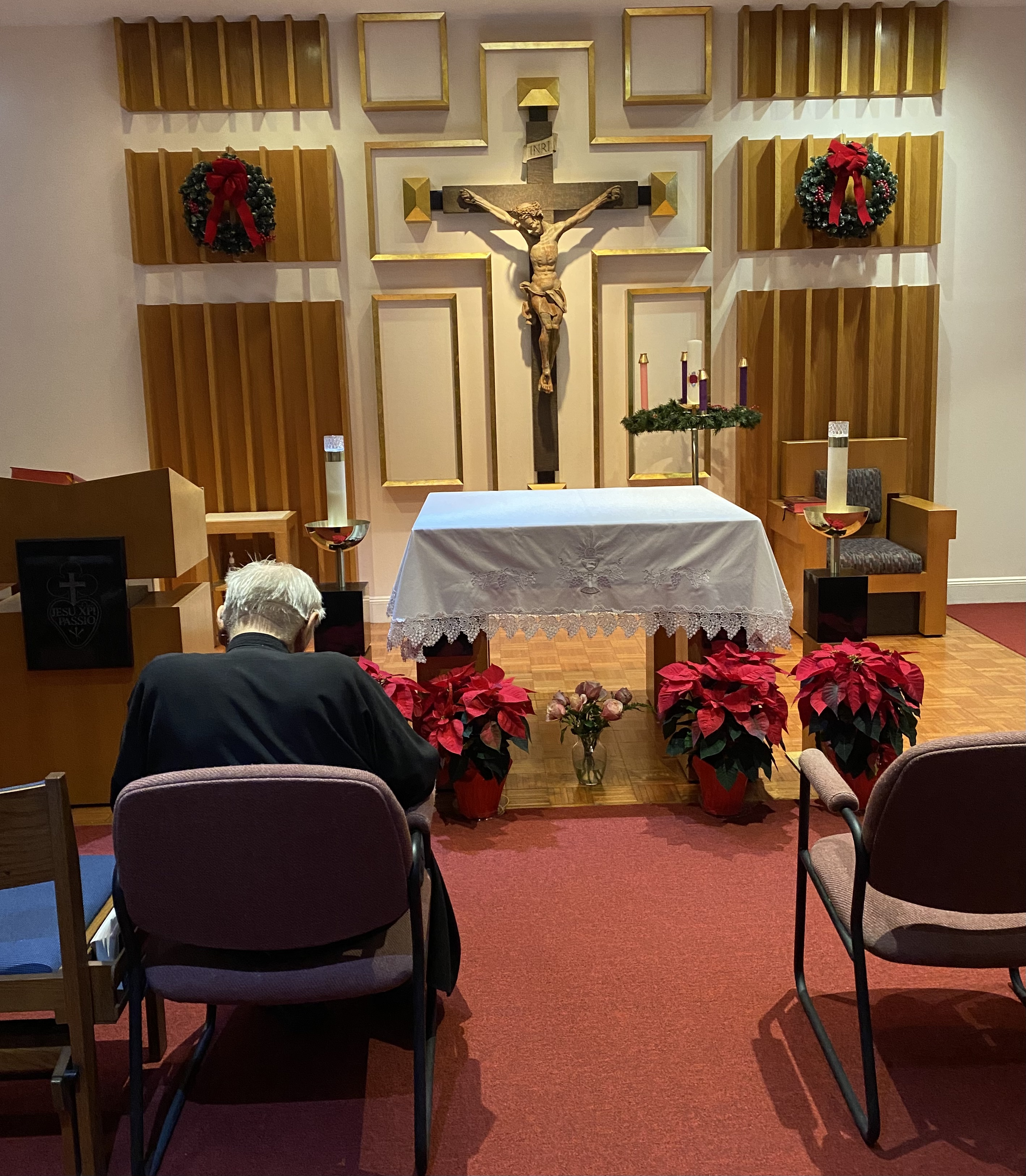
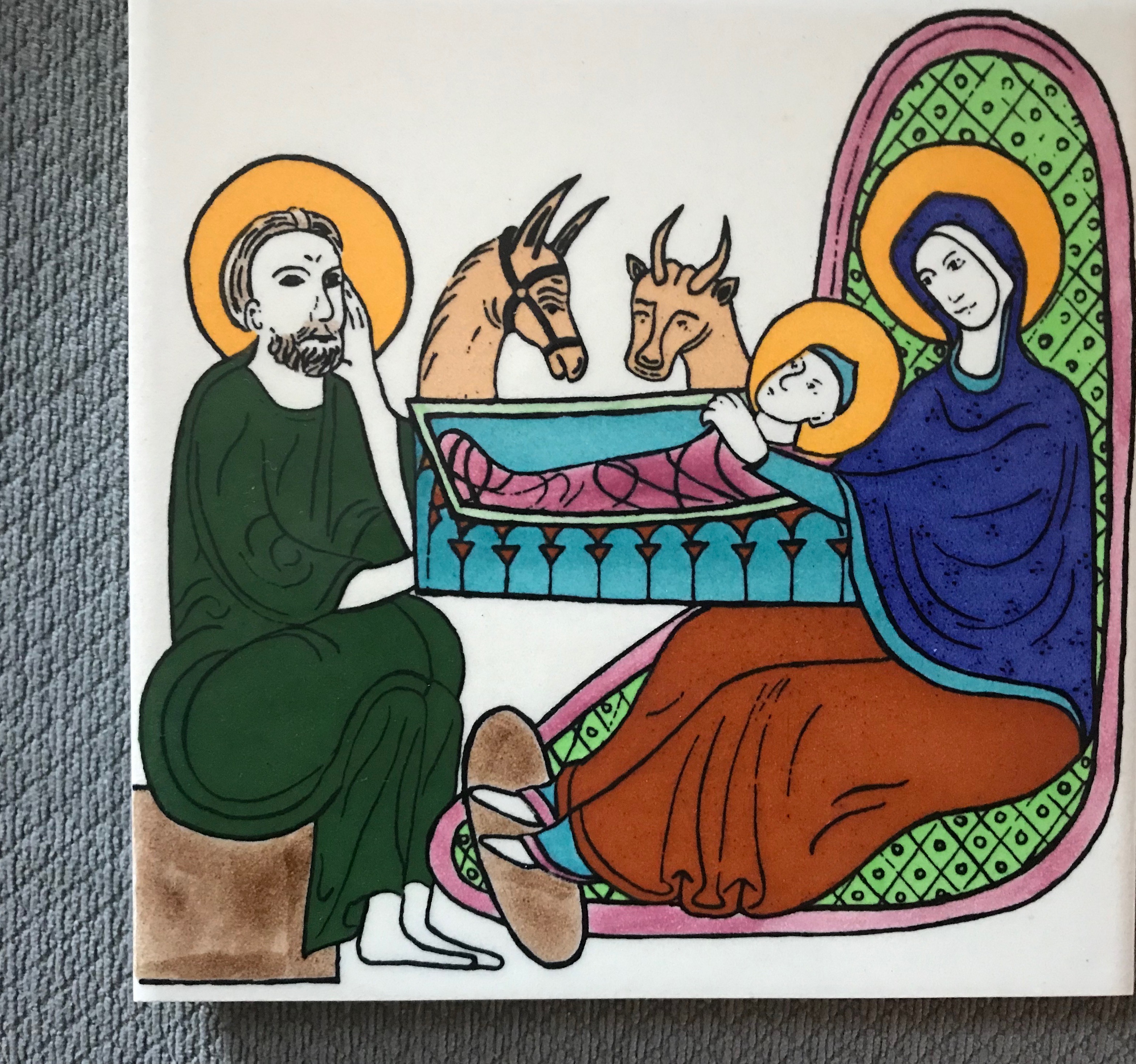
We placed poinsettias and wreathes in our chapel yesterday and a vase of roses where the figures of the Child, Mary and Joseph will go. We search for words and ways to understand the mystery we celebrate, but in the end they are all “like”. That’s what we have till we see.   

O Virgin, by whose blessing all nature is blessed!

The mystery of the Immaculate Conception of Mary brings blessings to all creation as well as to humanity, St Anselm says:

“Blessed Lady, sky and stars, earth and rivers, day and night – everything that is subject to the power or use of human beings – rejoice that through you they are in some sense restored to their lost beauty and are endowed with inexpressible new grace.

All creatures were dead, as it were, useless for human beings or for the praise of God, who made them. The world, contrary to its true destiny, was corrupted and tainted by the acts of humans who served idols. Now all creation has been restored to life and rejoices that it is controlled and given splendor by humans who believe in God.

  The universe rejoices with new and indefinable loveliness. Not only does it feel the unseen presence of God himself, its Creator, it sees him openly, working and making it holy. These great blessings spring from the blessed fruit of Mary’s womb–

Jesus Christ.

  To Mary God gave his only-begotten Son, whom he loved as himself. Through Mary God made himself a Son, not different but the same, by nature Son of God and Son of Mary. The whole universe was created by God, and God was born of Mary. God created all things, and Mary gave birth to God. The God who made all things gave himself form through Mary, and thus he made his own creation. He who could create all things from nothing would not remake his ruined creation without Mary.

  God, then, is the Father of the created world and Mary the mother of the re-created world. God is the Father by whom all things were given life, and Mary the mother through whom all things were given new life. For God begot the Son, through whom all things were made, and Mary gave birth to him as the Savior of the world. Without God’s Son, nothing could exist; without Mary’s Son, nothing could be redeemed.

  Truly the Lord is with you, to whom the Lord granted that all nature should owe as much to you as to himself.”

Feast of St. Nicholas

You would do a little friend, or child, or relative of yours a favor if you would introduce him or her to the real Santa Claus, St. Nicholas, whose feastday is today. My good friend, Mauro DeTrizio, whose family comes from Bari, Italy, has had a lifelong devotion to St. Nicholas. He’s also a good videographer and his dream has been to produce a video on St. Nicholas, our Santa Claus.

So we teamed up to produce a couple of them as part of our campaign for saving Santa Claus. Santa’s more than a salesman; he’s a saint, and his gift for quiet giving is in the spirit of our coming season of Advent and Christmas. He mirrors God’s love shown in Jesus Christ.

Telling his story is one of the ways to save him from being captured by Macys and Walmart. Previously, we offered a version for little children. Now here’s another modest contribution for bigger children– like us:

http://www.youtube.com/watch?v=ADevygB9jNs

2nd Sunday of Advent

For this week’s homily please watch the video below.

Thursday: 1st Week of Advent

God’s holy mountain will enjoy rock-like security, Isaiah announces in today’s first reading.

On that day they will sing this song in the land of Judah:

    “A strong city have we;
        he sets up walls and ramparts to protect us.
    Open up the gates
        to let in a nation that is just,
        one that keeps faith.
    A nation of firm purpose you keep in peace;
        in peace, for its trust in you.”

    Trust in the LORD forever!
        For the LORD is an eternal Rock.
    (Isaiah 27)

Our world today is thirsting for the security Isaiah promises. Listen to the growing cries around us for safe cities, safe neighborhoods, safe schools, safe roads, safe water.  We’re looking for a health care system, a work environment, a food supply, a government, a nation, a world that’s safe and dependable. Today, too, we’re worried about a planet that’s threatened.

Humanity and the earth itself need security to flourish. 

“Everyone who listens to these words of mine and acts on them will be like a wise man who built his house on rock.” Jesus says in today’s gospel.

We weaken the words of Jesus if we hear them only as words of personal assurance. They are meant for “everyone.” Jesus calls for society and the world itself to act on his words.  

The holy mountain promised by Isaiah is not just a place of personal security. It’s not the mountain the bird flies to when danger comes. ( cf. Psalm 11   ) It’s a mountain that  needs a “nation that is just and of firm purpose” to enter its gates, Isaiah says.

We hear a common longing in the words of the psalmist:

“There is one thing I ask of the Lord,

for this I long,

to live in the house of the Lord,

all the days of my life,

to savor the sweetness of the Lord,

to behold his temple.

For there he keeps me safe in his tent

in the day of evil.

He hides me in the shelter of his tent,

on a rock he sets me safe.” (Psalm 27)

Advent Prayers

How should we pray in Advent? One suggestion: Look at the psalm responses to the scriptural readings during the season.. Here’s one from the Mass for the 1st Sunday:

“ To you, O Lord, I lift my soul.
Make your ways known to me, O Lord;
   teach me your paths,
Guide me in your truth and teach me,
   for you are God my savior,
   and for you I wait all the day. “

Advent’s a teaching time, and God is our teacher and guide. 

The Advent prayers are prayers to make our own. Here’s part of the 1st Preface for Advent:

“We give you thanks, Father, almighty and eternal God, through Christ our Lord, For he assumed at his first coming the lowliness of human flesh and so fulfilled the design you formed long ago, and opened for us the way to eternal salvation that, when he comes again in glory and majesty and all is at last made manifest, we who watch for that day  may inherit the great promise In which we now dare to hope.”

God’s daring plan calls for daring hope from us.

Here’s part of the 2nd Preface for Advent                                   

“We give you thanks, Father, almighty and eternal God, through Christ our Lord,For all the oracles of the prophets foretold him, the Virgin Mother longed for himwith love beyond all telling. John the Baptist sang of his coming and proclaimed his presence when he came. It is by his gift that already we rejoice at the mystery of his Nativity so that he may find us watchful in prayer and exultant in his praise.”

We share with the prophets, Mary, and John the Baptist, who rejoiced in the gift they were given, Jesus Christ. 

Collect, Monday, First Week of Advent

Keep us alert, we pray, O Lord our God, as we await the advent of Christ your Son, so that, when he comes and knocks, he may find us watchful in prayer and exultant in his praise. Who lives and reigns…

Prayer after Communion 

Replenished by the food of spiritual nourishment we humbly beseech you, O Lord, that, through our partaking in this mystery you may teach us to judge wisely the things of earth and to hold firm to the things of heaven.

Prayer after Communion

May these mysteries  in which we have participated, profit us, we pray for even now, as we walk amid passing things you teach us by them to love the things of heavenand to hold fast to what endures. Through Christ our Lord.

1st Sunday of Advent C

For this week’s homily please watch the video below.

Bless the Lord, All You Works of the Lord

The Liturgy of the Hours, the prayer of the church, offers a rich feast of psalms, canticles and readings from scripture for morning and evening prayer. Prayers of the three young men, Shadrach, Meshach and Abednego, from the Book of Daniel 3, 14f are frequently  found  in the church’s morning prayers.

The three young men were bound and thrown into a fiery furnace by the Babylonian King Nebuchadnezzar because they won’t worship a golden idol he set up. But the fire doesn’t destroy them,  “Unfettered and unhurt” they walk freely in the fire, protected by an angel. They’re unharmed, saved by their faith in God.

The young men in the furnace belonged to a Jewish community in exile, with no priest, prophet or leader, no temple to offer sacrifice, but they willingly shouldered the world they lived in, which had become a fiery furnace.

They have sins and mistakes of their own, but the young men believe in God who promised offspring like the stars in the sky and the sands of the sea. “We follow you with our whole heart, we fear you and seek your face. Do not put us to shame.”

A good prayer for days and a world that become a fiery furnace. With  hope in God’s promises, trusting and uncomplaining, we can walk freely in the fire too, “unfettered and unhurt.” Azariah’s (Abednego) prayer for mercy. is found on Tuesday morning Week IV.

The second prayer from the Book of Daniel is long prayer that’s the canticle for Sunday morning in the 1st and 3rd weeks of the Liturgy of the Hours (Daniel 3, 51-90). A shorter form of the canticle is found in Sunday morning prayer for the 2nd and 4th weeks. (Daniel 3,54-57)

It’s a prayer of thanksgiving. When King Nebuchadnezzar saw the three young men walking unharmed in the fiery furnace he ordered the furnace heated seven times stronger than before. “But the angel of the Lord went down into the furnace with Azariah and his companions, drove the fiery flames out of the furnace, and made the inside of the furnace as though a dew-laden breeze were blowing through it. The fire in no way touched them or caused them pain or harm. Then these three in the furnace sang with one voice, glorifying and blessing God:
“Bless the Lord, all you works of the Lord,
praise and exalt him above all forever.
Angels of the Lord, bless the Lord,
You heavens, bless the Lord,
All you waters above the heavens, bless the Lord.
Sun and moon, bless the Lord;
Stars of heaven, bless the Lord;
Every shower and dew, bless the Lord;
All you winds, bless the Lord;
Fire and heat, bless the Lord;
Cold and chill, bless the Lord;
Dew and rain, bless the Lord;

Frost and chill, bless the Lord;

Ice and snow, bless the Lord;

Nights and days, bless the Lord;

Light and darkness, bless the Lord;

Lightnings and clouds, bless the Lord;

Let the earth bless the Lord,

Mountains and hills, bless the Lord;

Everything growing on earth, bless the Lord;

O Israel, bless the Lord;

Priests of the Lord, bless the Lord;

Servants of the Lord, bless the Lord;

Spirits and souls of the just, bless the Lord;

Holy men of humble of heart, bless the Lord;

Hananiah, Azariah, Mishael, bless the Lord;
praise and exalt him above all forever.
For he has delivered us from Sheol,
and saved us from the power of death;
He has freed us from the raging flame
and delivered us from the fire.” (Daniel 3, 51-90))

This is a resurrection prayer, a prayer of thanksgiving. We pray the canticle from Daniel on Sunday because it is the Lord’s day, the day of his resurrection. We’re not the only ones promised resurrection. All creation has that promise, and so we call all creation to bless the Lord.

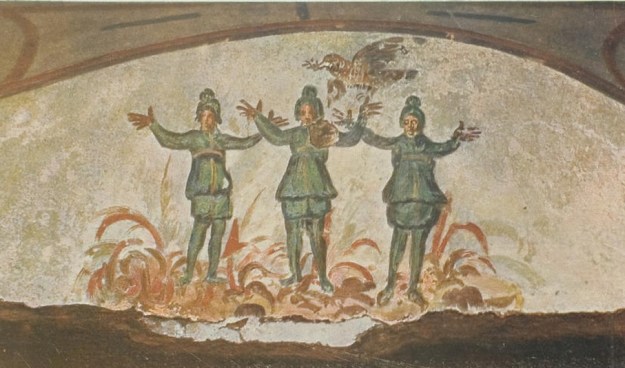
The three young men and their prayer in the fiery furnace was a story early Christians greatly admired. They frequently placed the representation of the three young men in the catacombs as a reminder that God hears us in the fiery furnace, whether it’s the fiery furnace of  life or of death. God not only promise us life. God promise all creation resurrection and life.

A Little Boy’s Small Gifts

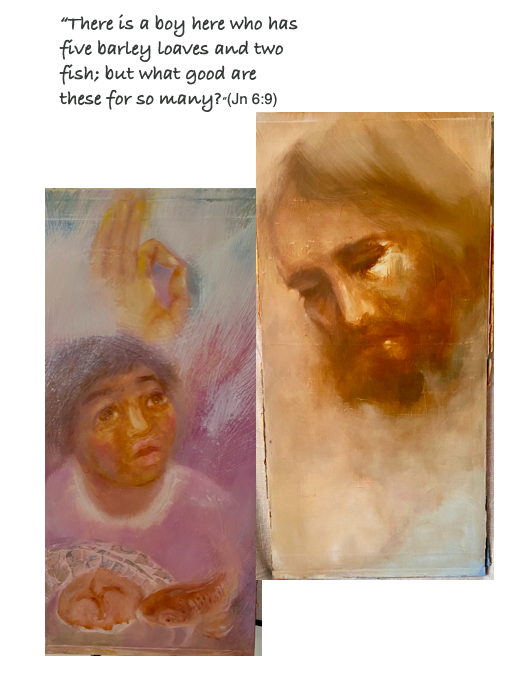
“When my mother would bring me as a little girl to the Buddhist temple in Korea, she would tell me to bring along some bread for the holy man there; he would be hungry,” my good friend Duk Soon Fwang told me not long ago. 

“When I became a Catholic, I found the story of the little boy who brought bread and fish to Jesus my favorite story. I have always wanted to paint that story. The little boy has no name. I wonder if his mother told him the same thing my mother told me. He could be me.”

During a recent visit, Duk Soon was working on the painting and she told me she wanted to show Jesus with his hand blessing the little boy but wasn’t sure. Maybe she could do what the painters of icons do, I suggested. Jesus’ hand, with the two index fingers joined together showed he is God and man, and his three other fingers indicating the Trinity.

The little boy is blessed by Jesus, human and divine, and by the Triune God, Father, Son and Holy Spirit. God blesses the small gifts we bring. 

Thanksgiving. Don’t forget to give thanks for the small gifts. God blesses them.  Remember the little boy.