Author Archives: vhoagland

 God’s Word is Love Part 2 

                                                                                              By Orlando Hernández

     Our expression, “The Word of God” has so many meanings and dimensions. I think of it as the Power that created everything, which is the infinite Love that God is. We also think of Jesus, the Logos, as the Word of God. “All things came to be through Him, and without Him nothing came to be.” (Jn 1: 3) Prayer with Jesus is direct contact with the Word of God, specially at the Eucharist. We also read or listen to “The Word of God” in holy Scripture. I believe that our God speaks to us through the text. A passage can affect or instruct us in different ways at different times. Then, a preacher, a spiritual director, a child, a friend, a homeless person in the street, can suddenly speak to us with the Word of God.

     In the end, I see the “Word of God” as God’s intent to communicate, and even more, to commune with us. Why? Because our God loves us with a love that is immense, and wishes us to experience this love, to share it, and act on it.  Often the Word of God can seem beyond our understanding, as if it were an advanced, specialized, or foreign language. Yet we can still appreciate it, perceive the love, the invitation to intimacy with the Giver of Life, an invitation to the Glory and Joy that God is.

     The problem is that, for many of us, for different reasons throughout the day, our hearts are like hardened, cold soil, unreceptive to the seed of this Divine wooing that is constantly taking place, even in moments of pain and sorrow. Only through perseverance on our part, united to God’s perseverance can we perceive the “Zoe”, the life to the fullest, that God speaks into us through His Word. 

     Last time I wrote about the “Season of Creation” that is now going on in our Church, a united focus on the beauty of, and also the threat to our planet and everything on it. We pray to our Creator: 

    “In the Season of Creation, we pray that You will call to us, as from the burning bush, with the sustaining fire of your Spirit. Turn us from our inward gaze. Teach us to contemplate Your Creation, and listen for the voice of each creature declaring Your Glory. Give us hearts to listen, enlighten us with Your Grace, and fill us with the hope to quench the fires of injustice with the light of Your healing love that sustains our common home.”

     I pray that the Word of God be perceived in the beauty and wonder of nature, filling us with awe, love, and gratitude to our God. 

     I have never forgotten a story written by the Argentinian writer, Jorge Luis Borges, titled “The Handwriting of the God.” In it, an Inca priest or leader is imprisoned and starved by the Spaniards in a tiny dungeon. To torment him, his captors have put a jaguar right next to him, separated only by bars. The captive is waiting for the gods to rescue him by sending a holy message of power that will change everything. As he dies of hunger, he becomes fascinated by the designs and patterns of the jaguar’s fur, as they become more and more like mysterious words. In the end, the captive man understands “the handwriting of the god” and becomes free in the glory of a spiritual experience.

     “The handwriting of the god”, The Word of God, is all around us. We can see it in those blessed days when the wind on the leaves seems to whisper sacred messages into our ears, or when the roar of the waves speaks of might and greatness. The rocks seem to converse when the brook rolls over them. The song of birds, even the sound of our breathing reminds us of the mercy and love of our life-sustaining God. The “handwriting” can be read in the patterns of the waves and ripples, in the textures of different barks of trees, in the geometry of leaves and flowers, the plumage of birds, the patterns in a cat’s fur. 

     Last week, at the Children’s Zoo in the Bronx I suddenly fell into this ecstasy of wonder and gratitude as I saw the beautiful, small creatures all around, surrounded by the music of the voices of four and five-year olds, filled with a joy that eleven year-olds can no longer feel in a place like this. The bark of a tree caught my attention when suddenly from a hole in the trunk a small, furry, black-and-white monkey emerged and looked straight at me. It was eating a little morsel. Unthinkingly, I uttered, “What’s that orange thing it’s eating?” From behind me a little voice said, “Don’t you know? It’s a carrot.” I turned around and saw this beautiful four-year old cautiously smiling at me. I suddenly remembered that we, God’s children, are also part of this wonderful tapestry. We are part of the message, the Word of God, which is Love. We are beloved!

     Dear Readers, if you haven’t done it, just take a little time away from the computer, the phone, the TV, and spend some moments in a park, a garden, or a church.

 Experience the Word of God. Only this way can we find the love and the zeal to save our suffering planet, our humanity, our trust in God’s eternal plan of Love!

     If you want to know more about this observance of The Season of Creation, or about the Laudato Si movement, you can go to https://seasonofcreation.org/ –
25th Week of the Year: Readings and Feasts

SEPTEMBER 19 Mon Weekday [St Januarius,] Prv 3:27-34/Lk 8:16-18 

20 Tue Saints Andrew Kim Tae-gŏn, Priest, and Paul Chŏng Ha-sang, and Companions, Korean Martyrs Memorial Prv 21:1-6, 10-13/Lk 8:19-21 

21 Wed Saint Matthew, Apostle and Evangelist Feast Eph 4:1-7, 11-13/Mt 9:9-13

22 Thu Weekday Eccl 1:2-11/Lk 9:7-9 

23 Fri Saint Pius of Pietrelcina, Priest Memorial Eccl 3:1-11/Lk 9:18-22 

24 Sat St.Vincent Strambi, Passionist Eccl 11:9—12:8/Lk 9:43b-45 

25 SUN TWENTY-SIXTH SUNDAY IN ORDINARY TIME

Am 6:1a, 4-7/1 Tm 6:11-16/Lk 16:19-31 

Leaders from all over the world meet for three days at the UN in New York this week from September 20-22. 

Readings from the Wisdom literature.  Proverbs and Ecclesiastes are read most weekdays. “The heart of the king is like channeled water in the hand of the Lord, He will direct it wherever he wills.” Good thing to remember as the UN meets this week.

Readings from Luke: Jesus prepares for his journey to Jerusalem was confirming his disciples in their mission. Luke 9-9.

 The Feast of the apostle Matthew is Wednesday.

The memorial of the Korean martyrs and the foundation of the church in Korea is recalled on Tuesday.

The popular Padre Pio is remembered on Friday.

The Passionists celebrate St. Vincent Strambi on September 24

25th Sunday c: See Something, Say Something

For this week’s homily please watch the video below.

  God’s Word Is Love (Part I)

                                                                                              By Orlando Hernández

     Luke’s Gospel (Lk 8:4-15) tells us Jesus’ Parable Of The Sower. Our Lord teaches us so much in this passage. The Word of God falls into our hearts like seed. If our hearts are like “rich soil” we are the ones “who, when they have heard the word, embrace it with with a generous and good heart and bear fruit with perseverance.”

     What is this fruit? In verse 12, Jesus seems to imply that this fruit is first of all to “believe and be saved”. Absolutely. In verse 15, our Lord speaks of “a generous and good heart.”  This fruit seems to include acts of generosity and goodness for our world. There are so many ways that we can do this. When I read this Gospel this week I felt that part of this goodness includes our commitment to love and save God’s Creation here on our Planet. 

     The Senegalese conservationist Baba Dioum once wrote this much-quoted line:

      “In the end we will conserve only what we love, we will love only what we understand, and we will understand only what we are taught.”

     Can the Word of God teach us to understand and love what He has created? Or are our hearts like the trampled, rocky, or weed-covered soil? How can we learn to care? How can we learn to hear this Word of God? It is, of course, a life-long endeavor. When stuck, it is always good to begin by praying to our God. In this period from September 1- October 4 (The Feast of St. Francis) Christians all over the world are observing the “Season of Prayer” , inspired by Pope Francis’ Laudato Si. It is a time for listening to this Word of God through prayer, contemplation, listening, learning, sharing, and doing generous and good acts to help preserve our planet Earth.

     The “Prayer for the Season of Creation” is part of the many prayers and activities that are taking place. For me, it addresses my questions at the beginning of this blog.

                                     Creator of All, 

                                    From your communion of love you word went forth to

                                    create a symphony of life that sings your  praise.      

                                    By your Holy Wisdom you made the Earth to bring forth a

                                    diversity of creatures who praise you in their being.

                                    You called human beings to till and keep your garden.

                                    But we turn in on ourselves and away from our co- creatures.

                                   We fail to listen to the cries of the poor and the needs of the

                                   most vulnerable. We silence the voices of those who hold

                                   the traditions that teach us to care for the Earth. We close

                                   our ears to your creative, reconciling and sustaining Word

                                   that  calls us through the Scriptures. 

                                  Creation cries out as forests crackle, and animals alike flee

                                  the fires of injustice that we have lit by our 

                                  unwillingness to listen.

                                  In this Season of Creation, we pray that you will call to us,

                                  as from the burning bush, with the sustaining fire of your Spirit.

                                  Turn us from our inward gaze. Teach us to contemplate

                                  your creation, and listen for the voice of each creature

                                  declaring your glory.

                                 Give us hearts to listen, enlighten us with your grace,

                                 and fill us with the hope to quench the fires of injustice 

                                 with the light of your healing love that sustains our common home.

                                 In the name of the One who came to proclaim good news

                                 to all creation, Jesus Christ. Amen.

     With this prayer I open my eyes, my ears, all my senses, my intellect, and my spirit, that God’s Word will make of my heart fertile ground for the many ways that my Lord can teach me and guide me in this holy mission, this Fruit, this devotion to serve His wounded people and His endangered creation. I will write more on the mystery of this Word of God, next time.

     If you are interested in learning more about this observance of the Season of Creation , you can go to https://seasonofcreation.org/ –  

      God bless you all. 

24th Week of the Year: Readings and Feasts

SEPTEMBER 12 Mon Weekday [The Most Holy Name of Mary]

1 Cor 11:17-26, 33/Lk 7:1-10

13 Tue St John Chrysostom, Bishop, Doctor of the Church Memorial

1 Cor 12:12-14, 27-31a/Lk 7:11-17

14 Wed The Exaltation of the Holy Cross Feast

Nm 21:4b-9/Phil 2:6-11/Jn 3:13-17 

15 Thu Our Lady of Sorrows Memorial

1 Cor 15:1-11 /Jn 19:25-27 or Lk 2:33-35 

16 Fri Sts Cornelius, Pope, and Cyprian, Bishop, Martyrs Memorial

1 Cor 15:12-20/Lk 8:1-3 

17 Sat Weekday [St Robert Bellarmine, Bishop and Doctor of the Church;

St Hildegard of Bingen, Virgin and Doctor of the Church] 

1 Cor 15:35-37, 42-49/Lk 8:4-15 

18 SUN TWENTY-FIFTH SUNDAY IN ORDINARY TIME

Am 8:4-7/1 Tm 2:1-8/Lk 16:1-13 or 16:10-13 

Every week the liturgy takes us through the centuries. It take us back to biblical times and, with the saints, we enter times that shaped our own: 

With Saints Cornelius and Cyprian we’re in the  age of the martyrs. The feasts of the Exaltation of the Holy Cross and our Lady of Sorrows bring us to to the age of pilgrimage, when Christians flocked to the Holy Land to visit the churches and holy sites where Jesus Christ was remembered. The feast of the Exaltation of the Holy Cross celebrates the blessing of the Church of the Holy Sepulcher, built over the place of Jesus’s tomb and where he was crucified.

St. John Chrysostom brings us to the patristic age.  

Robert Bellarmine and Hildergarde of Bingen to Reformation times and to the age of the medieval mystics. 

Whether we know it or not we have been shaped by these times and they point the path we have to take.

Morning and Evening Prayers, week 4, here https://praydaybyday.org

24th Sunday c: The Mercy of God

For this weeks homily please watch the video below.

A Mary Garden Procession

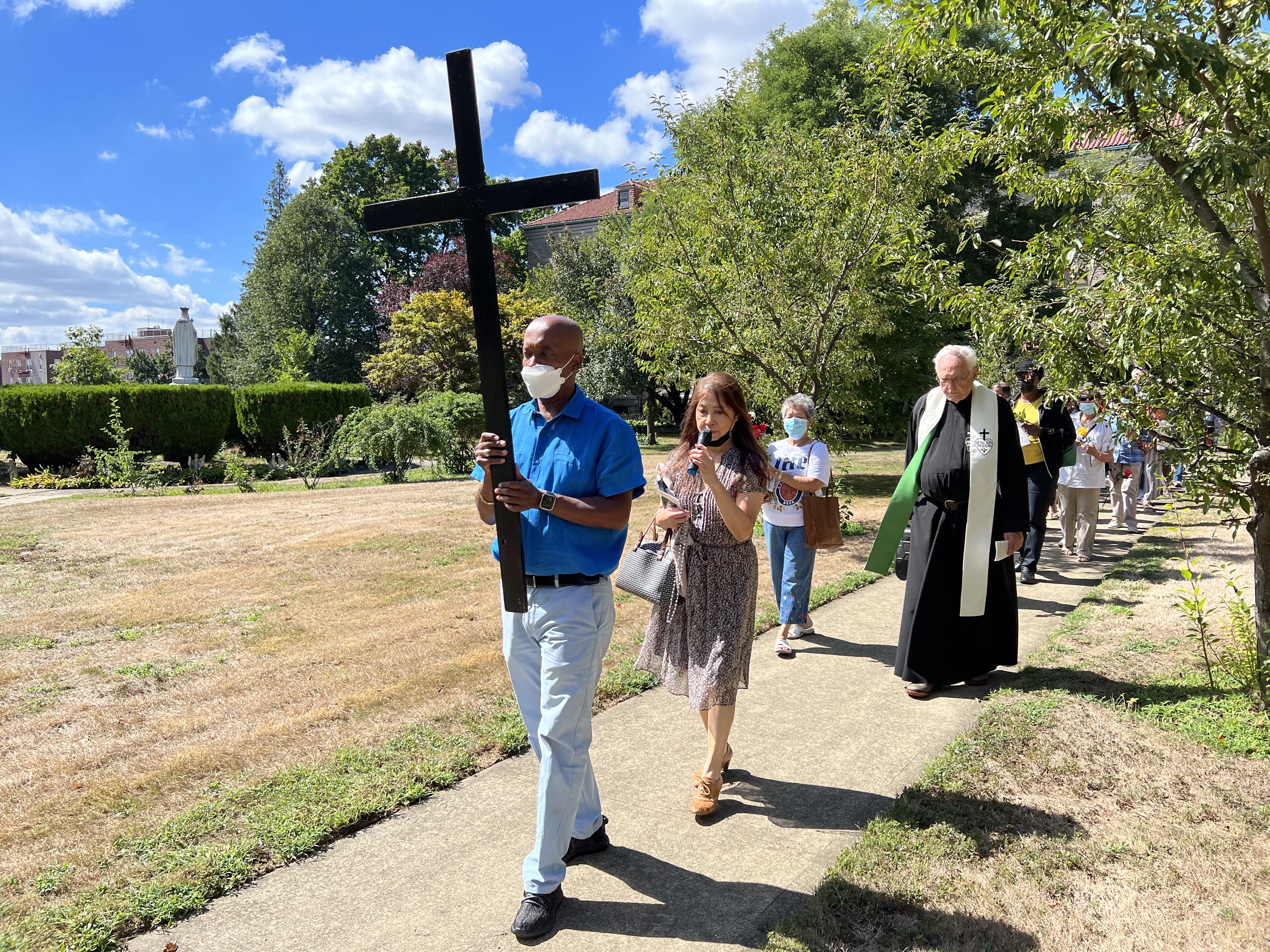
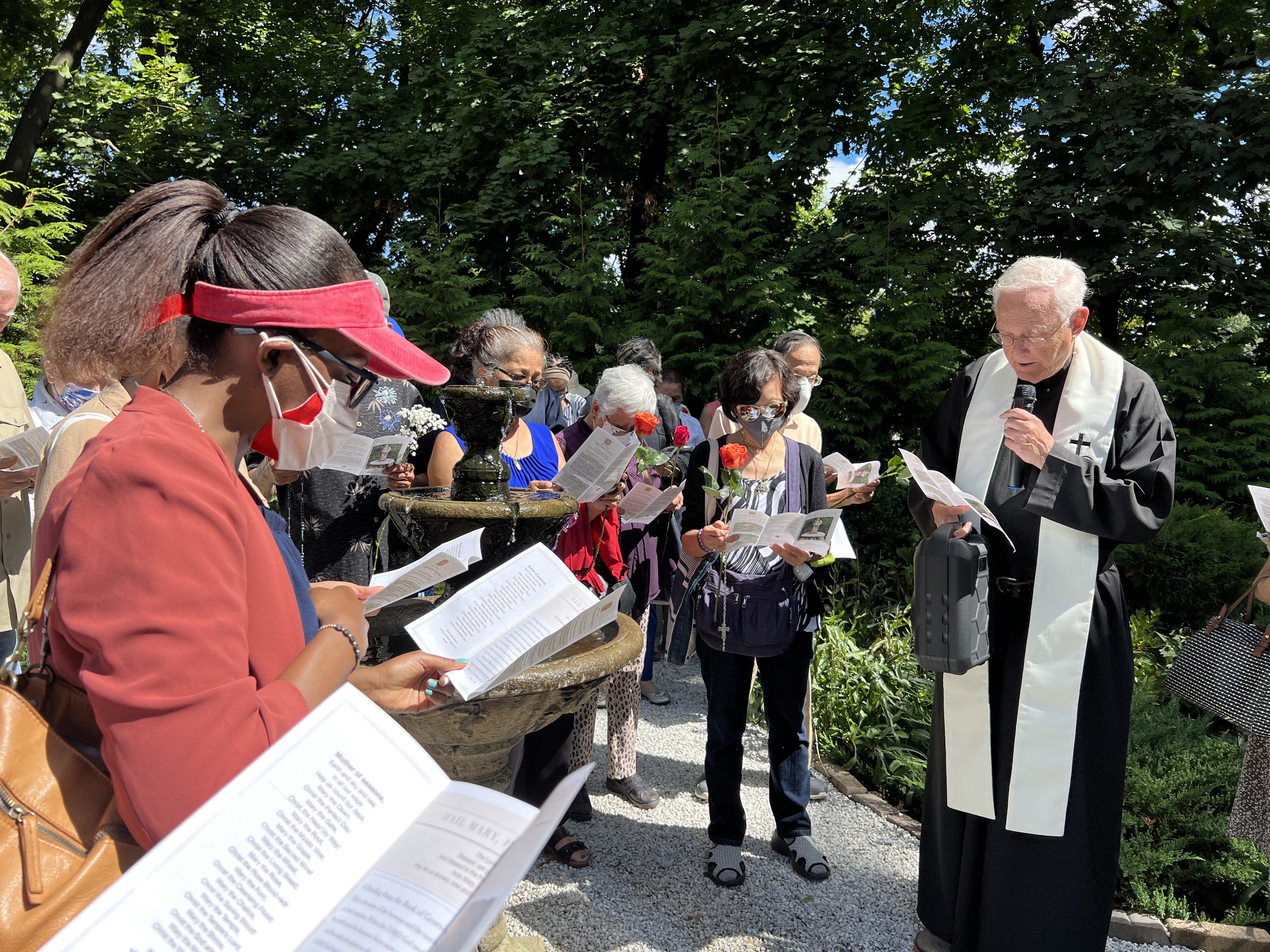
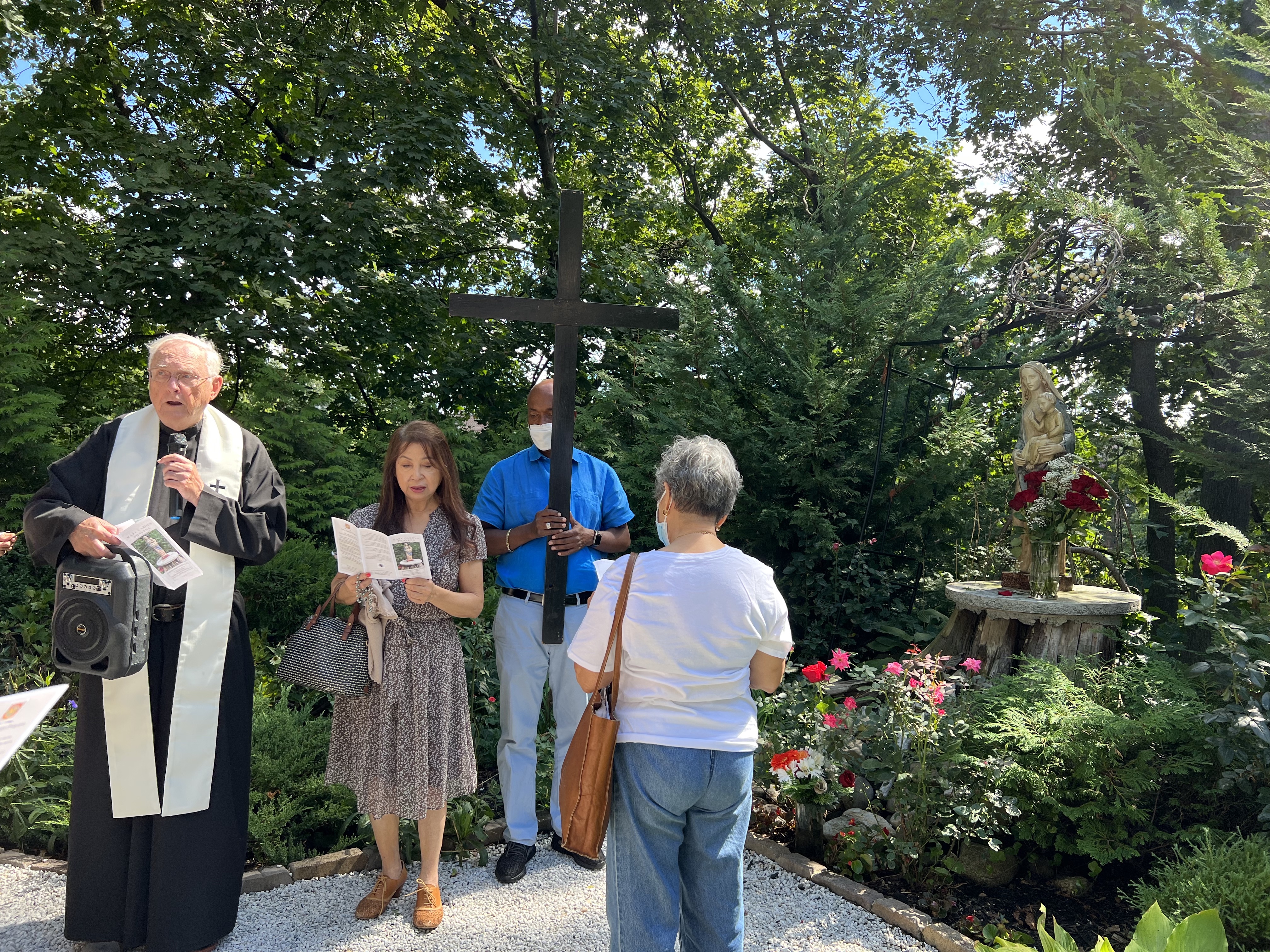
We had a procession to the Mary Garden today, the Feast of the Birth of Mary. A procession is so simple– walk, pray, sing, appreciate. We walked from the 11 AM Mass to the garden, not a long walk. We prayed a decade of the rosary, prayed some prayers from the scriptures and listened to a short reflection, then placed some flowers before the statue of Mary.

We were from all over, we represented the world, and we prayed for the world.

Hail Mary, full of grace…pray for us sinners, now and at the hour of our death. Amen.

23rd Sunday of the Year: Going to School

For this week’s homily please watch the video below.

The Season of Creation, September 1st -October 5th

1 September 2022, Pope Francis writes:

Dear brothers and sisters!

“Listen to the voice of creation” is the theme and invitation of this year’s Season of Creation.  The ecumenical phase begins on 1 September with the World Day of Prayer for the Care of Creation, and concludes on 4 October with the feast of Saint Francis.  It is a special time for all Christians to pray and work together to care for our common home.  Originally inspired by the Ecumenical Patriarchate of Constantinople, this Season is an opportunity to cultivate our “ecological conversion”, a conversion encouraged by Saint John Paul II as a response to the “ecological catastrophe” predicted by Saint Paul VI back in 1970. 

If we learn how to listen, we can hear in the voice of creation a kind of dissonance.  On the one hand, we can hear a sweet song in praise of our beloved Creator; on the other, an anguished plea, lamenting our mistreatment of this our common home.

The sweet song of creation invites us to practise an “ecological spirituality” (Laudato Si’, 216), attentive to God’s presence in the natural world.  It is a summons to base our spirituality on the “loving awareness that we are not disconnected from the rest of creatures, but joined in a splendid universal communion” (ibid., 220).  For the followers of Christ in particular, this luminous experience reinforces our awareness that “all things came into being through him, and without him not one thing came into being” (Jn 1:3).  In this Season of Creation, we pray once more in the great cathedral of creation, and revel in the “grandiose cosmic choir” made up of countless creatures, all singing the praises of God.  Let us join Saint Francis of Assisi in singing: “Praise be to you, my Lord, for all your creatures” (cf. Canticle of Brother Sun).  Let us join the psalmist in singing, “Let everything that breathes praise the Lord!” (Ps 150:6).

Tragically, that sweet song is accompanied by a cry of anguish.  Or even better: a chorus of cries of anguish.  In the first place, it is our sister, mother earth, who cries out.  Prey to our consumerist excesses, she weeps and implores us to put an end to our abuses and to her destruction.  Then too, there are all those different creatures who cry out.  At the mercy of a “tyrannical anthropocentrism” (Laudato Si’, 68), completely at odds with Christ’s centrality in the work of creation, countless species are dying out and their hymns of praise silenced.  There are also the poorest among us who are crying out.  Exposed to the climate crisis, the poor feel even more gravely the impact of the drought, flooding, hurricanes and heat waves that are becoming ever more intense and frequent.  Likewise, our brothers and sisters of the native peoples are crying out.  As a result of predatory economic interests, their ancestral lands are being invaded and devastated on all sides, “provoking a cry that rises up to heaven” (Querida Amazonia, 9).  Finally, there is the plea of our children.  Feeling menaced by shortsighted and selfish actions, today’s young people are crying out, anxiously asking us adults to do everything possible to prevent, or at least limit, the collapse of our planet’s ecosystems.

Listening to these anguished cries, we must repent and modify our lifestyles and destructive systems.  From its very first pages, the Gospel calls us to “repent, because the kingdom of heaven has come near” (Mt 3:2); it summons us to a new relationship with God, and also entails a different relationship with others and with creation.  The present state of decay of our common home merits the same attention as other global challenges such as grave health crises and wars.  “Living our vocation to be protectors of God’s handiwork is essential to a life of virtue; it is not an optional or a secondary aspect of our Christian experience” (Laudato Si’, 217).

As persons of faith, we feel ourselves even more responsible for acting each day in accordance with the summons to conversion.  Nor is that summons simply individual: “the ecological conversion needed to bring about lasting change is also a community conversion” (ibid., 219).  In this regard, commitment and action, in a spirit of maximum cooperation, is likewise demanded of the community of nations, especially in the meetings of the United Nations devoted to the environmental question.  

The COP27 conference on climate change, to be held in Egypt in November 2022 represents the next opportunity for all to join in promoting the effective implementation of the Paris Agreement.  For this reason too, I recently authorized the Holy See, in the name of and on behalf of the Vatican City State, to accede to the UN Framework Convention on Climate Change and the Paris Agreement, in the hope that the humanity of the 21st century “will be remembered for having generously shouldered its grave responsibilities” (ibid., 65).  The effort to achieve the Paris goal of limiting temperature increase to 1.5°C is quite demanding; it calls for responsible cooperation between all nations in presenting climate plans or more ambitious nationally determined contributions in order to reduce to zero, as quickly as possible, net greenhouse gas emissions.  This means “converting” models of consumption and production, as well as lifestyles, in a way more respectful of creation and the integral human development of all peoples, present and future, a development grounded in responsibility, prudence/precaution, solidarity, concern for the poor and for future generations.  Underlying all this, there is need for a covenant between human beings and the environment, which, for us believers, is a mirror reflecting “the creative love of God, from whom we come and towards whom we are journeying”.  The transition brought about by this conversion cannot neglect the demands of justice, especially for those workers who are most affected by the impact of climate change.

For its part, the COP15 summit on biodiversity, to be held in Canada in December, will offer to the goodwill of governments a significant opportunity to adopt a new multilateral agreement to halt the destruction of ecosystems and the extinction of species.  According to the ancient wisdom of the Jubilee, we need to “remember, return, rest and restore”.  In order to halt the further collapse of biodiversity, our God-given “network of life”, let us pray and urge nations to reach agreement on four key principles: 1. to construct a clear ethical basis for the changes needed to save biodiversity; 2. to combat the loss of biodiversity, to support conservation and cooperation, and to satisfy people’s needs in a sustainable way; 3. to promote global solidarity in light of the fact that biodiversity is a global common good demanding a shared commitment; and 4. to give priority to people in situations of vulnerability, including those most affected by the loss of biodiversity, such as indigenous peoples, the elderly and the young.

Let me repeat: “In the name of God, I ask the great extractive industries – mining, oil, forestry, real estate, agribusiness – to stop destroying forests, wetlands, and mountains, to stop polluting rivers and seas, to stop poisoning food and people”.

How can we fail to acknowledge the existence of an “ecological debt” (Laudato Si’, 51) incurred by the economically richer countries, who have polluted most in the last two centuries; this demands that they take more ambitious steps at COP27 and at COP15.  In addition to determined action within their borders, this means keeping their promises of financial and technical support for the economically poorer nations, which are already experiencing most of the burden of the climate crisis.  It would also be fitting to give urgent consideration to further financial support for the conservation of biodiversity.  Even the economically less wealthy countries have significant albeit “diversified” responsibilities (cf. ibid., 52) in this regard; delay on the part of others can never justify our own failure to act.  It is necessary for all of us to act decisively.  For we are reaching “a breaking point” (cf. ibid., 61).

During this Season of Creation, let us pray that COP27 and COP15 can serve to unite the human family (cf. ibid., 13) in effectively confronting the double crisis of climate change and the reduction of biodiversity.  Mindful of the exhortation of Saint Paul to rejoice with those who rejoice and to weep with those who weep (cf. Rom 12:15), let us weep with the anguished plea of creation.  Let us hear that plea and respond to it with deeds, so that we and future generations can continue to rejoice in creation’s sweet song of life and hope.

Rome, Saint John Lateran, 16 July 2022,  Memorial of Our Lady of Mount Carmel

Praying the Psalms

The psalms are prayers that never get old. Here’s Pius X, whose feast day was August 20, commenting on the psalms:

“Bless the Lord, O my soul.”

“The psalms are like a garden containing the fruits of all the other books of the Bible. Saints like Athanasius and Augustine recognized these powerful prayers. ‘The psalms seem to me to be like a mirror, in which the person using them can see himself, and the stirrings of his own heart; he can recite them against the background of his own emotions.”

Augustine says in his Confessions: “How I wept when I heard your hymns and canticles, being deeply moved by the sweet singing of your Church. Those voices flowed into my ears, truth filtered into my heart, and from my heart surged waves of devotion. Tears ran down, and I was happy in my tears. “

Pius X continues:  “Indeed, who could fail to be moved by those many passages in the psalms which set forth so profoundly the infinite majesty of God, his omnipotence, his justice and goodness and clemency, too deep for words, and all the other infinite qualities of his that deserve our praise?

Who could fail to be roused to the same emotions by the prayers of thanksgiving to God for blessings received, by the petitions, so humble and confident, for blessings still awaited, by the cries of a soul in sorrow for sin committed? Who would not be fired with love as he looks on the likeness of Christ, the redeemer, here so lovingly foretold? His was the voice Augustine heard in every psalm, the voice of praise, of suffering, of joyful expectation, of present distress.”