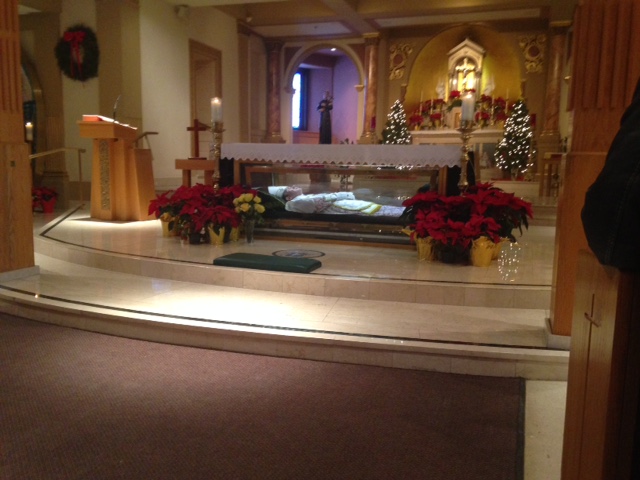
Today’s the feast of St. John Neumann,. “The sacrament of Holy Orders is at the service of the communion of the church.” (Catechism of the Catholic Church). John Neumann served the church in an heroic way as a priest and bishop. He’s one of the founding figures of the church in the United States.
Born in Bohemia in 1811, John Neumann was drawn to serve the church in the new world as a young seminarian. Arriving in New York City in 1835, he was immediately accepted for ordination by Bishop Dubois and ordained at Old St. Patrick’s Cathedral.
Canals and railroads were transforming the new nation then. The Eire Canal, completed in 1828, connected New York harbor and the Atlantic Ocean to the Great Lakes region, causing an explosive population growth in the cities and towns along its route. Bishop Dubois sent the newly-arrived priest to minister to the many Catholic immigrants settling there.
First as a diocesan priest and then as a Redemptorist religious, Neumann founded numerous parishes and missions in the cities and towns along the canal and railroad lines in Pennsylvania, Ohio, Maryland and New York.
He spoke a number of languages and learned to speak others, even Gaelic, as he reached out to the diverse immigrant population, many poor Irish workers on the canal. He wore himself out in his tireless efforts and joined the Redemptorist Order looking for the support and stability that a religious order provided, yet as a Redemptorist he continued establishing churches and parishes through the northeastern United States as a preacher and catechist.
In 1852 Neumann was appointed bishop of Philadelphia, where the Catholic population was rapidly growing. He was a tireless shepherd, building over 100 new schools and 50 churches, until his death in 1860. Convinced that young people needed good formation in the faith, Neumann fostered Christian education and wrote two catechisms. He preached continuously, administered the sacraments and encouraged the Forty Hours Devotion and other devotional practices in his diocese.
John Neumann served the church as a zealous priest and bishop. He left his own homeland to work tirelessly to build the Catholic Church in the United States. He was a true missionary of Christ.
We need priests and missionaries like him today. Not only priests who leave their own homeland to minister in different countries, but priests who minister in an evolving church where the boundaries are not fixed.
O God, who called the Bishop Saint John Neumann, renowned for his charity and pastoral service, to shepherd your people in America, grant by his intercession that, as we foster the Christian education of youth and are strengthened by the witness of his brotherly love, we may constantly increase the family of your Church. Through Jesus Christ, our Lord. Amen.
 The Victor's Place
Thank you for the bio of St. John Neuman. He surely was an engergetic Christian: 100 schools! The post mentioned that he wrote two catechisms.
That led me to look up Baltimore Catechism.
“In the nineteenth century, repeated efforts had been made in the United States towards an arrangement by which a uniform textbook of Christian doctrine might be used by all Catholics.[4] As early as 1829, the bishops assembled in the First Provincial Council of Baltimore decreed: “A catechism shall be written which is better adapted to the circumstances of this Province; it shall give the Christian Doctrine as explained in Cardinal Bellarmine’s Catechism (1597), and when approved by the Holy See, it shall be published for the common use of Catholics” (Decr. xxxiii). The clause recommending Bellarmine’s catechism as a model was added at the special request of the Sacred Congregation for the Propagation of the Faith. Bellarmine’s Small Catechism, Italian text with English translation, was published in Boston in 1853.”
I learned that several catechisms were in use before the offical Baltimore one. Charles and other Bishops wrote catechisms, promoting the need for such a teaching tool, even though he was not alive when Baltimore edition was approved.
From https://en.wikipedia.org/wiki/Baltimore_Catechism#History
LikeLike