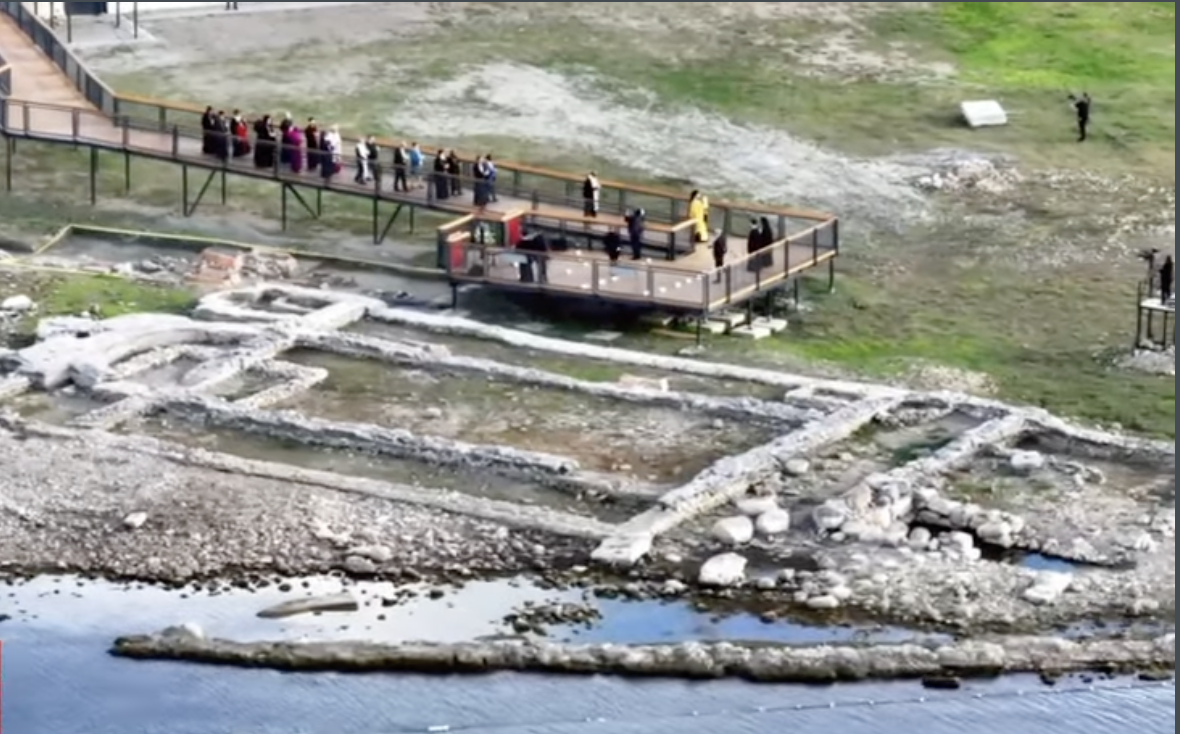
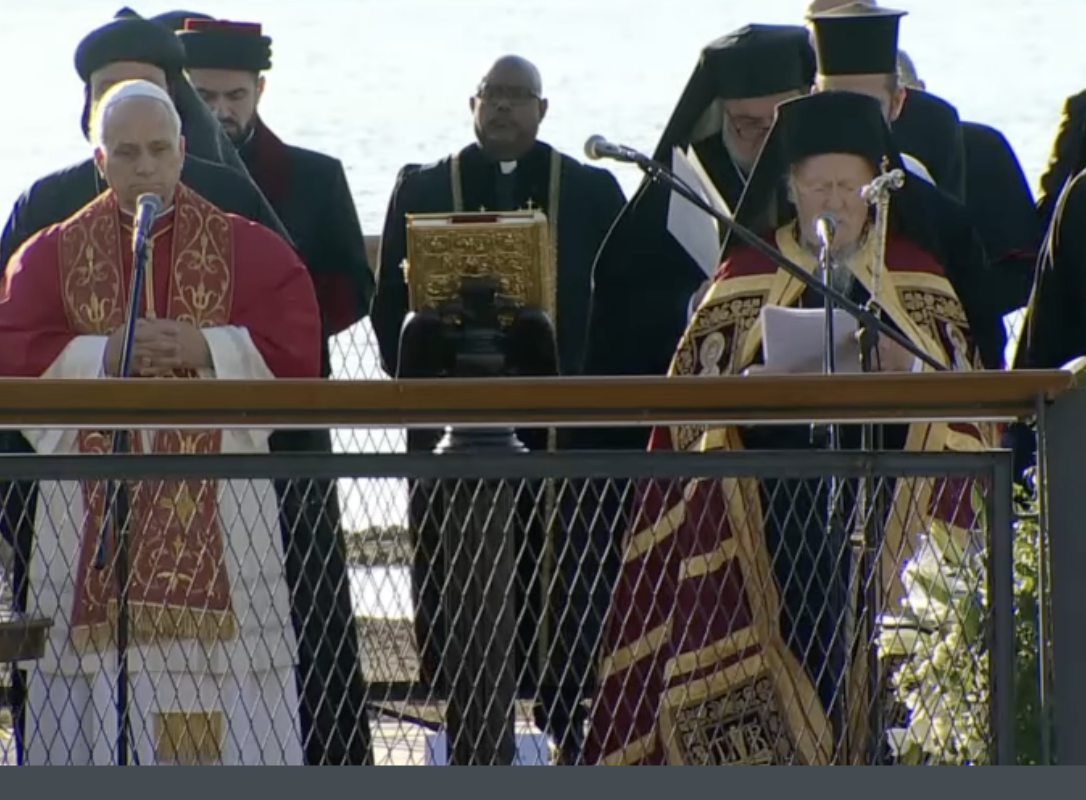
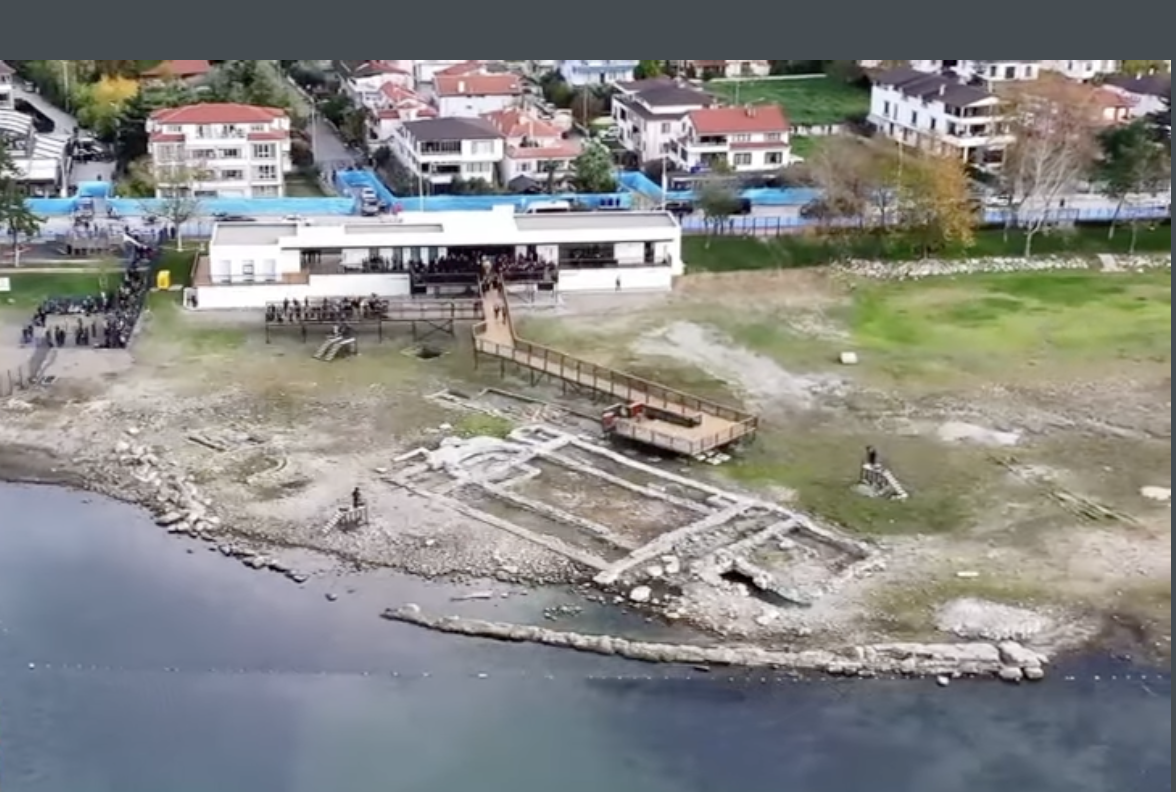
Pope Leo and 20 or more Christian leaders celebrated on November 28th, in Iznik, Turkey, the creation of the Nicene Creed 1700 years ago at the Council of Nicea. The Patriarch Bartholomew of the Greek Orthodox Church organized the meeting. Representing millions of Christians, they came as pilgrims to a place overlooking the ruins of an ancient church from that time.
In his apostolic letter De Unitate Fidei, November 23, 2025, Pope Leo urged the Catholic church to renew her enthusiasm for this fundamental profession of faith agreed upon in Nicea in 325. The creed is not simply a document from the past, the pope writes, but a “compass” into the future that can be “ understood in ever new and relevant ways.”
The Emperor Constantine called the bishops of the church to Nicea to deal with the disturbance caused by Arius, who denied the divinity of Christ. In a letter to them he wrote:”Since at first it had been agreed that a synod of bishops should take place at Ancyra of Galatia, it has now appeared to us, for many [reasons], that it is better that it should gather in the city of Nicaea, in Bithynia: both on account of those bishops coming from Italy and the other regions of Europe, and on account of the good climate, and because I shall be in a proximate way an observer of and a participant in the things that are going to take place.”
The emperor presided over the council, known as the “Synod of the 318 Fathers.” The number of attending bishops was unprecedented. Some still bore the marks of the torture they had suffered during the recent persecution of Christians by Diocletian. The vast majority came from the eastern Roman Empire. Only five came from the western part of the empire, despite the emperor’s plan. Pope Sylvester was represented by Bishop Hosius of Cordoba and two Roman presbyters. To reflect on the council today, Pope Leo recommends in his letter the study of a significant document,Jesus Christ, Son of God, Saviour. 1700th Anniversary of the Ecumenical Council of Nicaea, published December 15, 2024 by the International Theological Commission.
The International Theological Commission was founded by Pope Paul VI on April 11, 1969 to foster deeper theological dialogue and support for the pope and the Congregation of the Faith. Popes such as John Paul II, Benedict XVI, Francis and now Leo XIV have used the commission to deal with issues and challenges facing the church. The work of the commission often signals the direction the church will take as it charts its course in the world.
The document offers an enlightening history of the Creed and has important suggestions for uniting the Christian churches today. It describes the Creed.as more than a summary of doctrinal propositions. The Creed is “an icon of words”, revealing the mystery of God and the church.
How is Nicea a “compass” into the future that can be “understood in ever new and relevant ways”, an “icon of words”? The Council of Nicea brought together bishops and their advisors from all over the Christian world. Ecumenical, it united all the churches. It was a council received and accepted by the whole church. Its decisions shaped the whole church and secular society as well. Will another council like it come?
As leadership passed from apostles to bishops, Nicea was also a “ new institutional expression of authority in the Church.” From a Jewish world, the faith found a home in another culture and language at the Council of Nicea. Is Nicea an example of a global church?
The creed of the council had a profound influence on the church’s liturgy and prayer. Our liturgy today bears its imprint. Do we recognize the deep mysteries expressed in our prayer?
Pope Leo in “De Unitate Fidei reflected on the powerful words of its creed:
“It is worth emphasizing the verb descendit, in the Nicene Creed: ‘he came down.’ Saint Paul describes this movement in strong terms: ‘[Christ] emptied himself, taking the form of a slave, being born in human likeness’ (Phil 2:7). The prologue to the Gospel of Saint John likewise states that ‘the Word became flesh and dwelt among us’(Jn 1:14). The Letter to the Hebrews also teaches that ‘we do not have a high priest who is unable to sympathize with our weaknesses, but we have one who in every respect has been tested as we are, yet without sin’ (Heb 4:15). On the eve of his death, Jesus humbled himself like a slave to wash the feet of his disciples (cf. Jn 13:1-17). Only when he was able to put his fingers into the wound of the risen Lord’s side did the Apostle Thomas confess: ‘My Lord and my God!’(Jn 20:28).
It is precisely by virtue of his Incarnation that we now encounter the Lord in our brothers and sisters in need: ‘As you did it to one of the least of these brothers and sisters of mine, you did it to me’ (Mt 25:40). The Nicene Creed does not depict a distant, inaccessible and immovable God who rests in himself, but a God who is close to us and accompanies us on our journey in the world, even in the darkest places on earth. His immensity is revealed when he makes himself small, laying aside his infinite majesty to become our neighbor in the little ones and in the poor. This revolutionizes pagan and philosophical conceptions of God.
Another phrase from the Nicene Creed is also particularly revealing for us today. The biblical statement ‘became flesh’ is clarified by adding the word “man” after “incarnate.” Nicaea thus distances itself from the false doctrine that the Logos took on only a body as an outer covering and not the human soul, which is endowed with intellect and free will. Instead, it seeks to affirm what the Council of Chalcedon (451) would later explicitly declare: in Christ, God assumed and redeemed the whole human being, body and soul. Saint Athanasius explains that the Son of God became man so that man might be deified. [5] This enlightening understanding of divine revelation was prepared by Saint Irenaeus of Lyon and Origen, and then further developed with great richness in Eastern spirituality.”
I have been reflecting these days on the simple, pervasive ways the ancient council and its creed affects the way we pray today:
The Sign of the Cross, ever present in our prayers. “In the Name of the Father, and of the Son and of the Holy Spirit. Amen.” The creed we pray each Sunday and on major church feasts . The Eucharistic Prayer to the Father, through the Son, in union with the Spirit. The doxology, we pray at the end of a psalm: “Glory be Father, and to the Son, and to the Holy Spirit. As it was in the beginning, is now and will be forever, world without end. Amen.”
Yes, Jesus taught in simple parables easily understood, but he also revealed the greatest mysteries: “The Father and I are one.” “The faith preached by Jesus to simple people is not a simplistic faith…Basically, any Christian, by tracing the sign of the cross on himself or herself, expresses the heart of the Trinitarian and Paschal faith in a fitting and full way,” the document from the International Theological Commission states. (118)
And in a footnote from the document we hear the great theologian Yves Congar, OP., ’All my faith is in the most banal of my signs of the cross, and, when I pronounce ‘Our Father’, I have already included all that knowledge which will be delivered to me only in the Revelation of glory.”
We often hear the complaint today that our liturgy is not “spiritual” or “reverent” enough. Some seek a return to the Latin Mass as a remedy.
Maybe our celebration of the 1700 years of the Council of Nicea will awaken us to the treasure we have in our present liturgy, filled with mysteries so simply stated in the language of the bible and the creed.
 The Victor's Place