For this week’s readings and homily please watch the video below.
This week’s post is special in that I am sharing background and details of St. John Lateram Church in Rome.

Churches have stories. They tell us our history. That’ s especially true of the Church of St. John Lateran in Rome, one of first of the great Christian churches built by the Emperor Constantine who came to power early in the 4th century.
He gave Christians freedom to practice their religion throughout the Roman empire. He also built them churches– St. John Lateran was the first of the many he built. At its entrance is an inscription, “The mother of churches”. Rebuilt many times, It’s been there over 1700 years.
Rome’s Christians must have been thrilled when the church, holding 10,000 people, was dedicated around 320 AD. Many were persecuted or had seen relatives, friends or other believers jailed or put to death during the reign of Diocletian, before Constantine.
Now, a new emperor built them a church, a great Christian church, that everyone in Rome could see. He built it on property belonging to his enemies, the Laterani family, which is why it’s called St. John Lateran. It’s situated on the southeastern edge of the city, away from the Roman Forum, because Constantine didn’t want to antagonize followers of Rome’s traditional religions. Still, the Lateran church was a sign that Christianity had arrived.
Before this, throughout the Roman empire, Christians had no churches but met in ordinary homes or small buildings. In Rome 25 homes can be identified where they met and worshipped.
That in itself made people wonder about them. Why didn’t Christians participate in public rites and religious sacrifices conducted for the good of the empire, as good Romans did? What kind of religion was this anyway, people said? They’re godless atheists plotting rebellion, the 2nd century pagan writer Celsus said. They were “ people who cut themselves off and isolate themselves from others.” (Origen, Contra Celsum,8,2)
The church of St. John Lateran signaled changing times. After centuries meeting apart in homes and small community settings, Christians now gathered as one great family.
That’s what churches do; they bring people together as one body, one family, one people. That’s how Paul described the church in his Letter to the Romans: “As in one body we have many members, and all the members do not have the same function, so we, though many, are one body in Christ, and individually members one of another.” (Romans12, 4-5)
An important part of the church of Saint John Lateran is its baptistery, a large building connected to the church itself, worn and patched, as you would expect from a building over 1700 years old. You can still see bricks from Constantine’s time. For centuries Romans have been baptized here. Conveniently, it’s built over a Roman bath supplying water for baptism. The church is called St. John Lateran because St. John the Baptist is one of its patrons, along with St. John the Evangelist. A beautiful Latin inscription over the big baptismal basin and fount says:
Those bound for heaven are born here,
born from holy seed by the Spirit moving on these waters.
Sinners enter this sacred stream and receive new life.
No differences among those born here,
they’re one, sharing one Spirit and one faith.
The Spirit gives children to our Mother, the Church, in these waters.
So be washed from your own sins and those of your ancestors.
Christ’s wounds are a life-giving fountain washing the whole world.
The kingdom of heaven is coming, eternal life is coming.
Don’t be afraid to come and be born a Christian.
One last thing about St. John Lateran, which many people don’t know. It’s the pope’s church. From the time of Constantine till the 15th century, the popes, leaders of the Church of Rome, resided next to this church. Then, they moved to the Vatican, where they live today.
Celebrating the dedication of a church, as we are doing today, reminds us how important church buildings are for our faith. God speaks in our churches, God comes to us in our churches.
“Do you not know that you are the temple of God,
and that the Spirit of God dwells in you?” St. Paul says.
“If anyone destroys God’s temple,
God will destroy that person;
for the temple of God, which you are.

The Lateran Basilica was the central worship place for the Roman church and home of the popes until the 15th century. The Eucharist and other sacraments were celebrated here. Important church councils were held here. Christian pilgrims came to venerate Christian relics honored here. The site is important in Christian history.
By the 15th century, Rome’s fortunes had faded and the southeastern parts of the city became isolated and depopulated, an easy prey for invading armies. Fires and earthquakes left the Lateran church and its surroundings in ruins many times. The popes decided to move their residence and church offices to the safer areas of Vatican Hill and St. Peter’s, across the city. Still, the Lateran Basilica remains Rome’s principal church.
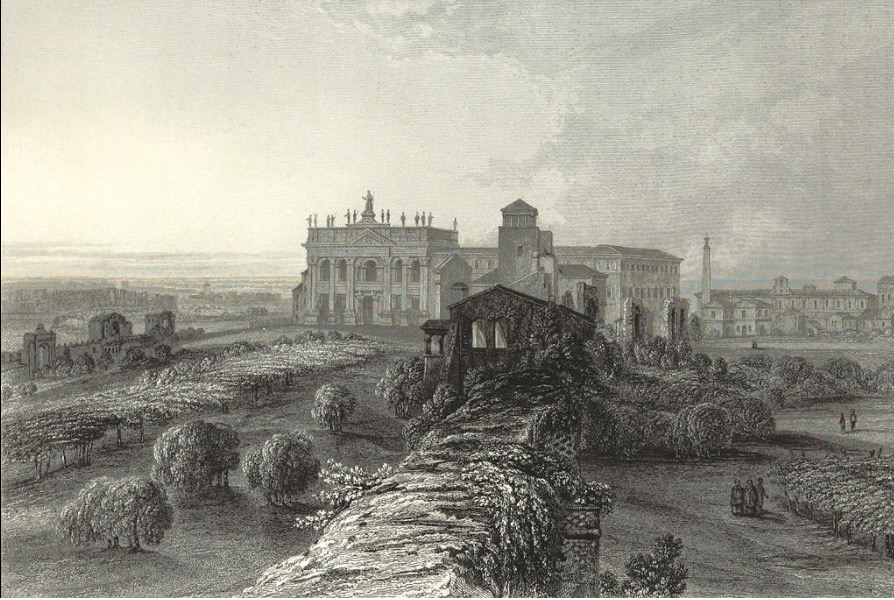
Tides of change wash over the church, as we see so well here at the Lateran. The Lateran Basilica offers an image of change. We’re losing our churches now in some parts of the world, as people turn away from them. What shall we make of it?
In Luke’s gospel read today, Jesus calls Zachaeus, the publican, the outsider, to come down from the tree where he watches from a distance. “I want to stay in your house today,” Jesus tells him, and he brings salvation to his house. “My house shall be called a house of prayer for many nations,” we read from the Prophet Isaiah.
We need to cherish our churches, signs of the God’s presence. They’re places we meet God.
A video on the Church of St. John Lateran is here.
 The Victor's Place
Thank you, Fr Victor. That is a great piece. Be well. Harry
LikeLike
Thank you for this story, Father. I knew that St. John Lateran was important but I never understood why. Now, I do.
LikeLike
The history of St. John Lateran Basilica reminded me of the raging fire at Notre Dame Cathedral in Paris during 2019.
Much loved by the people of France and other countries, a flood of donations poured in for the restoration. Hopefully, the work will be completed by 2024 when the city hosts the Olympics.
Nothing material lasts forever but through the efforts of dedicated donors, historical landmarks are preserved.
When we visted Europe we favored the small parish churches for Sunday Mass. Once we were offered hospitality in a French convent high up on a prescipice in the Alsace area. Across from the convent was the church. Mass was tri-lingual, celebrated
in Latin, French and German. Sturdy structures of faithful people remind me that Christ is the rock on which the church is built. We are the Body of Christ!
LikeLike
The raging fires that ruined St. John Lateran
Remind me of the fire at Notre Dame Church.
News reports showed the awful devastation
As people looked on shedding tears.
The church is more than concrete construction.
Faithful worshippers are the buttresses,
Christian hope builds the high ceilings,
Service to others shines like stained glass,
Liturgy gives out grace like tiled floors,
An altar to gather for celebrating Mass.
LikeLike
Well said.
LikeLike
Dear Father Victor, Your reflection reminds me that we are the living stones and Christ is the cornerstone. Thank you, Father Victor, for helping lead us on.
LikeLike
Celebrating this feast is an opportunity to reclaim the meaning of church.
Bricks and mortar provide structure.
Sinners invited to the Lord’s table,
Singing hymns for worship.
Praying as Holy Spirit will enable,
We go forth to spread the Good News.
LikeLike