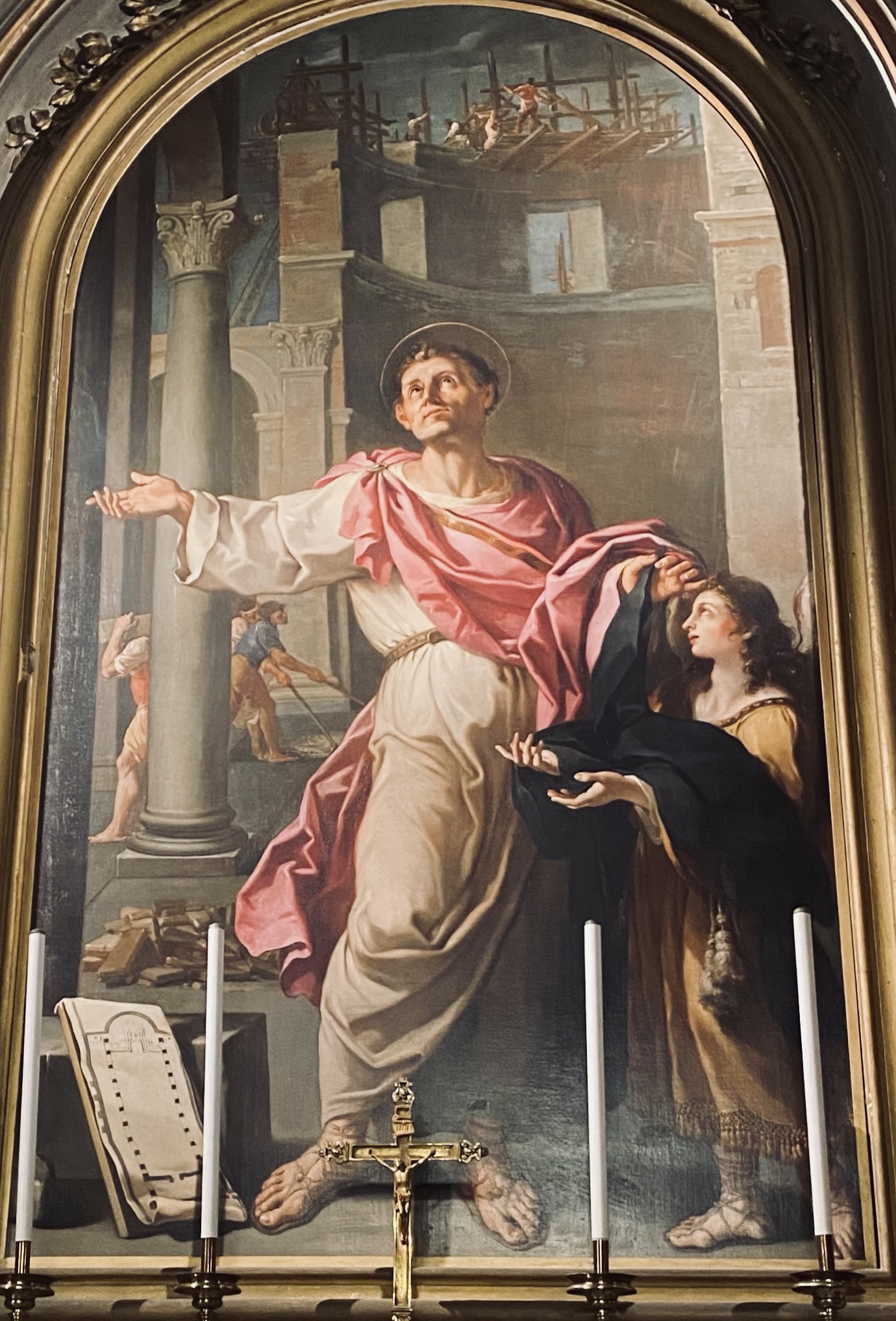
A picture of St. Pammachius (c 409), builder of the Church of Saints John and Paul in Rome, is on the right side of the church towards the altar. He was a friend and patron of St. Jerome (342-420) . Jerome had strong connections with this church and influential Christians like Pammachius, Paula and Fabiola who lived on the Celian Hill.
Before the church was built around 400, Celian Christians met in the house of Pammachius, a Roman senator.The house was owned before him by his father, Byzantus. It was one of the 25 original house churches in Rome. .
Jerome and Pammachius (+c 409 ) studied in Rome together. Pammachius likely introduced Jerome to influential people on the Celian Hill, like Paula and Fabiola and Pope Damasus. Paula and her daughter Eutochium later accompanied and supported Jerome in the Holy Land. Pammachius married another of Paula’s daughters, Paulina. They had no children.
Was Pammachius with his friend Jerome on his visits to the catacombs where Christian martyrs made Jerome question the strength of his own faith? Was he instrumental in bringing his friend to be baptized at St. Peter’s on the Vatican? Jerome recalls renewing his baptism at the fount there after Easter.
Certainly Pammachius shared Jerome’s interest in the scriptures and the religious questions of the day. Jerome later dedicated many of his scriptural commentaries to him. Besides corresponding with Jerome, Pammachius corresponded with Augustine and Paulinus of Nola, important church figures then. He was a leader of the fervent group of prominent Roman Christians, many of them women, who promoted Jerome’s new scriptural translations and commentaries.
After his wife Paulina died in 397 Pammachius began leading a religious life, probably in the style described in the Life of Anthony, written by Athanasius. The bishop of Alexandria and other eastern holy men were visitors to Rome and admired by Christians on the Celian Hill as spiritual teachers.
Anthony heard the scriptures as if they were written for him alone. He gave away all that he had to the poor to follow Jesus. Pammachius pursued a similar path. He and Fabiola, a Christian from the Celian Hill, built a hospice for the poor and the sick near the Tiber River. Pammachius worked vigilantly for the interests of the church. He built the Church of Saints John and Paul.
Why did Pammachius build the Church of Saints John and Paul on the western side of the Celian Hill facing the Palatine Hill and the Roman Forum, center of Roman power? The usual answer it that it honors the relics of the two soldier saints, John and Paul, who were reportedly martyred there.
Certainly that was so, but was his purpose limited to that? Perhaps a monument to his wife Paolina, pictured in the portrait that hangs in the church?
An added suggestion is that Pammachius’ church is an outreach to the hard core of Romans still invested in the traditional Roman religion, whom Augustine also addressed in his work “The City of God”. After Constantine freed Christianity in 312 AD, Christians from the Celian must have been part of an effort to win over to Christianity the powerful Roman majority that remained distant and sometimes resentful of the new faith. The Church of Saints John and Paul must have been part of an effort of Christian evangelization.
Before 312 AD, Christians promoted their faith cautiously; now they presented it boldly, using the Christian scriptures freshly translated by St. Jerome, along with his learned commentaries. The new faith, St. Augustine argued in his City of God, far from causing the empire to fall, offered it a powerful new wisdom it needed. Roman Christians confidently believed they had something to say to their city and made their appeal from splendid new churches, like the Church of Saints John and Paul.
 The Victor's Place