Monthly Archives: June 2025

The Saints Come Marching In

The readings at Mass approaching the Feast of Pentecost speak of closure. Jesus speaks his last words to his disciples before his death. Paul bids farewell to the elders at Ephesus and in Jerusalem is taken into custody for judgment in Rome.

It’s not the end, however, but a beginning. 

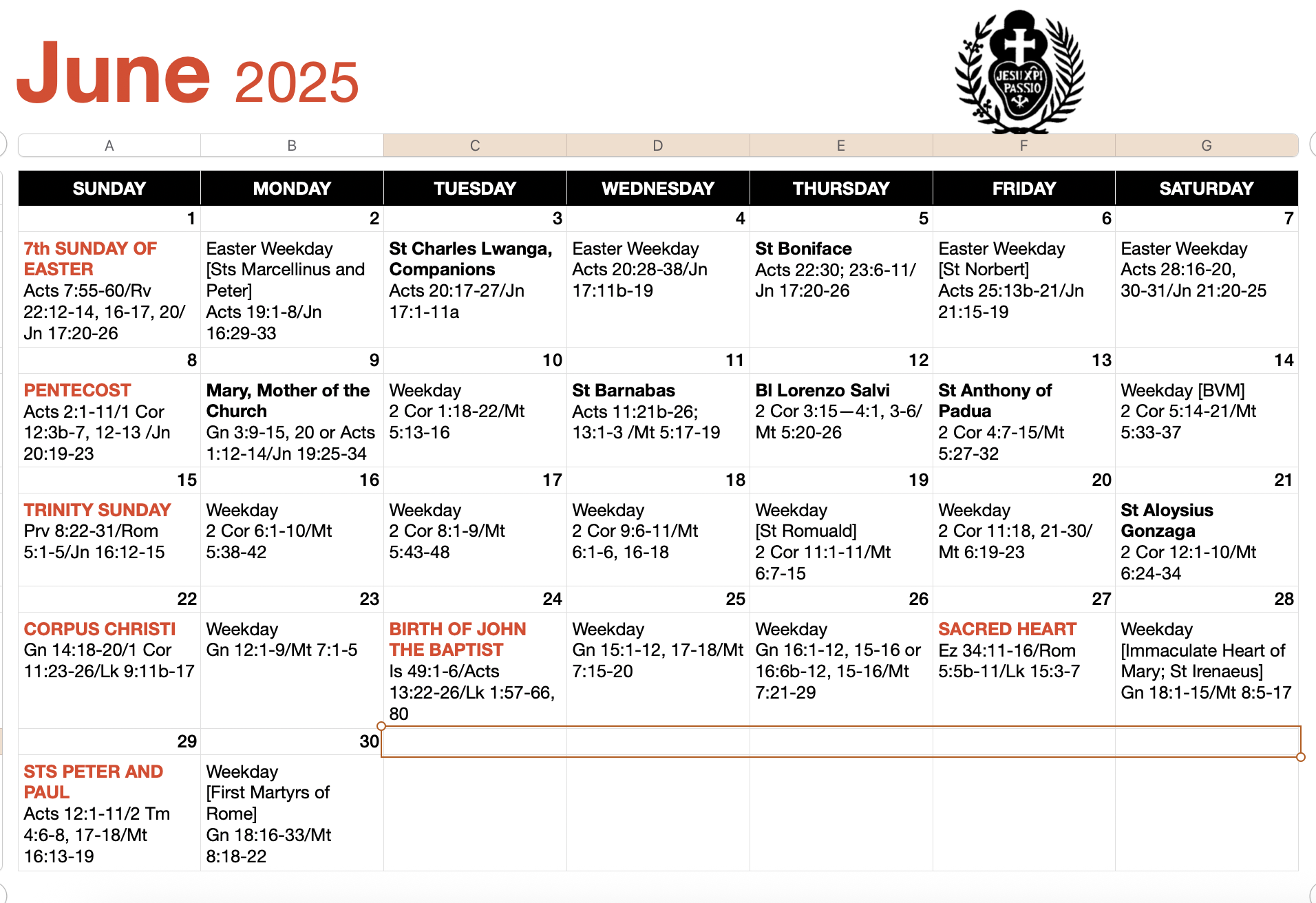
We’re entering Ordinary time, when we celebrate feasts of the saints more extensively, as our June calendar indicates.  St. Justin, the philosopher (June 1), engages the learned in Rome; St. Charles Lwanga and his companions (June 3) cause a new birth of Christianity in Africa; St. Boniface (June 5) brings the gospel to the fractured Germanic tribes of Europe. No, it’s not over, the gospel will be preached in every age.

We’re going to need good leadership. That’s why we read Paul’s Letter to Timothy immediately after Pentecost. Paul’s advice is especially interesting. “Stir into flame the gift of God that you have through the imposition of my hands. For God did not give us a spirit of cowardice, but rather of power and love and self-control. So do not be ashamed of your testimony to our Lord, nor of me, a prisoner for his sake; but bear your share of hardship for the Gospel with the strength that comes from God.” Timothy is losing a powerful mentor, but the Spirit never leaves the church without pastors.

We’re not left orphans. The Holy Spirit broods over the world, constantly making all things new. Every age will have its saints. The calendar of saints is the calendar written by the Holy Spirit. The saints are signs of the Holy Spirit. No age, however critical, is without them. 

Come, Holy Spirit, fill the hearts of your faithful people. Send us saints for the healing and new vision that will benefit our church and our world. We need them.
St. Justin, Philosopher and Martyr (c.100-165 AD)

Justin-Martyr
Justin Martyr

We need Christians today like St. Justin, the 2nd century philosopher we remember June 1. “We need to make our teaching known,” he said. Still true today.

In Justin’s time, philosophers were the mentors, teachers, influencers of Roman society and were welcomed in the forum and private homes of the Roman world. St. Paul addressed them in Athens with limited success. Justin was an Christian philosopher in Rome.

Born in Nablus in Palestine of Greek parents, Justin studied all the philosophers of his time in Alexandria, Athens and Ephesus. It may have been in Ephesus around the year 130 that he encountered Christianity when, walking along the seashore, he met an old man who told him the human heart could never be satisfied by Plato for “the prophets alone announced the truth.”

“After telling me these and other things…he went away and I never saw him again, but a flame kindled in my soul, filling me with love for the prophets and the friends of Christ. I thought about his words and became a philosopher..” (Dialogue 8)

Justin was influenced, not only by Christian teaching, but also by the example of Christians he met:

“I liked Plato’s teaching at first and enjoyed hearing evil spoken about Christians, but then I saw they had no fear of death or other things that horrify, and I realized they were not vicious or pleasure-loving at all.” (Apology 2,12)

Forum q
Ruins of the Roman Forum

Justin championed the cause of Christians who were increasingly attacked by society. Donning a philosopher’s cloak he taught and wrote in Rome about the year 150 AD. He was a new kind of Christian, a Christian philosopher engaging Roman society on its own terms. He gave Christianity a Roman face and voice.

Justin defended Christians against the charge they were atheists and enemies of the Roman state. Christians were good citizens, he wrote, who pray for Rome, though they don’t worship in temples, who had no statues of gods or who did not participate in the religious rites of the state.  Justin’s writings give us a unique picture of 2nd century Christianity and early Christian worship.

In his “Dialogue with Trypho, the Jew” Justin offered the traditional Christian defense of Christianity to a Jewish antagonist. The Jewish prophets predicted the coming, the death and resurrection of Jesus, Justin argues.

In the documents of Vatican ii, Justin is recognized as an early example of Christian ecumenism. (Evangelium Nuntiandi 53) Through the Word of God all things came to be, he said.  The Word became flesh in Jesus Christ, but Justin linked the biblical Word to the Logos of the philosophers. “Seeds of the Word” were scattered throughout the world, Justin claimed. Every human being possesses in his mind a seed of the Word, and so besides the prophets of the Old Testament, pagan philosophers like Heraclitus, Socrates and Musonius lead us to Jesus Christ, Justin said. (Apology 1,46)

A prolific writer and teacher, Justin was an early Christian intellectual using his talents to promote his faith, Unfortunately only three of his writings come down to us. Other Christian intellectuals followed him, using the tools of philosophy to dialogue with the Greco-Roman world.

Finally, rivals in Rome pressed charges against Justin as an enemy of the state and he was  brought before a Roman judge along with six companions. Sentenced to death, they were beheaded probably in the year 165 AD. The official court record of their trial  still survives.

7th Week of Easter: Readings and Feasts

The readings and feasts of this week are a wonderful preparation for the Feast of Pentecost on Sunday.

The Apostle Paul, in Luke’s readings from the Acts of the Apostles, hurries through the Roman world in answer to the command of Jesus:  “Go out into the whole world and preach the gospel. ”  He’s inspired by the Spirit, like Jesus.

Like Jesus, Paul bids farewell to his followers, the elders from Ephesus, and urges them to continue the ministry given to them by the Spirit. ( Tuesday and Wednesday) “I know that after my departure savage wolves will come among you, and they will not spare the flock. And from your own group, men will come forward perverting the truth to draw the disciples away after them. So be vigilant.”

Like Jesus, Paul must go up to Jerusalem (then to Rome). “ Compelled by the Spirit, I am going to Jerusalem. What will happen to me there I do not know, except that in one city after another the Holy Spirit has been warning me that imprisonment and hardships await me. Yet I consider life of no importance to me, if only I may finish my course.

Paul experiences the passion of Jesus as he clashes with the Jewish leadership and appears before the Roman tribunal where Festus, judging him innocent yet in a quandary over the religious issues that are raised, sends Paul, at his own request, to be judged by the Emperor in Rome. (Thursday and Friday)

In the gospel readings through the week  from John,  Jesus bids farewell to his disciples and promises to be with them, no matter what. “In the world you will have trouble, but take courage, I have overcome the world.” (Monday) He will send them his Spirit.

“I pray for them,” Jesus says.  “I do not ask that you take them out of the world, but that you preserve them from the Evil One.” (Wednesday) “I pray not only for these, but also for those who will believe in me through their word, so that they may all be one, as you, Father, are in me and I in you, that they also may be in us, that the world may believe that you sent me.” (Thursday)

Friday and Saturday’s gospel readings from John takes us to the Lake of Galilee where Jesus commissions his apostle Peter to feed his sheep. Peter will stretch out his hands and be led where he did not want to go–“signifying by what kind of death he would glorify God.” Paul too will be led to death like Peter. He will follow Jesus.

We’re called to go through our world and fulfill the mission God gives us, The Lord prays for us and helps us as we go.