Monthly Archives: May 2025

Readings for the Fourth Week of Easter

This week’s readings from the Acts of the Apostles describe the growth of the church in the Gentile world. Peter journeys to Joppa, the seaport  Jonah embarked from on his mission to Nineveh. On his way he raises up a paralyzed man at Lydda and in Joppa  he raise a young girl, Tabitha, from the dead–signs similar to those Jesus worked.(Saturday, 3rd Week of Easter) 

Doubters, however, question Peter for baptizing the Roman soldier Cornelius and eating at table with him. (Monday) “God has given life-giving repentance to the Gentiles too,” Peter responds, initiating a new phase in the church’s growth. His response is based, not on human judgment, but because he has seen signs from the Spirit.

The readings from Acts from Wednesday to Saturday describe Barnabas and Saul’s opening campaign into the Gentile world. Let’s not ignore, though, the reading from Tuesday which recalls the unknown survivors of the persecution of Stephen who, driven into the Gentile world, “speak to the Greeks, proclaiming the Lord Jesus to them. The hand of the Lord was with them and a great number turned to the Lord.” Clearly, others besides those we know brought the gospel to the Gentiles.

We are all involved in bringing the gospel to the world,not just a chosen few,

In the  Gospel readings from John (Monday-Wednesday) Jesus continues to speak of himself as the Good Shepherd. As Risen Lord, he goes before us, guiding his flock to final pasture. We hear his voice, not the voice of a stranger. His voice is the same as the Father’s voice.

On Thursday, the readings from John bring us back to the supper room. (John 13 ff) For the remaining days of the Easter season, we will listen to Jesus’ words of encouragement and love for his own who are in this world.

The feast of St. Matthias, successor to Judas, celebrated on May 14. Our Lady of Fatima is celebrated on May 13. St. Gemma is celebrated May 16.

Morning and Evening Prayer for the 4th week here.

4th Sunday of Easter: The Good Shepherd

For this week’s homily please play the video below.

What Power Does the Pope Have?

Many recent news stories on the papal conclave seem to suppose that a pope has absolute power in ruling the church. Some think Pope Leo XIV can take the church wherever he wants it to go.

 A look at today’s reading from the Acts of the Apostles may help us question that view.. Luke sees Peter as leader and spokesman for the Christian community in Jerusalem. He underscores his importance with his description of the miracles Peter performs in Jerusalem and Joppa. They’re like those Jesus performed. He tells a paralyzed man named Aeneas to get up from his bed and he got up at once. He tells a woman named Tabitha who died to rise up and she rose from the dead. (Acts 9: 31-42)

Afterwards, however, Peter is commanded in a vision to baptize a Roman centurion named Cornelius, but he balks at the command. . It’s altogether against what he believes a Jew should do. . 

It’s not for Peter to judge, however. God plan is unfolding, which Peter may not always understand.. Peter is subject to God’s plan. He must follow his Lord. 

A pope does not have absolute power ruling the church. It’s the Church of Jesus Christ and the pope, like Peter, must listen for his voice. 

Our times finds it difficult to believe in God’s presence and guidance in our world. The future is what we decide it will be, whether it’s the future of the world or the future of the church. We think the world is in human hands.

Peter is a good example to consider when we think of the pope. Our readings today describe the miracles he performed, yet the scriptures always remind us of his humanity.  Peter is human. As he himself said: “I am a sinful man.” He doesn’t know everything. Yet, God reveals his plans to him and he must read the signs of the times. 

That’s why we pray today that Pope Leo be a humble holy man.

MISSION TO THE GENTILES

When Peter visits followers of Jesus in Joppa I’m sure he had no idea he would be called to journey up the coast to Caesarea Maritime to meet Cornelius, the Roman centurion and baptize him and his household. Significantly, Joppa was the seaport where Jonah began his mission to Nineveh. Like Jonah, Peter was reluctant to undertake the mission he’s given. Jonah and Peter are very much alike.

Only after God’s strong prodding in a vision does Peter accept the invitation from Cornelius to come and speak about Jesus. When he finally goes to Caesarea Maritime Peter experiences nothing less than a Gentile Pentecost .

That’s what we’re seeing in our readings at Mass this week. A Gentile Pentecost.

Not all saw it that way, however. Some in Jerusalem question the apostle for entering a Roman city, baptizing a Roman soldier and his friends and eating at their table. “God has given life-giving repentance to the Gentiles too,” Peter responds. The Spirit has come once more.  

It was not his doing, but the work of the Spirit, Peter adds. “As I began to speak, the Holy Spirit fell upon them as it had upon us at the beginning… God gave them the same gift he gave to us when we came to believe in the Lord Jesus Christ, so who was I to be able to hinder God?”

The apostle makes no claim his eloquence, wisdom or planning did it. He wasn’t expecting what happened and he doesn’t know where it will lead. It’s the work of God. It didn’t happen in Jerusalem, where the Spirit appeared at first, but in a Roman city Jews considered an enemy’s stronghold.

Is it the same today? The church is on a journey led by the Holy Spiirt. It’s a path that not easily discerned, from our perspective. It’s according to God’s plan, not ours.

I think Pope Francis was following this story of Peter when he called recently for a Synod of Synodality. He’s calling the church to recognize the Spirit but, as we see in the story of Peter, it’s not easy to see the Spirit’s activity beyond the world we know. 

“Glory be to the Father and to the Son and to the Holy Spirit. As it was in the beginning, is now, and ever shall be, world without end. Amen.”

The Conversion of Paul

National Gallery, 15th century, Style of Ambrogio Bergognone

In this week’s readings from Acts of the Apostles, the death of Stephen and the persecution of the Greek-speaking Jewish Christians result in the church’s growth beyond Jerusalem. Philip the deacon and others bring the neighboring Samaritans to the faith and send off the Ethiopian eunuch to Africa with the good news. Peter reaches out to the Roman centurion Cornelius and baptizes him and his household.

For Luke, however, the conversion of Paul, recalled in today’s readings, is more important than any of these events. Paul will be the one he uses to tell how the gospel spread to the ends of the earth. He recalls Paul’s conversion three times in the Acts of the Apostles, indicating Paul’s importance in bringing God’s word to the Gentiles.

Jesus himself appears to Paul and speaks to him “Saul, Saul, why are you persecuting me?” All three accounts in Acts insist that Paul is divinely chosen for his mission by the Risen Jesus.

Paul also shows us our capabilities, how far we can rise, from the depths to the heights. That’s why the church recalls his conversion a number of times in the church year. As he himself acknowledges, he rose from being a persecutor of the church to became a powerful force for its growth in the world through God’s grace.

St. John Chrysostom says of him: 

“Paul, more than anyone else, has shown us what we really are, and in what our nobility consists, and of what virtue a human being is capable. Each day he aimed ever higher; each day he rose up with greater ardour and faced with new eagerness the dangers that threatened him. He summed up his attitude in the words: I forget what is behind me and push on to what lies ahead. When he saw death imminent, he bade others share his joy: Rejoice and be glad with me! And when danger, injustice and abuse threatened, he said: I am content with weakness, mistreatment and persecution. These he called the weapons of righteousness, thus telling us that he derived immense profit from them…The most important thing of all to him, however, was that he knew himself to be loved by Christ.”

Paul’s letters were circulated and read among the early Christian churches for their spirituality and their teaching. In the early Roman church, those newly baptized in the church of St. John Lateran at Easter were told to visit the church of St. Paul outside the walls on the Tuesday after their baptism and constantly seek his wisdom and guidance.

May we still seek Paul’s wisdom and may God raise up the Paul in us.

The Eucharist

Our reading from the 6th chapter of St. John ends this Friday this way: “ Jesus said these things while teaching in the synagogue in Capernaum.”  It was a new teaching about Bread come down from heaven. 

Jesus introduced this new teaching by feeding a multitude of people with bread and fish as the Passover feast approached. (Friday, 2nd Week of Easter) Then, during the days of the feast, he gave new meaning to the Passover celebration. Commenting on the readings for the feast in the synagogue in Capernaum, he focused especially on readings from the Book of Exodus.

 “I am the bread of life;
whoever comes to me will never hunger,
and whoever believes in me will never thirst.” ( John 6:35)

Jesus is the true bread that comes down from heaven. Moses gave bread to the people and they died. Those who eat this bread will never die. This bread gives life to the world. “Everyone who sees the Son and believes in him may have eternal life.”  (Wednesday, 3rd Week of Easter) A Teacher sent from God, Jesus offers a wisdom that brings life.

He does not come just as a messenger of wisdom, however. Jesus comes to share his life, flesh and blood, with those who hear him. 

“Amen, amen, I say to you,
unless you eat the Flesh of the Son of Man and drink his Blood,
you do not have life within you.
Whoever eats my Flesh and drinks my Blood
has eternal life,
and I will raise him on the last day.
For my Flesh is true food,
and my Blood is true drink.
Whoever eats my Flesh and drinks my Blood
remains in me and I in him.
Just as the living Father sent me
and I have life because of the Father,
so also the one who feeds on me will have life because of me.
This is the bread that came down from heaven.
Unlike your ancestors who ate and still died,
whoever eats this bread will live forever.” (John 6:52-59)

 Jesus is not only the  bread of wisdom,  he is flesh to be eaten and blood to be drunk. His  solemn words “Amen, amen, I say to you” announce the mystery of the Holy Eucharist. He promises those who eat his flesh and drink his blood that he will remain in them and they will remain in him. “ The one who feeds on me will have life because of me.” 

Chapter 6 of St. Johns gospel, read these days of the Easter season, is one of the most important sources of our belief in the Eucharist. Jesus lived among us. He died and rose again. He ascended into heaven. He remains with us now in signs, especially in signs of bread and wine. If we remain in him we will have life because of him. 

Commentators on John, like Raymond Brown, recognize a two fold meaning given to bread in the 6th chapter of John. In verses 35-51 Jesus describes himself as a Teacher; he is the bread of wisdom. In verses 51-59 the Bread he speaks of is his own flesh and blood. Both meanings are present in the Mass. Jesus is our Teacher as the scriptures are read. He is flesh and blood as the bread and wine are offered and then given to us.

The Ethiopian Eunuch

Philip eunuch

Readings
Rembrandt’s biblical subjects are always interesting. As a child he used to sit with his mother while she prayed and look at the illustrations in her prayerbook. All his life the painter was attracted to the bible. Even without a commission, he’d sketch a biblical story that caught his eye.

Here’s the Ethiopian eunuch–our reading from Acts for today– kneeling and looking intently at the stream of water, waiting to be baptized by Philip the deacon. He’s been profoundly moved by the story he’s been told.

His servant stands behind him holding his rich outer garments. He’s the queen’s treasurer, don’t forget, but something greater awaits him now.  An imposing guard on horseback, armed to the teeth, maybe an Ethiopian security agent, looks on. The rest of his retinue stand back, maybe puzzled by it all and anxious to get on their way on the long trip home from Jerusalem.

Like Zacchaeus — another rich man Luke recalls — the Ethiopian sees something greater than riches in Jesus and the water promising life.

Though visibly absent, the Holy Spirit who orchestrated this scene is here too. .

How does it all turn out, we wonder? When they get home, does the eunuch get sacked because the security agent turns him in for foolish behavior? Does the servant who watched the baptism become a follower of Jesus too? Did the eunuch tell the Queen the story of Jesus? Did he ever get back to Jerusalem again?

Luke is a wonderful story-teller. In his day Ethiopia was the end of the world, and so the gospel reaches there. In this account, he invites us to think about another path taken in the spread of the gospel.  Luke is a wonderful story-teller, and Rembrandt is too.

Caesarea Maritime

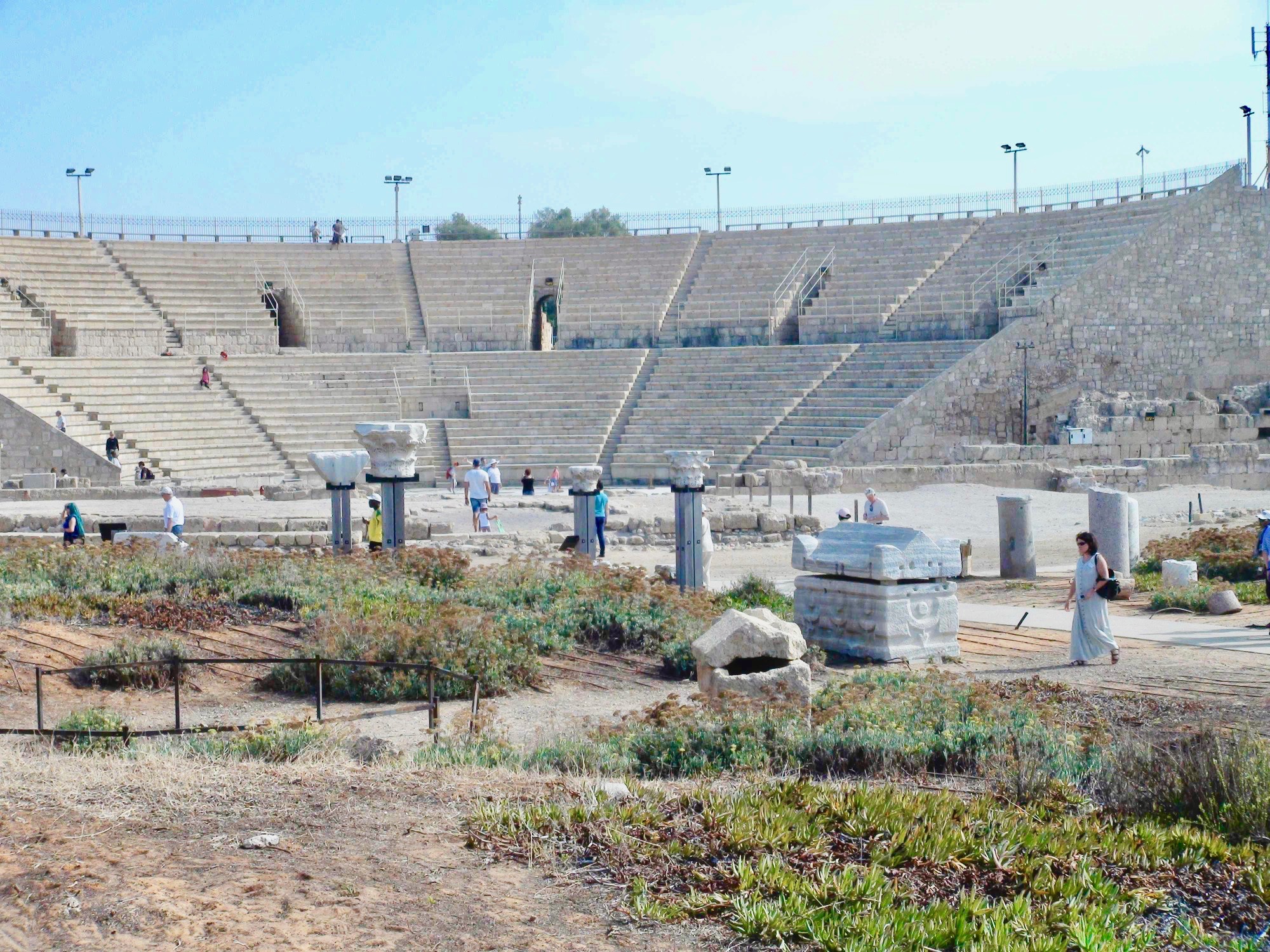
Caesarea Maritime is an important city to keep in mind as we read these early chapters of the Acts of the Apostles. It’s important first because a “Gentile Pentecost” took place in this city. The Roman centurion Cornelius and his household were baptized here by the Apostle Peter. The mission into the gentile world began here.

Luke highlights Peter’s journey to Caesarea Maritime from Joppa, the port where Jonah began his journey to Nineveh. ( Acts 10:1-48; 11:1-18)  Later, at a crucial meeting in Jerusalem Peter will offer his experience in Caesarea Maritime as God’s sign to announce the gospel to the gentiles. (Acts 15:7-11) 

Caesarea Maritime, 33 miles north of Joppa, was built as a seaport by Herod the Great  and for many years was the Roman military center of Judea where Roman officials, like Pontius Pilate, resided. It was a major port connecting Palestine to the rest of the world.

Philip the Deacon and his four daughters settled there after the persecution of Stephen, Luke reports. They received Paul in their house on his way to Jerusalem. When Jerusalem and its temple were destroyed in 70 AD, Caesarea Maritime became the main city of Judea and also a home for the Christian church. In later years, its bishop was the region’s leading bishop, until a bishop was installed in Jerusalem after Constantine rebuilt it in the 4th century.  

Caesarea Maritime remained a thriving center of Christian learning where great figures like Origen, Gregory Nazianzen and Jerome studied and taught. Only impressive ruins now tell us of the city’s former glory. Poor infrastructure and Moslem invasions finally brought about its end about six centuries after Herod built it.

Luke describe the spread of Christianity through the mission of Paul, but he is not the only missionary. If we follow him alone, we may miss the rich life and spirituality of Eastern Christianity that occurred as the gospel spread to Syria and Egypt. That’s why we should keep Caesarea Maritime in mind. The gospel has more than one story that traces how it spread; it’s not all found in the Acts of the Apostles.

Saint Stephen, the Deacon

Stephen martry
Our readings from the  Acts of the Apostles this week  tell us one thing about the early church: it doesn’t evolve from human planning but from God’s plan. The disciples  certainly didn’t expect Stephen.

The church was pretty settled in Jerusalem after Jesus rose from the dead, according to Acts. The followers of Jesus, good Jews, continued to worship in the temple. Yes, there  were occasional squabbles with the Jewish leaders, but they were mainly tolerated as they worshipped and preached in Jerusalem. This was their world. Besides praying in the temple, they met together, probably on Mount Sion where the Last Supper was celebrated or maybe in Bethany.  They broke bread and prayed there. 

They were mostly Galileans at first, then others joined them from elsewhere. One of them was Stephen.

Stephen was a new-comer. He may have been a Samaritan, which could explain his polemic against the Judaism of the day.  The scriptures see him as one who follows Jesus in his passion. So many of his sufferings are like those Jesus endured. But he was also the cause of the first scattering of believers to other places. He was brash and undiplomatic. I would also think that some of the Galileans didn’t like him.

Yes, he was a saint, but a hard-nosed saint.

He brought change, or better, God brought about change through him. We would like change to take place smoothly, without disagreements, but our early church history says change doesn’t come so easily. 

Readings here.

Morning and evening prayers, 3rd week,  here.  

I Am The Bread of Life

Jordan satellite


The dark green around the Lake of Galilee in the upper part of this Google satellite picture of Palestine points to good farmland. It was good farmland at the time of Jesus. Herod the Great and his son Herod Antipas,  Galilee’s rulers then, appreciated the land and created a network of roads and cities – Tiberius, Sepphoris and Caesarea Maritime on the sea– for shipping goods from Galilee to the rest of the world. Here Jesus proclaims in John’s gospel: “I am the bread of life”,  

All four gospels say that Jesus fed a great crowd near the Sea of Galilee by multiplying a few loaves of bread and some fish. Like the Passover feast, the miracle and the teaching that follows occur over a number of days in the gospels. We will read .John’s account (John 6) at Mass on weekdays from the Friday of the 2nd week of Easter until Saturday of the 3rd week of Easter,

The Passover feast commemorated the Manna God sent from heaven to sustain the Jews on their journey to the promised land. Jesus claims to be the “true bread,” the “living bread” that comes down from heave

Jesus is a commanding presence during the miracle and the days that follow in John’s account. “Where can we buy enough food for them to eat?” he asks Philip as crowds come to him. Then he directs the crowd to sit down, feeds them with the bread and fish, and says what should be done with the fragments left over. The disciples have only a small role in this miracle.

A sudden storm occurs as Jesus and his disciples return to Nazareth after feeding the crowd. Jesus rebukes the wind and the sea; the forces of nature obey him. All four gospels have some version of Jesus power over the sea and the natural world occurring with this miracle. All obey him.

As Jesus reaches Capernaum after the miracle, the crowds want to make him king. Their faith is imperfect; they are limited in their understanding of this sign from heaven. The disciples are also tested; some walk with him no more.

The miracle of the loaves and the fish reminds us that Jesus is Lord and we are people of limited faith. “Master, to whom shall we go? You have the words of everlasting life,” Peter says to Jesus at the end of John’s account. We share His response.

In his commentary on Jesus as the bread of life, the early theologian Origen says that Jesus is bread because he is “nourishment of every kind.” He nourishes our minds and our souls; he also nourishes creation.  When we ask “Give us this day our daily bread,” we’re asking for all that nourishes the life of the world.

“Give us this day our daily bread.”