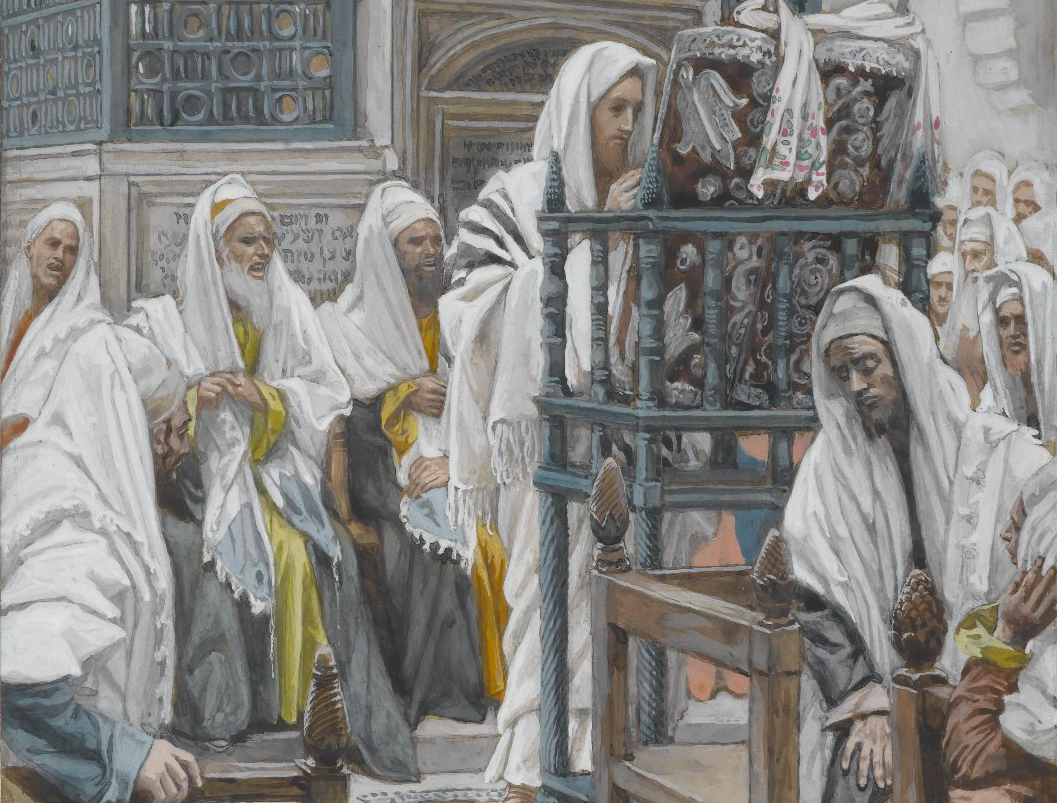
The evangelists Matthew, Mark and Luke all say that Jesus after he began his ministry went back to Nazareth where he’s rejected by those who knew him from his childhood. The evangelists describe the visit taking place at different times. Mark’s gospel says he returned to Nazareth after he raised a little girl from the dead. A miracle like that would be widely known, the girl’s father, Jairus, was an official in the synagogue.
Mark also says that before Jesus returned to Nazareth, others were already questioning the marvelous things he did. Scribes from Jerusalem, the religious experts of the time, came and warned about him. “Keep away from him, they said.”
So when Jesus visited Nazareth there were already suspicions, warnings about him. But still, after raising a little girl to life, you would think he would be well received as he taught in the synagogue at Nazareth. He wasn’t.
Over and over we hear in Mark’s Gospel what we wouldn’t expect: that Jesus was rejected in places where he went. In Capernaum, he drives out an unclean spirit, cures Peter’s mother-in-law and, at the end of the day, the whole town is at his door. {Mark 1, 16-34) But the enthusiasm doesn’t last. Capernaum and other towns in Galilee first receive him, then reject him. (Matthew 11,23)
In pagan territory, over the Sea of Galilee on the east bank, he also meets rejection. He casts out the unclean spirit there, as he did at Capernaum, but when the pigs stampede down into the sea the townspeople ask him to leave. He’s endangering their economy, they say. (Mark 5, 1-20)
Jesus doesn’t have continual path of success in his ministry, or an unbroken parade of achievements, Mark insists. Even his own hometown, his family, don’t receive him well. Final rejection takes place on Calvary in his passion and death, but rejection and misunderstanding meet him all through his public life.
Nazareth has a prominent place in the story of Jesus’ rejection. From his earliest years as a child, he was thought little of there, it seems. Later apocryphal gospels that date from the 2nd century relate miraculous stories about Jesus as a child in Nazareth, but they lack credibility. Jesus did nothing remarkable in his “hidden years.” Some blissful modern portrayals in music and art miss this point. They did not watch his every move with expectation as he grew up.
Jesus “was not able to perform any might deed” in Nazareth; he did not impress or convert many there, as far as we know. He was just “the carpenter’s son.” Like any other human being, he seemed part of the world in which he lived, someone of the time and place. Subject to Mary and Joseph, hardly noticed, “ he grew in wisdom and age and grace before God and man.” (Luke 2,52)
From his time and through the centuries, Nazareth never seems to have accepted the one we call God’s Son. Historians say early Jewish-Christians after his resurrection were expelled from the town. The Christian presence in Nazareth has been small, even till today.
Nazareth is part of the mystery of the Incarnation. The scandal of the Incarnation.
Recent commentaries on the Passion of Jesus, like those of Fr. Donald Senior, CP, ask us to recognize that mystery of Jesus, not only as he enters the Garden of Gethsemane, but all through his life. Well before Gethsemane, Jesus knew suffering. He knew it in Nazareth, where rejection of him continued. Earlier, Mark’s gospel says, members of his own family came to Capernaum trying to take him home because they said he was out of his mind.
We limit our understanding of Jesus if we see him only as a powerful teacher, a merciful worker of cures, one who commands the wind and the sea. The evangelists remind us by incidents like this that Jesus, who was in the form of God, humbled himself. He carried a silent cross. a cross unseen, before the cross of wood was given him.
 The Victor's Place