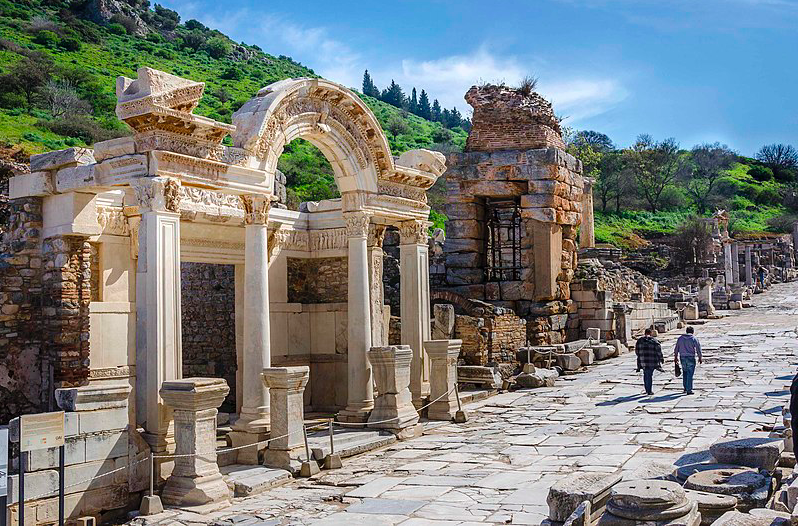
Timothy and Titus were companions of St.Paul on his missionary journeys and continued his mission. Timothy led the church at Ephesus; Titus assumed leadership of the church in Crete. Paul wrote letters of advice to them: one letter to Titus and two letters to Timothy, most likely written from house arrest in Rome.
Like Jesus, Paul never saw himself handing on a church that was completely developed. He ministered to a church evolving from a “way”, a movement, to a church settled in places like Ephesus and Crete. He had men and women companions at his side.
Timothy and Titus were important companions who represent another stage in Paul’s ministry. While Paul and other apostles went out to the nations, the church had to be firmly established in every place they visited. The roles of bishops, priests and other ministries evolved to fulfill that task. A local church needed to be organized. The church is missionary, global, sent by Jesus to the nations, but it’s also local, part of a town. city, neighborhood.
The feasts of the Conversion of Paul and Timothy and Titus represent those two aspects of the church.
Paul’s advice to Timothy is especially interesting. “Stir into flame the gift of God that you have through the imposition of my hands. For God did not give us a spirit of cowardice, but rather of power and love and self-control. So do not be ashamed of your testimony to our Lord, nor of me, a prisoner for his sake; but bear your share of hardship for the Gospel with the strength that comes from God.”
Is Paul trying to bolster Timothy’s confidence as he loses a powerful mentor. Timothy needs the gift of God to make the church in Ephesus a flourishing local church.
Timothy and Titus were given “apostolic virtues” by God to continue the work of Paul and the other apostles, the opening prayer of their feast says. And “May we merit to reach our heavenly homeland” by “living justly and devoutly in this present age.” Like them “we” also are given a task –to work for the church’s growth and development in this present age.
Let’s remember them as our mentors, mindful that God “ does not give a spirit of cowardice, but rather of power and love and self control.” Like the two followers of Paul, we have to hold on to what we’re given and continue their work: “Go into all the world, and proclaim the gospel. I am with you always, says the Lord.”
I see in the notes in the American Bible that the deacons Paul refers to in I Timothy 3, 8-13 may include women as well as men. “This (deacons) seems to refer to women deacons, but may possibly mean the wives of deacons. The former is preferred because the word is used absolutely…”
Why not today? We need women in roles of leadership. I have some in mind who would fit the role very well. I wonder if Timothy’s mother Eunice and grandmother Lois found a home and were involved there. I wonder what my mother would say.
 The Victor's Place
There was something I read in the writings of the Desert Fathers, that touched my heart. The monk said, if you find yourself becoming too regarded, (too popular in my words), discredit yourself and move away. Perhaps that is why our saints now come in the ordinary of little ways because they point to the Heart of Jesus and Mary.
What once was called a monk, may now be a homemaker living in the desert of Brooklyn… and it is the people in the grocery store who listen to her with the ear of the heart and pray the Amen.
LikeLiked by 1 person
Amen.
LikeLiked by 1 person
Thank you, Fr. Victor. Hope you don’t mind my quoting the entire footnote.
Its words are very encouraging..
My most current version of the NABRE, The Catholic Youth Bible, approved in 2010 by the USCCB, footnote on 1Tm 3:3-11– “Women: this seems to refer to women deacons but may possibly mean wives of deacons. The former is preferred because the word is used absolutely: if deacons’ wives were meant, a possessive ‘their’ would be expected. Moreover, they are also introduced by the word ‘similarly,’ as in v. 8; this parallel suggests that they, too, exercised ecclesiastical functions.” There is also a highlighted inset at the beginning of 1 Tm 3, explaining for young people,women and cultural roles in the ancient world, ending with examples of women’s leadership roles in contemporary Christianity and society, including the quote, “Today, if you ask people to name influential Church leaders, Mother Teresa almost always comes up.” Wy not today, indeed? I also have some
in mind.
LikeLiked by 1 person
Grateful for faithful companions
Like Titus and Timothy were for Paul.
Persons who encourage me
to stay the course,
to run the race,
to keep my eyes fixed on Christ.
Placed in my path by God,
not accidently.
Showing up when needed,
pointing me to my goal,
cheering me onward,
holding out a water bottle,
when I pass by,
my thirst is quenched.
All due to what God gives
providently.
LikeLike