Hold fast to the hope that lies before us. This we have as an anchor of the soul,
sure and firm, which reaches into the interior behind the veil,
where Jesus has entered on our behalf as forerunner,
becoming high priest forever according to the order of Melchizedek. Hebrews 6:10-20
Travelers on the Mediterranean Sea from one port to another in early times were never sure on its unpredictable waters. An anchor became a symbol of their safe arrival . Large ancient seaports on the Mediterranean like Alexandria and Antioch adopted the anchor as a symbol for their city. Welcome home!
Hope is “an anchor of the soul”, the Letter to the Hebrews says. Early Christians adopted the sign as a symbol of their hope for reaching their heavenly port, the kingdom of God. Anchors are common inscriptions in the Christian catacombs expressing hope in Jesus Christ.
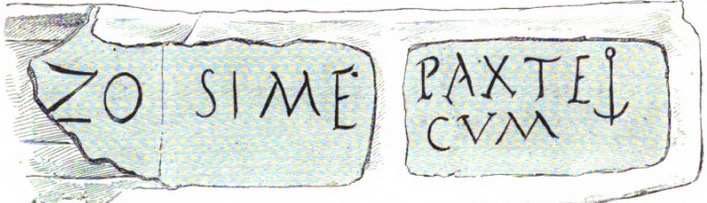
The anchor closely resembles a cross and surely that was what early Christians thought it to be. It’s the most common, and sometimes the only mark, found on the earliest Christian graves in the ancient Roman catacombs of Priscilla, Domitilla and Callistus.
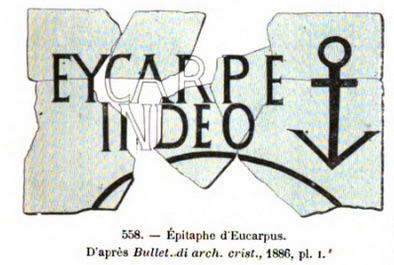
“Pax tecum,” “Peace be with you” the inscription (above) next to an anchor on one of these gravesites reads. “Eucarpus is with God” is the inscription of the deceased on the grave (below) half destroyed by robbers looking for valuables long ago.
Agnes knew that sign, and I would expect it’s found among the number of inscriptions that marked her grave on the Via Nomentana where she is buried.
 The Victor's Place
May Brother Paul Joseph Morgan live on in the eternal love, light, and peace of Jesus Christ, his hope.
LikeLike
Thanks, Gloria. FV
LikeLike
Thanks for this article. It supplements my “research” on crosses and crucifixes. And may Brother Paul have eternal rest.
LikeLike
Isabel,
I hope to do more on the history of crosses, crucifixes. May need your help.
FVictor
LikeLike