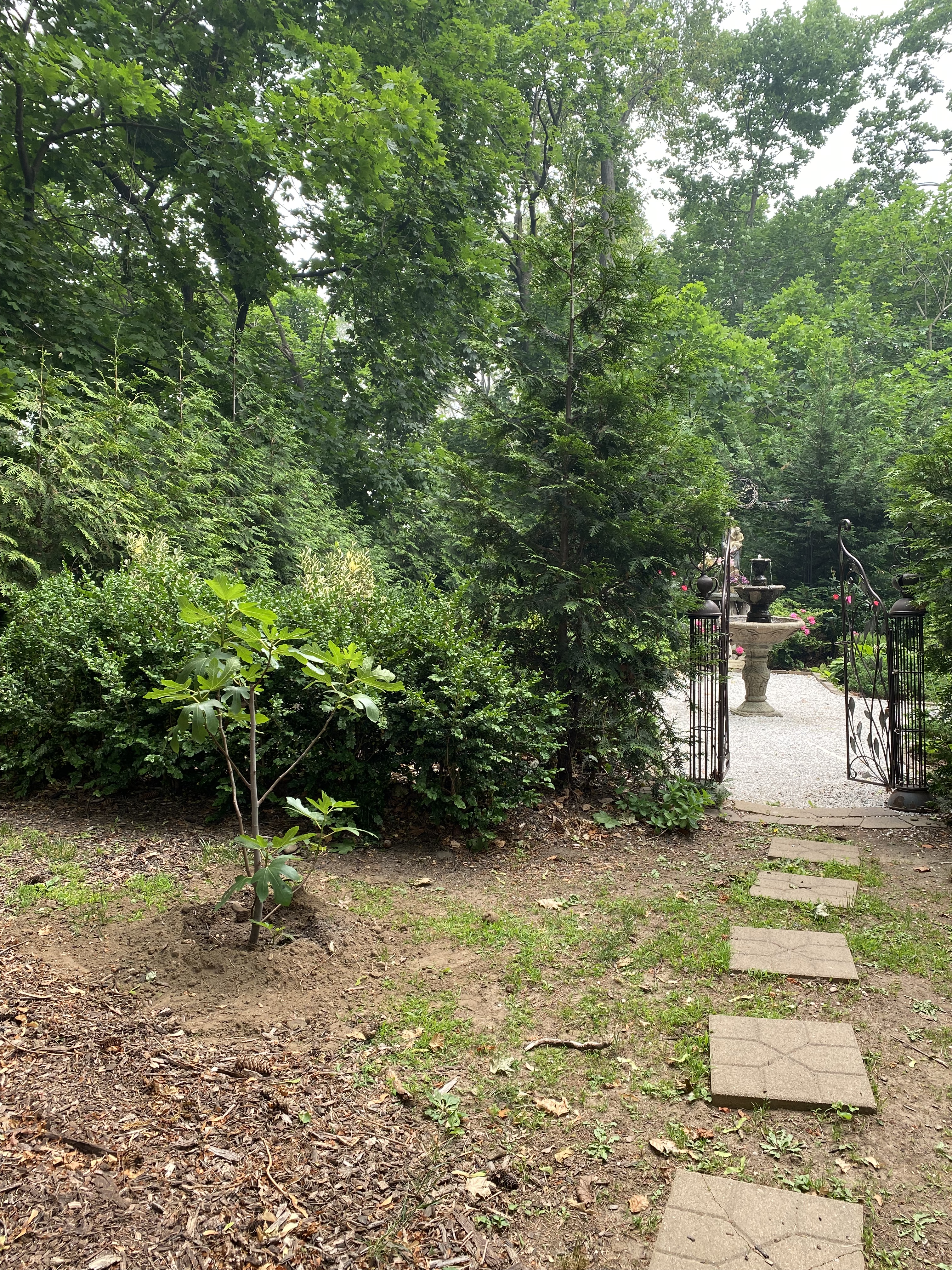
Our neighbor Manuel came over yesterday with the gift of a fig tree, which he planted near the entrance to our Mary Garden. A fig tree belongs there. It’s the first tree named in the garden of Eden (Genesis 3: 7 ), and the last tree mentioned in the Book of Revelations (6: 13). No tree is mentioned more in the Bible.
The fig tree was treasured by Jewish families who prized its dependable supply of fruit, a sign of God’s dependable providence. The prophets often used it to describe God’s blessings and his people’s unfaithfulness. The Prophet Habakkuk’s in our morning prayer describes his own faithfulness to God, using it as an image:
“For though the fig tree blossom not, nor fruit appear on the vine. Though the yield of the olive fails and the terraces produce no nourishment. Though the flocks disappear from the foldand there is no herd in the stalls, Yet I will rejoice in the LORD and exult in my saving God. GOD, my Lord, is my strength; he makes my feet swift as those of a deer, and enables me to go upon the heights. (Habakkuk 3: 17-19)
Michelangelo’s tree of good and evil in the Sistine Chapel is a fig tree.
We’re reading this week about Jesus’ entry into Jerusalem from Mark’s Gospel. Unfaithfulness is why Jesus curses the fig tree as he enters the city, and its roots wither. He finds no fruit on it. (Though it was not time for fruit)
It’s the only miracle of Jesus in Jerusalem recorded by Mark, and it surprises his disciples. (Mark 11:12-14; 20-25 ) Jesus, hungering for a response of faith, finds none from Jerusalem’s leaders he meets.
Manuel explained to me the fig tree’s roots spread quickly so the soil doesn’t have to be especially good, but it needs plenty of sun for growing. I have a feeling it will grow in that holy place. It’s meant to be there.
 The Victor's Place
My Daddy planted figs trees on our place in northwest Florida, and we enjoyed their fruits long after he died in 1959. For all I know, those trees may still be there.
LikeLike