Monthly Archives: June 2023

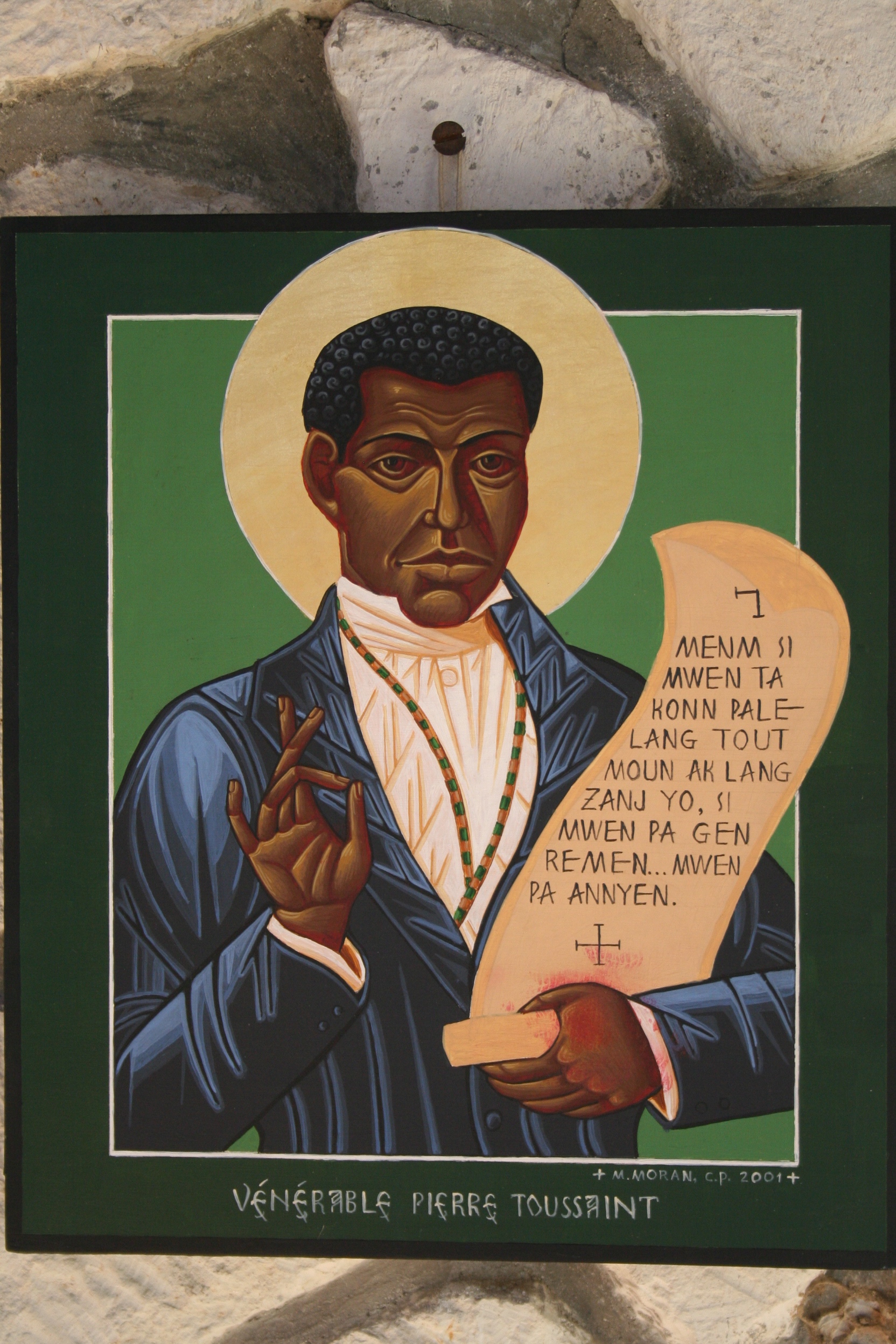
Pierre Toussaint: +June 30, 1873

Pierre Toussaint, who came to the United States as a slave from Haiti, died 150 years ago in New York City. He’s been declared Venerable by the Catholic Church, a man admired for his dedication to the poor and his strong religious faith. See video above.

We may think slavery is a thing of the past in most of the world now, but a recent UN report reminds us it’s more than alive today, everywhere in the world.

Over 50 million people live in modern forms of slavery today and the number is growing. 28 million live in forced labor, 22 million in forced marriages; a large number  are women and children. Enslavment takes place in every country of the world. Many are sexual exploitated.

Pierre Toussaint is a voice for them. Like Jesus, who “took on the form of a slave” Toussaint became a sign of God’s grace that raises the human condition to glory.

We remember him today.

Here are some references to slavery together, courtesy of Annmarie O’Connor, who represents the Passionists at the United Nations:

https://www.un.org/en/delegate/50-million-people-modern-slavery-un-report

It includes a link to the full International Labor Organization (ILO) Report:

And the UN has Special Rapporteurs – Independent Experts who monitor various issues.  Here is information (and you can read his full report) from the Special Rapporteur on Contemporary Forms of Slavery

https://www.ohchr.org/en/special-procedures/sr-slavery

And regarding alarming US discussions about child labor restrictions:

“Child Labor Laws under attack in states across the country: Amid increasing child labor violations, lawmakers must act to strengthen standards”

Finally, the Passionists are connected to Haiti today through Fr. Rich Frechette CP who has long labored among the poor in that country. Native born Haitians are now also members of our community.

Bishop Norbert Dorsey wrote this extensive appreciation of Pierre Toussaint and his spirituality. https://vhoagland.com/wp-content/uploads/2015/01/pierre-toussaint.jpg

The Faith of Abraham

Abraham and Isaac
Roman catacombs, 3rd century

What does it mean to believe? Abraham is “our father in faith.” We read his story from the Book of Genesis at the Easter Vigil, where it appears as a key reading, and in odd years from Monday of the 12th week of the year to Thursday of the 13th week of the year.

First, faith is a gift by which God invites us to a life far beyond what we have now. “The Lord said to Abram: ‘Go forth from the land of your kinsfolk and from your father’s house to a land I will show you.’” It’s not a land we discover, but a land God shows us. We must leave a land we know and enter a land unknown.

Faith’s a gift, but also a challenge. Genesis 22,1-19 begins: “God put Abraham to the test.” There would be no greater test for Abraham than to take his son, Isaac, “your only one, whom you love,” and go up a high mountain and “offer him up as a burnt offering.”

Intimations of the Passion of Jesus are here: “the high mountain… the only son, whom you love.” Approaching the mountain, Abraham takes “the wood for the burnt offering and laid it on his son Isaac’s shoulders.” “God will provide the sheep.” Abraham tells Isaac. He builds an altar and arranges the wood. “Next he ties up his son Isaac, and put him on top of the wood on the altar.” All suggesting the Passion of Jesus.

But when Abraham takes his knife, God stops him. “I know how devoted you are. You did not withhold from me your beloved son.” And God blesses him. “I will bless you abundantly and make your descendants as the stars of the sky and the sands of the sea.”

The Letter to the Hebrews says, “By faith Abraham, when put to the test, offered up Isaac, and he who had received the promises was ready to offer his only son of whom it was said, ‘Through Isaac descendants shall bear your name.’ He reasoned that God was able to raise even from the dead and he received Isaac back as a symbol.” (Hebrews 11,18-19)

“He reasoned that God was able to raise even from the dead.” He faces sadness and cruelty. He’s not a dumb executioner, immune to what he was to do, but “he reasoned,” he believed deep within that God was a God of life. Like Jesus, Abraham faced an absurd death like this, and he believed in a God of love and promise. Like Jesus, his answer was “Not my will, but yours be done.”

The commentator in the New American Bible describes Abraham’s test. “… after the successful completion of the test, he has only to buy a burial site for Sarah and find a wife for Isaac. The story is widely recognized as a literary masterpiece, depicting in a few lines God as the absolute Lord, inscrutable yet ultimately gracious, and Abraham, acting in moral grandeur as the great ancestor of Israel. Abraham speaks simply, with none of the wordy evasions of chapters 12 and 21.  The style is laconic; motivations and thoughts are not explained, and the reader cannot but wonder at the scene.

We ask for Abraham’s faith.

Abraham’s sacrifice is portrayed frequently in the Christian catacombs of Rome, where believers also faced the mystery of death. (above)

A medieval book for artists, “Speculum humanae salvationis,” the prime resource medieval artists used for comparing New Testament stories with the Old Testament, pairs the story of Abraham bringing Isaac to be sacrificed with the story of Jesus carrying his cross to Calvary, as shown in the example below:

abraham Passion

Abraham, The Unwavering Nomad

We reading the story of Abraham in our lectionary this week. He is called “Our father in faith” in our 1st Eucharistic Prayer. That’s because Abraham believed when God called him to leave his own land and go to a land he did not know. He believed in God’s call.

A pastoral nomad who settled down and then moving on. Abraham moved on to a permanent home. That’s us too. Abraham trusted in God rather than in himself. As an old man, he believed God who said he would have a child. His wife Sarah was old too.

The great patriarch was tested. Faith grows through testing. Abraham’s greatest test came when God asked him to sacrifice his only son Isaac.

My favorite reflection on Abraham is Jessica Power’s beautiful poem:

“I love Abraham, that old weather-beaten
unwavering nomad; when God called to him
no tender hand wedged time into his stay.
His faith erupted him into a way
far-off and strange. How many miles are there
from Ur to Haran? Where does Canaan lie,
or slow mysterious Egypt sit and wait?
How could he think his ancient thigh would bear
nations, or how consent that Isaac die,
with never an outcry nor an anguished prayer?

I think, alas, how I manipulate
dates and decisions, pull apart the dark
dally with doubts here and with counsel there,
take out old maps and stare.
Was there a call after all, my fears remark.
I cry out: Abraham, old nomad you,
are you my father? Come to me in pity.
Mine is a far and lonely journey, too.

Genesis 11-50

For the next two weeks at Mass we’re reading selections from the Book of Genesis we could call its Jewish phase (Genesis 11-50). The first 10 chapters of Genesis described the origins of the world and the beginnings of the human race. Then, the various peoples multiply and go out to parts of the earth God assigns them. 

Chapter 11 begins with the call of Abraham. A Jewish tradition suggests that the peoples of the earth became so unmanageable that God decided to concentrate on one nation, the Jews, with the hope that they will bring all the other peoples together. 

God calls Abraham and his family to take possession of the land God will show them, but that won’t be easy. It’s going to be a mysterious, difficult and messy journey. Abraham and his wife Sarah are old and childless. How can two old people take possession of a land without anyone to follow you?

They have to trust in God and not themselves. We can see that trust in the story of Abraham and his nephew Lot. They can’t all go on together, too much conflict between them, so Abraham tells Lot to pick out the land he wants. Abraham will take whatever God wants him to have.

He trusts in God. Of course, the supreme act of trust is when Abraham is told to sacrifice his son, his only son after many years.

Our lectionary readings for the next few weeks relate some key events from the story of Abraham and Sarah and their descendants. Jews recognize this as their history and Christians see it as theirs too. 

It’s a messy journey. Our lectionary omits many dis-edifying parts and details from the accounts of the patriarchs and their wives and their times, which the Bible doesn’t hesitate to recall.  That might be a weakness in reading the scriptures from the lectionary and not the bible itself.

The bible is not a story of human achievement and human courage and human trust. It’s the story of God’s grace moving humanity on its journey, where human weakness knows the power and love of God. 

From the beginning, God creates the heavens and the earth and all that is in them.

12th Sunday a: Speaking the Truth

For this week’s homily please watch the video below.

Saint Thomas More

Thomas More by Hans Holbein

On June 22, we celebrate two men of conscience, Thomas More and John Fisher.  More was born in London in 1478. He studied law at Oxford, received his doctorate and in 1504 became a member of the English Parliament. He married Jane Holt in 1505 and had four children, three girls and one boy– Margaret, Cecilia, Elizabeth and John.

The More household was a model of spiritual and intellectual life. More saw that his daughters were well educated, something unusual in those days, and led his family in prayer, study of scripture and discussion on the important matters of the day.  He welcomed into his home distinguished scholars like Erasmus and John Fisher, but also poorer neighbors whom he treated warmly and respectfully. His wife died, and More married a widow, Alice Middleton, in 1511. 

When Henry VIII became king he sought out More as a friend and advisor, making him Lord Chancellor in  1529. More functioned wisely and justly in that office. His friend Erasmus wrote: “In serious matters no one is more prized, while if the king wishes to relax no man is more cheerful…Happy the nations where kings appoint such officials.”

Shortly after More took office, Henry VIII began proceedings to divorce Catherine of Aragon. Because he could not agree with the king, More kept silent and eventually, in 1532, resigned from office. 

Without income and in disfavor, he spent the next few years writing and reflecting, living quietly with his family, “being merry together” he said. But in 1534 he was asked, with John Fisher, to take an oath to the king that he could not accept. He refused, and after 15 months in prison, he was beheaded on July 6, 1545, “the king’s good servant, but God’s first.” 

He is the patron of lawyers and politicians.

In prison More wrote to his daughter, “ I trust only in God’s merciful goodness. His grace has strengthened me till now and made me content to lose goods, land and life as well, rather than swear against my conscience.  I will not mistrust him, Meg, though I shall feel myself weakening and being overcome with fear. I shall remember how St. Peter at a blast of wind began to sink because of his lack of faith, and I shall do as he did: call upon Christ and pray for his help. And then I trust he shall place his holy hand me and in the stormy seas hold me up from drowning. “

St. Thomas More’s life was portrayed in a celebrated movie, “Man for All Seasons.”

“Lord, give us faith like Thomas More to do what is right and trust in you.”

St. John Fisher

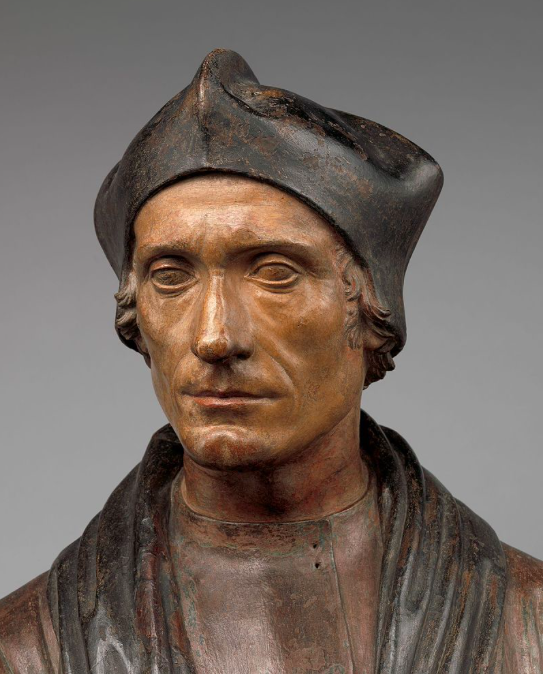
St. John Fisher. Pietro Torrigiano

John Fisher was born in Beverly, Yorkshire England in 1469, and entered Cambridge University at 14. Ordained a priest, he became chancellor of Cambridge in 1504 and Bishop of Rochester, the poorest diocese in England, that same year. He attracted some of the leading scholars of Europe to the university and his learning, holiness and pastoral dedication caused the young king, Henry VIII, to say there was no better bishop in all the world.

When Henry sought to divorce his wife, Catherine of Aragon, John Fisher strongly upheld the validity of their union. Furious at Fisher’s opposition to the Oath of Supremacy that stated Henry was the head of the English church, Henry had him arrested and imprisoned in 1534.  “Not that I condemn anyone else’s conscience,” Fisher said, “ Their conscience may save them, and mine must save me.”

While in prison, Pope Paul III made Fisher a cardinal. After 10 months in jail, he went to his death, carrying with him a copy of the New Testament. To the crowd gathered for his execution, he proclaimed his faith in the Catholic Church and asked for their prayers. Then he recited the Te Deum and the psalm “ In you I hoped, O Lord.”  He was beheaded on June 22, 1535.

His execution, two days before the Feast of the Nativity of John the Baptist caused many to see him following courageously his namesake, who condemned Herod’s attempted marriage to Herodias,  He was canonized along with Thomas More by Pope Pius XI on May 19, 1935. His feast, with Thomas More, is celebrated today by the Church of England on July 6.  

The Roman Catholic Church celebrates the joint feast of John Fisher and Thomas More on June 22.

Tower Hill, Execution Place of John Fisher and Thomas More

Matthew 6: 7-15 Descending with Jesus


by Orlando Hernandez

In this Thursday’s Gospel (Mt 6: 7-15) our Lord Jesus introduces the “Our Father” to His followers. This prayer is certainly a pillar of our Catholic faith. I find the Lord’s Prayer so comforting and yet so challenging, even disturbing. At times it feels like a downward slide from Heaven into the heart of life’s darkness.

In the previous day’s Gospel (Mt 6: 6) Jesus describes prayer as a private, secret moment with God in our “inner room”. This is the kind of prayer I always yearn for, full of gratitude, no petitions, not even words, just basking in the loving light of God, present within, and all around me. It feels like a vacation from life. To feel loved like that!

Unfortunately, this does not happen every day. There are times when I feel so dry and lost in darkness, where the fire within me has dwindled down to a small, smoldering ember. There are times when I feel so frustrated with the situation, or so anxious, that I don’t know what to do. It is always in these moments that I find myself going back to the Lord’s Prayer. It never fails to begin to put me back on track, with my Lord. It is my way back into the Light. I find myself praying the “Our Father” several times during the week. This prayer is no vacation from life. It strengthens us to confront the dangers of life, but it is not easy.

I try to pray it in a quiet place, slowly and carefully. It has such a blissful beginning. I feel so close to Jesus, praying with me, teaching me. Sometimes I even imagine myself with Him, on a Galilean hill, beneath the rim of the Milky Way, surrounded by the universe, in the presence of Abba, the tender Father. In my mind’s eye, Papa has blue eyes, like my handsome earthly father, Orlando, when he would hold me in his arms as a toddler. I feel so loved and protected. I am indeed in Heaven, with my loving God.

And I am not alone, but with all of humanity, saints and angels “hallowing” , praising, recognizing the goodness, the beauty, the truth of “His name!” Wow! This Kingdom is a kingdom of love and hope. The Will of the Father is all mercy and happiness for me.

Then, it seems, maybe not completely. I realize how much is required of me, so many difficult tests, so many painful experiences that might come. I must accept what God has in store for me. I say “Yes,” even knowing how prone I am to letting Him down.

In asking for “our daily bread,” I imagine Jesus, the Bread of Life. I can almost taste Him. I love Him so much. But somehow He reminds me of humanity’s constant challenge to find the daily bread, the basic things that we need to survive. I pray for my family, my friends: may they not lose their jobs. We have it so good in our country, but the threat of having to rely upon a food pantry or a homeless shelter is not so far away for most of us. I pray for the hundreds of millions of people without adequate shelter, nourishment, even water. I think about how little I do to be God’s instrument for the fulfillment of this petition— send money to relief agencies, work at St. Vincent de Paul, give $20 to a homeless person? Does that even make a dent? I find myself feeling helpless and guilty.

Then I ask forgiveness once again for the many sins I constantly repeat! My heart breaks when I imagine His Son on the Cross, because of these sins. I realize how undeserving I am. I remember my grudges and secret resentments. Can I forgive? I pray for so many brothers, sisters, parents and children in my own family, who cannot forgive each other. I pray for humanity, caught in a cycle of offense and counter-offense. Am I an instrument of God’s peace?

I am filled with the fear of giving in to so many temptations within and without me. Come on! Where is my confidence? Father, help me, help me! Deliver us from the evil inside of us. Help us to control ourselves!

And the evil from outside? The danger of violence, disease, accidents, natural disasters? The morning news remind us of so many ruined lives. I think of my atheist friends asking, “How could a loving God permit this?”

And then, abruptly, the prayer ends. Am I ready to say “Amen?” Do I believe with all my heart that God will actually answer all our pleas? I find myself forcing my eyes away from the not-so-far-away abyss of doubt. I frown. I approach the abyss. I jump and cry, “Lord!” And God always catches me in His loving hands. I begin to feel this strange peace, this hope that our God has the best plan for all of us. I believe that Supernatural Grace has touched me once again. Lord, why do You love me like this? Thank You, Beloved, King of Peace!

I sometimes think of this prayer as Jesus’ battle hymn. Yes, it has a somewhat bleak ending, but it “works”, it strengthens, it comforts. The extra ending that our Church fathers added explains why: “Because Thine is the Kingdom, the Power and the Glory.”
You better believe it! Amen!

Orlando Hernández
Matthew 7: 12. Do To Others

“Do to others what you would have them do to you.”  (Matthew 7:12)

It’s so simple, isn’t it? “Do to others what you would have them do to you,”  They call it the Golden Rule, because it can be so broadly applied. Though it’s found among the teachings of Jesus in the Sermon on the Mount, which we’re reading today, it’s not just a Christian, or Catholic rule. It could apply to any religion, Moslem, Buddhist, Hindu– or no religion at all.

It’s a rule that stands out among all the teachings of Jesus.

It’s more than just a rule for individuals, a norm for personal conduct. If it were adopted by the community of nations, it would bring peace to our world, fairness to the way we live together. It would bring equality to the present unequal world of ours. How could the strong exploit the weak? How could we go to war? How could we enslave others? How could we neglect those in need?

“How would you like it if someone did that to you? Thought that about you? Wanted that to happen to you? It’s a rule so simple, yet we shy away from it.

“Do to others what you would have them do to you.”  (Matthew 7:12)