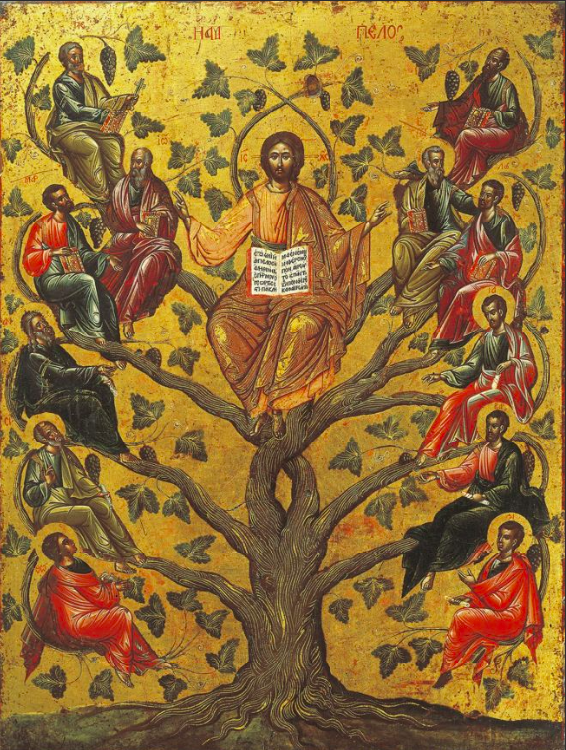
“I am the true vine, and my Father is the vine grower.He takes away every branch in me that does not bear fruit, and every one that does he prunes so that it bears more fruit.You are already pruned because of the word that I spoke to you.Remain in me, as I remain in you. Just as a branch cannot bear fruit on its own unless it remains on the vine, so neither can you unless you remain in me. I am the vine, you are the branches. Whoever remains in me and I in him will bear much fruit, because without me you can do nothing.” (John 15:1-5)
In the Farewell Discourse Jesus prepares his disciples for his new presence among them–in signs and sacraments. Some of those signs come from the human world. Jesus is the Shepherd who forever cares for his flock. Other signs come from creation. The vine is a sign of life that feeds and nourishes other life. Water, bread, light are part of the signs that reveal God’s plan. Learning to appreciate signs is part of the sacramental age we live in. Today, as Pope Francis reminds us, we need a greater appreciation of signs, schooled as we are by a world disposed to science and scientific thinking.
This icon, Christ the Vine, was painted by a famous fifteenth-century Cretan iconographer Angelos Akotantos (d.1450) before the Byzantine Empire collapsed, leading to the separation of Eastern and Western churches. The icon is a call for unity of the churches.
In John’s readings from the Last Supper today and tomorrow, Jesus’ disciples , Thomas and Philip, appear unsure of the way and the power of Jesus himself. An important question raised in mystagogic catechesis.
St. Ambrose in the 4th century met the same uncertainty of signs as he spoke to the newly baptized of his time. They signify so much, but we find them hard to accept. “Is this it?” he hears them say as they approach the waters of baptism and the table of the Eucharist.
Encountering God through sacraments in weakened further today by a lack of a symbolic sense, Pope Francis writes in his letter Desiderio Desideravi . Now, more than ever, human beings, like Thomas and Philip, want to see. We want immediate experience.
Ambrose calls on stories of the Old Testament. The Israelites were saved as they flee from Egypt through the waters of the Red Sea, the cloud that guides them on their way–foreshadowing the Holy Spirit, the wood that makes the bitter waters of Marah sweet–the mystery of the Cross.
“You must not trust, then, wholly to your bodily eyes. What is not seen is in reality seen more clearly; for what we see with our eyes is temporal whereas what is eternal (and invisible to the eye) is discerned by the mind and spirit.” (On the mysteries)
The Assyrian general, Naaman, doubted as he stood before the healing waters of the Jordan, Ambrose reminds his hearers. There’s more here than you see or think.
So we’re invited into an unseen world. Still, we’re like those whom the gospel describes and the saint addresses. Is this it? Moreso now, schooled as we are in the ways of science and fact, we look for proof from what our eyes see. We live in a world that tells us what we see is all there is.
Faith is a search for what we don’t see. God desires to approach us through signs. Will he not help us approach him that way? Believe in me, Jesus says.
The Last Supper Discourse from John’s gospel, read as a mystagogic catechesis, begins appropriately in our lectionary today with Jesus washing his disciples’ feet– an act of mercy– and continues with a reminder of human sinfulness and betrayal. He did not call perfect disciples; he does not eat with perfect disciples, nor does he send out perfect disciples.
Jesus took the form of a slave when he came among us today’s gospel says. At every Eucharist he comes to wash away our sins we’re reminded in the initial rites of the Mass. At the same time we’re call to be merciful, following him.
“You were sent to heal the contrite, Lord have mercy. You came to call sinners, Christ have mercy. You plead for us at the right hand of the Father, Lord have mercy.”
When Jesus had washed the disciples’ feet, he said to them: “Amen, amen, I say to you, no slave is greater than his master nor any messenger greater than the one who sent him. If you understand this, blessed are you if you do it. I am not speaking of all of you. I know those whom I have chosen. But so that the Scripture might be fulfilled, The one who ate my food has raised his heel against me. From now on I am telling you before it happens, so that when it happens you may believe that I AM. Amen, amen, I say to you, whoever receives the one I send receives me, and whoever receives me receives the one who sent me.” (John 13:16-20)
The Last Supper Discourse is a wonderful way to reflect on the presence of Jesus in the Eucharist.
“Is this it?” St. Ambrose begins one of his catechetical sermons to his newly baptized Christians as they begin their new life of faith. “Is this it?”The Christian life may not be the vision of Paradise they heard described in the scriptures. For now, Christian life is a life of signs, the signs of sacraments, and they are wondering “Is this it?”
St. Cyril of Jerusalem, another of the great catechists of the early church, heard the same question in his church when he was instructing catechumens. In his catechetical sermons after Easter he told them to look for Christ in the scriptures as Jesus told his first disciples to do. The Holy Spirit will reveal him to you. he told them..
Easter time is the church s time for mystagogic catechesis, a big word for remembering and reflecting on the presence of Jesus in sacraments. When Jesus rose from the dead, he appeared to his disciples and other witnesses and showed them he was alive. Yet even as he appears to them risen, Jesus begins to wean them away from knowing him physically. His resurrection appearances are occasional. None of them are long. All of them verify he is risen body and spirit. He’s alive.
Those who saw him bodily had to learn to see him in another way –through signs, like bread and wine, water, gathering together to remember him, in the scriptures that speak of him, in the poor and suffering who are wounded like him, in the signs of the times that unfold before them.
That’s the way Jesus will remain with them, and that’s the way Jesus remains with us. Ascending into heaven, he returned to the right hand of the Father, but it also ended one way of seeing him and began another.
From Easter to Pentecost this is the myste the liturgy unfolds so beautifully. In our readings these last few days we’re told we will hear the voice of the shepherd rather than see him. On Thursday, we’ll begin reading the Last Supper discourse from John’s Gospel for the remaining days of the Easter season.
Some commentators, like those in the Jesus Seminar, question whether Jesus actually spoke the words of the Last Supper discourse in John at the Last Supper; they claim it’s a prime example of the historical inaccuracy of the New Testament.
Should we see instead John’s Last Supper discourse arising from the new presence of Jesus in sacraments, and so an early mystagogic catechesis?
In Peter’s important discourse after meeting the Roman soldier Cornelius in Caesaria Maritime, he says: “This man God raised (on) the third day and granted that he be visible not to all the people, but to us, the witnesses chosen by God in advance, who ate and drank with him after he rose from the dead.” (Acts 10:$0-41)
Peter and the others ate and drank with Jesus after his resurrection. He invites Cornelius and his household to be baptised. Doesn’t he also invite him to share in the continuation of the Last Supper meal, to eat and drink with Jesus who shares his body and blood in signs, whose voice is heard in signs? He is present. His presence is real, a sacramental presence.


 The Victor's Place