Monthly Archives: August 2020

A Sermon Beneath the Cross

Choir, Immaculate Conception Monastery, Jamaica, NY

                                                                                                                   By Orlando Hernández


     The Traditional Passionist Mission Prayer to Jesus Crucified expresses what happens to many of us Catholics after years of sitting at Mass or walking past crucifixes in churches, rectories and other religious places, even in our homes:     “Lord, Jesus, for how many ages have You hung upon Your Cross, and still people pass You by and regard You not, except to pierce anew Your Sacred Heart. How often have I passed You by, heedless of Your great sorrow, Your many wounds, Your infinite Love.”     

We look the other way, perhaps not wanting to be disturbed by His Passion, and the stark reminder of our own cruelty and mortality. Maybe we just take it for granted. This is an attitude similar to the one many of us have when we see His crucified people in the news, suffering all over the world, and we just change the channel. We feel more comfortable with happy news, with an image of a powerful, indestructible, sovereign God, instead of the “scrawny one on his cross,”  as the Catholic novelist Shusaku Endo writes.   

 Perhaps Peter was feeling like this in the Gospel for the 22nd Sunday in Ordinary Time. (Mt 16: 21-27):     “Jesus began to show His disciples that He must go to Jerusalem and suffer greatly from the elders, the chief priests, and the scribes, and be killed and on the third day be raised. Then Peter took Jesus aside and began to rebuke Him, ‘God forbid, Lord! No such thing shall ever happen to You.’”   

 Perhaps Peter sees Jesus as the Warrior King, the Anointed One, the liberator of Israel from the Romans. Jesus, of course, rebukes him sharply and declares one of the messages that we can get from looking at all those crucifixes in our church: “Whoever wishes to come after me must deny himself, take up his cross, and follow me. For whoever wishes to save his life will lose it, but whoever loses his life for my sake will find it.” Maybe not a very inspiring “pep talk” from a Warrior King to His soldiers.     

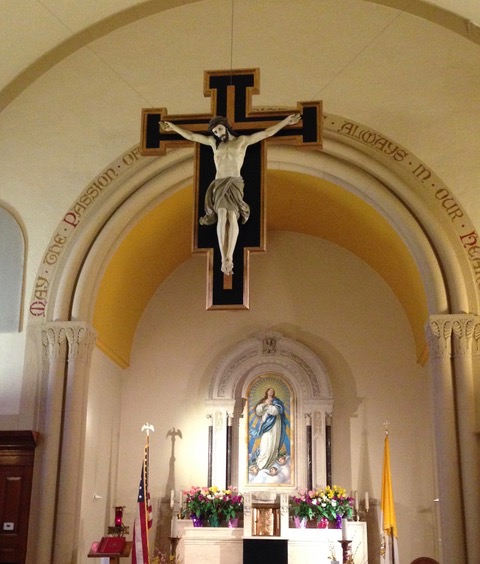
At Our Lady of Victory Church in Floral Park, NY, a large crucifix hangs from wires, high over the first few pews. It is very impressive, similar to the one in “The Choir” chapel at the Passionist Monastery in Jamaica, Queens. I was sitting beneath it, admiring the artistry of this sculpture of the crucified Jesus, as I was waiting for Mass to begin. It was a beautiful object, nothing more.    

 I still had a half-hour wait so I started to read the Psalms on my phone. I was reading my beloved Psalm 24, which celebrates the entrance of the Arc of the Covenant, the Living God, into the Temple of Jerusalem. I always take it as an invitation to let God into my soul:  “Lift up your heads, O you gates,/ Be lifted up you ancient portals,/ Let the king of glory enter in.” …..

Suddenly, the Holy Spirit of God decided to stop me on my tracks and teach me a big lesson. Psalm 24 goes on : “Who is this king of glory/? The Lord, strong and mighty/ The Lord, mighty in war/ …..Who is this king of glory?/ The Lord of hosts, he is the king of glory.”     

I have many Catholic friends who talk about how we as a Church are engaged in a war. We are soldiers in this war; we are part of those “hosts.” However, I usually approach my spirituality in another way. I never think of my God as a military leader, a fighter, a general. But at that moment, in that Church, I felt it with all my heart, the urgency of the battle. I found myself asking: “Whom is He fighting against? Well, evil, suffering, and death, no?… And what are His weapons in this campaign?”      

I was  starting to imagine swords, and helmets, and breastplates, when suddenly I felt the urge to look up. My eyes were raised above me and I saw Him on he Cross, not a statue, but my Beloved Lord Jesus Christ. The thought struck me. THIS is the Warrior, the King of Glory. His weapons, incredibly enough, are surrender, non-violence, compassion, forgiveness, concern, self-giving, sacrifice, healing! That is what he offered me on that cross. In Revelation 19 it does say that He has a sword. It comes out of His mouth. It’s His Word, but it also says that He IS this Word. What word could possibly describe who He is except the word LOVE. That is the greatest weapon in this war! I was feeling dizzy, lost in Him as these thoughts swirled in my head. 

   Revelation 19 also describes the hosts of His Army. No military weapons either— just the white robes that He washed in His own blood, and I believe they were also equipped with hearts full of Love and all the work and sacrifice that it entails. So yes, as His warriors we carry His Cross in our hearts. This is how we can only possibly gain the ability to fight the evil around us and within our hearts. 

   I ran out of words beneath that Cross. I just sat there in pain and joy, sadness and glory, full of gratitude for the gift of His presence. I lost a little bit of my “life” right there.  He came with His Life, filled that empty space with it, and made me just a little more like Him. Thank You, thank You, thank You, Beloved, Prince of Peace, King of Glory.    

 Since then every time I pass a crucifix I take a second look, maybe say “Thank You”. My Patron Saint, Paul of the Cross writes:      “When you are alone in your room, take your crucifix, kiss its five wounds reverently, tell it to preach to you a little sermon, and then listen to the words of eternal life that it speaks to your heart.” 
22nd Sunday a: Thinking Like Human Beings

For this week’s homily, please watch the video below.

How Did They Do It?

A feast of an apostle makes us ask: How did the apostles do what they did, venture so far, weak as they were? St. John Chrysostom gives this answer for today’s feast of Bartholomew, the apostle.

“How could twelve uneducated men, who lived on lakes and rivers and wastelands, get the idea for such an immense enterprise? How could men who perhaps had never been in a city or a public square think of setting out to do battle with the whole world?

That they were fearful, timid men, the evangelist makes clear; he did not reject the fact or try to hide their weaknesses. Indeed he turned these into a proof of the truth. What did he say of them? That when Christ was arrested, the others fled, despite all the miracles they had seen, while he who was leader of the others denied him!  

How then account for the fact that these men, who in Christ’s lifetime did not stand up to the attacks by the Jews, set forth to do battle with the whole world once Christ was dead – if, as you claim, Christ did not rise and speak to them and rouse their courage?

Did they perhaps say to themselves: “What is this? He could not save himself but he will protect us? He did not help himself when he was alive, but now that he is dead he will extend a helping hand to us? In his lifetime he brought no nation under his banner, but by uttering his name we will win over the whole world?”

Would it not be wholly irrational even to think such thoughts, much less to act upon them?  It is evident, then, that if they had not seen him risen and had proof of his power, they would not have risked so much.”

21st Sunday of the Year a: Send Us The Leaders We Need

For this week’s homily please watch the video below.

20th Sunday of the Year a: Great Faith

For this week’s homily please watch the video below.

In the Beginning, Now, and Forever

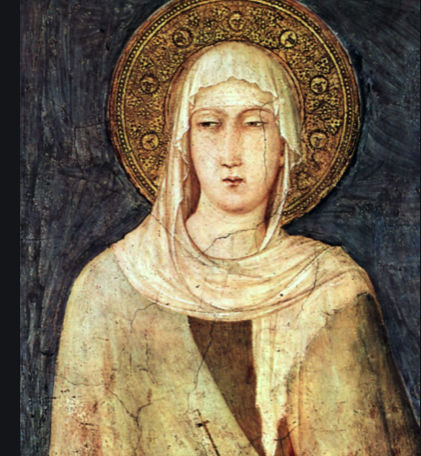
Our liturgical calendar this week, like other weeks, takes us to distant times and places. On Monday it took us to 3rd century Rome for the martyrdom of Lawrence the Deacon; Tuesday to 13th century Assisi with St. Clare; Friday it takes us to a German concentration camp during the 2nd World War with Maximilian Kolbe, and Saturday to 1st century Jerusalem where Mary is assumed into heaven. The feasts of the saints take us continually to distant times and places.

Our scripture readings do it too. The Prophet Ezekiel, our first reading this week, takes us to Babylon where the Jews are trapped in exile. The gospel readings, of course, always take us to times and places of Jesus’ life, death and resurrection.

We’re reminded, I suppose, that God’s presence is “always and everywhere”. There’s no time or place when God is not present. There is no circumstance where God does not give life.

We give thanks for that in the Eucharist.

We need that perspective today especially when life seems stuck in the grips of a pandemic. 

God who is present “always and everywhere” is with us now. Our prayers tell us that; we need to listen to them. 

“Glory to the Father and to the Son and to the Holy Spirit. As it was in the beginning is now and will be forever. Amen.”

Little Prayers

Little prayers are just that–the small, taken-for-granted prayers we pray all the time. Like “Amen.” How many times do we say that word in prayer? Usually we end all our prayers with it.

What does it mean? I suppose we could say it means “yes” in English. “Si” in Spanish or Italian. “Ya” in German. If you look it up in the dictionary, you find it traced back into the Greek and then to the Hebrew. Amen means “so be it”; a strong “yes,” and it’s been part of the language of our faith for centuries.

Here we are in the 21st century using a word generations before us have used; we draw on the faith of generations before us to say, “Yes, I believe,” “Amen” to God’s word to us and our word to God.

“The Lord be with you,” “And with your spirit.” Another little prayer, wishing that God be with us and bring us together in faith. We can trace that little prayer back generations too.

Little prayers can give us a way to express what we can hardly put into words or understand. Besides words, they can also be simple gestures, like the Sign of the Cross; they can be moments of listening or seeing and waiting in silent attention before God.

Psalm 123 describes a servant waiting and watching before her mistress.

“To you I lift up my eyes,
you who dwell in the heavens.
My eyes like the eyes of slaves
On the hand of their lords.
Like the eyes of a servant
On the hand of her mistress,
So our eyes are on the Lord our God
Till he show us his mercy.”

Little prayers can be a cry or even tears. You often hear that kind of prayer in the psalms:

“I cried to you, Lord, and you heard me,” the psalmist says in Psalm 30.

Remember the simple cry of the Canaanite woman: “Have pity on me, Son of David…Please, Lord” (Matthew 15:21).

Little prayers are important, they’re not little at all.

The Light Shines in the Darkness

                                                                                          
                                                                                                                   By Orlando Hernandez

Dear readers. I hope that you don’t mind that I try and share my “God experiences” with you. That’s what I do with my grandchildren when they ask me about God and prayer. They are each having a hard time with their faith, specially during these last few months. So I share stories like these with them.

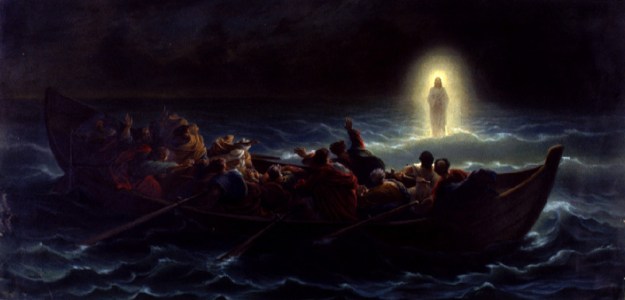
The Gospel for the Nineteenth Sunday in Ordinary Time (Matthew 14:22-33) recounts the powerful story of Jesus walking on the water to rescue His disciples. On August 3rd, 2020, on this blog, Gloria M. Chang wrote a wonderful reflection on this Gospel. I was especially impressed by the beautiful painting she showed us: “Jesus Walking on the Sea,” by Amedee Varin.

I had never realized that between the hours of 3:00AM and 6:00AM (“the fourth watch”) the Apostles on that boat must have been rowing and bailing water in total darkness. The painting portrays Jesus as a nebulous, luminous figure in the distance across the waves, the only source of light, defining everything in the picture. 

He looks a little scary to me, indeed like a ghost. The “terrified” Apostles really needed to hear those words from our Lord: “Take courage; it is I; do not be afraid.” Don’t we all?  But Peter was still not sure: “Lord IF it is You…..”  Many years later this wonderful saint would write, “we possess the prophetic message that is altogether reliable. You will do well to be attentive to it, as to a lamp shining in a dark place…”

My most powerful, pivotal experiences of Jesus have always reminded me of this Gospel story and this passage in 2Peter.  That blessed day I first believed in Him, I saw Him in as a blinding light radiating from a risen host during a Catholic Mass. I had to close my eyes, and, nobody can convince me otherwise, I saw Him in the turbulent darkness of my tormented mind, looking a lot like His depiction in the painting by Varin. I did not know Him like Peter did, so I could not help but to keep my mouth shut as He got closer and I felt Him saying, “I love you; you’re Mine. I will never let you go.”

A few years later, during a Life In The Spirit Seminar, that distant, ghostly light came to me once again in a most powerful way. About 300 people were assembled in a school cafeteria/gym. The presenter had the lights turned off, and the many assistants started to pray over us in tongues. The young guy in the music ministry played eerie, dissonant notes, on his electric guitar. The presenter asked us to close our eyes and imagine, in the darkness, a distant shining light that that became larger and larger as it came closer to each one of us. He told us, “This is Jesus, our Lord, let Him in.”  The light became extremely bright, and there, on the tiled floor(in my mind’s eye?), I saw Jesus kneeling almost naked before me. He had all the wounds of His Passion. He was so bloody, and there was such sorrow in his eyes as He stared straight at me. My heart was broken.  He raised His arms in my direction. I held Him and tried to help Him up, but He embraced me right back and sprung up. There was such love in His piercing eyes as He raised me up, up, up, into the Heavenly arms of His Father. The lights in the place were suddenly back on, and there I was, dazed and tearful, standing somewhere in the meeting hall. Wow!

I have never had any other experiences quite like these two, but when I suffer from insomnia at 3;00AM in my bed, I look for Him in the darkness and turbulence of my worries. I feel that My Lord eventually comes and helps me to fall asleep, patiently teaching me once again to slowly pray the Our Father with Him. I truly believe that He does that for all of us. 

The prayer meeting, the Liturgy, the verbal prayer, the meditation, the beauty of nature, are vehicles that lead us across the waters of our mind in search of God, but in the end, I believe that the Lord is the One who draws us, beyond all those wonderful experiences, into a one-to-one, intimate encounter. As Christians, this is what we always yearn and strive for. It certainly does not happen to me all the time, but I keep on trying. In the meantime, it is the faith that God has lovingly given me that keeps me rowing in the dark.

My 21-year old grandson tells me sadly that he still prays every night, “just in case God is real,” hoping to find again that feeling that he had when he was little. I encourage him to keep on trying. God is always with him, even if he does not sense Him. One of these nights he might just get a big, wonderful, awesome surprise!

Beloved Lord. Please help all those who seek you in the dark. Be their light!

19th Sunday a: Believing up to a point

For this week’s homily please play the video below.

Divinity is Infinity!