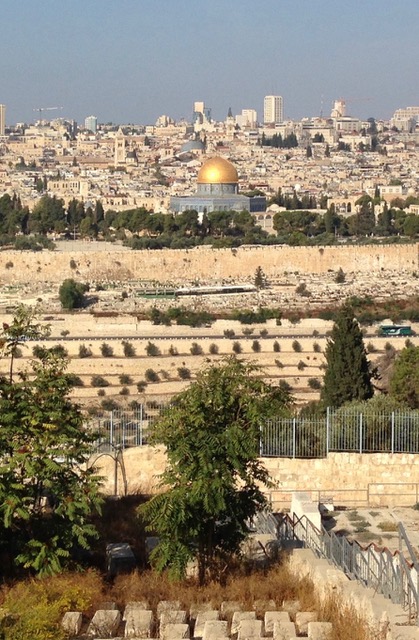
The Gospel for Thursday of the 33rd week in Ordinary Time describes the poignant moment when Jesus stood upon the slope of the Mount of Olives, and our Lord wept (“Dominus Flevit”) over the Holy City of Jerusalem: “ As Jesus drew near Jerusalem, He saw the city and wept over it, saying, ‘If this day you only knew what makes for peace–but now it is hidden from your eyes. For the days are coming upon you when your enemies will raise a palisade against you; they will encircle you and hem you in on all sides. They will smash you to the ground and your children within you, and they will not leave one stone upon another within you because you did not recognize the time of your visitation.’” (Lk 19: 41-44)
On the second day of our pilgrimage to the Holy Land our group of 33 stood upon the place where, over the centuries, people have believed Jesus said these words. From this high point we looked upon the vast panorama of the city of Jerusalem, rising from across the Kidron Valley. On our side of the valley (the Mount of Olives) we were surrounded by vast Jewish graveyards that covered most of the slope. Large quantities of older limestone tombs right below us were vandalized and damaged by the retreating Jordanians in the 1967 Six-Day War.
To our left, numerous, newer, empty gravesites waited for the bodies of well-to-do, living Israelites who could afford the exorbitant price for a spot where the first thing that they will see on the day of the Resurrection of the Dead is the Holy City of Jerusalem.
All around you could see hill upon hill densely populated by Arab and Jew. In the middle of the landscape, the ancient city rises, surrounded by the high, crenelated wall that was rebuilt by the Turks some 5 centuries ago. In the center of the wall stands the “Golden Gate,” where Jesus is said to have entered the city on Palm Sunday. Many years ago, this gate was sealed with stones by one of the Muslim rulers in order to prevent Him from ever doing this again!
The imposing Temple Mount rises right behind the wall. Where once the center of the Jewish religion stood, beautiful Muslim structures stand now. How the world changes! Jesus’ predictions sadly came true for His people. Interspersed upon the thousand of houses, mosques and buildings all around, one can spot the towers and domes of churches where it is said the holiest of events took place: Caiphas’ house, where Jesus affirmed “I AM” and Peter denied Him, the Cenacle, where the last supper and Pentecost took place, the Basilica of the Agony in Getsemane, and further up, behind and above the lovely Dome of the Rock, the blue domes of the Church of the Holy Sepulcher, where our Lord died and was resurrected.
It is all overwhelming to see; tears came upon the faces of most of us as we looked in silence (before we fell into the frenzy of picture-taking).
Behind us was the small church named Dominus Flevit (Jesus wept) commemorating the Gospel moment. This church was completed in 1955 by the Franciscans, and designed by the Italian architect Antonio Balucci, who throughout the 20th century designed many of the important churches in the Holy Land.
This building was said to be shaped like a tear drop. I was attracted to the structures standing on top of each of the four corners of the building. They looked like elegant, slim jars of some kind. They were actually supposed to represent “tear flasks.” In ancient times, some people would collect their tears in small flasks that had that shape. Perhaps the woman who washed Jesus’ feet with her tears used such a flask.
In the religious movie “The Shack,” the character of the Holy Spirit collects the tears of a heart-broken man in such a flask, promising that She would use these tears to water the garden of his faith and healing. St. Paul writes that the love of God is poured upon us by His Holy Spirit. In prayer, I imagine a luminescent waterfall. Is it His tears? Can the impassible God weep over us? Our Lord Jesus certainly did!
Back to the pilgrimage. We were unable to celebrate mass inside the small church (it was reserved by a Spanish group), but we celebrated on one of the many covered spaces along the mountain side. Fr. Charles said that it was a miracle that we were even able to get this spot. It was special. We sat on benches and plastic folding chairs on top of a sandy floor (Holy Ground)! Some surrounding trees and a plastic roof protected us from the growing heat. Behind the table that served as an altar we could see the expanse of the Holy City that Jesus wept over. The seriousness, the holiness of the occasion cold be felt in our group. Our friendly conversations stopped one by one; there was a great silence, even before Mass started.
Fr. Charles read this same Gospel (Lk 19: 41-44). In his homily, he focused on Jesus’ words, “If this day you only knew what makes for peace—but now it is hidden from your eyes.” He spoke about the dangerous tensions that exist between Arab and Jew, Muslim and Christian, in this city and country, the poverty and suffering of so many Palestinians. He asked us to pray quietly for peace. I thought of the strife, the destruction and hatred that afflicts most of the Middle East and so much of the world, the opposition and conflict that exists even in our country of the United States.
I could smell the dust of the ancient, broken stones. I imagined this dust covering the face of the staggering, bleeding, (probably weeping) Jesus, telling us on the way to Calvary, “weep for yourselves and for your children”. I thought about my 5 grandchildren and the future that might await them, and I cried, kneeling upon the sand. I started to plead, “Jesus, Wonder-Counselor, Prince of Peace, teach us on this day what makes for peace. Open up our eyes and teach them to see the hidden way of love.”
But the noise of hundreds of people all round us began to distract me. Other groups, celebrating their own Liturgies, were singing in their own languages and playing loud guitars. A group of young people had come out of the church and they were laughing and bantering noisily, while another guide was reading the Bible to his own groups as loudly as possible, stopping often to tell everyone to “Shushh!” It did little good.
With a faint smile on my face, I became aware of this mass of humanity, each person lost in their own intentions, competing for air and space. I closed my eyes and imagined Invisible Tears falling softly upon everyone. Jesus the Pilgrim was weeping over all of us.
Orlando Hernandez
 The Victor's Place
Poignant.
LikeLike
Orlando , Beautiful Homily , Joe.
LikeLike
Thanks, Orlando, I can relate to Pilgrim tears. Tears that flow from eyes are salty. Christ could be looking now at our cities in this world, crying copious tears with the violence and suffering of so many today. Tears that heal are the ones we shed for our failings, realizing how weak we are. Oh then we can shed tears of joy as at a wedding. There’s no better eye wash than a good cry!
LikeLike