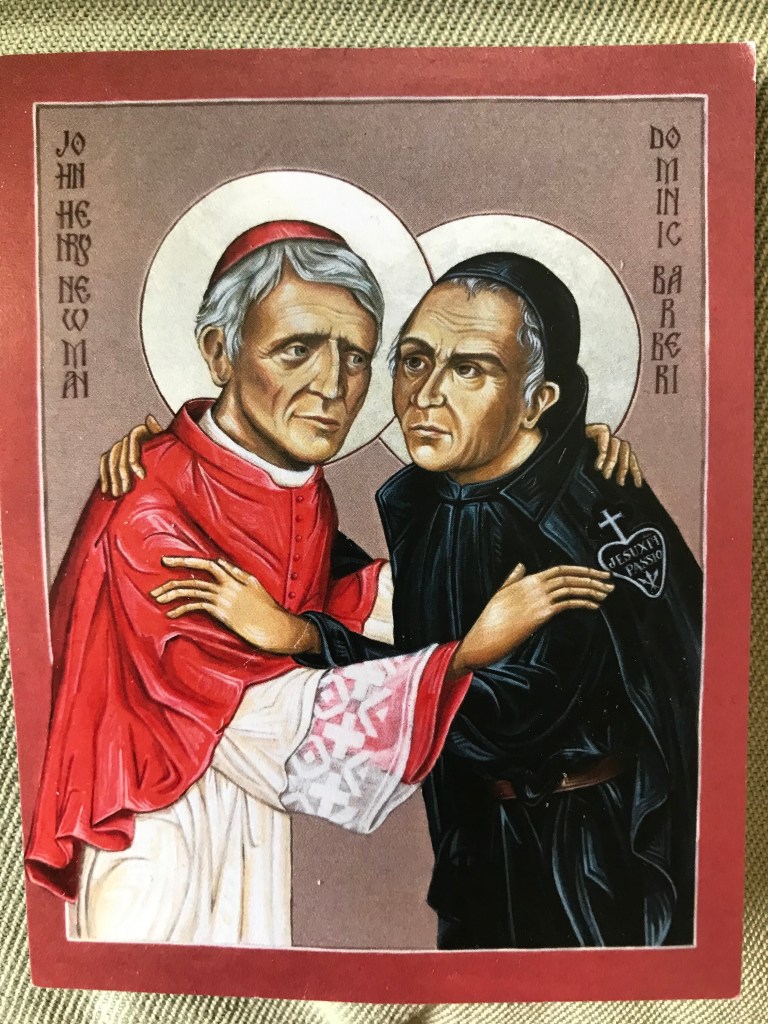
October 13, 2019, John Henry Newman (1801-1890) was canonized a saint by Pope Francis in Rome. Newman, a member of the Anglican Church. was received into the Catholic Church by the Italian Passionist, Blessed Dominic Barberi.
Newman admired Dominic, a Passionist missionary recently from Italy. More than a kindly Catholic priest and religious, Dominic represented something Newman treasured, the mystery of the Passion of Jesus.
For Newman the mystery of the Cross interpreted everything. “ It is the death of the Eternal Word of God made flesh, which is our great lesson how to think and how to speak of this world. His Cross has put its due value upon everything which we see.”
The mystery of the Cross distinguished Christianity from all other religions for Newman. Shortly after his conversion he reflected on the Word of God made flesh in “The Mystery of Divine Condescension.” (Discourses to a Mixed Congregation” 14)
“The Eternal Word, the Only-begotten Son of the Father, put off his glory, and came down upon earth, to raise us to heaven. Though He was God, He became man; though He was Lord of all, He became as a servant; though He was rich, yet for our sakes He became poor, that we, through his poverty, might be rich.”
The first step to understand the mystery of Divine Condescension for Newman is to contemplate through reason and faith “the Almighty in Himself, then we should understand better what His incarnation is to us, and what it is in Him… when you have fixed your mind upon His infinity, then go on to view, in the light of that infinity, the meaning of His incarnation.”
Through reason and faith, Newman reflects on “the Almighty in himself.”
“Reason teaches you there must be a God; else how was this all-wonderful universe made? It could not make itself; man could not make it, he is but a part of it; each man has a beginning, there must have been a first man, and who made him?
To the thought of God then we are forced from the nature of the case; we must admit the idea of an Almighty Creator, and that Creator must have been from everlasting. He must have had no beginning, else how came He to be?
The Creator of the world had no beginning;—and if so, He is self-existing; and if so, He can undergo no change. What is self-existing and everlasting has no growth or decay; It is what It ever was, and ever shall be the same. As It originated in nothing else, nothing else can interfere with It or affect It. Besides, everything that is has originated in It; everything therefore is dependent on It, and It is independently of everything.
Contemplate then the Supreme Being, the Being of beings, even so far as I have yet described Him; fix the idea of Him in your minds. He is one; He has no rival; He has no equal; He is unlike anything else. He is sovereign; He can do what He will. He is unchangeable from first to last; He is all-perfect; He is infinite in His power and in His wisdom, or He could not have made this immense world which we see by day and by night…
He has lived in an eternity before He began to create anything. What a wonderful thought is this! there was a state of things in which God was by Himself, and nothing else but He. There was no earth, no sky, no sun, no stars, no space, no time, no beings of any kind; no men, no Angels, no Seraphim. His throne was without ministers; He was not waited on by any; all was silence, all was repose, there was nothing but God; and this state continued, not for a while only, but for a measureless duration; it was a state which had ever been; it was the rule of things, and creation has been an innovation upon it.
Creation is, comparatively speaking, but of yesterday; it has lasted a poor six thousand years, say sixty thousand, if you will, or six million, or six million million; what is this to eternity? nothing at all; not so much as a drop compared to the whole ocean, or a grain of sand to the whole earth. I say, through a whole eternity God was by Himself with no other being but Himself; with nothing external to Himself, not working, but at rest, not speaking, not receiving homage from any, not glorified in creatures, but blessed in Himself and by Himself, and wanting nothing.”
Like the psalmist who asks “What is man that you are mindful of him, mortal man that you keep him in mind?”Newman dwells on the distance between God and us, a distance that seems to separate us from God.
“We can hardly understand other human beings, how can we know God so infinitely greater than us? If God has no need of us, why did he create the world, why did he create us?”
Our limited knowledge, our humanity, our human way of knowing things through our senses, makes our relationship to God so challenging, Newman observes. “And hence it is that I am drawn over to sinful man with an intenser affection than to my glorious Maker…and thus does my fellow-man engage and win me; but there is a gulf between me and my great God… It is a want in my nature to have one who can weep with me, and rejoice with me, and in a way minister to me; and this would be presumption in me, and worse, to hope to find in the Infinite and Eternal God.”
Our temptation, Newman says, is to abandon any relationship with God.
“Perhaps you are tempted to complain that, instead of winning you to the All-glorious and All-good, I have but repelled you from Him. You are tempted to exclaim,—He is so far above us that the thought of Him does but frighten me; I cannot believe that He cares for me. I believe firmly that He is infinite perfection; and I love that perfection, not so much indeed as I could wish, still in my measure I love it for its own sake, and I wish to love it above all things, and I well understand that there is no creature but must love it in his measure, unless he has fallen from grace.
But there are two feelings, which, alas, I have a difficulty in entertaining; I believe and I love, but without fervour, without keenness, because my heart is not kindled by hope, not subdued and melted with gratitude. Hope and gratitude I wish to have, and have not; I know that He is loving towards all His works, but how am I to believe that He gives to me personally a thought, and cares for me for my own sake? I am beneath His love; He looks on me as an atom in a vast universe. He acts by general laws, and if He is kind to me it is, not for my sake, but because it is according to His nature to be kind…
“Your complaint is answered in the great mystery of the Incarnation,” Newman continues.
“ Never suppose that you are left by God; never suppose that He does not know you, your minds and your powers, better than you do yourselves. Ought you not to trust Him, that, if your complaint be true, He has thought of it before you? “Before they call, I will attend,” says He, “and while they speak, I will hear.” Add this to your general notion of His incomprehensibility, viz., that though He is infinite, He can bow Himself to the finite; have faith in the mystery of His condescension; confess that, though He “inhabiteth eternity,” He “dwelleth with a contrite and humble spirit,” and “looketh down upon the lowly”.
God discloses himself in nature, first of all, Newman says. The natural world is part of the mystery of Divine Condescension and we should embrace it because it begins the disclosure of God that’s perfected by revelation:
“Lift up your eyes, I say, and look out even upon the material world, and there you will see one attribute above others on its very face which will reverse your sad meditations on Him who made it. He has traced out many of His attributes upon it, His immensity, His wisdom, His power, His loving-kindness, and His skill; but more than all, its very face is illuminated with the glory and beauty of His eternal excellence…mountains, cliffs, and sea rise up before you like a brilliant pageant, with outlines noble and graceful, and tints and shadows soft, clear, and harmonious, giving depth, and unity to the whole; and then go through the forest, or fruitful field, or along meadow and stream, and listen to the distant country sounds, and drink in the fragrant air which is poured around you in spring or summer; or go among the gardens, and delight your senses with the grace and splendour, and the various sweetness of the flowers you find there; then think of the almost mysterious influence upon the mind of particular scents, or the emotion which some gentle, peaceful strain excites in us, or how soul and body are rapt and carried away captive by the concord of musical sounds, when the ear is open to their power; and then, when you have ranged through sights, and sounds, and odours, and your heart kindles, and your voice is full of praise and worship, reflect— not that they tell you nothing of their Maker,—but that they are the poorest and dimmest glimmerings of His glory, and the very refuse of His exuberant riches, and but the dusky smoke which precedes the flame, compared with Him who made them. Such is the Creator in His Eternal Uncreated Beauty,”
The saints, the mystics have glimpses of God and yearn to see him, like Moses who asked to see God’s face after coming before the burning bush. “ What saints partake in fact, we enjoy in thought and imagination” Newman says, recognizing religious experience as part of the Condescension of God.
But the Condescension of God goes beyond nature, beyond human religious experience. In the mystery of the Word made flesh. The Creator humbles himself to the creature.”Your God has taken on Him your nature.”
What form do we humans expect God to take? “Doubtless, you will say, He will take a form such as “eye hath not seen, nor ear heard of” before. It will be a body framed in the heavens, and only committed to the custody of Mary; a form of light and glory, worthy of Him, who is “blessed for evermore,” and comes to bless us with His presence.
Pomp and pride of men He may indeed despise; we do not look for Him in kings’ courts, or in the array of war, or in the philosophic school; but doubtless He will choose some calm and holy spot, and men will go out thither and find their Incarnate God. He will be tenant of some paradise, like Adam or Elias, or He will dwell in the mystic garden of the Canticles, where nature ministers its best and purest to its Creator.”
But, “the Maker of man, the Wisdom of God, has come, not in strength, but in weakness. He has come, not to assert a claim, but to pay a debt. Instead of wealth, He has come poor; instead of honour, He has come in ignominy; instead of blessedness, He has come to suffer. He has been delivered over from His birth to pain and contempt; His delicate frame is worn down by cold and heat, by hunger and sleeplessness; His hands are rough and bruised with a mechanic’s toil; His eyes are dimmed with weeping; His Name is cast out as evil.
He is flung amid the throng of men; He wanders from place to place; He is the companion of sinners. He is followed by a mixed multitude, who care more for meat and drink than for His teaching, or by a city’s populace which deserts Him in the day of trial.
And at length “the Brightness of God’s Glory and the Image of His Substance” is fettered, haled to and fro, buffeted, spit upon, mocked, cursed, scourged, and tortured. “He hath no beauty nor comeliness; He is despised and the most abject of men, a Man of sorrows and acquainted with infirmity;” nay, He is a “leper, and smitten of God, and afflicted”. And so His clothes are torn off, and He is lifted up upon the bitter Cross, and there He hangs, a spectacle for profane, impure, and savage eyes, and a mockery for the evil spirit whom He had cast down into hell.”
We also find this face of God hard to understand, Newman says:
“Oh, wayward man! discontented first that thy God is far from thee, discontented again when He has drawn near,—complaining first that He is high, complaining next that He is low!—unhumbled being, when wilt thou cease to make thyself thine own centre, and learn that God is infinite in all He does, infinite when He reigns in heaven, infinite when He serves on earth, exacting our homage in the midst of His Angels, and winning homage from us in the midst of sinners? Adorable He is in His eternal rest, adorable in the glory of His court, adorable in the beauty of His works, most adorable of all, most royal, most persuasive in His deformity.
Think you not, my brethren, that to Mary, when she held Him in her maternal arms, when she gazed on the pale countenance and the dislocated limbs of her God, when she traced the wandering lines of blood, when she counted the weals, the bruises, and the wounds, which dishonoured that virginal flesh, think you not that to her eyes it was more beautiful than when she first worshipped it, pure, radiant, and fragrant, on the night of His nativity?”
So is it, O dear and gracious Lord, “the day of death is better than the day of birth, and better is the house of mourning than the house of feasting”. Better for me that Thou shouldst come thus abject and dishonourable, than hadst Thou put on a body fair as Adam’s when he came out of Thy Hand.
Thy glory sullied, Thy beauty marred, those five wounds welling out blood, those temples torn and raw, that broken heart, that crushed and livid frame, they teach me more, than wert Thou Solomon.
The gentle and tender expression of that Countenance is no new beauty, or created grace; it is but the manifestation, in a human form, of Attributes which have been from everlasting.
Thou canst not change, O Jesus; and, as Thou art still Mystery, so wast Thou always Love. I cannot comprehend Thee more than I did, before I saw Thee on the Cross; but I have gained my lesson. I have before me the proof that in spite of Thy awful nature, and the clouds and darkness which surround it, Thou canst think of me with a personal affection. Thou hast died, that I might live.
“Let us love God,” says Thy Apostle, “because He first hath loved us.” I can love Thee now from first to last, though from first to last I cannot understand Thee. As I adore Thee, O Lover of souls, in Thy humiliation, so will I admire Thee and embrace Thee in Thy infinite and everlasting power.”
As the Amazon Synod continues in Rome, you get the impression it’s different than previous synods. More grassroots reports, more listening, more searching to understand the church in the context of the”the Signs of the Times.”
The Amazon region, the size of the United States, faces environmental challenges. It’s an area that’s crucial to our planet, but it’s also home to indigenous people who have rights to a way of life and the gift of the gospel. They need to be heard.
Some are claiming a change in church discipline, clerical celibacy especially, is the point of the synod, but It’s goal is much bigger than that. Just read the preliminary working paper and see the scope of the synod.
It seems Pope Francis is offering a way of pastoral planning that is good everywhere in the church. We could use it here in the USA.
Prophets, like saints, are sometimes hard to figure out. Scholars can’t tell us much about the Prophet Joel, who speaks in our readings at Mass these days. They’re not sure when he was born or the circumstances of his life. Yet, prophets like him offer important morsels of insight into the mystery of God.
Joel sees Judea reduced by waves of locusts and no rain until it’s a desolate and impoverished land. Climate change? Yet, in those dire times, when everyone suffers and nature is in revolt, the prophet says the Day of the Lord will come. God will hear the cries of his people who complain about their enemies’ taunts: “Where is your God?”
Joel says the Day of the Lord, when God brings justice and peace, will come in the Valley of Jehoshaphat, a name the Jews applied to the Kidron Valley, which lies between the Mount of Olives and the temple of Jerusalem. God will destroy his enemies there and then pour his blessings on Jerusalem and his holy people. (Joel 4, 12-21)
We remember, of course, that Jesus crossed the Kidron Valley and went onto the Mount of Olives to pray the night before he died. On that dark night, he pleaded with his Father in heaven to take away the cup of suffering, as his own disciples abandoned him. There he faced the great enemy Death, that cries out to us all: “Where is your God?” He left that place to bring blessings of life as he died and rose again.
Did Jesus remember the words of Joel as he prayed on the Mount of Olives, facing the Kidron Valley and the Holy City?
At Pentecost, the Apostle Peter uses a long quotation from Joel to explain the blessings God gives through Jesus’ death and resurrection: “It will come to pass in the last days, God says, that I will pour our a portion of my spirit on all flesh. Your sons and daughters shall prophesy, your young men shall see visions and your old men shall dream dreams…I will work wonders in the heavens above and signs of the earth below…” (Acts 2, 17-19)
It has been a while since I put any words on paper or computer (is it “writer’s block”, or have I just become lazy ?). One thing I can say with relief is that through these difficult days my prayer life has not stopped giving me the consolation and hope that I so desperately need.
In the first reading for the 27th Sunday in Ordinary Time, the prophet Habakkuk states that the Lord tells him to : “Write down the vision clearly upon the tablets so that one can read it readily. For the vision still has its time, presses on to fulfillment, and will not disappoint;” (Hab 2: 2- 3b) My wife Berta, upon reading and hearing this Word, truly believes that God told her to encourage all other fellow Christians to get themselves a notebook of some sort and write down the thoughts or images that come to them in surprising or powerful ways while they are praying, so that later, they can be shared with others. When she told me this, it was as if my inability to write was suddenly alleviated. We’re often told to try and “listen” to God in prayer. Usually, on those special moments, my Lord seems to “talk” to me in images and sensations. So here I am trying to write down what is impossible to fully express in mere words. I am actually sharing my heart with you.
A few decades ago a Franciscan named Ignacio Larrañaga wrote this prayer of “Elevation” that I try to practice every day. I sit on a comfortable armchair in a bright room and read it, very slowly, and stop after every few words. This is what I experienced yesterday. I read, “Oh! My God!” and closed my eyes, and let my self be taken by the word “Oh!” It felt like a groan, or a moan, a cry of pain into the darkness, “a surge of the heart,” as St. Therese de Lisieux writes. I needed so much to do this! “My God!” Was also a cry from the heart, a yearning, “a simple look turned toward heaven”. And then again, “Oh! My God!”, felt more like St. Therese’s “cry of recognition and of love”, the gift of faith, the comfortable, safe, liberating feeling that I was not alone talking to myself in my head.I was not alone. I felt the soft luminescence of His Presence. I felt loved. I rested in Him.
The written prayer continued, “Trinity that I adore.” A series of images unfolded. I imagined my Loving Father, not unlike Michelangelo’s bearded Creator, with my own earthly father’s beautiful turquoise eyes, taking me in His arms so tenderly. To think that I used to be afraid of Him, and maybe I should be. He is powerful beyond imagination, Creator of supernovas and galactic collisions. In my vision I see Him embracing the whole universe in His arms, and yet, He’s looking at me, kid ! He adores me? Is that the right word? I used to look at my baby boy for long periods of time, thinking that maybe God was looking right back at me through those smiling little eyes. I was so crazy about the boy! Is that what adoration is ? Does my Heavenly Papa look at me like that? I think so!
The Old Guy begins to look young and handsome and I look into the face of My Lord and Savior, the Resurrected, Glorious Jesus Christ. What do I feel? Joy, love, gratitude, sorrow, guilt, upon looking at that incredible, luminous face? My heart opens up and I feel like crying and laughing at the same time. He is my Brother, my Love, and my God. He created me! He died for me! He smiles and breathes His Holy Spirit of Peace within me, and all becomes light and contentment . The Spirit of God gives me a glimpse of His fulness. It is too much. Gradually, His calmness soothes me and I feel so much gratitude for so much love. I could spend the whole day here, but my attention waivers. I am sitting in an armchair in my room and all kinds of cumbersome, mundane thoughts and discomforts try to barge in. So the written prayer goes on. “Oh! My God! Trinity that I adore, help me!” “Help me!” I feel so weak and harassed by the problems of my life, of the whole world, for that matter. They flush into my mind. I could spend the next hour listing them! The prayer goes on: “Help me – to forget about myself.” Good luck with that! I have unsuccessfully spent a whole lifetime trying to enjoy the moment and stop thinking, thinking, thinking. I ask the Lord to rescue me from this mental mess.
The prayer helps me by continuing: “Help me to forget about myself so I can INSTALL myself in YOU.” Now, that catches my attention. To “install” my self in God? Like a computer component, or a carburator? To become part of Him? To function within Him? He is so vast and unknowable! But He has my attention and I feel His attraction. He wants me within Him. I let myself go. He takes me. There are no words to describe this. All I can say about this is, “Thank you, thank you, Beloved!” The next part of the prayer gives an inkling of what it feels like: “Oh! My God! Trinity that I adore, help me to forget about myself, so that I install my self in You, immobile and peaceful, as if my soul already resided in Your Eternity.” I actually “float” upon these words! I rest in his Glory. As you can imagine, on the good days, when God wills it so, this prayer can be a source of great relief and consolation, an “Elevation”, an “interchange of intimacies,” as Fr. Larrañaga likes to say, a mutual search and finding between an “I” and a “Thou”, a delightful state to be in, if this is done with complete faith, which is of course a gift from God.
Unfortunately, this state usually lasts for only a few minutes or even seconds, because my mind is so rebellious and turbulent . Fortunately, this is only the first sentence in the prayer! There is much more to come! I hope you don’t mind my sharing this vision with you. It almost seems like a childish fantasy. But that is how I worship my Beloved. Prayer, contact with God, is the best thing that can happen in anybody’s life. I know that It happens to millions of my fellow Christians, for each one in Its own special way. This helps me feel connected to each one of them. I hope I was able to share some of my joy with someone out there! Orlando Hernández
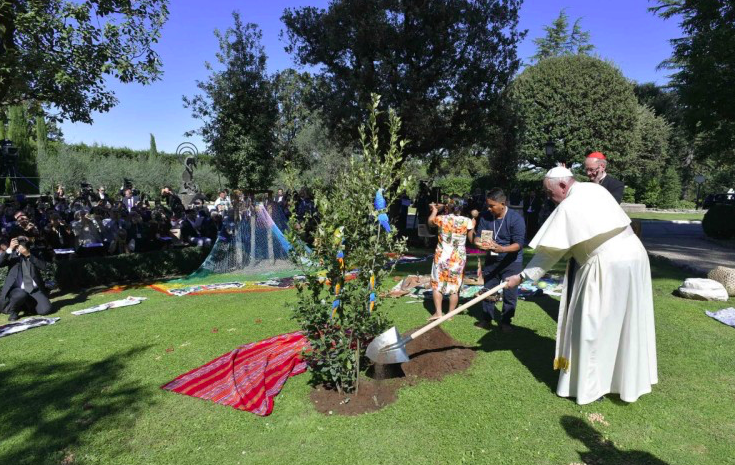
Pope Francis plants a tree to begin Amazon Synod: Feast of Francis of Assisi
The Synod for the Amazon began today in Rome, Sunday, October 6, and will continue till October 26th. The synod can be traced to a proposal of Pope Francis in October, 2017, to convoke a synod of bishops to look for “new pathways for the church and for an integral ecology.”
The Amazon synod seeks to promote pastoral activity in the Amazon region, 2.1 million square miles of land, mostly rainforest, home of 30 million people; many are indigenous peoples who live off the land.
The Amazon, Pope Francis noted today in his homily, has a crucial role in the world’s climate, but is being despoiled by fires set for immediate commercial gain.
The synod addresses issues of injustice and pastoral challenge in the Amazon region, but they are also issues affecting the whole church and the entire planet as well.
“States view the Amazonia as a storage room filled with natural resources, with little regard for the lives of indigenous peoples or for the destruction of nature. The harmonious relationship between God the Creator, human beings and nature is broken by the harmful effects of neo-extractivism; by the pressure being exerted by strong business interests that want to lay hands on its petroleum, gas, wood, and gold; by construction related to infrastructure projects (for example, hydroelectric megaprojects and road construction, such as thoroughfares between the oceans); and by forms of agro-industrial mono-cultivation”. (Preparatory Document)
The synod sees human life, not isolated from the rest of creation, but coming from creation and in need of creation to flourish.
The Church testifies that Jesus “offers life to the full (cf Jn 10:10), a life full of God, a salvific life (zōē), which begins with creation and manifests itself from the start in the most elementary dimension of life (bios).In the Amazon, it is reflected in its abundant bio-diversity and cultures. That is to say, a full and integral life, a life that sings, a song to life, like the songs of rivers. It is a life that dances and that represents divinity and our relationship with it.
‘Our pastoral service,’ as the Bishops affirmed in Aparecida, is a service ‘to the full life of indigenous peoples [that] requires proclaiming Jesus Christ and the Good News of the Kingdom of God, denouncing sinful situations, structures of death, violence and internal and external injustices, and fostering intercultural, interreligious and ecumenical dialogue’. Such announcing and denouncing we discern in the light of Jesus Christ the Living One (Rev 1:18), ‘the fullness of all revelation’ (Dei Verbum, no. 2).” (Instrumentum Laboris, no. 11).
Pope Francis planted a tree in the Vatican Garden on the Feast of St. Francis, October 4, as the Amazon synod began. Tomorrow, the Feast of the Holy Rosary, we hope to plant a tree in our Mary Garden after the 11 AM Mass,
Prayer
“Lord of the incarnation, Word made flesh, who became one of us, was born like us and lived in time and place like us, guide us in our time and place to new ways to care for creation.
Help us plant new life instead of cutting down and despoiling the world you have made. Help us live as one with the earth below us, the earth on which we stand, and the heavens above, so that “at the name of Jesus, every knee will bend in heaven and on earth and under the earth, and every tongue confess to the glory of God the Father, Jesus Christ is Lord.”
We pray for the Amazon region. May we learn from it to live in harmony with our own land and the earth which is our common home. Amen.

 The Victor's Place