Monthly Archives: February 2015

5th Sunday B: He Takes Our Hand

Audio version of homily here:

If you’ve had the opportunity to visit the Holy Land, you may have visited Capernaum, the fishing village on the Sea of Galilee which was the base of Jesus’ ministry in Galilee.  Archeologists have uncovered much of that town in recent years; you  can see the ancient black basalt stones of houses from the time and the foundations of a synagogue where Jesus may have taught and prayed. It’s a fascinating place.

Jesus called this place home after he came from the Jordan River where he was baptized. Nearby, along the shore of the Sea of Galilee, he called Peter and his brother Andrew, James and his brother John, to  follow him. On the Sabbath day, he began his ministry by going into the synagogue where he taught and  all were amazed at his teaching. That same remarkable day, he drove out an evil spirit from a man in the synagogue.

The synagogue wasn’t the only place Mark’s gospel mentions that day. He tells us Jesus  left the synagogue and went with Peter and Andrew into their house, a short distance from the synagogue, where he would stay much of his time in Galilee.

In recent times,  Franciscan archeologists have identified its location of what they call “Peter’s house” among the houses closely packed together. (See the picture above) The house is actually a compound where a number of families lived together. Peter’s mother in law was in bed with a fever. Jesus “approached her, took her hand, and raised her up. Then the fever left her and she waited on them.”
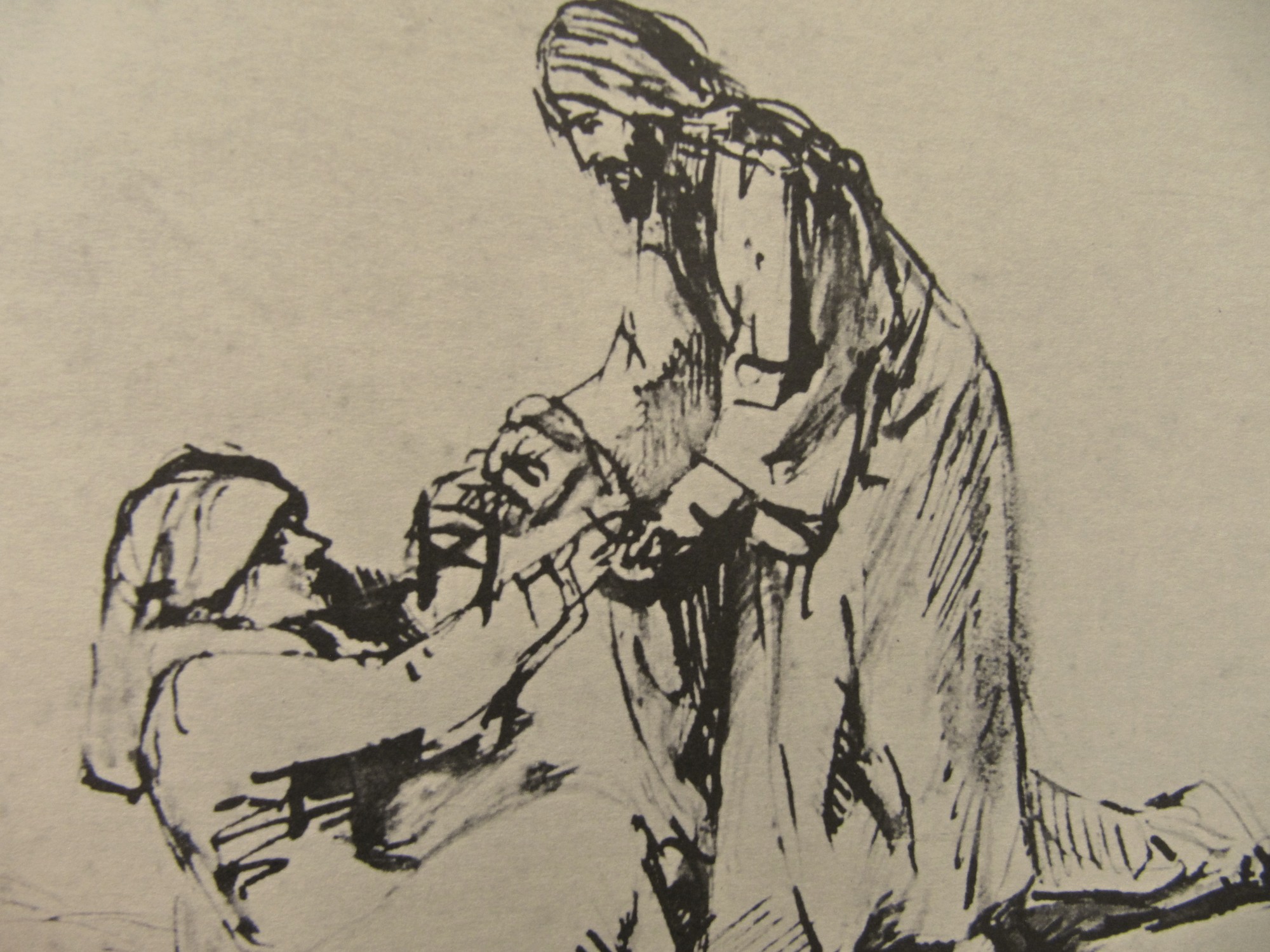
This may seem to be a minor healing when you compare it to some of the miracles Jesus worked: the paralyzed man who would later be lowered through the roof of Peter’s house, the lepers, the blind, the deaf, the dead like Lazarus or the daughter of Jairus.

But maybe this healing tells us something important, namely, that God is concerned for our every need, however small it may seem when compared to others. Think of it: shortly before this, in the Jordan River, the heavens opened and God said of Jesus “This is my beloved Son, listen to him.”

Now here the Son of God comes to this small village, to this little house, and his first concern is to take this woman by the hand and raise her up. As he does on other occasions, he gives the woman the power to live and do again what she did before. “She waited on them.”

We may think that God as interested only in great things. Jesus, the image of God, shows us God is interested in the smallest things. The very hairs of our head are numbered. The smallest concerns that no one sees, but God sees.

After Peter’s mother in law is healed, others come from Capernaum and all over, crowding around the door. And Jesus meets them all. The same Lord of heaven and earth, the same Jesus, the Risen Christ who always walks with us is with us here.
The Consecrated Life

This year we’re remembering the Consecrated Life in the Catholic Church.  Pope Francis asked religious and religious communities this year to remember their past with gratitude, to live in the present with passion and to embrace the future with hope.

The other day I was on the internet browsing through iTunes University, where you can get courses–most for free– from various universities on all kinds of subjects. I noticed a course from Yale, given by Professor Paul Freedman on monasticism and early religious life. I have an interest in that period, so I thought I’d see what the historian said to his students about monks in monasteries and hermits in the desert.

Freedman knows a lot about early monasticism and its history, people like Benedict , Augustine, Anthony, Martin of Tours. He offers some interesting insights, as you would expect from a Yale professor, but after listening to his lecture I’m not sure he really appreciates or understands what religious life is all about.

For him monks and the hermits were people who turned their back on the world to pursue a life of prayer. They gave up everything to be with God and separated themselves from everyday life. Because they did that, other people sought them out as intercessors. Ordinary people looked up to them because they’re above them, as it were. They’re holy people who intercede before God for you.

Certainly religious have that intercessory role. But the Epistle to the Hebrew, which we’re reading these days at Mass, reminds us that the one who intercedes must know and experience human life and its weakness. Jesus did that. He is a compassionate high priest, not because he turned his back on human life but because he embraced it. A compassionate high priest, he embraced the cross of human experience.

I’m not sure Professor Freedman appreciates that element of the consecrated life. Anthony in the desert and Martin of Tours in Gaul were wise teachers to whom others came, not just to ask for prayers, but because they knew the human heart. Freedman gives the example of Simon Stylites, the Syrian who lived on top of a pillar for years. People came from all over and built ladders to reach him and ask for prayers, Freedman says.

They weren’t only asking for his prayers; they wanted Simon’s advice, because from his high pillar Simon saw more clearly into their busy lives than they themselves did.

Indeed, the consecrated life goes beyond intercession and wisdom. Over the centuries, religious communities blazed trails into the future for the church and the world. They created new forms of life and culture, they provided missionaries who drew distant peoples together and thinkers who saw beyond the present. They saw what had to be done and did it. Christopher Dawson shows us the reach of religious life and monasticism in the period Freedman covers in his classic The Making of Europe.

It’s important to reflect on the consecrated life this year. It can be unappreciated. Even people in the consecrated life can get it wrong and miss its dimensions, so let’s do what the pope asks:   remember our past with gratitude,  live the present with passion and embrace the future with hope.


The Woman who touched Jesus’ Garments

Mark 5, 21-43

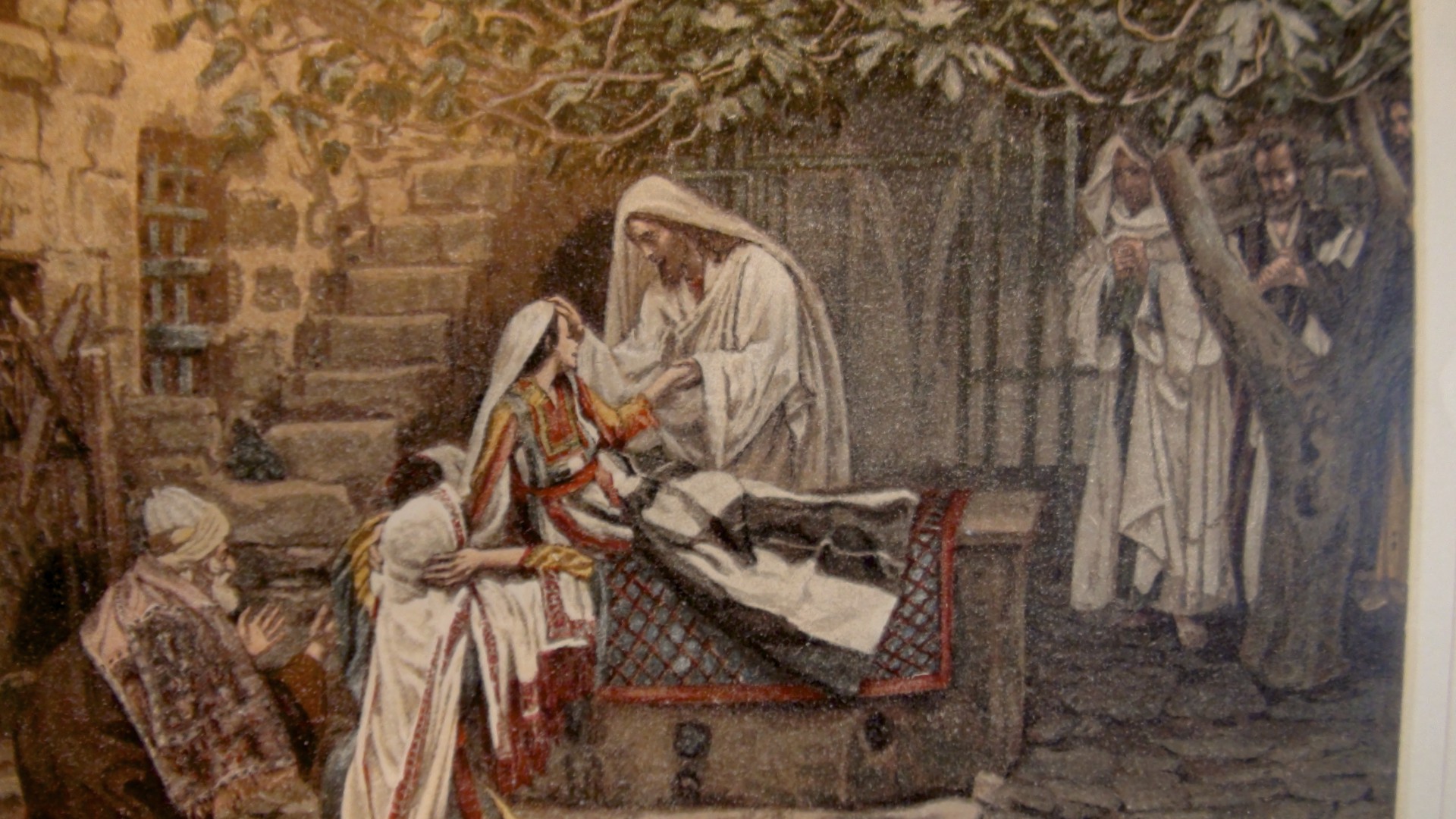
We read this story today at Mass. Why does Mark insert the story of the woman who touched Jesus’ garments into the story of the dead girl brought back to life? Was it simply that she happened to meet him on his way to the girl’s house? Maybe there’s another reason.

A picture of the woman touching the garments of Jesus is one of the oldest pictures  found in the catacombs of Rome, where early Christians buried their dead. Is it there  to remind them that those who died had also touched the garments of Jesus? They didn’t see him, but he met them in signs.

Those buried there believed in him and were baptized with water; they received his life through that sign and entered into the mystery of his death and resurrection. They received his body and blood in the signs of bread and wine, and so like the woman they touched his garments.  His power and life went out to them.

The Gospel of Mark was written in Rome, most scholars say. Is Mark’s arrangement of the  stories of Jesus raising the dead girl to life and the woman touching his garments a way of teaching Roman Christians about the mystery of death? Jesus was with them on their last journey.

In preparing the Catechism of the Catholic Church after the Second Vatican Council the Roman authorities responsible for the catechism instructed publishers to put the picture from the catacombs of the woman touching the garments of Jesus at the beginning of the section on the sacraments.

She’s an example, an image of the present church which knows Jesus through sacraments.  She helps us believe in the power of simple signs.

The Presentation of Jesus in the Temple

Presentation

The Feast of the Presentation of our Lord is the last of the feasts of Christmas, even though most Christmas decorations have disappeared awhile ago.

The Feast is based mainly on Luke’s Infancy narrative which begins in the temple with the announcement to the priest Zacharias of the birth of John the Baptist and ends with the presentation of Jesus in the temple by Mary and Joseph. The two elderly Jews, Simeon and Anna represent the faithful generations that have been waiting for the Messiah.

Previously, Luke tells of the poor shepherds, the outcasts waiting in the dark, who are greeted by the angels. In Matthew, the gentiles are invited in the coming of the magi. Now the long wait of the Jewish people is rewarded as old Simeon takes the child in his arms and utters a prophecy that he will bring light to his people.

We bless candles today to symbolize our acceptance of the light of Christ.

God was present in the Temple of Jerusalem, the Jews believed. They prayed there and offered sacrifices to the Lord. Luke would have us see that God’s Son is one with his Father as he is presented in the temple. He becomes the new temple, God present in our midst in a unique way.  He is our new High Priest who unites us to the Father by the sacrifice of himself.

Jesus later claims that role as he teaches in the temple and prays there.

From simple places, Bethlehem and Nazareth, Jesus was taken by his parents to the splendid temple of Jerusalem. From an everyday world where he’s hardly noticed, he’s carried to the glorious place where heaven and earth meet. From a town hidden on a mountain and a cave cut into a hill, he’s brought and placed as Light for the world.

The presentation of Jesus in the  temple is a highly symbolic feast. Here are the readings for Mass.  Here’s how St. Sophronius, an early bishop of Jerusalem, describes it:

“The light has come and has shone upon a world enveloped in shadows; the Dayspring from on high has visited us and given light to those who lived in darkness. This, then, is our feast, and we come in procession with lighted candles to reveal the light that has shone upon us and the glory that is yet to come to us through him. So let us hasten all together to meet our God.

Rejoicing with Simeon, let us sing a hymn of thanksgiving to God, the Father of the light, who sent the true light to dispel the darkness and to give us all a share in his splendor.

Through Simeon’s eyes we too have seen the salvation of God which he prepared for all the nations and revealed as the glory of the new Israel, which is ourselves…   By faith we too embraced Christ, the salvation of God the Father, as he came to us from Bethlehem.

Gentiles before, we have now become the people of God. Our eyes have seen God incarnate, and because we have seen him present among us and have mentally received him into our arms, we are called the new Israel.

Never shall we forget this presence; every year we keep a feast in his honor.”